
In This Article
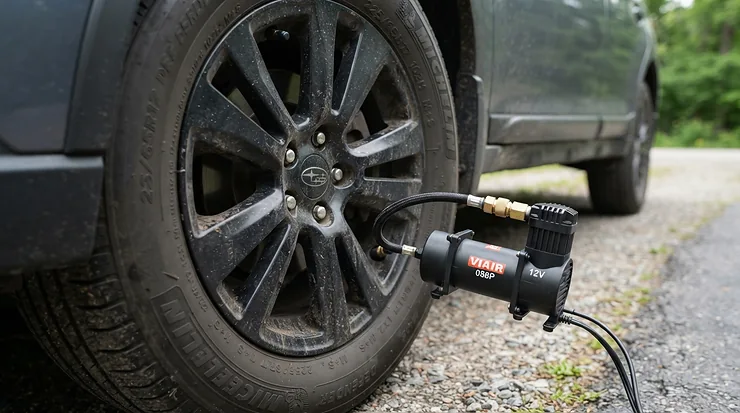
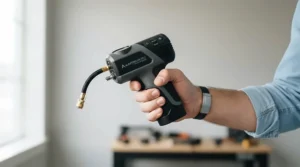
A portable tyre inflator under £30 is a small, tankless air compressor that runs from your car’s 12V socket or a rechargeable battery, letting you top up or restore tyre pressure on the driveway or at the roadside. Most models at this price add a pressure gauge, a torch and a few adaptors for bike tyres and footballs.

Picture the scene: a drizzly Monday morning, the dashboard’s amber tyre warning glowing like a tiny accusation, and the forecourt air machine demanding coins you haven’t carried since 2019. A cheap tyre inflator in the boot makes that drama evaporate.
It matters more than most gadgets at this price. Soft tyres quietly cost you in fuel, tyre life and braking confidence all at once. With decent models now costing a fraction of a tank of petrol, a portable tyre inflator under £30 is one of the easiest safety upgrades in motoring.
But cheap and good don’t always travel together. In its January 2026 lab tests, Which? found that the slowest digital inflators needed over six and a half minutes to take a tyre from 12 to 32 PSI, while the quickest did it in under two. Gauge honesty varied just as widely. Some units read as much as five PSI out, and one Don’t Buy model could leave a tyre 15 PSI over target. Speed and a truthful gauge, not the sticker, separate the keepers from the landfill.
A word on how this guide works. I haven’t hand-tested these seven models and won’t pretend otherwise. Instead, you’ll get honest spec analysis, published test findings and aggregated buyer feedback, translated into what it means on a cold, wet forecourt. Prices appear as ranges at the time of research (October 2026) and will move, so always check the current price before buying.
Portable Tyre Inflator Under £30: Quick Comparison Table
Every pick below is a real model sold in the UK, chosen to cover corded, cordless, digital and analogue designs. Think of this as the menu before the full tasting, and a shortlist for the best portable tyre inflator under £30 for your boot.
| Pick | Power | Auto-stop | Typical price range | Best for |
|---|---|---|---|---|
| Ring TYREINFLATE 20 | 12V corded | Not clearly listed | Around £15–£21 | Cheapest digital readout |
| AA 12V Digital Tyre Inflator (AA5502) | 12V corded | Yes (preset) | Around £20–£28 | Set-and-forget top-ups |
| AstroAI Tyre Inflator 12V DC | 12V corded | Yes (preset) | Around £17–£30 | All-round value |
| Draper 12V Mini Air Compressor (21256) | 12V corded | No (analogue) | Around £15–£19 | Absolute lowest budget |
| Ring TYREINFLATE GO 10 | Rechargeable battery | Yes | Around £25–£30 | Pocket-sized cordless |
| Ring RAC635 | 12V corded | Yes (preset dial) | Around £27–£35 | Proven, faster corded use |
| SUNPOW Cordless Tyre Inflator | Rechargeable battery (7,500 mAh) | Yes | Around £25–£35 | Battery with power-bank bonus |
Looking at the comparison above, the AstroAI Tyre Inflator 12V DC and AA 12V Digital Tyre Inflator (AA5502) deliver the most complete feature set for the money. The Draper 12V Mini Air Compressor (21256) is the pick when every pound counts. Anyone allergic to trailing cables should weigh the Ring TYREINFLATE GO 10 or SUNPOW Cordless Tyre Inflator, accepting slower speed in exchange. Note that the Ring RAC635 often hovers just above the cap, so patience may be needed to land it under £30.
💬 Just one click — help others make better buying decisions too!😊
Top 7 Portable Tyre Inflator Under £30 Picks: Expert Analysis
A quick transparency note: some links below are affiliate links, and I earn a small commission from qualifying purchases at no extra cost to you. It never changes the verdicts. Each entry covers the specs in plain English, who it suits, what buyers keep saying, and a value verdict.
1. Ring TYREINFLATE 20 — best digital readout for the least cash
The headline feature is a large digital display that reads to one decimal place, a touch of precision you rarely get from a cheap tyre inflator.
Ring launched this model in mid-2025 as a deliberately no-frills answer to cost-of-living pressure. It runs from the 12V socket at 85W, with a 3 m fused cable that reaches the back wheels of an average hatchback and a hose of roughly half a metre. Ring says it takes a 13-inch tyre from flat to 35 PSI in under 4.5 minutes. Larger 16-inch tyres will take longer than that benchmark implies, but topping up four tyres that are a few PSI low is a couple of minutes’ work. At about 0.59 kg and 14 × 16.5 cm, the compact design slots into most glovebox storage with room to spare.
Based on the spec comparison, this suits the commuter who wants a proper digital readout from a well-known British brand without stepping up to the pricier Ring RTC1000. One caveat: Ring’s published specification lists a digital gauge and one-button operation but doesn’t clearly advertise a preset auto-stop. Confirm that on the listing if “set it and walk away” matters to you.
Because it only arrived in 2025, I couldn’t verify a meaningful pool of independent reviews, so treat the performance figures as manufacturer claims for now.
Pros:
- ✅ Digital readout to one decimal place
- ✅ 3 m cable reaches all four wheels
- ✅ Adaptor kit included for bikes and balls
Cons:
- ❌ Auto-stop not clearly listed in specs
- ❌ Very little independent review history
Expect roughly £15–£21 at the time of research, which is excellent value on paper. Check current price before buying.
2. AA 12V Digital Tyre Inflator (AA5502) — set-and-forget auto-stop from a trusted badge
The standout is preset auto-stop. Dial in your target pressure, press start, and the pump switches itself off, a real upgrade over analogue rivals.
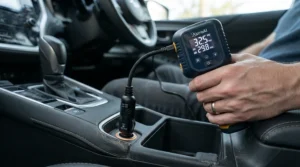
Which?’s 2026 line-up includes an AA digital compressor listed at about 0.82 kg and 16.3 × 20.2 × 7.7 cm. It has programmable auto shut-off, a built-in light, a screw-on valve connector and PSI, bar and kPa readouts. The 3 m cord gets round all four wheels. The LED lamp offers torch, flash and SOS modes, which is more useful than it sounds when you’re sorting a tyre in a dark lay-by. Listings quote a maximum of roughly 100–120 PSI, far above what any car tyre needs.
Here’s what to weigh: the screw-on connector forms a secure seal but takes a few turns to attach, which can be fiddly with cold fingers. For drivers who’d rather leave the pump running while they check the next tyre, auto-stop is worth more than raw speed.
Aggregated sentiment: a deal-tracking site’s snapshot of the Amazon listing showed an average near 4.5 out of 5 from roughly 14,800 ratings. Marketplace buyers commonly describe the unit as easy to use and compact, while mentioning some noise and that fiddly valve connection.
Pros:
- ✅ Preset pressure with automatic shut-off
- ✅ LED light with flash and SOS modes
- ✅ 3 m cord reaches every tyre
Cons:
- ❌ Screw-on connector is fiddly in the cold
- ❌ Audible droning noise under load
Prices sit around £20–£28, which is fair value for the preset feature. Check current price.
3. AstroAI Tyre Inflator 12V DC — most-reviewed budget all-rounder
Its standout trait is sheer weight of opinion. A deal-tracking snapshot of an AstroAI listing of this type logged an average near 4.5 out of 5 across more than 86,000 ratings.
The corded 12V unit claims 35 litres a minute, and the listing says a 195/55 R15 tyre goes from empty to 35 PSI in roughly five minutes. That’s a little slower than premium corded rivals but perfectly adequate for top-ups. Which? lists the model it assessed at around 0.7 kg and 18.4 × 14 × 7.8 cm, with a thumb-lock valve connector, programmable auto shut-off, a built-in light and four pressure units. A 3 m lead and 0.48 m hose cover a typical hatchback.
The thumb-lock connector is the practical winner. Flip the lever and you’re sealed in a second, which matters more than any headline PSI figure when your hands are freezing. The maker claims accuracy within 1.5%, but that’s a claim rather than a lab result, so cross-check it once against a separate gauge.
The numeric rating is strong, but I couldn’t pull a reliable breakdown of written complaints. Read it as “broadly positive” rather than a guarantee.
Pros:
- ✅ Thumb-lock connector seals in seconds
- ✅ Preset auto shut-off plus LED light
- ✅ Huge pool of buyer ratings
Cons:
- ❌ Claimed five minutes from empty on 195/55 R15
- ❌ Accuracy figure is the maker’s, not a lab result
Typically about £17–£30 depending on promotions, making it the sensible default among affordable portable air pump options.
4. Draper 12V Mini Air Compressor (21256) — cheapest ticket out of the forecourt queue
The standout is pure economy. At roughly 475 g it’s the lightest unit here and usually the cheapest, a no-nonsense affordable portable air pump for occasional use.
It’s an analogue 12V unit with a 10 A draw, 11 L/min flow, a 3 m lead, a 450 mm hose and a dial in PSI and bar. Draper’s own specification quotes gauge accuracy of ±10 PSI and a duty cycle of ten minutes on, ten off. That ±10 isn’t a typo, and it’s arguably the most important number in this article. The dial is a rough guide, so pair it with a separate pen gauge. The 130 × 160 × 115 mm body suits glovebox storage in many cars, though not all.
For context, Expert Reviews judged the earlier Storm Force Mini a basic but competent budget buy with skimpy accessories. What Car? once timed a similar Draper mini at close to nine minutes for a flat tyre, with the dial reading about 1.5 PSI low. Those were predecessors, not this exact model, so treat them as a guide to the family’s character. I found little verified buyer data for the current 21256 code.
Pros:
- ✅ Lightest and cheapest unit on the list
- ✅ Simple analogue dial with nothing electronic to fail
- ✅ Handy for bikes and balls with adaptors
Cons:
- ❌ Gauge accuracy is only ±10 PSI
- ❌ Slow, no auto-stop, ten-minute duty cycle
Around £15–£19 makes it the best budget tyre pump for cars if you already carry a decent gauge.
5. Ring TYREINFLATE GO 10 — pocket-sized cordless that ditches the cable tangle
Its standout is cordless freedom in a body about 12 cm tall and 5 cm deep, according to Ring’s spec sheet, making it the smallest pick here.
Under the hood it’s a 7.4V, 74W lithium-ion unit charged by USB-C, with a 20 cm hose, a valve light, a three-piece adaptor kit and a storage bag. Ring quotes under six minutes to take a 13-inch tyre from flat to 35 PSI, with a digital readout in PSI, bar and kPa and an auto-stop. Car tyres are rated up to 100 PSI and bicycle tyres up to 150 PSI, and the pack weighs about 0.53 kg. That compact design makes it a natural for glovebox storage, a rucksack or a bike pannier.
Here’s battery vs 12V power in miniature. No cable means you can stroll round the car freely, but you’re relying on a battery you might have forgotten to charge. The 20 cm hose is stubby, so valves tucked behind busy alloy spokes may be a stretch.
Reviewer sentiment: one UK site scored it 9 out of 10 for size and versatility across car and bike tyres, while noting it may need recharging after several uses. Ring also points to a 2025 Auto Express mini-test that judged it makes bulkier corded pumps look oversized, though that’s Ring’s own selection of praise.
Pros:
- ✅ Truly pocket-sized, ideal for glovebox storage
- ✅ USB-C charging with digital auto-stop
- ✅ Valve light for dark roadsides
Cons:
- ❌ Battery limits multi-tyre sessions
- ❌ Short 20 cm hose
Ring’s recommended price is around £30, with street prices seen a little below. Expect £25–£30 and check current price.
6. Ring RAC635 — proven award-winner with a preset dial
The standout is the preset dial. Twist to your target pressure, click, press start, and the inflator stops itself.
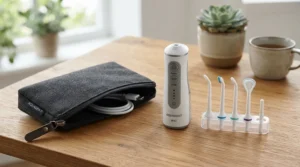
CAR magazine’s budget group test named it editor’s pick, praising a backlit digital screen, auto shut-off and LED light in a unit that fits a generous glovebox. It draws about 120W and, by Ring’s claim, takes a 13-inch tyre from flat to 35 PSI in around three minutes. It also comes with a 3.5 m cable, a 70 cm hose, three adaptors and a deflation valve for fine-tuning. At 1.17 kg it’s the heaviest 12V option here, but the extra power shows in the speed.
The deflate button is underrated. Overshoot by 2 PSI and you can bleed it off in seconds instead of wrestling the valve. That chunkier body does mean a shallow glovebox may not take it, so measure first.
Reviewers consistently praise the intuitive operation, and Ring cites multiple Auto Express awards. Against that, Honest John notes readers reporting occasional reliability issues, and one marketplace buyer described the preset resetting at low pressure. Sentiment is broadly positive with a thin tail of reliability complaints.
Pros:
- ✅ Preset dial with automatic stop
- ✅ Deflation valve for fine adjustments
- ✅ Long 3.5 m cable and 70 cm hose
Cons:
- ❌ Heavier and bulkier at around 1.2 kg
- ❌ Price can nudge above £30
Roughly £27–£35 at the time of research. Wait for a dip under £30 and it’s a bargain.
7. SUNPOW Cordless Tyre Inflator — 7,500 mAh battery that doubles as a power bank
The standout is a 7,500 mAh battery that does double duty as an emergency phone charger.
SUNPOW claims a 160 PSI maximum, 32 L/min flow, five preset modes (car, motorcycle, bicycle, ball and manual), an LCD dual-screen display and auto shut-off. It also has an LED light and a fast-charging USB port. The listing says it can lift a 205/55 R16 tyre from 0 to 36 PSI in about six minutes with ±0.5 PSI accuracy. All of those are manufacturer claims.
That battery capacity is the interesting part. A bigger cell should mean more tyres per charge than slimmer rivals, and the power-bank function turns a boot-dweller into a useful emergency kit. The 160 PSI ceiling is overkill for cars but handy for bike tyres. Because it’s cordless, treat it as a top-up and emergency tool rather than a four-flat-tyre rescue. As an affordable portable air pump with a bonus, it’s a neat idea.
A deal-tracking snapshot recorded roughly 4.5 out of 5 across around 5,500 ratings. I couldn’t find independent lab results, so performance figures remain claims.
Pros:
- ✅ Large battery doubles as a power bank
- ✅ Five presets including bike and ball modes
- ✅ LCD display with auto shut-off
Cons:
- ❌ Sub-£30 pricing often depends on vouchers
- ❌ No independent lab test found
Around £25–£35 depending on vouchers, so it sits right on the budget line. Check current price.
Specs Side by Side
| Pick | Power and weight | Claimed flat-to-full | Gauge | Best for |
|---|---|---|---|---|
| Ring TYREINFLATE 20 | 12V, about 0.59 kg | Under 4.5 min (13″ tyre) | Digital, 0.1 PSI | Budget digital |
| AA 12V Digital Tyre Inflator (AA5502) | 12V, about 0.82 kg | Not stated | Digital, preset | Preset convenience |
| AstroAI Tyre Inflator 12V DC | 12V, about 0.7 kg | About 5 min (195/55 R15) | Digital, preset | Everyday value |
| Draper 12V Mini Air Compressor (21256) | 12V, about 0.48 kg | Not stated (11 L/min) | Analogue, ±10 PSI | Lowest outlay |
| Ring TYREINFLATE GO 10 | Battery, about 0.53 kg (pack) | Under 6 min (13″ tyre) | Digital | Smallest footprint |
| Ring RAC635 | 12V, about 1.17 kg | About 3 min (13″ tyre) | Digital, backlit | Faster, sturdier corded use |
| SUNPOW Cordless Tyre Inflator | Battery, 7,500 mAh | About 6 min (205/55 R16) | LCD dual screen | Power-bank bonus |
Don’t read the speed column as a race. The claims use different tyre sizes, so “three minutes” on a 13-inch tyre isn’t automatically quicker than “five minutes” on a 15-inch one. What the table does show is the trade-off between weight and capability: the heaviest unit, the Ring RAC635, has the longest cable and hose, while the lightest, the Draper 12V Mini Air Compressor (21256), pays for it with a rough dial. If compact design is your priority, the Ring TYREINFLATE GO 10 wins outright.
✨ Ready to Pick Your Portable Tyre Inflator Under £30?
🔍 Take your tyre care to the next level with these carefully selected products. Click on any highlighted item to check current pricing and availability. These tools will help you keep your family rolling safely, whatever the weather!
How to Choose a Portable Tyre Inflator Under £30
Choosing well comes down to seven quick checks. Work through them in order and the shortlist practically writes itself.
- Pick your power source. Corded 12V units deliver more punch per pound, while cordless models trade speed for freedom. CAR magazine’s budget test reached the same conclusion: cordless looks tempting but generally can’t match a similarly priced corded unit on power. Battery vs 12V power is the first fork in the road.
- Demand a believable gauge. Which? found readings out by as much as five PSI on some models, so favour digital displays and verify with a separate gauge.
- Look for preset auto-stop. Set the target, press start and wander off. It prevents over-inflation and saves squinting at a dial.
- Check the valve connector. Thumb-lock clamps are fastest, screw-on types seal firmly but take longer, and snap-on fittings sit in between.
- Measure your space. A compact design that fits your glovebox storage will actually get used. A bulky one lives in the garage and never rescues anyone.
- Count the cable and hose. You need at least 3 m of cable to reach the back wheels of a hatchback, and estates and vans want more.
- Check the duty cycle. Budget compressors overheat, so look for stated run times, such as ten minutes on and ten off, and plan to pause.
Tick all seven and the best budget tyre pump for cars in your situation is rarely a mystery.
Battery vs 12V Power: Which Cheap Tyre Inflator Wins?
This is the big fork in the road, and the honest answer is: it depends on what you’re afraid of.
Corded 12V: more muscle per pound
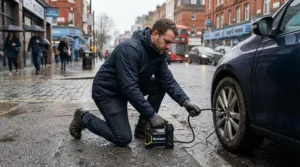
A 12V unit draws current from your car’s accessory socket, so there’s no battery to fade or forget. That’s why four of our seven picks are corded: the budget goes into the motor rather than the cells. The trade-off is the cable. Most reach about 3 m, fine for a hatchback but fussier on a long van. Check your socket’s fuse too, since the Draper 12V Mini Air Compressor is listed at a 10 A draw.
Battery: freedom with a catch
Cordless models such as the Ring TYREINFLATE GO 10 and SUNPOW Cordless Tyre Inflator skip the cable tangle, and the SUNPOW doubles as a power bank. The catch is the one nobody mentions at the checkout: a flat battery means a flat inflator. So when weighing battery vs 12V power on a cheap tyre inflator, choose corded for re-inflating and cordless for quick top-ups.
| Option | Speed | Convenience | Reliability when stranded | Typical price | Best for |
|---|---|---|---|---|---|
| Corded 12V inflator (e.g. AstroAI Tyre Inflator 12V DC) | Faster for the money | Needs socket; about 3 m reach | Works whenever the socket does | Around £15–£30 | Re-inflating from low pressure |
| Cordless battery inflator (e.g. Ring TYREINFLATE GO 10) | Slower per tyre | No cable; must be charged | Only if charged | Around £25–£35 | Quick top-ups and compact storage |
| Manual barrel foot pump | Slowest, per Which? | No power; real effort | Never runs out of power | Around £3–£11 | Unpowered backup |
The table explains why a mixed kit works best. If you can only buy one budget tyre pump for cars, a corded 12V model rarely runs out of puff at the worst moment. Cordless units shine for convenience, and a foot pump is a humble insurance policy for remote trips.
Compact Design and Glovebox Storage: What Actually Fits?
A tyre inflator you can’t find is just a very small anchor. The best affordable portable air pump is the one within reach on the night you need it, so size matters as much as speed.
Published dimensions tell the story. The Ring TYREINFLATE GO 10 is about 12 cm tall and 5 cm deep, the smallest of the lot, while the Ring TYREINFLATE 20 measures roughly 14 × 16.5 cm and weighs under 0.6 kg. Which? lists the AstroAI Tyre Inflator 12V DC at around 18.4 × 14 × 7.8 cm and the AA 12V Digital Tyre Inflator at roughly 16 × 20 × 7.7 cm, which will fill a shallow glovebox on its own. At 1.17 kg, the Ring RAC635 is more likely a boot resident.
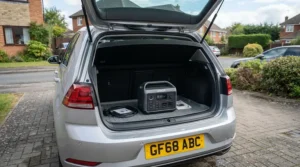
Here’s a practical tip: lay a tape measure in your glovebox before ordering. Many gloveboxes are already full of handbook, wet wipes and mystery receipts. For glovebox storage, keep the inflator in its bag with the adaptors so nothing rattles loose. Lithium-ion batteries generally dislike prolonged heat, so if your glovebox bakes in summer, a battery model may be happier in the shaded boot.
A compact design only counts if it still reaches the back tyres, so check cable length too. Which? scores inflators on how neatly the cable and hose tuck away, which tells you how seriously size should be taken.
Features That Actually Matter (And Those That Don’t)
Every listing shouts about something. Here’s how to separate substance from sparkle on a cheap tyre inflator.
What matters: a gauge you can trust (or verify), preset auto-stop, a secure valve connector, enough cable and hose to reach every wheel, and a realistic duty cycle. These decide whether the job takes three calm minutes or ten grumpy ones.
What doesn’t: the headline maximum PSI. Car tyres often sit in the low-to-mid 30s, so the gap between a 100 PSI and a 160 PSI badge is irrelevant unless you’re inflating bicycle tyres. Marketing flourishes such as the “19-cylinder” pump boasted in SUNPOW’s listing are equally hard to verify, and I couldn’t find anything useful behind that number. A rainbow of preset modes is nice for bikes and balls, but nobody chooses a car inflator for its ball setting.
In between: the built-in light. A torch that illuminates the valve in the dark is a genuine perk, and flashing SOS modes are comforting, but treat them as bonuses. When shopping for an affordable portable air pump, spend your attention on the gauge and the connector first. Which? tests exactly these things, plus noise and storage, because they’re what you’ll notice every single time.
Common Mistakes When Buying a Budget Tyre Pump for Cars
Even a small purchase can go wrong in familiar ways. Here are the pitfalls worth dodging.
Chasing the biggest PSI number. A 160 PSI badge sounds mighty, but for cars it’s marketing rather than muscle.
Trusting the gauge blindly. Which? found some inflators miss their target by up to five PSI, and the Draper 12V Mini Air Compressor quotes ±10 PSI itself. Verify with a separate gauge.
Ignoring the duty cycle. Cheap compressors need rest breaks. Pushing through can overheat a budget tyre pump for cars and shorten its life.
Expecting a cordless to do everything. A small battery unit is a top-up tool, not a four-flat-tyres rescue kit.
Comparing claimed times like-for-like. Makers quote 13-inch, 15-inch and 16-inch tyres, so “three minutes” and “six minutes” aren’t directly comparable.
Using it as a repair. Which? is blunt on this point: repeatedly topping up a slow puncture just kicks a dangerous can down the road. If you’re reaching for the inflator more than monthly, it’s time for the garage, not the pump.
How to Use a Portable Tyre Inflator Under £30 Properly
You’ve bought one. Now let’s get proper results from day one.
Setup and first use
- Find your target pressure on the door-frame sticker or in the handbook, and remember loads change it.
- Inflate cold. TyreSafe advises checking when the car has travelled less than two miles, because driving heats the air and inflates the reading.
- Keep the valve cap somewhere safe, then connect firmly. Flip a thumb-lock fully down, or twist a screw-on connector clockwise until the hissing stops.
- Add air in short bursts and check often. Use the deflate button or valve to bleed off any overshoot.
- Refit the cap, repeat for all four tyres, and don’t forget the spare.
Maintenance schedule
Check pressures monthly and before long journeys, which is TyreSafe’s recommendation. Coil cables loosely rather than wrapping them tightly, keep adaptors in the bag, and top up a battery model every few months so it isn’t flat when needed.
First 30 days
The commonest slip is blind faith in the display. Check each tyre once with a separate gauge and note any offset, then compensate. It’s the same trick Which? uses in its reviews, which list how far to over- or under-inflate each model to hit target.
Real-World Scenarios: Which Cheap Tyre Inflator Suits Your Life?
Specs are abstract. Let’s match three drivers to the right kit.
The city commuter
A small hatchback, a shallow glovebox, a street-parked car and a monthly pressure check. The budget is tight and space tighter. The Ring TYREINFLATE 20 or AA 12V Digital Tyre Inflator fits: digital readouts, compact design and corded reliability. If fiddly connectors annoy you, the AstroAI Tyre Inflator 12V DC‘s thumb-lock is the friendlier bet.
The family with a roof box
An estate car, four tyres plus a spare, and holiday loads that call for adjusted pressures, which TyreSafe says should follow the manufacturer’s recommendations. Reach matters here. The Ring RAC635 offers a 3.5 m cable, a 70 cm hose and a deflation valve for fine-tuning, so it’s the sturdy choice, and the AstroAI is the thriftier alternative.
The cyclist-driver
One tool for the car, the bike and the kids’ footballs, used occasionally and carried in a rucksack. The Ring TYREINFLATE GO 10 (rated to 150 PSI for bicycle tyres) or the SUNPOW Cordless Tyre Inflator with its power-bank bonus makes sense. Accept slower inflation in exchange for freedom, and remember battery vs 12V power means planning ahead with a charge.
Problem → Solution: Fixing Common Tyre Inflator Headaches
Even good kit throws the odd tantrum. Here’s how to handle five common ones.
The reading jumps while pumping
Pressure displays can fluctuate during inflation. One marketplace buyer of the AA unit noted a small discrepancy between the pumping and idle readings. Pause, read the gauge with the pump off, and trust that figure.
Air hisses at the valve
Reseat the connector. Which? advises twisting a screw-on type clockwise until the hissing stops, or flipping a thumb-lock fully down before inflating.
It cuts out mid-job
You’ve likely hit the duty cycle, such as ten minutes on and ten off for the Draper 12V Mini Air Compressor. Let it cool. If it still won’t run, check the 12V socket fuse.
The battery is flat
Prevention beats cure. Charge battery models every few months, keep the USB-C lead in the glovebox, and consider a corded backup for long trips.
The tyre loses pressure again within days
That’s a slow puncture, not an inflator problem. Which? says that if you’re topping up more than once a month, see a garage.
Long-Term Cost & Maintenance: Is a Cheap Tyre Inflator Worth It?
Short answer: yes, and the sums are friendly. A unit at the top end of this budget, used once a month for three years, works out at under a pound per use, before counting the forecourt trips you skip.
The bigger prize is running costs. Figures shared by a TyreSafe member suggest tyres under-inflated by around 6 PSI (20%) use about 3% more fuel, and under-inflation also scrubs the tyre edges and shortens tyre life. A cheap tyre inflator that keeps pressures right pays back quietly, month after month.
Ownership costs are small but real:
- Corded units have no battery to age, so the main risk is a blown fuse or tired motor.
- Battery units lose capacity over time, and replacements are rarely practical at this price.
- Warranty terms vary. One AstroAI listing advertised three years, while a marketplace listing for the AA unit mentioned one year.
Treat the cheapest option as a consumable you’ll replace once, and the dearer ones as multi-year tools. Either way, a portable tyre inflator under £30 costs less than a single set of fuel wasted on soft tyres.
Tyre Pressure, Safety and the Law: What UK Drivers Should Know
Pressure is a safety issue first and a money issue second. The government’s Think! vehicle safety checks page warns that under- or over-inflated tyres harm braking distances, steering, fuel efficiency and tyre life. It also notes that illegal tyres can bring a £2,500 fine and three penalty points per tyre, and the legal minimum tread depth for cars is 1.6 mm.
Practical safety points when using an inflator:
- Never leave it unattended. Cheap compressors can overheat, so respect the duty cycle.
- Stay out of danger. If you’re stuck on a motorway hard shoulder, Think! guidance says to get yourself and passengers clear of the road and call for help, rather than working on a tyre.
- Check the markings. Electrical equipment sold in the UK generally carries UKCA or CE marking. If a listing doesn’t mention it, ask the seller.
- Mind your car’s systems. If your car has a tyre-pressure monitoring system, check the handbook for reset steps after you’ve corrected the pressures.
An inflator is a maintenance tool, not a licence to ignore damage. Cuts, bulges or persistent pressure loss need a professional.
FAQ
❓ Is a portable tyre inflator under £30 accurate enough for car tyres?
❓ Will a cordless cheap tyre inflator inflate four tyres on one charge?
❓ Can a budget tyre pump for cars handle a completely flat tyre?
❓ Does an affordable portable air pump work on bicycle tyres and footballs?
❓ How should I organise glovebox storage for a tyre inflator?
Conclusion
Soft tyres are a slow tax on your fuel, your tyres and your nerves, and the fix has never been cheaper. A portable tyre inflator under £30 won’t win design awards, but the right one turns tyre care from a forecourt chore into a five-minute habit.
So which should you choose? Based on the spec comparison and published reviews:
- Best all-round value: the AstroAI Tyre Inflator 12V DC, for its thumb-lock connector and huge buyer feedback.
- Best set-and-forget: the AA 12V Digital Tyre Inflator (AA5502), for preset auto-stop.
- Best on a shoestring: the Draper 12V Mini Air Compressor (21256), with a separate gauge.
- Cheapest digital readout: the Ring TYREINFLATE 20, once reviews catch up.
- Smallest cordless: the Ring TYREINFLATE GO 10, ideal for glovebox storage.
- Proven performer: the Ring RAC635, if the price dips below £30.
- Best bonus feature: the SUNPOW Cordless Tyre Inflator, for its power-bank function.
Whichever you choose, settle the battery vs 12V power question first, verify the gauge once, and check your tyres monthly. Do that, and any of these seven will keep you safer for the price of a sandwich meal deal.
✨ Ready to stop gambling on soft tyres?
🛞 Take your tyre care to the next level with these carefully selected picks. Click on any highlighted product to check current pricing and availability, and keep your family safely on the road.
Recommended for You
- Tyre Inflator For Cars: 7 Best Picks For UK Drivers (2026)
- Screenwash For Winter Under £10: 7 Best Buys For UK Drivers (2026)
- Screenwash Concentrate For Winter: 7 Best Picks For UK (2026)
Disclaimer: This article contains affiliate links. As an Amazon Associate, I earn from qualifying purchases. If you purchase products through these links, we may earn a small commission at no additional cost to you.
✨ Found this helpful? Share it with your friends! 💬🤗
