
In This Article
A portable jump starter is a compact lithium battery pack with built-in leads and safety clamps. It delivers a short, powerful burst of current to your starter motor, so you can restart a flat car without a second vehicle. Most also work as a power bank, with USB charging ports and a torch.
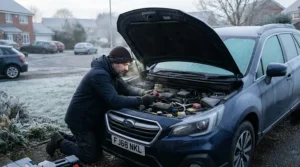
Picture the scene. It’s 7am in November, the windscreen is crunchy with frost, and your car answers the key with a pathetic click-click-click. A neighbour with jump leads might help, if they’re up and willing to stand in the cold. Or you could clip a box the size of a paperback onto the battery and be moving in about two minutes. The RAC’s step-by-step jump-starting guide covers both methods, and it’s easy to see why the pack route is winning. There’s no second car, no stranger and no tangled cables.
The market has become a minefield, though. Listings shout about 3000A, 4000A and even 6000A, and prices run from the cost of a pub lunch to the cost of a weekend away. I’ve pulled together this portable jump starter buying guide from specification sheets, UK editorial group tests and aggregated reviewer verdicts. It covers seven real models, from a compact car jump starter that lives in the glovebox to a heavyweight jump start power pack that also inflates tyres.
One note on method: I haven’t personally tested any of these units. Everything below is analysis built on published specs and cited reviews, and where I couldn’t verify something, I say so.
Portable Jump Starter Quick Comparison Table
Here’s the whole field at a glance. Prices are indicative ranges at the time of research, so check the current price before you buy.
| Product | Price range | Claimed peak amperage | Standout feature | Best For |
|---|---|---|---|---|
| TOPDON JS2000 Pro | Around £100 | 2500A | Large 59.2Wh battery | Diesels and vans |
| NOCO Boost GB40 | Around £100 | 1000A | IP65 rugged build | Reliability-first buyers |
| GOOLOO GP2000 | Around £45 | 2000A | Tiny, light, long standby | Best all-round value |
| AstroAI B8 | Around £30 | 3000A | Lowest price here | Tightest budgets |
| Draper Lithium Jump Starter and Tyre Inflator | Around £95 | Not headline-led | Fast, accurate tyre inflation | Drivers wanting one-box emergency kit |
| AstroAI MF16 6000A | Around £70 | 6000A | Huge 27,000mAh battery | Long road trips, spare charge |
| WOLFBOX MegaVolt 24 Air | Roughly £150-£210 range | 4000A | 65W USB-C and 160PSI inflator | Big engines and campers |
Look at the claimed peak amperage column, then look at the price column. They barely correlate. The AstroAI B8 has the loudest number at the cheapest price, while the NOCO Boost GB40 has the quietest number and a premium tag. The honest reading is that engine-size ratings, battery capacity and safety engineering tell you far more than a peak-amps headline. Budget shoppers should note that the GOOLOO GP2000 is the sweet spot on paper, while the WOLFBOX MegaVolt 24 Air costs more because it replaces two gadgets, not one.
💬 Just one click — help others make better buying decisions too!😊
Top 7 Portable Jump Starter Models: Expert Analysis
I’ve ranked these by how well they cover the widest range of UK drivers, not by price. Every product section combines real specs, real reviewer findings and a plain-English view of who should buy it.
1. TOPDON JS2000 Pro — big battery headroom for diesels
The headline here is capacity. The TOPDON JS2000 Pro carries a 16,000mAh (59.2Wh) battery, which is where the starting reserve actually lives.
It claims 2500A peak, with ratings of petrol up to 8.0L and diesel up to 6.0L. In practice that means a 2.0-litre diesel van isn’t pushing the pack anywhere near its limits. Capacity of this size also supports roughly 35 starts per charge, and a 300-lumen torch plus Quick Charge 3.0 make it a proper power bank.
Based on the spec comparison, this is the most sensible premium option for anyone with a diesel, a van or a second vehicle. The trade-off is bulk, since it’s chunkier than the glovebox-friendly units below. On reviews, I couldn’t verify an Amazon UK star rating at the time of research. UK roundup coverage from Gadget Scout describes it as a well-rounded pick, with the bigger battery and engine rating singled out as the main advantages over the NOCO Boost GB40.
Pros:
- ✅ Large 59.2Wh battery for roughly 35 starts
- ✅ Rated for diesels up to 6.0L
- ✅ Bright 300-lumen torch with Quick Charge 3.0
Cons:
- ❌ Bulkier than compact rivals
- ❌ Peak amperage figure is still optimistic
Price: around £100. For diesel owners, that’s fair value for the headroom.

2. NOCO Boost GB40 — rugged, honest-rated and trusted
The big draw is trust. The NOCO Boost GB40 claims only 1000A peak, with a 24Wh battery and ratings of petrol up to 6.0L and diesel up to 3.0L.
On paper that looks underpowered next to the budget crowd. What the spec sheet won’t tell you, but reviewers consistently note, is that NOCO’s figure is conservative and its engineering is not. It has UltraSafe spark-proof protection, an IP65 case that shrugs off rain, and a 100-lumen torch with seven modes. It manages up to 20 starts per charge.
My analytical take is that you’re paying for confidence. It suits drivers with ordinary petrol cars or small diesels who want a pack they can forget about until the one morning it matters. The recurring complaint is slow recharging through an older micro-USB input, and the premium over rivals with larger batteries is hard to ignore. Multiple roundups, including a 2026 Gadget Scout UK guide, treat it as the benchmark brand. I couldn’t verify current Amazon UK review counts.
Pros:
- ✅ Genuine spark-proof protection
- ✅ IP65 weatherproof, rugged casing
- ✅ Conservative, trustworthy power rating
Cons:
- ❌ Slow micro-USB recharging
- ❌ Smaller 24Wh battery, 3.0L diesel limit
Price: around £100. You’re buying peace of mind rather than raw specs.
3. GOOLOO GP2000 — light, cheap and surprisingly capable
The standout is the power-for-money ratio. The GOOLOO GP2000 claims 2000A peak, with ratings of petrol up to 8.0L and diesel up to 6.0L, which matches the TOPDON JS2000 Pro on engine coverage for less than half the price.
It’s also remarkably small, at around half a kilo. The 44.4Wh battery (about 12,000mAh) supports roughly 30 starts, there’s a 400-lumen light, and a quoted 24-month standby time means it holds charge in a cold boot far better than you’d expect. That standby figure is manufacturer-quoted, so a top-up every few months remains sensible.
This is a textbook compact car jump starter for ordinary petrol cars and small diesels. Compared with the NOCO Boost GB40, you give up IP-rated weatherproofing and some build polish, but you gain capacity and engine range. Owners are described in UK roundup coverage as having a strong reliability record, but I couldn’t verify review counts on the current Amazon UK listing.
Pros:
- ✅ Excellent power for the price
- ✅ Tiny and very light
- ✅ Long 24-month standby claim
Cons:
- ❌ Less premium build than NOCO
- ❌ No IP weatherproof rating
Price: around £45. Strong value for most drivers.
4. AstroAI B8 — the bargain that shouldn’t make sense
Its hook is price. The AstroAI B8 costs around £30 and quotes the biggest peak amperage of the budget pair, at 3000A.
It includes USB-C and USB-A power-bank ports, a three-mode LED light and clamps in the box. Engine ratings published for it vary between sources, so confirm the exact petrol and diesel litre ratings on the listing before relying on it for anything larger than a family car.
In practical terms, an ultra-cheap pack is best thought of as a spare. Keep it in the boot of a second car, a student’s first car or a campervan, and treat it as better than nothing rather than a lifetime tool. Because peak amperage isn’t standardised, the 3000A figure is the most optimistic number on this page, and long-term durability is the genuine unknown. Roundups describe it as reviewing well for the money, though I couldn’t verify its Amazon UK star rating.
Pros:
- ✅ Remarkable value at around £30
- ✅ USB-C and USB-A ports included
- ✅ Capable for everyday cars
Cons:
- ❌ Optimistic peak amperage claim
- ❌ Long-term durability unproven
Price: around £30. Tremendous value as a backup, with realistic expectations.
5. Draper Lithium Jump Starter and Tyre Inflator — the UK group-test winner
This one wins on completeness. The Draper Lithium Jump Starter and Tyre Inflator (listed as 23722) topped Auto Express’s 2026 jump starter group test with five stars.
Its 12,000mAh battery fed an inflator that took a 16-inch tyre from 10 to 30psi in just over two minutes, the second-fastest in the test. The colour LCD gauge read accurately and the hose is 43cm long. It also carries a three-mode LED, one USB-C and two USB-A ports.
Honest analysis: this suits the driver who wants one box for both emergencies, a flat battery and a soft tyre. The Auto Express reviewers flagged that the jump cables are on the short side at 17cm, so you may need to park carefully to reach the battery. That finding is editorial testing, not customer reviews, and I couldn’t verify Amazon UK review volumes.
Pros:
- ✅ Fast, accurate tyre inflation
- ✅ USB-C plus two USB-A ports
- ✅ Strong starting performance in testing
Cons:
- ❌ Short 17cm jump leads
- ❌ Not the cheapest all-in-one
Price: around £95. Reasonable value for a proven two-in-one.
6. AstroAI MF16 6000A — enormous battery, modest manners
The big hook is a 27,000mAh battery, the largest capacity in the Auto Express test. The AstroAI MF16 6000A also has a 60cm hose (the longest in that line-up) and a carrying strap.
Auto Express rated it 4.5 stars, finishing second behind the Draper Lithium Jump Starter and Tyre Inflator. It isn’t the quickest inflator or the most accurate gauge, and the testers also noted short jump leads and slow-responding buttons. There’s only a single USB-A outlet, which limits its power-bank usefulness.
Capacity of this scale means plenty of reserve for repeated starts and a long inflation session, which suits owners of larger tyres or those who park for weeks at a time. Think of it as the long-distance option: less polished, with more fuel in the tank. I couldn’t verify customer-review figures for the current Amazon UK listing.
Pros:
- ✅ Huge 27,000mAh battery reserve
- ✅ Long 60cm hose and carry strap
- ✅ Strong value against pricier rivals
Cons:
- ❌ Short leads and slow buttons
- ❌ Single USB-A output only
Price: around £70. Excellent value if capacity is your priority.
7. WOLFBOX MegaVolt 24 Air — premium all-rounder for big engines
This is the flagship. The WOLFBOX MegaVolt 24 Air claims 4000A peak from a 24,000mAh (88.8Wh) battery, with ratings for 12V petrol and diesel engines up to 10L.
It adds a 160PSI inflator, 65W USB-C fast charging, a 160W DC output, a 400-lumen light and an IP64 rating. The manufacturer quotes up to 24 months of standby. At around 2.4kg it’s a brick, and it’s meant to be.
My analytical take: this is the pick for motorhome owners, campers, large diesel 4×4 drivers and anyone who wants one device to handle starts, tyres and laptop charging. US coverage from PopSci was positive after an emergency start, and TechGearLab named the MegaVolt 24 its best overall. A mirrored copy of the US Amazon listing showed roughly 4.6 stars from about 1,700 ratings, though UK listing figures may differ.
Pros:
- ✅ Very large 88.8Wh battery
- ✅ 65W USB-C and 160W DC output
- ✅ Inflator, torch and jump start in one
Cons:
- ❌ Heavy and bulky for a glovebox
- ❌ Priciest option in this guide
Price: roughly £150-£210 range, with RRP around £210. Check current pricing, as discounts are common.
How the Seven Compare Side by Side
| Product | Battery | Starts per charge (claimed) | Extras | Evidence base |
|---|---|---|---|---|
| TOPDON JS2000 Pro | 59.2Wh | About 35 | 300lm torch, QC3.0 | UK roundup (Gadget Scout) |
| NOCO Boost GB40 | 24Wh | Up to 20 | IP65, 7-mode torch | Multiple roundups |
| GOOLOO GP2000 | 44.4Wh | About 30 | 400lm torch, dual USB | UK roundup |
| AstroAI B8 | Not verified | Not verified | USB-C and USB-A | UK roundup |
| Draper Lithium Jump Starter and Tyre Inflator | 12,000mAh | Not published | Inflator, USB-C | Auto Express 5 stars |
| AstroAI MF16 6000A | 27,000mAh | Not published | Inflator, strap | Auto Express 4.5 stars |
| WOLFBOX MegaVolt 24 Air | 88.8Wh | Not published | Inflator, 65W USB-C | PopSci, TechGearLab |
The table makes one thing clear: the units with inflators trade a little power-bank convenience for a lot of roadside usefulness. If you only ever want to restart a flat battery, the GOOLOO GP2000 and NOCO Boost GB40 are the cleaner, smaller choices. If you want one box that also fixes a soft tyre, the Draper Lithium Jump Starter and Tyre Inflator and WOLFBOX MegaVolt 24 Air earn their extra size.
Portable Jump Starter Buying Guide: How to Choose
Use this section as a quick-reference portable jump starter buying guide. Work through these six steps in order.
- Match the pack to your engine. Find the petrol and diesel litre ratings, not the peak amps. Diesels always get a lower rating because they need far more grunt, especially when cold. Don’t buy at the limit of the range.
- Check real capacity. Watt-hours (Wh) tell the truth more reliably than milliamp-hours, because they account for voltage. More capacity means more starts and a stronger reserve on frosty mornings.
- Insist on safety features. Reverse-polarity protection and spark-proof safety clamps are non-negotiable, along with over-current and short-circuit protection.
- Decide whether you want an inflator. A jump start power pack with a tyre pump is two gadgets in one, but it’s bigger and costs more.
- Check the outputs. Look for USB charging ports, ideally USB-C, if you’ll use the pack as a power bank.
- Read the standby claim sceptically. A long quoted standby time is welcome, but you should still top up every few months.
For an independent cross-check, What Car?’s 2026 jump starter test gave full marks to the Clarke JumpStart Micro 1200 as its best compact car jump starter, which shows that high-scoring compact models exist beyond the seven here. If you’re comparing anything outside this list, apply the same six steps.
Peak Amperage: The Number That Misleads Most Buyers
Almost every listing leads with peak amperage. It’s the biggest number on the box, and it’s the least useful for comparing brands.
Peak amperage is the maximum instantaneous current a pack can deliver for a tiny fraction of a second. There’s no UK or EU standard forcing manufacturers to measure it the same way. That’s why a £30 pack can claim 3000A while a respected unit around £100 claims 1000A. What actually turns your engine over is sustained cranking current over the two or three seconds the starter motor spins, and cheaper brands often don’t publish it.
So here’s a practical way to read the number. Treat peak amperage as a sanity check, not a ranking. If two packs claim wildly different figures but similar litre ratings and battery capacity, the claim difference is mostly marketing. The NOCO Boost GB40 is the clearest example, with a modest 1000A claim that reviewers repeatedly describe as honest. By contrast, the AstroAI B8 and AstroAI MF16 6000A advertise some of the biggest figures here at far lower prices.
What matters more is the combination. A decent battery (Wh), an honest engine rating, proper safety clamps and a brand with a track record. If the listing shows only peak amperage and hides capacity, that omission is itself a warning sign.
USB Charging Ports: Your Jump Pack as a Power Bank
Every unit here doubles as a power bank, but not equally. USB charging ports vary enormously in speed, and that decides whether the pack rescues your phone or merely nibbles at it.
The WOLFBOX MegaVolt 24 Air is the standout. It offers 65W USB-C and a 160W DC output, enough in principle to top up a laptop on a camping trip. The TOPDON JS2000 Pro supports Quick Charge 3.0, which is fast for phones. The Draper Lithium Jump Starter and Tyre Inflator has one USB-C and two USB-A ports, a sensible mix. At the other end, the AstroAI MF16 6000A offers just one USB-A outlet despite its huge battery, and the NOCO Boost GB40 uses an older micro-USB input for recharging, which makes topping up slow.
Two rules of thumb apply. First, USB-C input matters as much as output, because it determines how quickly you can restore the pack itself. Second, never drain a jump pack for phone charging and then forget about it. A depleted pack can’t help when you need it most, so keep a healthy reserve and recharge every few months.
For drivers who rarely use the power-bank function, this is a minor point. For commuters who live off a phone and a dashcam, it’s a deciding factor.
Safety Clamps: Why They Matter More Than the Case
Of all the specifications, safety clamps are the one I’d refuse to compromise on. A jump starter pushes hundreds of amps through two metal jaws, and you’ll often be clipping them on in the dark, in the rain, with cold hands.
Good safety clamps are “smart”. They won’t pass current until they detect a correct, solid connection, which prevents sparks when the jaws touch and protects you if you accidentally reverse them. Reverse-polarity protection is the key feature to look for, alongside short-circuit, over-current and over-charge protection. The NOCO Boost GB40 is the clearest example, with its UltraSafe system and IP65 casing. Budget units generally include core protections too, but the engineering rigour is where premium money goes.
Lead length matters for usability, and group tests flag it. Auto Express noted short leads on the Draper Lithium Jump Starter and Tyre Inflator and AstroAI MF16 6000A, which can force awkward parking when a battery sits at the far end of the engine bay.
Practical advice: before you buy, look for the words “reverse-polarity protection” and “spark-proof” in the listing. If a seller won’t state them, move on. And always check the owner’s manual for your car’s recommended connection points.
Compact Car Jump Starter vs Jump Leads vs Breakdown Cover
How does a pack compare with the old-fashioned alternatives? The table sets it out.
| Option | Needs a second car? | Speed | Upfront outlay | Best For |
|---|---|---|---|---|
| Compact car jump starter | No | Around two minutes | Low to moderate | Solo drivers, winter commuters |
| Jump leads | Yes | Depends on finding a donor | Low | Occasional backup |
| Breakdown call-out | No | Waiting time varies | Subscription or fee | Serious faults, not just flat batteries |
The comparison shows the real appeal. A jump start power pack removes the dependency on other people. Jump leads are cheap but rely on a donor car and the correct connection order, which, if you get it wrong, can damage the electronics in both vehicles. Breakdown cover remains valuable for faults a pack can’t fix, such as a failed alternator or starter, but it isn’t ideal for a routine flat battery.
For most drivers, the best approach is a pack in the boot and breakdown cover as the safety net. If you only do short journeys, or your car sits unused for days, the pack will earn its place quickly.
Long-Term Cost & Maintenance
A portable jump starter is a battery, and batteries age. Thinking about total cost of ownership helps you avoid false economies.
A pack at the budget end, such as the AstroAI B8 at around £30, is cheap to replace if it fails. The cost per rescue drops fast the first time it saves you a call-out or a missed appointment. A premium unit such as the NOCO Boost GB40 costs more upfront, but you’re paying for build quality and the likelihood of a longer working life. Whether that premium repays itself depends on how many years you keep it.
Maintenance is minimal but real:
- Recharge the pack every three to six months, even if you haven’t used it.
- Avoid leaving it in a baking summer boot or a freezing winter one for months.
- Never store it fully drained.
- Top it up before winter and before long trips.
Models with long quoted standby times, such as the GOOLOO GP2000 (24 months, as claimed) and the WOLFBOX MegaVolt 24 Air, are more forgiving if you forget. Still, treat those figures as best case. A reminder in your phone twice a year costs nothing.
Over five years, the real cost question isn’t “which pack is cheapest?” It’s “which one will still work on the one morning I need it?”
Safety, Storage and UK Regulations
A lithium battery in your boot deserves a little respect. The UK government’s buy-safe guidance on lithium-ion batteries notes the growing number of fires linked to lithium-ion batteries and urges buyers to choose products carefully. Although that guidance is aimed at consumer products generally, the lesson applies to jump packs: buy from established sellers and avoid unbranded, uncertified units.
Practical points:
- Look for UKCA or CE marking and a recognised brand.
- Use only the supplied or recommended charger.
- Don’t use a pack that’s swollen, damaged or unusually hot.
- Keep it away from heat sources and out of reach of children.
- Check your airline’s dangerous goods rules before travelling with a pack, since policies vary.
For electric and hybrid cars, the 12V battery can still go flat, and a pack can help. However, EV jump procedures and connection points are vehicle-specific, so consult the owner’s manual and never touch the high-voltage system.
✨ Don’t Get Caught Out This Winter!
🔍 Take your car’s winter readiness to the next level with these carefully selected packs. Click on any highlighted product name to check current pricing and availability. A small box in the boot could save you a very long, very cold morning!
How to Use a Portable Jump Starter Step by Step
This is the practical guide the product listings skip. Follow the order every time, and always read your pack’s and your car’s manuals first.
- Check the pack is charged before you leave it in the boot, and again before use.
- Remove rings and metal jewellery. The RAC recommends this to avoid accidental contact with terminals.
- Switch off the ignition and all accessories.
- Connect red to positive (+). Then connect black to negative (-) or a clean, unpainted metal point, depending on your pack’s instructions.
- Switch on the pack and wait for the ready indicator, if it has one.
- Crank in short bursts of a few seconds. If the engine doesn’t fire, wait around 30 seconds before trying again. Constant cranking strains the starter motor.
- Disconnect in reverse order: black first, then red, after the engine is running.
- Let the car recover. The RAC’s guidance is to keep the engine running for a few minutes after a start. Many sources recommend a longer drive of 20-30 minutes to help the alternator recharge the battery.
Common mistakes in the first 30 days: forgetting to recharge the pack, leaving it in a hot car all summer, and trusting it to fix a failing battery. A jump pack is a rescue tool, not a cure. If you need it twice in a week, get the battery and charging system tested.
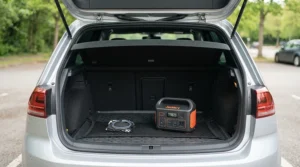
Compact units suit glovebox storage, while larger ones like the WOLFBOX MegaVolt 24 Air belong in the boot, ideally in a bag with the instructions on the outside.
Real-World Scenarios: Which Portable Jump Starter Fits Your Life?
Specs only help if they match your life. Here are three typical profiles.
The urban commuter with a small petrol hatchback. Short journeys, an older battery, a tight budget and a car parked on the street. The GOOLOO GP2000 (around £45) is the logical fit. It’s light, cheap and has plenty of engine headroom for a small petrol car. If money is very tight, the AstroAI B8 at around £30 works as a backup, provided the owner keeps expectations realistic.
The family with a diesel SUV and a van. Two vehicles, cold driveways and kids to move. A larger battery and a higher diesel rating matter here, so the TOPDON JS2000 Pro (around £100) is the sensible choice. If the family wants a tyre pump too, the Draper Lithium Jump Starter and Tyre Inflator is a strong one-box option.
The camper or motorhome owner. Big engine, remote pitches, lots of devices to charge. The WOLFBOX MegaVolt 24 Air is built for this, with its 10L engine rating and 160W DC output. A budget alternative with a huge battery is the AstroAI MF16 6000A, though you’ll live with short leads and fewer ports.
If reliability and rugged build matter most, such as for a work vehicle exposed to rain, the NOCO Boost GB40 earns its premium. Match the pack to your engine, your parking situation and how much you’d lose if it failed.
Frequently Asked Questions
❓ Do I need a jump start power pack if I already have breakdown cover?
❓ Can a compact car jump starter start a diesel van or 4x4?
❓ Will using USB charging ports drain the pack so it can't start my car?
❓ How long does a portable jump starter take to recharge?
❓ Are safety clamps really necessary on a cheap portable jump starter?
Conclusion: Which Portable Jump Starter Should You Buy?
The portable jump starter you’ll actually be glad of is the one that matches your engine and your habits, not the one with the biggest number on the box.
For most UK drivers, the GOOLOO GP2000 (around £45) offers the best balance of engine rating, capacity and price. If you value rugged build, honest ratings and a trusted name, the NOCO Boost GB40 (around £100) is the dependable choice. Diesel, van and 4×4 owners should look at the TOPDON JS2000 Pro (around £100) for its larger battery. The Draper Lithium Jump Starter and Tyre Inflator (around £95) is the strongest one-box answer for a flat battery and a soft tyre, and the AstroAI MF16 6000A (around £70) is the capacity-first alternative. For the largest engines and the heaviest device-charging demands, the WOLFBOX MegaVolt 24 Air is the premium option, while the AstroAI B8 (around £30) is a perfectly sensible backup if budget rules.
Remember the three rules from this guide: ignore peak amperage as a ranking, insist on proper safety clamps, and recharge your pack every few months. A flat battery never gives warning, and a modest purchase now beats a long wait on a cold morning later.
Recommended for You
- Tyre Tread Depth Gauge: 7 Brilliant Picks For UK Drivers (2026)
- Tyre Changing Tools For Home Use: 7 Best Must-Have Picks (2026)
- Tyre Repair Kit For Emergencies: 7 Essential Picks For UK 2026
Disclaimer: This article contains affiliate links. As an Amazon Associate, I earn from qualifying purchases. If you purchase products through these links, we may earn a small commission at no additional cost to you.
✨ Found this helpful? Share it with your friends! 💬🤗
