
In This Article
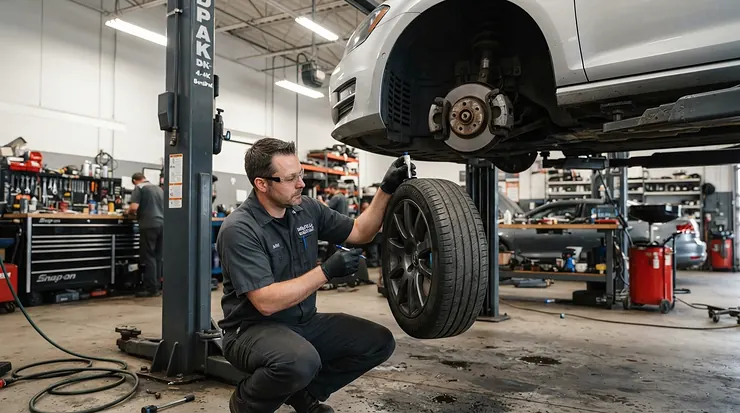
A tyre tread depth gauge is a small handheld tool that measures how deep the grooves in your tyre are, in millimetres. Push the probe into a main groove, read the number, and you know within seconds whether that tyre is comfortably legal or creeping towards trouble. Think of it as a thermometer for your tyres: cheap, quick and far more honest than a hopeful glance at the rubber.
Honesty matters here, because the rules are unforgiving. The DVSA MOT inspection manual on GOV.UK says the primary grooves must be at least 1.6mm deep within the central three-quarters of the tread, all the way round the tyre. Fall short and you risk a fine of up to £2,500 and three penalty points per tyre. Four tired tyres? Do the sums. It’s not a pleasant morning.
This guide compares seven real gauges using published specifications, independent bench tests from UK motoring publications such as Auto Express, Parkers and Car Magazine, and the themes that recur in buyer feedback. To be clear, this is research and analysis, not hands-on testing. Where a review pool couldn’t be verified, I say so rather than papering over it.
Along the way you’ll get a proper tread depth gauge buying guide and a straight-talking look at the digital tread depth checker versus its analogue cousins. You’ll also find plain-English explainers on the legal tyre tread limit, MOT tyre requirements, tread wear indicators and everyday tyre safety checks. Prices are ranges only and they move often, so check current price before you buy. This article contains affiliate links; the full disclaimer sits at the end.
Tyre Tread Depth Gauge Quick Comparison Table
Short on time? Here’s the lay of the land. All seven gauges read tread depth in millimetres, but they differ wildly in how they deliver the answer and what else they do while they’re at it.
| Product | Type | Price range | Best For |
|---|---|---|---|
| Sealey TSTPG12 | Digital pressure and tread combo | Around £15 | Everyday drivers wanting a backlit, traffic-light readout |
| PCL TSP1T15 | Analogue kit with VOSA-approved tread gauge | Around £17 | Pre-MOT peace of mind |
| Sakura SS5144 | Digital pressure, analogue tread | Under £10 range | Tight budgets |
| GODESON dial gauge | Battery-free dial | Under £15 range | Garage-drawer reliability |
| Draper TG92 | Mechanical sliding barrel, 1-26mm | £5-£12 range | The cheapest legal-limit check |
| Sealey VS0560 | Standalone digital, listed ±0.02mm | £15-£40 range | Enthusiasts who track wear precisely |
| Racex RX2931 | Rubber-armoured pressure and rod-style tread | Around £17 | Rough-and-tumble boot or van use |
Looking at the comparison above, the Sealey TSTPG12 is the easiest all-rounder to recommend at under £20, thanks to its colour-coded warning blocks. If all you want is a legal-limit check, the Draper TG92 is the lowest-cost route to a 1.6mm mark. Buyers chasing precision should look at the Sealey VS0560, while the Sakura SS5144 trades a little accuracy for the lowest price on the list. Prices reflect the time of research and may vary.
💬 Just one click — help others make better buying decisions too!😊
Top 7 Tyre Tread Depth Gauge Picks: Expert Analysis
Here’s each pick with what the specs mean on the driveway, plus the honest caveats. Independent test results come from Auto Express’s group test, last updated in 2021, so check that current versions match.
1. Sealey TSTPG12 — traffic-light display for instant verdicts
Its party trick is a colour-coded readout that turns “should I worry?” into a glance. In Auto Express’s test this combined digital unit took top spot, with a large backlit display and an LED nose light that stayed live for over 30 seconds. The tread blocks shift from green to red as depth falls towards 3.2mm and 2mm. On paper, that means the tool nudges you to act before the 1.6mm legal limit, which neatly matches the 3mm replacement advice from safety bodies. The pressure side offered four scales and tested accurately, so one pocketable gadget covers the monthly pressure-and-tread ritual.
Based on the spec comparison, this suits drivers who check tyres on dark winter mornings and want a verdict, not a maths problem. The catch with any two-in-one is that neither half is a specialist. If you want fine measurement, the standalone digital further down is the sharper tool.
Reviewer sentiment: Auto Express awarded five stars, and its only real grumble was thin instructions. It fitted a car tyre easily but felt fumbly on a motorbike. I couldn’t verify a large pool of owner reviews, so treat that as editorial opinion rather than a crowd verdict.
Pros:
- ✅ Large backlit display with LED nose light
- ✅ Green-to-red warning blocks flag wear early
- ✅ Accurate multi-scale pressure gauge included
Cons:
- ❌ Instructions were judged disappointing in testing
- ❌ Fiddly fit on motorcycle valves
Price: around £15, which is strong value for a backlit combo.
2. PCL TSP1T15 — VOSA-approved analogue kit in a metal case
Sometimes old-school wins. This kit pairs an analogue pressure gauge with a separate VOSA-approved tread gauge, both housed in a foam-packed metal case. Auto Express found the pressure gauge spot on at 20psi and 30psi, with an angled head that suits most tyres and a plastic valve-removal cap. The tread gauge was equally accurate. In practice, that means readings you can trust when you’re deciding whether a tyre will survive the MOT. The instructions also explain the tread limit and the three-quarters rule, something several pricier rivals skipped.
Here’s what to weigh: with no batteries, there is nothing to go flat in the glovebox in January. The flip side is that you’ll squint. The scale reads in millimetres, which helps, but it will never be as glanceable as a backlit digital screen. This is a sensible choice if you’d rather own a tool that outlasts the car than a gadget that needs coin cells.
Reviewer sentiment: Auto Express rated it 4.5 stars and praised the accuracy and the case. It noted the instructions lacked advice about checking tyres when cold. Larger owner-review pools couldn’t be verified here.
Pros:
- ✅ VOSA-approved tread gauge, accurate in testing
- ✅ Protective metal case with foam padding
- ✅ Instructions explain the three-quarters rule
Cons:
- ❌ Small scale takes some squinting
- ❌ No backlight or digital convenience
Price: around £17, good value for a kit that should last for years.
3. Sakura SS5144 — cheapest kit that still earns respect
A digital pressure gauge plus a separate analogue tread gauge for around £8 sounds too good to be true, yet Auto Express still gave it 4.5 stars. The digital pressure gauge stayed live for a useful 30 seconds and was perfect at 30psi, though 0.5psi adrift at 20psi. The analogue tread gauge was 0.5mm off, with a hexagonal scale marked in metric and imperial.
That 0.5mm deserves unpacking. A reading of 2.0mm could be a true 1.5mm, which is illegal. So here’s my practical advice: with this gauge, treat anything under about 2.5mm as “replace soon” and don’t try to squeeze the last millimetre. For a casual driver watching the big picture, the error is tolerable. For someone near the limit before an MOT, cross-check with a second tool.
Reviewer sentiment: Auto Express liked the value and the easy use, but said the instructions mentioned only the legal tread depth. There was no backlight on the digital unit. I couldn’t verify a large owner-review sample.
Pros:
- ✅ Remarkably low price for a two-tool kit
- ✅ Metric and imperial scale on the tread gauge
- ✅ Digital pressure gauge stays live for 30 seconds
Cons:
- ❌ Tread reading ran about 0.5mm off in testing
- ❌ No backlight on the pressure display
Price: under £10 range, which makes it a smart, low-risk first gauge.
4. GODESON dial gauge — battery-free dial reading
If you hate batteries, meet the dial. This zinc-bodied gauge uses a needle dial instead of a screen, weighs around 80 grams and measures roughly 7.1 x 5.9 x 2.7cm, so it slips into a door pocket. It is marketed for cars, motorcycles, trucks and buses, which makes it handy if your household runs more than one type of vehicle. Press the base flat on the tread, push the probe into the groove and the needle settles on the number.
What the spec sheet won’t say is how it feels to live with. Dial gauges are mechanical, so there’s nothing to switch on and nothing to fail on a freezing morning. Car Magazine’s roundup noted the sturdy zinc construction but cautioned that readings may not be as precise as a digital device. Parkers named a GODESON model its pick for easy-to-read display. If you value resilience over decimal places, it fits the brief.
Reviewer sentiment: the few review snippets I could verify describe it as accurate and easy to use. A larger sample wasn’t available, so treat that as an indication, not a verdict.
Pros:
- ✅ No batteries to replace or forget
- ✅ Compact, light zinc body
- ✅ Suits cars, bikes and larger vehicles
Cons:
- ❌ Not as precise as a quality digital gauge
- ❌ Dial needs a steady hand to read cleanly
Price: under £15 range, which is excellent value for a no-fuss dial.
5. Draper TG92 — a 1.6mm marker on a simple sliding barrel
This is the minimalist’s choice. The Draper TG92 is a plated steel sliding-barrel gauge that reads from 1 to 26mm in one-millimetre steps and includes a specific 1.6mm graduation. UK distributor listings say it is accepted in the UK for MOT testing. A pocket clip lets it live in your jacket like a pen.
So what does that mean on the driveway? The dedicated 1.6mm line answers the one question that matters legally: pass or fail. The trade-off is resolution. With 1mm graduations you’ll be estimating between marks, so it’s poorer at tracking slow wear than a digital readout. A useful rule of thumb: if the barrel sits close to the 3mm mark, start shopping for tyres.
Reviewer sentiment is mixed in the sources I could verify. One UK retailer listing showed a middling 2.5-star rating. A different Draper product, the 51550 service kit, read 0.5mm under in Auto Express’s test, though the TG92 wasn’t in that test. If you buy this one, cross-check it against a second gauge once.
Pros:
- ✅ Dedicated 1.6mm graduation for legal checks
- ✅ Wide 1-26mm range suits many vehicles
- ✅ Steel body with a handy pocket clip
Cons:
- ❌ One-millimetre steps limit fine tracking
- ❌ Mixed retailer feedback on build quality
Price: £5-£12 range across UK retailers, so it’s very good value as a backup or glovebox spare.
6. Sealey VS0560 — fine-measurement digital precision
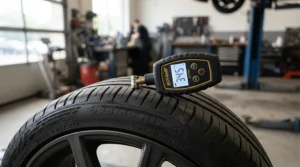
For anyone who enjoys numbers, the Sealey VS0560 is a standalone digital gauge. A retailer listing describes accuracy within ±0.02mm and positions it for garages, tyre-fitting centres and mobile mechanics, covering cars, vans and light commercial vehicles. That degree of precision means you can do something clever: measure the same tyre each month, note the millimetres lost per thousand miles, and predict when it will hit 3mm. Analogue gauges simply can’t do that reliably.
Who is it for? Keen DIYers, anyone buying a used car, or households running several vehicles. Here’s what to weigh: digital tools can mislead if grit sits in the groove or the zero has drifted, so wipe the groove and check the zero first. It also relies on a battery, so keep a spare cell in the glovebox.
Reviewer sentiment: I couldn’t verify a meaningful pool of independent reviews for this exact model, so I’m relying on the manufacturer’s listed spec. Independent accuracy data wasn’t available. That’s worth remembering when you see “±0.02mm” on a product page.
Pros:
- ✅ Very fine listed accuracy for tracking wear trends
- ✅ Standalone design built for frequent professional use
- ✅ Suits cars, vans and light commercial vehicles
Cons:
- ❌ Needs a battery and a clean zero
- ❌ Costs more than simple mechanical options
Price: roughly £15-£40 depending on the retailer, so shop around.
7. Racex RX2931 — rubber-armoured for rough handling
If your tools live in a boot or van footwell, armour matters. The Racex RX2931 pairs a pressure gauge in a thick rubber cover with a metal-rod tread gauge you push into the groove by hand. Auto Express liked the valve-release button and short angled nozzle, which showed just 0.5psi error across its two pressure tests, and found the rod accurate. The rubber cover cushions knocks, and with no screen to crack, it suits anyone whose tools get tossed around.
The weak point is readability. The needle is wide and the psi scale moves in steps of two, which can make fine readings fiddly. The instructions were also limited and missed key facts such as the legal width rule. If your priority is a robust, no-battery tool that gets the job done rather than a gadget to admire, it’s a decent fit.
Reviewer sentiment: Auto Express gave four stars, praising the design and accuracy but marking it down for the wide needle and sparse instructions. A large owner-review sample couldn’t be verified here.
Pros:
- ✅ Thick rubber cover protects against knocks
- ✅ Accurate pressure and rod-style tread gauges in testing
- ✅ No batteries or screens to fail
Cons:
- ❌ Wide needle and 2psi steps make fine reads fiddly
- ❌ Limited instructions with little legal guidance
Price: around £17, which is fair value for a tough two-tool setup.
How the Seven Stack Up
| Product | Independent verdict | Watch-out | Best For |
|---|---|---|---|
| Sealey TSTPG12 | Five stars, Auto Express | Thin instructions | Daily-driver checks |
| PCL TSP1T15 | 4.5 stars, Auto Express | Small scale | Pre-MOT peace of mind |
| Sakura SS5144 | 4.5 stars, Auto Express | Tread read 0.5mm off | Tight budgets |
| Racex RX2931 | Four stars, Auto Express | Fiddly dial scale | Rugged storage |
| GODESON dial gauge | Named easiest-to-read pick by Parkers | Not lab-grade | Battery-free simplicity |
| Draper TG92 | Not in the group test; MOT-accepted per distributors | One-millimetre steps | Legal-limit checks |
| Sealey VS0560 | Not in the group test; listed ±0.02mm | Pricier at the top end | Precise wear tracking |
Reading across the table, the independent verdicts cluster tightly, which tells you the real differences are about convenience, not raw capability. The highest-rated tools win on clarity (backlight, traffic-light blocks) or on build, rather than on magic accuracy. Where two products tie, choose the one you’ll actually pick up every month.
How to Use a Tyre Tread Depth Gauge Properly: A Step-by-Step Guide
Owning a tyre tread depth gauge is half the job; using it well is the other half. Here’s a routine that takes about five minutes.
- Start with cool, clean tyres. Park on level ground with the steering straight. Clear stones and mud from the main grooves, because a pebble can add a phantom millimetre.
- Pick a primary groove. These are the wide channels running around the tyre. Secondary grooves can be shallower by design, so measuring them will mislead you.
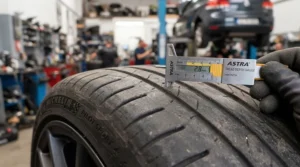
- Seat the gauge flat. Press the base across the tread blocks, push the probe to the bottom of the groove, then read. Tilting the gauge gives false readings.
- Measure across the width. Take readings on the inner, middle and outer thirds, staying within the central three-quarters that the law cares about.
- Repeat around the circumference. Roll the car forward about a metre and measure again, three or four times per tyre.
- Write it down. Use a phone note. Falling readings month by month tell you when to book replacements.
- Care for the tool. Wipe it clean, store it in its case, and check a digital gauge’s zero before each session.
The most common first-month mistakes are measuring a worn shoulder only, trusting a single reading, and forgetting the zero check. If the inner edge is wearing faster than the outer, suspect tracking or pressure problems, not bad luck.
Real-World Scenarios: Which Tyre Tread Depth Gauge Suits Which Driver?
Specs are abstract; driving isn’t. Here are four common buyer profiles and the logic behind each match.
The student on a budget. A second-hand hatchback, an occasional monthly check and limited funds. The Sakura SS5144 or the Draper TG92 cover the essentials for the lowest outlay. Just treat readings below 2.5mm as “replace” to absorb their tolerance.
The motorway commuter. Twelve-thousand-mile years, dark winter starts and no patience. The Sealey TSTPG12 shines here: its backlight and traffic-light blocks make a ten-second check realistic.
The family with two cars and a trailer. Several vehicles mean tools get thrown in glove boxes and boots. A battery-free option such as the GODESON dial gauge or the rugged Racex RX2931 survives the chaos.
The tinkerer or used-car buyer. If you’ll measure often and want trend data, the Sealey VS0560 rewards the effort. If an MOT looms, the PCL TSP1T15 gives a trusted second opinion.
Quick decision framework
- If you want simple and cheap, choose the Draper TG92 because it gives you a 1.6mm mark.
- If you want a fast verdict in poor light, choose a backlit digital such as the Sealey TSTPG12.
- If you hate batteries, choose a dial or analogue kit.
- If you want to predict replacement dates, choose the precise digital option.
Tread Depth Gauge Buying Guide: How to Choose the Right One
Every tread depth gauge buying guide boils down to a few sensible questions. Work through these seven and the choice usually makes itself.
- Digital or analogue? A digital tread depth checker is easier to read, while analogue gauges avoid batteries and are often cheaper.
- Check the range. You need a scale that covers roughly 0 to 10mm or more; most cars start life with around 8 to 9mm of tread.
- Look for a 1.6mm marker. It makes legal-limit checks instant, especially on mechanical gauges.
- Demand honest accuracy. Parkers suggests looking for accuracy within about 0.1mm. Independent tests matter more than marketing claims.
- Check the probe and base. The probe must fit narrow grooves, and the base should sit flat on the tread blocks.
- Weigh the extras. A pressure gauge, case or backlight can add convenience, but they can also add cost and compromise.
- Set a budget. Reasonable gauges cost £5-£40; spend more only if you’ll use the precision.
Keep this tread depth gauge buying guide handy before you click anything.
✨ Don’t Miss These Exclusive Deals!
🔍 Take your tyre safety routine to the next level with these carefully selected gauges. Click on any highlighted item to check current pricing and availability. These tools will help you create authentic peace of mind for you and everyone who rides with you!
Digital Tread Depth Checker vs Analogue Gauge: Which Wins?
The digital tread depth checker has taken over the shelves, but does it deserve to? The honest answer: it depends on how you drive and what you hate more, squinting or batteries.
| Option | How it reads | Strength | Weakness | Best For |
|---|---|---|---|---|
| Digital tread depth checker | Screen shows millimetres | Easy reading, often fine resolution | Needs batteries and a clean zero | Frequent checkers |
| Analogue dial or rod | Needle or sliding scale | No batteries, rugged | Harder to read precisely | Low-maintenance owners |
| 20p coin test | Visual pass or fail | Free and instant | Only a screening check | Quick roadside sanity checks |
| Tread wear indicators | Moulded bars in grooves | Always on the tyre | Only tells you when you’ve arrived at the limit | A last-resort warning |
Looking at the comparison above, a digital tread depth checker wins on convenience and on fine tracking, while analogue designs win on resilience. The 20p test and moulded bars are free and handy, but neither gives you the trend data that lets you plan a replacement. For most drivers, a mid-priced digital checker with a backlight is the sweet spot, but a mechanical backup in the glovebox never hurts.
Legal Tyre Tread Limit in the UK: What the Law Actually Says
The legal tyre tread limit for cars, light vans and light trailers is 1.6mm across the central three-quarters of the tread, in a continuous band around the whole circumference. Drive on a tyre below that and you face a fine of up to £2,500 and three penalty points per tyre, according to UK motoring and council road-safety sources. Larger goods vehicles, buses and motorcycles over 50cc are generally subject to a 1mm minimum instead.
Legal doesn’t mean ideal, though. Tests by the Motor Industry Research Association, as summarised by West Yorkshire Police, found that once a tyre drops below 3mm, stopping distances increase dramatically. Publications quote stopping-distance penalties for 1.6mm tyres in the wet of roughly a third to a half longer than at 3mm, depending on the test. So treat 3mm as your practical replacement point, and consider 4mm for winter tyres, as some insurers and tyre brands suggest.
Notice the phrase “central three-quarters”. Wear on the outer edges outside that band doesn’t count towards the law, but a tyre worn to the cords will still fail. Measure the central band, and measure it in more than one place.
MOT Tyre Requirements: What Testers Actually Check
MOT tyre requirements go beyond tread depth, though that’s the headline number. Under the GOV.UK MOT manual, a tyre whose tread depth doesn’t meet the requirement is classed as a dangerous defect, which means an immediate fail. Testers check all four fitted tyres for tread depth, cuts and bulges, correct size and suitability.
The manual also treats mismatches seriously. Tyres of different sizes or different structure on the same axle are recorded as major defects. Outside the central three-quarters, the tread can be bald and still pass, but that’s a poor place to rely on luck.
Here’s the practical angle. Testers may flag tyres that are close to the limit as an advisory, which is your early warning. So measure a week or two before the test, not the morning of it. If your gauge says 2mm or less, book replacements first; you’ll avoid a fail and a re-test hassle. Your MOT history online shows past tyre advisories, which tells you what the previous tester noticed.
Tread Wear Indicators: Handy Clues, Not a Substitute
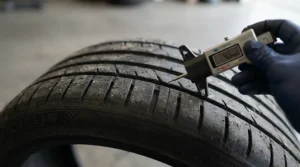
Tread wear indicators are small raised bars moulded into the base of the main grooves, set at 1.6mm above the lowest point of the groove. When the tread surface is flush with them, you’ve reached the legal limit. Manufacturers commonly mark their positions on the sidewall with a “TWI” label or a small triangle, so you know where to look.
Their strength is that they’re always on the tyre; their weakness is that they only tell you when you’ve already arrived. There’s no early warning, no trend, and no margin for the 3mm advice. They also appear only in primary grooves, while secondary grooves can be shallower by design, so reading the wrong groove can mislead you into thinking a tyre is worn out.
The 20p test is a handy cousin: if the coin’s outer band is hidden by the tread, you’re above the limit. It’s a screening tool, not a measurement. Use tread wear indicators and coins to spot trouble, then confirm with a gauge before you make decisions.
Tyre Safety Checks: A Five-Minute Monthly Routine
Tyre safety checks needn’t be a chore. Which? Trusted Traders suggests checking your tyres at home every month, covering tread, pressure, condition and age. Here’s a routine you can do while the kettle boils.
- Tread: Use your gauge in three places per tyre, as described earlier.
- Pressure: Check when the tyres are cold, using the figures in your handbook, not the number on the sidewall.
- Condition: Look for cuts, bulges and embedded nails or sharp objects in the tread and sidewalls.
- Age: Find the date code on the sidewall; ageing rubber deteriorates even when the tread looks fine.
- Warning lights: If a tyre pressure warning light is on, investigate promptly.
Add a check before any long journey, particularly when the car is loaded. A good tyre tread depth gauge, a pressure gauge and a torch make a tidy kit. These routines catch the slow punctures and uneven wear that become expensive when ignored.
Long-Term Cost & Maintenance: Is a Tyre Tread Depth Gauge Worth It?
Let’s talk money. A gauge costing around £15, used monthly for five years, works out at roughly 25p per check. Against that sits a potential fine of up to £2,500 per tyre, plus the hidden costs of wearing tyres down unevenly or replacing them too early.
| Tier | Examples | Price range | Value verdict | Best For |
|---|---|---|---|---|
| Budget | Draper TG92, Sakura SS5144 | Under £12 range | Great first gauge | Occasional checks |
| Mid-range | Sealey TSTPG12, PCL TSP1T15, Racex RX2931 | Around £15-£17 | Best balance of features and price | Regular drivers |
| Premium | Sealey VS0560 | Up to around £40 range | Worth it only if you’ll use the precision | Enthusiasts |
Looking at the table above, the middle tier is where most households should land, since the added cost buys readability and build quality. The budget tier is a smart safety net, but not a precision tool. Maintenance is trivial: wipe it down, keep it in its case, and replace batteries before they leak. Prices may vary, so check current price at the time of purchase.
Features That Actually Matter (And Those That Don’t)
Marketing loves a feature list. Here’s the filter.
What matters:
- Real accuracy. Independent tests beat spec-sheet claims. Look for readings within about 0.1mm of a trusted reference.
- A readable scale. If you can’t read it in a dim garage, you won’t use it.
- A clear 1.6mm marker or colour coding. It speeds up legal checks.
- A probe that fits the groove. A fat probe on narrow grooves gives sloppy numbers.
What doesn’t:
- Gimmicky auto-off timers. The Michelin 12291B was marked down by Auto Express partly because it switched off after only 10 seconds. The same test found its tread reading wouldn’t go above 3.4mm and gave it three stars. It’s a cautionary tale, so check recent buyer feedback if you consider it.
- Fancy styling. Pretty housings don’t improve precision.
- Too many pressure scales. Useful, but they don’t help tread checks.
Spend on clarity and honesty of measurement, not on bells and whistles.
Common Mistakes When Buying and Using a Tyre Tread Depth Gauge
Mistakes are common, and cheap to avoid.
- Checking only the centre. Wear on the shoulders can still make a tyre illegal if it falls inside the central three-quarters.
- Trusting one reading. Take several measurements around each tyre.
- Waiting until 1.6mm. The legal line isn’t a safe line; plan replacements around 3mm.
- Buying on price alone. A gauge that reads 0.5mm low can lull you into a false sense of security.
- Ignoring the groove choice. Measuring a shallow secondary groove gives misleading results.
- Forgetting batteries. A dead digital gauge in January is useless.
The Motor Ombudsman’s tyre guidance notes that most car tyres start at roughly 8 to 9mm, so you have plenty of margin to monitor. Build a habit of recording readings, and the numbers will tell you when to act well before an MOT.

Frequently Asked Questions
❓ What is the best tyre tread depth gauge for MOT checks?
❓ Is a digital tread depth checker more accurate than a dial gauge?
❓ How much should I spend on a tyre tread depth gauge in the UK?
❓ Can I use a tyre tread depth gauge on motorcycle or trailer tyres?
❓ Do tread depth gauges work on winter or all-season tyres?
Conclusion
A good tyre tread depth gauge costs less than a takeaway and could save you a four-figure fine. The real point isn’t the gadget; it’s the habit. Check monthly, record the numbers, and replace around 3mm rather than 1.6mm.
If you want the easiest all-rounder, the Sealey TSTPG12 is hard to beat for its backlit, traffic-light readout. Prefer no batteries and a trusted second opinion before an MOT? The PCL TSP1T15 and the GODESON dial gauge fit that bill. On a tight budget, the Sakura SS5144 and Draper TG92 deliver the basics. If precision matters, the Sealey VS0560 rewards the keen. And for rough handling, the Racex RX2931 is built for the boot.
Whichever you choose, pair it with sound tyre safety checks and a clear understanding of the legal tyre tread limit and MOT tyre requirements, and remember that tread wear indicators are only your last-resort warning. Your tyres are the only thing between your car and the tarmac, so treat them accordingly.
Recommended for You
- Tyre Changing Tools For Home Use: 7 Best Must-Have Picks (2026)
- Tyre Repair Kit For Emergencies: 7 Essential Picks For UK 2026
- Tyre Repair Kit For Punctures: 7 Best Picks For UK Drivers (2026)
Disclaimer: This article contains affiliate links. As an Amazon Associate, I earn from qualifying purchases. If you purchase products through these links, we may earn a small commission at no additional cost to you.
✨ Found this helpful? Share it with your friends! 💬🤗
