
In This Article
A budget tyre inflator is a compact electric air pump, powered by your car’s 12V socket or a rechargeable battery, that tops up your tyres to a pressure you choose. In the UK, a decent budget tyre inflator costs roughly £15-£55, and it saves you hunting for a forecourt air machine that actually works.
Here’s the awkward truth. Most of us know we should check our tyres, and most of us don’t. TyreSafe, the UK’s tyre-safety charity, urges motorists to check pressures at least once a month. October happens to be its annual Tyre Safety Month. Cold snaps make things worse, because Auto Express notes that pressure drops by around 2psi for every 10°C fall in temperature.
The money side is just as persuasive. A TyreSafe member has estimated that tyres running about 6psi under (roughly 20%) burn around 3% more fuel. Tyres at 80% of recommended pressure may last only around 75% as long. Even a modest inflator pays you back if it gets you checking monthly instead of never.
This guide covers seven real inflators sold in the UK, from a mid-teens digital unit to a long-running award-winner. I’ve also given proper room to the questions that matter at this price. Is a value tyre inflator accurate enough? Is an inflator for occasional use worth the boot space? Will a low-cost air compressor for tyres survive? And what does warranty coverage really look like?
A quick word on method. I haven’t taken these home and tortured them on a driveway. Everything below is analysis built from published group tests, manufacturer spec sheets and aggregated owner reviews, and where I couldn’t verify something, I say so.
Budget Tyre Inflator Quick Comparison: 7 Picks at a Glance
| Product | Power | Typical price range | Standout | Best For |
|---|---|---|---|---|
| AstroAI Digital Car Tyre Pump | 12V corded | £15-£20 | Digital and auto shut-off at rock-bottom cost | Glovebox emergencies |
| RAC 12V Digital Air Compressor | 12V corded | £15-£20 | Superb accuracy in testing | Accuracy on a shoestring |
| Ring RAC635 | 12V corded | £30-£45 | Preset digital, long cable | All-round corded value |
| VonHaus Cordless Tyre Inflator | Rechargeable | £30-£50 | Cordless freedom, built-in torch | Occasional cordless top-ups |
| Ring RTC2000 | Rechargeable | £40-£55 | Doubles as a power bank | Compact, car and bike top-ups |
| Ring Ultrainflate 20 | 12V corded | £35-£50 | Top score in Auto Express 2026 test | Best overall value |
| Ring RTC1000 | 12V corded | £40-£50 | About two minutes to 35psi (13-inch tyre) | Speed and long-term reliability |
Looking at the comparison above, the RAC 12V Digital Air Compressor and AstroAI Digital Car Tyre Pump set the price floor. The Ring Ultrainflate 20 is where Auto Express found the best blend of performance, features and cost. Cordless buyers face a trade-off. The VonHaus Cordless Tyre Inflator and Ring RTC2000 free you from the cable, but corded units such as the Ring RAC635 generally deliver more punch per pound, as Car Magazine notes. If sheer speed is the priority, the Ring RTC1000 is the benchmark.
💬 Just one click — help others make better buying decisions too!😊
Top 7 Budget Tyre Inflator Picks: Expert Analysis
Each pick below runs through the same checklist: what the specs mean in practice, who it suits, and what owners and testers keep saying. Prices are ranges, because they move constantly, so always check the current price.
1. AstroAI Digital Car Tyre Pump — cheapest digital option tested
The headline is price. This is the budget tyre inflator you buy when your budget is “whatever’s left after the fuel”.
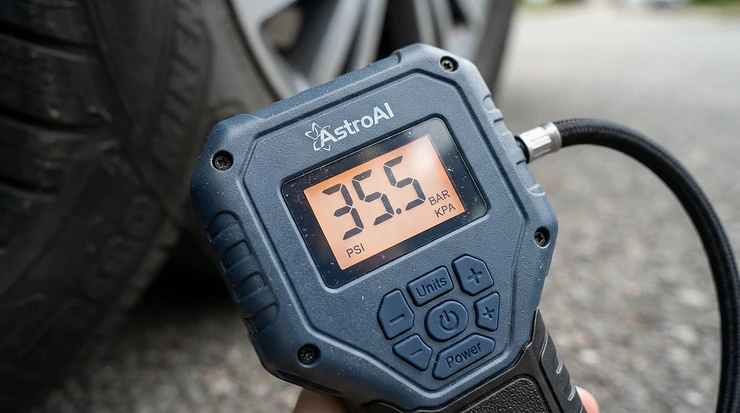
Auto Express’s 2026 group test found a digital display, auto shut-off at your chosen pressure and a built-in work light for around £15-£20. That light switches on the moment the 12V plug goes in and can’t be turned off. It’s brilliant on a dark forecourt and faintly irritating everywhere else. On the stopwatch it beat the RAC unit by roughly 15 seconds, so call it just under three minutes to fill the test tyre.
Now the catch. The gauge under-read by 2psi, which means the pump stops when its display says 35 but the tyre actually holds closer to 37. On a family hatchback that’s tolerable. For anything pressure-sensitive, set the target a couple of psi low or check with a separate gauge. The testers also found it noisy, with cable storage that’s fiddly, and awarded 3.0 stars.
It suits someone who wants a value tyre inflator for the glovebox and will double-check readings. I couldn’t verify a trustworthy aggregate customer rating for this exact model, so lean on the test findings rather than star counts.
Pros:
- ✅ Digital display and auto shut-off at a rock-bottom price
- ✅ Quicker than the RAC unit in Auto Express’s timing
- ✅ Built-in light helps after dark
Cons:
- ❌ Gauge under-read by 2psi in testing
- ❌ Noisy, with fiddly cable storage and an always-on light
Price: around £15-£20 (check current price). Verdict: a decent budget tyre inflator for emergencies, provided you treat the display as a guide, not gospel.
2. RAC 12V Digital Air Compressor — accuracy champion at the bottom of the range
Some budget tyre inflator options punch above their weight. This one out-scored pricier rivals on accuracy and earned 4.5 stars from Auto Express.
It has an auto shut-off at your selected pressure and a basic but clear digital gauge. In testing it over-read by only half a psi, which is effectively a rounding error on a 35psi target. The cable and hose are long enough to reach around a car and then wrap behind the unit for storage, a small touch that separates “thought through” from “thrown together”. It took exactly three minutes to fill the test tyre, so it’s leisurely rather than lively.
What does that mean in real life? For a monthly top-up, where you’re adding a few psi, three minutes for a big fill is irrelevant. You’ll be done before the kettle boils. One note on shopping: listing names for this model vary between AA-branded and RAC-branded wording, so match the digital-gauge and auto-shut-off description before buying.
I couldn’t verify a robust customer-review aggregate, so the expert test is the evidence here.
Pros:
- ✅ Superb accuracy, just 0.5psi out in testing
- ✅ Auto shut-off at your chosen pressure
- ✅ Cable and hose reach all four wheels
Cons:
- ❌ A leisurely three minutes for a larger fill
- ❌ Basic gauge with few extras; listing names vary
Price: around £15-£20. Verdict: the smartest low-cost air compressor for tyres if accuracy matters more than speed.
3. Ring RAC635 — Car Magazine’s all-round budget favourite
Car Magazine’s budget tyre inflator test made this its editor’s pick, praising quality, usability and efficiency for well under £50.
The spec sheet reads 120W at 12V, a 3.5-metre cable, three adaptors and a weight of about 1.17kg. Car Magazine reports it takes a flat 13-inch tyre to 35psi in around three minutes. That generous cable is the unsung hero: it should reach the far-side wheels without you shuffling the car about. The backlit digital screen, preset auto-stop and LED light mean you can set 35psi, walk away and come back to a finished job.
For a value tyre inflator, this is the “just works” option. Ring’s own review portal shows roughly 4.5 stars across about 250 reviews, and a mirror of the Amazon listing shows low-4s across several thousand ratings. Owners praise the ease of use. One described a previous model lasting years until it was dropped on concrete, a neat reminder to store it carefully. Gripes include a snug valve connector that’s fiddly when moving between wheels.
Pros:
- ✅ Backlit digital screen with auto shut-off
- ✅ Long 3.5-metre cable
- ✅ Good value for a recognised brand
Cons:
- ❌ Corded, so you need the car’s socket
- ❌ Slower than its 180W RTC1000 sibling
Price: around £30-£45. Verdict: the sweet spot for most drivers shopping a budget tyre inflator.
4. VonHaus Cordless Tyre Inflator — cord-free convenience without premium pricing
Cordless used to mean costly. This model shows how far the price has fallen.
It’s a rechargeable handheld with an LCD pressure display, a listed maximum of 125psi, and a built-in torch with a flashing red light, which is handy for roadside use. Expert Reviews named it best for emergencies, at around £48 at the time. Weighing roughly 1.1kg, it’s chunkier than the Ring RTC2000 but still glovebox-friendly.
Think about what cordless buys you in practice: no cable snaking across the drive, no need to hunt for the 12V socket, and no engine running. The catch is battery capacity. Reviewers have said they’d like more, so expect it to manage top-ups of several tyres better than repeated flat-to-full fills.
The eBay UK listing shows about 4.7 stars across roughly a thousand ratings, and a Tesco Marketplace listing about 4.1 from 126. Buyers cite value, simplicity and the torch. Complaints centre on battery size and fiddly bike-valve connections. One Trustpilot reviewer says VonHaus guarantees its cordless products for two years, but confirm the term for this model before buying.
Pros:
- ✅ Truly cordless, with a built-in torch
- ✅ Consistently strong owner ratings for the price
- ✅ Handy for cars, bikes and inflatables
Cons:
- ❌ Battery capacity limits big fills
- ❌ Bike valve connection can be fiddly
Price: around £30-£50. Verdict: a great inflator for occasional use if you hate cables.
5. Ring RTC2000 — pocket-sized power bank that doubles as an inflator
This is the clever one. It’s two gadgets in one body, and the second job is genuinely useful.
Specs: 3.7V rechargeable, 67W, a maximum reading of 120psi, and a 5200mAh power bank. The air line is only 14.5cm, so you’ll be holding the unit against the wheel. Ring says it tops up a car tyre in under three minutes and inflates a bike tyre from flat in under two. At around 485g it fits in a coat pocket, which matters if you cycle as well as drive.
The short hose is the real-world limiter. For adding a few psi, holding it against the valve is easy. For inflating from flat, you’ll tire before it does. Car Magazine’s verdict is blunt: it’s suited to car-tyre top-ups only. That suits an inflator for occasional use perfectly.
I couldn’t find a large verified review pool. Forum owners report it working fine every time, including on a scooter with a slow puncture, but that’s anecdotal.
Pros:
- ✅ Doubles as a 5200mAh power bank
- ✅ Under half a kilo and pocketable
- ✅ Handles car, bike and scooter tyres
Cons:
- ❌ Short hose means holding the unit
- ❌ Top-ups only, not flat-tyre rescues
Price: around £40-£55. Verdict: pricey for its power, but unbeatable for portability.

6. Ring Ultrainflate 20 — Auto Express’s top-scoring 12V inflator
Auto Express gave it a full five stars in its 2026 test, finding it the best mix of performance, features and value.
It runs on 12V at 180W and 15A, maxes out at 100psi, and has a 60cm hose, a 3-metre wind-up cable and a backlit display with a progress bar. Ring quotes about 3.5 minutes to inflate a 13-inch tyre. In Auto Express’s test it was second fastest, and its cable and hose were among the longest. The only blemish was a gauge reading about 1psi awry.
That 15A draw deserves respect. Check your car’s accessory-socket fuse, and keep the engine running so the battery isn’t doing all the work. One retailer Q&A also advises against using it continuously for more than 15 minutes. The progress bar is a lovely touch, showing how far you are from your target without arithmetic.
This is a newer model, so I couldn’t verify a mature review aggregate. Retailer Q&A confirms it’s 12V-only with a one-year manufacturer guarantee.
Pros:
- ✅ Top score in Auto Express’s 2026 group test
- ✅ Long cable and hose for the class
- ✅ Progress bar with auto-stop
Cons:
- ❌ Gauge about 1psi out in testing
- ❌ 15A demand; avoid continuous use beyond 15 minutes
Price: around £35-£50. Verdict: the best all-round value tyre inflator on this list. Auto Express didn’t think the dearer Ultrainflate 30 was worth the extra.
7. Ring RTC1000 — the long-running Best Buy that earns its premium
If you’re willing to stretch, this is the one that keeps winning.
It’s a 180W 12V unit with a large backlit display, a dial to preset pressure, auto-stop, a carry case, three adaptors, spare valve caps and even latex gloves. Ring claims two minutes to take a 13-inch tyre from flat to 35psi, and Auto Express named it a 2024 Best Buy. Parkers’ tester reported inflating a 14-inch tyre from 28 to 32psi in roughly 17 seconds. That means a typical monthly top-up takes less time than unscrewing the valve caps.
Reviews are strong. Ring’s portal sits at roughly 4.6-4.7 stars across about 220 reviews, and a mirror of the Amazon listing shows around 4.4 across several thousand ratings. Owners praise how quiet and quick it is and how tidily the cable stores. The recurring complaint is that rewinding the cable is awkward. The listing cites a one-year warranty.
Pros:
- ✅ Around two minutes from flat to 35psi (13-inch tyre)
- ✅ Case, spare caps and gloves included
- ✅ Large backlit display and simple dial
Cons:
- ❌ Cable rewinds awkwardly, say reviewers
- ❌ Costs more than the budget floor
Price: around £40-£50. Verdict: the budget tyre inflator for people who want one purchase to last.
Accuracy and Warranty Scorecard
| Product | Accuracy note | Warranty coverage (as reported) | Best For |
|---|---|---|---|
| AstroAI Digital Car Tyre Pump | Under-read by about 2psi (Auto Express) | Check listing; couldn’t verify | Glovebox emergencies |
| RAC 12V Digital Air Compressor | Over-read by about 0.5psi (Auto Express) | Check listing; couldn’t verify | Accuracy on a shoestring |
| Ring RAC635 | No independent error figure found | 12 months per supplier (buyer Q&A) | All-round corded value |
| VonHaus Cordless Tyre Inflator | No independent error figure found | Reportedly two years on cordless range (confirm) | Occasional cordless top-ups |
| Ring RTC2000 | No independent error figure found | Check listing | Compact top-ups |
| Ring Ultrainflate 20 | About 1psi out (Auto Express) | One-year manufacturer guarantee (retailer Q&A) | Best overall value |
| Ring RTC1000 | Reviewers praise accuracy | One year (listing) | Speed and longevity |
The pattern is telling. Accuracy errors range from half a psi to a couple, which is why a separate pressure gauge is a worthwhile £5-£10 companion. Warranty coverage clusters around a year, so the cheapest units aren’t necessarily the riskiest on paper, but their durability at low price points is less documented. In short, buy the Ring Ultrainflate 20 if you want a balanced all-rounder, or the RAC 12V Digital Air Compressor if accuracy per pound is your obsession.
Your First 30 Days: Setup, Use and Care for a Budget Tyre Inflator
The first month decides whether your inflator becomes a habit or a boot ornament. Here’s a practical routine.
Day 1: unbox and prep. Charge cordless models fully before first use. For corded models, check the fuse in the 12V plug, which many Ring models ship with.
Day 2: find your numbers. TyreSafe says the correct pressure is in the handbook, on the fuel filler cap or on the driver’s door sill. Write it on your phone.
Day 3: first use, cold tyres. Warm tyres give misleading readings. Plug a corded unit in with the engine running, screw the connector on fully, set your target and let auto-stop do its work.
Week 1: calibrate. Compare your inflator’s display against a separate gauge. Test results show errors from about half a psi to several psi, so know your unit’s bias and note it.
Weeks 2-4: build the habit. Set a monthly phone reminder and check the spare too. Never run a corded unit for more than about 15 minutes at a time, and let it cool between tyres.
Common first-month mistakes include inflating hot tyres, forgetting valve caps and leaving cordless units uncharged. Fix those three and your budget tyre inflator will outlast most of its rivals.

Real-World Scenarios: Which Budget Tyre Inflator Fits Your Life?
These are illustrative profiles, not case studies of real people. Each is matched to a pick, with the reasoning shown.
Scenario 1: the student with a tight budget. An older supermini, driven daily, topped up three or four times a year, with a budget under £20. The RAC 12V Digital Air Compressor wins here. Its accuracy beats the price tag, and you’ll never wait long enough to care that it takes three minutes. The AstroAI Digital Car Tyre Pump is the fallback if you can verify readings separately.
Scenario 2: the holiday-loaded family. A family of four, roof box on, monthly checks and a summer run to Cornwall. Loaded cars often need different pressures per the handbook, so speed and auto-stop matter. The Ring RTC1000 (two minutes flat-to-35psi, carry case) or the Ring Ultrainflate 20 (progress bar, long hose) are the natural fits.
Scenario 3: the cyclist-commuter. One car, one bike, one scooter, a small storage cupboard and a budget around £50. The Ring RTC2000 handles all three and charges a phone in a pinch. If you prefer a bigger battery and torch, the VonHaus Cordless Tyre Inflator is the alternative.
The lesson? Match the inflator to your frequency, environment and fussiness, not to a spec-sheet number.
Budget Tyre Inflator Problems and Fixes
Even good kit misbehaves. These are the most common budget tyre inflator headaches and how to fix them.
Problem 1: the gauge disagrees with another gauge. Cheap displays drift, and the AstroAI Digital Car Tyre Pump under-read by 2psi in testing. Fix: cross-check with a trusted gauge, then apply the offset. If yours reads 2psi low, set the target 2psi lower.
Problem 2: the unit shuts off or gets hot. Small compressors have limited duty cycles, and one retailer Q&A for the Ring Ultrainflate 20 advises against more than 15 minutes continuous use. Fix: pause between tyres and keep the engine running.
Problem 3: the connector hisses. A leaking valve connection wastes time. Fix: use the screw-on type, seat it fully and tighten before pressing start.
Problem 4: a cordless unit dies mid-job. Lithium batteries self-discharge in storage. Fix: recharge every few months, and consider a corded backup like the Ring RAC635 if you run a lot of tyres.
Problem 5: nothing happens at all. Check the fuse in the 12V plug and the car’s socket fuse before blaming the pump. A blown fuse is the usual culprit and the cheapest fix.
How to Choose a Budget Tyre Inflator: 7 Steps
Which? tests tyre inflators, naming Best Buys, Great Value models and a Don’t Buy, although the full results sit behind a paywall. These seven steps will get you to a sensible choice without one.
- Pick your power source. Car Magazine notes that corded 12V units usually beat cordless ones on power and reliability at the same price. Cordless wins on convenience.
- Digital or analogue? A backlit screen and auto shut-off usually cost only a few extra pounds, and they stop you over-inflating by distraction.
- Check maximum pressure. Cars need roughly 30-40psi, but Auto Express tested to 60psi because many space-saver spares need it. Vans and campervans can need more.
- Mind cable and hose length. If it can’t reach all four wheels, you’ll be moving the car mid-job.
- Expect accuracy variation. Auto Express found one wheel-shaped budget unit showing 30psi when the true pressure was 22.5psi. A separate gauge is cheap insurance.
- Read the warranty coverage. One year is typical, so check what it excludes.
- Match it to your use. Weekly users need speed and auto-stop. Occasional users need storage and shelf-life.
What Makes a Value Tyre Inflator? Features That Matter (and Those That Don’t)
A genuine value tyre inflator gets the basics right: auto shut-off, a readable backlit display, enough cable, and a screw-on valve connector. Those are the features that save you time and mistakes.
Ignore headline numbers. Manufacturers benchmark with a 13-inch tyre, but a modern family car runs bigger wheels, so expect longer. Huge maximum-psi claims are marketing, since you’ll rarely exceed 45psi on a car. LED modes and fancy carry cases are nice, not necessary. Spend on accuracy and cable length first.
Inflator for Occasional Use: What You Really Need
If you check tyres once a month or less, an inflator for occasional use has different priorities from a weekly workhorse. Speed barely matters, because a few psi top-up takes seconds on any of these. Storage, shelf-life and a forgiving gauge matter far more.
For a glovebox or boot, the RAC 12V Digital Air Compressor and AstroAI Digital Car Tyre Pump are compact and cheap. The Ring RTC2000 suits people who want to stash something small and also carry a power bank. Cordless units come with a caveat: lithium cells self-discharge, so an inflator for occasional use left in a cold boot all winter may be flat when you need it. Recharge it every few months, or choose a corded unit that has no battery to forget.
Build the habit around natural triggers: clocks changing, the first cold snap, and the pre-holiday check. With Auto Express reporting pressure drops of about 2psi per 10°C, your first frost is a perfect reminder.

Low-Cost Air Compressor for Tyres vs Foot Pump vs Forecourt Air
| Option | Typical outlay | Speed | Convenience | Best For |
|---|---|---|---|---|
| 12V low-cost air compressor for tyres | £15-£50 | 2-3½ minutes (flat to 35psi benchmark) | Needs the car socket | Everyday drivers |
| Cordless handheld | £30-£55 | Slower for big fills | No cable, battery to manage | Occasional top-ups |
| Foot pump | Lowest outlay | Slowest | No power needed; durable | Backup or camping |
| Forecourt air machine | Free or coin-operated, varies | Fast | Requires a trip; gauges vary | One-offs |
Looking at the table above, a low-cost air compressor for tyres is the best balance of speed, price and independence for most drivers. Car Magazine praised Draper’s all-metal double-cylinder foot pump for durability, though it’s slower and its analogue gauge is hard to read after dark. Forecourt machines are fine in a pinch, but you can’t test the gauge or choose the time.
Durability at Low Price Points: What to Expect
Let’s be honest about durability at low price points. Owner experiences vary widely. One forum member reported buying inflators repeatedly that died within about three years despite roughly three uses a year, while another had an eBay unit last about ten years before a Ring replacement disappointed. That’s anecdotal, but it fits the picture. A cheap compressor is a small piston and motor working hard in a small case, and heat is its enemy.
You can tilt the odds. Respect the duty cycle (about 15 minutes of continuous use on the Ring Ultrainflate 20, for example), keep the unit in its case, and never drop it, as one Ring RAC635 owner learned about a predecessor. Coil cables loosely rather than crushing them.
The cost-per-use maths is encouraging. A unit in the mid-£30s used monthly for five years is around 60 uses, or roughly 60p a go. Even if it lasts only three years, durability at low price points still beats paying and queuing at a forecourt, if your local air machine charges.
Warranty Coverage: What You Actually Get
Warranty coverage on a budget tyre inflator is usually modest, but it’s worth understanding. The Ring RTC1000 listing cites a one-year warranty against defects in materials and workmanship. Retailer Q&A for the Ring Ultrainflate 20 confirms a one-year manufacturer guarantee. A buyer on the Ring RAC635 referred to a supplier’s 12-month warranty, and one Trustpilot reviewer says VonHaus covers its cordless range for two years. For comparison, Halfords lists a one-year limited warranty on its Michelin 12V inflator.
“Defects in materials and workmanship” typically excludes drops, misuse and wear, so a dropped unit probably isn’t covered. Keep your receipt or order confirmation, as one Ring reviewer found customer service helpful after sharing a retailer receipt.
Your statutory rights sit alongside any manufacturer warranty coverage. Under the Consumer Rights Act 2015, goods must be of satisfactory quality, fit for purpose and as described, and the seller is responsible. I’m not a lawyer, so check the gov.uk consumer-rights guidance or Citizens Advice for specifics. Where I couldn’t verify warranty terms (AstroAI, RAC 12V, RTC2000), check the live listing before you buy.
Safety, Regulations and Legal Checks for UK Drivers
A budget tyre inflator is only useful if it keeps you legal and safe. Rule 97 of the Highway Code expects you to ensure your vehicle is legal and roadworthy before setting off. Its maintenance advice includes checking pressures weekly, when tyres are cold. Tyres should be inflated to the manufacturer’s specification for the load being carried, and legal minimum tread depth is 1.6mm.
Never exceed the maximum pressure on the tyre’s sidewall, and don’t inflate hot tyres, because heat inflates the reading. If your car has a tyre pressure monitoring system, you may need to reset it after inflating, as the handbook will explain.
On equipment, check that the unit has CE or UKCA conformity marking. Its absence on a no-name import is a red flag. For 12V models, know your socket’s fuse rating, since the Ring Ultrainflate 20 can draw up to 15A. For cordless lithium models like the VonHaus Cordless Tyre Inflator or Ring RTC2000, avoid leaving them in very hot cars and don’t charge them unattended.
FAQ
❓ Is a cheap tyre inflator accurate enough for my car?
❓ Can a budget tyre inflator inflate a completely flat tyre?
❓ How long should a cheap tyre inflator last?
❓ Do I need a cordless inflator, or is a 12V one enough?
❓ Can I use a budget tyre inflator on a van or campervan?
Conclusion: The Budget Tyre Inflator That Fits Your Boot
There’s no single perfect budget tyre inflator, only the right one for how you drive. If you want the best all-rounder, the Ring Ultrainflate 20 earned a full five stars from Auto Express for performance, features and value. If speed and longevity matter, the Ring RTC1000 keeps winning awards and loyal owners. Shoestring buyers should look at the RAC 12V Digital Air Compressor for accuracy and the AstroAI Digital Car Tyre Pump for the lowest price, as long as they double-check pressure. Cordless fans can choose the VonHaus Cordless Tyre Inflator for value or the Ring RTC2000 for portability, and the Ring RAC635 remains the corded all-rounder.
Whichever you choose, the habit matters more than the gadget. Check pressures monthly, on cold tyres, against a trusted gauge. Keep an eye on warranty coverage and durability at low price points, and treat a value tyre inflator as a tool that pays you back in fuel, tyre life and peace of mind.
✨ Don’t Miss These Exclusive Deals!
🔍 Take your tyre care to the next level with these carefully selected products. Click on any highlighted item to check current pricing and availability. These tools will help you keep every tyre at the right pressure all year round!
Recommended for You
- Portable Tyre Inflator Under £30: 7 Best Buys For UK Drivers (2026)
- Tyre Inflator For Cars: 7 Best Picks For UK Drivers (2026)
- Screenwash For Winter Under £10: 7 Best Buys For UK Drivers (2026)
Disclaimer: This article contains affiliate links. As an Amazon Associate, I earn from qualifying purchases. If you purchase products through these links, we may earn a small commission at no additional cost to you.
✨ Found this helpful? Share it with your friends! 💬🤗
