
In This Article
What is screenwash concentrate for winter? It’s a strong, alcohol-and-glycol-based windscreen fluid that you dilute with water to the freezing point you need. Unlike summer mixes, it stops washer pipes, jets and the glass itself from icing over, while shifting road salt, traffic film and grime in the cold. One bottle can fill your tank several times over.

Here’s the awkward truth. A frozen washer system doesn’t feel urgent until you’re behind a gritter at 7:40am, staring through a grey film of salt spray, and the jets give you a pathetic dribble. Rule 229 of the Highway Code says you must be able to see, and the official Highway Code guidance on icy and snowy weather makes clear that clearing your windows is a legal duty, not a courtesy.
That’s where screenwash concentrate for winter earns its keep. It’s cheaper per litre once mixed, it’s easier to store, and it lets you tune protection to the forecast rather than guessing. Pay attention to two things: the freeze protection rating on the label, and the dilution ratios that rating assumes. Plenty of buyers miss that the two are linked. A bottle shouting “-20°C” is only that strong when poured in neat.
Most UK motorists need protection of around -15°C to -20°C, according to the AutoPartsPro winter guide, and the usual advice is to switch before the first frost, typically by late October. That’s right about now.
This guide compares seven real products and explains how to dilute them. It also covers what to do about windscreen streaking, and where winter screenwash costs are quietly hiding. Prices are given as ranges only, so check current prices before buying.
Quick Comparison: Screenwash Concentrate for Winter at a Glance
| Product | Rated Protection (Neat) | Pack Size | Price Range | Best For |
|---|---|---|---|---|
| Sonax AntiFrost & ClearView Concentrate | -30°C at 2:1 mix | 5L | £15-£25 | Cold regions, best overall cleaning |
| Halfords -20°C Concentrate Citrus Screenwash | -20°C | 5L | £10-£15 | Everyday UK commuters |
| Prestone Extreme Performance Screenwash Concentrate | -18°C | 2.5L | Under £6 | Value-minded drivers |
| Scrubb Professional Super Concentrate -20 | -20°C | 5L | £7-£10 | High-mileage and fleet users |
| Mobil Screenwash Concentrate -65°C | -65°C | Varies | Check current price | Extreme cold, heavy dilution |
| Rain-X Concentrated Screen Wash with Rain Repellent -15°C | -15°C | Varies | Under £10 | Wet-weather visibility |
| Carplan All Seasons Screenwash Concentrate | -5°C to -6°C | 1L-2.5L | Under £6 | Mild regions, shoulder seasons |
The table shows how much the headline number hides. Sonax AntiFrost & ClearView Concentrate and Mobil Screenwash Concentrate -65°C are the only two here that comfortably cover a genuine Scottish cold snap once diluted. Halfords -20°C Concentrate Citrus Screenwash and Scrubb Professional Super Concentrate -20 cover most of the UK if you pour them neat. Carplan All Seasons Screenwash Concentrate is the cheapest, but it simply isn’t a deep-frost product.
💬 Just one click — help others make better buying decisions too!😊
Top 7 Screenwash Concentrate for Winter: Expert Analysis
1. Sonax AntiFrost & ClearView Concentrate — widest dilution range and strongest overall cleaning
The standout feature here is flexibility. The maker’s mixing table runs from 1 part concentrate to 2 parts water (-10°C), through 1:1 (-20°C), up to 2:1 (-30°C). A 5L canister makes up to 15 litres of mixed fluid at the mildest ratio. In practice you can run a thrifty 1:2 in November and bump to 1:1 when the forecast turns nasty, using the same bottle.
The spec sheet adds useful detail. There’s an anti-limescale formula, so you can mix with tap water in hard-water areas. There’s glycerine to keep rubber supple, and it’s rated safe for polycarbonate headlight lenses. The maker also says to avoid mixing with other screenwashes, which is a clue to the streaking problems covered later.
On paper this suits drivers who want one product across the whole season. Forum users report running it at 1:1 for winter and say they’ve never needed the 2:1 strength. One German comparison site, meanwhile, ranked it top on subjective cleaning performance.
Pros:
- ✅ Three clearly labelled ratios from -10°C to -30°C
- ✅ Anti-limescale formula works with hard tap water
- ✅ Safe for plastic headlight lenses and rubber
Cons:
- ❌ Higher upfront cost than supermarket concentrates
- ❌ Strong smell when poured neat
Price: roughly £15-£25 for 5L at the time of research. Worth it if you want flexibility and top-tier cleaning.
2. Halfords -20°C Concentrate Citrus Screenwash — the dependable high-street default
This is the “sensible shoes” pick. Halfords rates the 5L bottle to -20°C when used neat. Its listing says the formula contains extra detergents and water softeners, so it should keep cleaning even at a 5:1 water dilution. The 2L product page gives a dilution guide: 50/50 with water gives roughly -7.5°C, and 20% concentrate gives around -2.5°C.
That guide matters more than the headline. Halve the strength and the protection falls to roughly a third of the neat figure, so this is a product to pour in stronger than you think. For most of England and Wales, a ratio close to neat in January is the safe play.
Reviewers on Halfords’ own site give the 5L bottle a strong average rating, around 4.7 to 4.8 stars at the time of research. In an older forum thread, some drivers pointed out that a “-20 concentrate” only reaches -20 undiluted, exactly like a ready-mixed bottle. They have a point, but you’re still buying the option of diluting for milder days.
Pros:
- ✅ Reliable -20°C protection when used neat
- ✅ Contains a bittering agent for child safety
- ✅ Widely available with a strong customer rating
Cons:
- ❌ Protection drops fast when diluted
- ❌ Not especially cheap per litre once mixed for winter
Price: around £10-£15 for the 5L bottle; check current price. Good value for most UK commuters.
3. Prestone Extreme Performance Screenwash Concentrate — the bargain with a big review pile
The headline is simple. This 2.5L bottle is rated to -18°C when used neat, and the maker’s guide for milder seasons is 1:9 in autumn and 1:19 in spring and summer. It also claims to reduce sun dazzle, which is a rare nod to low winter sun on a wet road.
What that means in practice is cheap, year-round use. Dilute it heavily in warmer months, then switch to neat for the coldest weeks. A 2.5L bottle poured neat fills a typical washer tank once, and that’s the maths to keep in mind: it’s a value pick for when the forecast bites, not a marathon concentrate for bulk dilution.
Aggregated ratings on the Amazon listing are high. A deal-tracking site quoting the listing reported an average around 4.6 out of 5 across thousands of reviews. Drivers on one older forum thread said they’d had mixed experiences with the brand, so treat results as variable.
Pros:
- ✅ Strong freeze protection for the price
- ✅ Handy seasonal dilution guide on the label
- ✅ Very large review base to check before buying
Cons:
- ❌ Neat winter use means you go through bottles quickly
- ❌ Mixed forum feedback on cleaning power
Price: under £6 for 2.5L at the time of research. Great value for budget-conscious drivers.
4. Scrubb Professional Super Concentrate -20 — the workhorse for high-mileage drivers
This one comes from a trade-oriented listing. The maker says it’s suitable for use neat down to -20°C, and the pitch is practical: it removes road grime, flies and salt deposits. The listing even mentions boat windscreens, which says something about where it’s expected to work. A 5L pack suits multi-vehicle households, delivery drivers and anyone who covers serious winter miles.
The sensible reading is that this is a no-frills product with a clear job. Run it neat on freezing mornings and dilute it down for slightly milder days. Because it’s sold as a pro-grade item, you get volume rather than packaging gloss, which is great if you’re topping up weekly.
I couldn’t verify a meaningful pool of independent consumer reviews, so I can’t report review sentiment here. If you’re sceptical, that’s a good reason to start with a single 5L pack and see how your jets respond.
Pros:
- ✅ Neat use covers -20°C conditions
- ✅ 5L pack suits multiple vehicles
- ✅ Works on boat and van screens too
Cons:
- ❌ Few consumer reviews available to verify
- ❌ Minimal branding or dilution detail
Price: around £7-£10 for 5L; check current price. A solid pick if volume matters most.
5. Mobil Screenwash Concentrate -65°C — extreme protection that dilutes a very long way
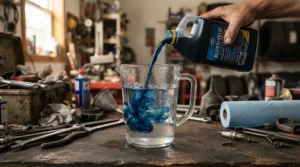
This is the heavyweight of the group. Mobil’s data sheet gives a clear dilution table. Mixed at 10% concentrate it protects to about -2°C, at 25% it reaches -9°C, at 50% about -25°C, and used neat it goes down to -65°C. It’s a clear blue liquid with an apple scent, and it’s meant for severe conditions as well as year-round cleaning.
What that means in practice is cost efficiency. For a typical UK winter, 25% to 33% concentrate would cover most nights, so one bottle stretches a very long way. The catch is that you need to measure properly, and a jug with marked lines is your friend. Anyone running 50% is probably overspending for UK conditions.
The product page is a technical data sheet, so there’s no consumer review sentiment to summarise. Availability varies by supplier, so check stock before relying on it.
Pros:
- ✅ Dilutes further than almost anything else here
- ✅ Published dilution table makes mixing easy
- ✅ Handles even extreme cold when used neat
Cons:
- ❌ Stock and pack sizes vary by seller
- ❌ Needs careful measuring to avoid overspending
Price: varies by pack; check current price. Best for drivers heading to colder regions or those wanting maximum dilution.
6. Rain-X Concentrated Screen Wash with Rain Repellent -15°C — the rain-beading all-rounder
The hook is the hydrophobic coating. Rain-X says its formula causes rain to bead and slide off at speed, and the concentrate is rated to -15°C for winter, with dilution possible in milder months. Wet winter roads throw up spray, and a screen that sheds water makes night driving less tiring.
Based on the spec comparison, this is the pick when your commute is more drizzle than deep freeze. At -15°C it covers most of the UK but sits below the -20°C options for a Scottish cold snap. A practical tip: start with clean wiper blades, because a worn blade will smear any coating.
I couldn’t find enough independent review data to summarise, so this verdict rests on the maker’s claims and the rating. If you try it, pay attention to how the screen behaves in heavy rain at motorway speeds.
Pros:
- ✅ Water-repellent effect helps in heavy spray
- ✅ Rated to -15°C for typical UK winters
- ✅ Dilutable for milder months
Cons:
- ❌ Lower protection than the -20°C picks
- ❌ Limited independent reviews to verify claims
Price: typically under £10; check current price. Best for rainy-commute drivers.
7. Carplan All Seasons Screenwash Concentrate — the shoulder-season budget option
Be clear-eyed about this one. The label advice is 10% concentrate in summer, 50% in winter at around -2°C, and neat in severe weather, with the neat figure around -5°C to -6°C depending on the pack. That’s protection for a mild frost, not a cold snap.
Reviews on a supermarket listing split sharply. One reviewer said it froze at just -5°C even when used neat. Another called it not exactly concentrated, since the label asks for 50% in conditions where rivals suggest 20%. A third simply said it does what it says. The takeaway is that it’s cheap and fine for mild coasts, but it isn’t frost-resistant screenwash in the deep-winter sense.
Pros:
- ✅ Very low purchase price
- ✅ Handy for autumn and spring dilution
- ✅ Easy to find in shops
Cons:
- ❌ Neat protection only around -5°C to -6°C
- ❌ Reviewers question its concentrate strength
Price: under £6 at the time of research. Fine as a shoulder-season top-up, but not for January.
✨ Don’t Miss These Exclusive Deals!
🔍 Take your winter driving to the next level with these carefully selected products. Click on any highlighted item to check current pricing and availability. These screenwashes will help you keep a crystal-clear view all season long!
How to Choose Screenwash Concentrate for Winter
Choosing well comes down to a handful of decisions. Work through them in order.
- Match the freeze protection rating to your region. Most UK drivers are covered by -15°C to -20°C. If you regularly drive across the Pennines, Scottish Highlands or Welsh uplands, aim for a mix that reaches -25°C or colder.
- Check the dilution ratios on the label. The headline number assumes neat use unless the label says otherwise. A product that halves its protection at 50/50 will cost you more bottles than one that holds up well.
- Work out cost per litre of mixed fluid. A cheap bottle that must be used neat is not a bargain. Divide the price by the total litres you’ll actually mix.
- Look for cleaning claims you can verify. Detergent and water-softener mentions suggest the product keeps cleaning when diluted, which protects against windscreen streaking.
- Check material compatibility. Plastic headlight lenses, paint and rubber should be listed as safe.
- Consider safety features. A bittering agent matters in households with children or pets.
- Think about storage. A 5L bottle is great for mixing in batches, but a 2.5L is easier to store in a small boot.
The rule of thumb is simple: buy for the coldest night you reasonably expect, then dilute down on milder days.

Dilution Ratios Explained: Getting the Mix Right
Here’s a step-by-step guide to mixing screenwash concentrate for winter properly, because the mixing is where most drivers go wrong.
| Product | Strong Mix | Medium Mix | Mild Mix | Best For |
|---|---|---|---|---|
| Sonax AntiFrost & ClearView Concentrate | 2:1 (-30°C) | 1:1 (-20°C) | 1:2 (-10°C) | Drivers wanting a clear ladder |
| Halfords -20°C Concentrate Citrus Screenwash | Neat (-20°C) | 50/50 (about -7.5°C) | 20/80 (about -2.5°C) | Neat-use commuters |
| Mobil Screenwash Concentrate -65°C | Neat (-65°C) | 50% (-25°C) | 25% (-9°C) | Heavy dilution |
| Carplan All Seasons Screenwash Concentrate | Neat (-5°C to -6°C) | 50% (about -2°C) | 10% (summer) | Mild climates |
Look at how differently these products behave at the same 50% mix. Mobil Screenwash Concentrate -65°C keeps roughly -25°C, while Halfords -20°C Concentrate Citrus Screenwash falls to about -7.5°C. Same ratio, wildly different protection, which is why the label number alone tells you very little.
Mixing method:
- Run the tank as low as you can before topping up.
- Pour in the concentrate first, then add clean water.
- Use a marked jug rather than guessing.
- Run the washers for a few seconds so the new mix reaches the jets.
- Don’t blend with summer fluid unless the label allows it.
Because leftover summer dilution often lingers in the reservoir, bear in mind your first fill may be weaker than planned. Err on the strong side for the first top-up.
Freeze Protection Rating: What the Number Really Means
The freeze protection rating describes the temperature at which the mixed fluid in your reservoir begins to freeze. It’s not a guarantee that the spray hitting your glass at 60mph won’t flash-freeze. Airflow and cold glass can make conditions harsher than the air temperature suggests, which is why a safety margin helps.
So what’s a sensible margin? Aim for a rating at least 5°C colder than the lowest overnight temperature you expect. If the forecast says -8°C, a -15°C mix has headroom, and a -10°C mix is cutting it fine.
Independent testing shows why this matters. In an Auto Express screenwash test, one budget product advised a 1:5 mix for -15°C yet quickly solidified in the testers’ freezer, even at that stronger dilution. Another, from a premium brand, did well on cleaning at a 1:9 mix but cost too much to use at winter strengths.
What do you take from that? Label claims vary in reliability, and the cheapest bottle isn’t always the best value. A trusted maker’s published dilution table, like those from Sonax AntiFrost & ClearView Concentrate and Mobil Screenwash Concentrate -65°C, gives you something to check against.
Real-world UK cold also varies. A few drivers on forums point out that it’s rarely very cold across much of the country, and that holds. But a frozen nozzle on a bad morning is exactly when you can’t afford a weak mix.
Fixing Windscreen Streaking in Winter: Problems and Solutions
Windscreen streaking is the most common winter complaint, and it’s usually fixable. Here are the typical culprits and what to do.
Problem 1: Worn wiper blades. Cold hardens rubber, and a tired blade will smear any fluid. Replace blades that chatter or leave bands of water.
Problem 2: Mixing incompatible fluids. Sonax AntiFrost & ClearView Concentrate specifically advises avoiding mixing with summer or other winter cleaners. Drain as much as you can before switching products.
Problem 3: Neat concentrate residue. Strong mixes can leave a film. One supermarket product notes that residue wipes away easily with warm soapy water, so clean the screen periodically.
Problem 4: Hard water. Limescale in tap water can cause spotting. A formula with anti-limescale, like Sonax AntiFrost & ClearView Concentrate, copes better, or you can mix with filtered water.
Problem 5: Oily or waxy glass. Road film, polish and wax build up. A proper glass clean once in a while resets the surface.
Problem 6: Coating conflicts. If you use Rain-X Concentrated Screen Wash with Rain Repellent -15°C, make sure the glass and blades are clean before starting, so the coating behaves evenly.
Small tweaks make a big difference. Fix the blades first, since that’s the cheapest and most common cause of windscreen streaking.
Real-World Scenarios: Which Concentrate Fits Which Driver
Matching products to real lives makes the choice clearer. Here are three profiles.
The suburban commuter. You drive 20 miles each way on A-roads in the Midlands, parked outside overnight. Lows rarely go below -6°C. Halfords -20°C Concentrate Citrus Screenwash poured close to neat on the coldest nights gives comfortable headroom. Budget: low to moderate. Frequency: daily.
The rural high-mileage driver. You cover 30,000 miles a year including Peak District and Scottish Borders runs. Cold snaps hit -12°C or worse. Mobil Screenwash Concentrate -65°C diluted to about 33% stretches your money furthest. If you prefer an easier ratio ladder, Sonax AntiFrost & ClearView Concentrate at 1:1 gives dependable -20°C protection. Frequency: daily, long distances.
The occasional winter driver. You drive a few short trips a week around a milder south-coast town. Prestone Extreme Performance Screenwash Concentrate or Carplan All Seasons Screenwash Concentrate keeps costs low, but keep a spare bottle of something stronger in the boot for the odd cold night.
Fleet users might also consider Scrubb Professional Super Concentrate -20, since a 5L pack stretches across several vehicles.
Screenwash Concentrate vs Ready-Mixed Winter Screenwash
Concentrate and ready-mixed fluids both protect against ice, but they suit different habits.
| Factor | Concentrate | Ready-Mixed | Best For |
|---|---|---|---|
| Cost per litre mixed | Lower if diluted sensibly | Higher, but predictable | Concentrate: regular drivers |
| Flexibility | Adjust to the forecast | Fixed strength | Concentrate: variable climates |
| Storage | Compact | Bulky | Concentrate: small boots |
| Convenience | Needs mixing | Pour and go | Ready-mixed: occasional users |
| Risk of error | Easy to under-mix | Low | Ready-mixed: beginners |
Looking at the table, concentrate wins on flexibility and storage, but only if you measure properly. Ready-mixed wins on simplicity. One review site noted that a ready-mixed Prestone winter bottle could work out cheaper per litre than a supermarket concentrate if you wanted protection to around -10°C, which shows ready-mixed isn’t always dearer.
For frost-resistant screenwash that adapts to changing weather, concentrate is the better long-term bet. If you hate measuring, a ready-mixed -20°C bottle is a perfectly reasonable alternative.

Long-Term Cost and Maintenance of Winter Screenwash
True cost comes from price per litre of mixed fluid, not the sticker on the bottle. A review from Hagerty UK worked out costs per litre when mixed for summer and winter. A Halfords -20°C concentrate came out around £1.37 per litre at winter strength, while a premium brand reached over £3 per litre. A super-concentrated Wynn’s product reached over £6 per litre at winter strength. The figures are a snapshot, so treat them as indicative.
| Option | Typical Winter Cost per Litre (Indicative) | Best For |
|---|---|---|
| Halfords -20°C Concentrate Citrus Screenwash | Around £1-£1.50 | Everyday commuters |
| Sonax AntiFrost & ClearView Concentrate | Depends on ratio, often competitive at 1:2 | Flexible users |
| Premium cleaning brands | Over £3 | Back-up use |
The maths says dilute where you can. Mobil Screenwash Concentrate -65°C and Sonax AntiFrost & ClearView Concentrate give the most mixed litres per bottle at moderate ratios.
Maintenance is simple. Check the level fortnightly in winter, since rain and snow can dilute the mix. Keep a spare bottle in the boot, top up with the same product, and flush the system with a fresh mix at the start of the season. Store bottles away from heat and sparks.
Common Mistakes When Buying Screenwash Concentrate for Winter
A few errors crop up again and again.
Trusting the headline number. A “-20°C” label might only apply neat. Always check the dilution ratios.
Buying on bottle price alone. A cheap concentrate you must use neat can cost more per litre than a pricier one you dilute.
Ignoring cleaning performance. Protection from ice is only half the job. If the formula smears, you’ll be squinting through windscreen streaking all winter.
Mixing different products. Blending summer and winter fluids can weaken protection and cause streaking.
Leaving it too late. Switch before the first frost. A frozen reservoir can crack or block pipes.
Forgetting the tank is already part-full. Leftover summer mix lowers the strength of your first winter top-up.
Overdoing the ratio. Running 2:1 when 1:1 would do wastes money. Most UK conditions don’t need the strongest mix.
Skipping wiper care. Even the best frost-resistant screenwash can’t fix a split blade.
Features That Actually Matter (And Those That Don’t)
Marketing loves a long feature list. Here’s the sorted version.
What matters:
- A published dilution table. It lets you hit the freeze protection rating you need.
- Verified material safety. Safe for paint, rubber and plastic headlight lenses is worth having.
- A bittering agent. Both Halfords -20°C Concentrate Citrus Screenwash and Sonax AntiFrost & ClearView Concentrate include one.
- Anti-limescale or water-softening additives. They help in hard-water areas.
- Decent pack size. A 5L pack beats three small bottles for regular use.
What matters less:
- Fragrance. Citrus or apple scents are pleasant but irrelevant to performance.
- Colour. Dye tells you nothing about protection.
- Extreme headline ratings. A -65°C neat rating is impressive, but you’ll never use it neat in the UK. The real value is how far it dilutes.
- Glossy packaging. It adds cost without adding protection.
What about hydrophobic claims? They can help in rain, as with Rain-X Concentrated Screen Wash with Rain Repellent -15°C, but only if your wipers and glass are in good shape.
Safety Guide: Handling Winter Screenwash Properly
Winter screenwash is flammable and shouldn’t be treated casually. Labels on Halfords -20°C Concentrate Citrus Screenwash and the Tesco concentrate carry a flammable liquid and vapour warning, so keep bottles away from heat, sparks and open flames. Store them upright, out of reach of children, and keep the cap tight.
Bittering agents, such as those named in the Halfords -20°C Concentrate Citrus Screenwash and Sonax AntiFrost & ClearView Concentrate listings, make the liquid taste foul, which helps reduce accidental swallowing. They aren’t a substitute for safe storage.
Paintwork needs care too. Carplan’s label advises rinsing neat spills off paintwork immediately. When filling, use a funnel and wipe any splashes. Wear gloves when handling strong concentrate, since it can irritate skin.
Never pour screenwash into a coolant system, and don’t use it as a de-icer on engine parts. Dispose of unwanted fluid at a local recycling centre rather than down a drain.
On the road, remember that your legal duty is to keep your view clear. The Highway Code requires you to clear all snow and ice from your windows before setting off. Fluid in the tank is a tool for that job, not a replacement for scraping.

FAQ
❓ What is the best screenwash concentrate for winter in the UK?
❓ Will frost-resistant screenwash damage my car paint?
❓ Can I mix summer and winter screenwash together?
❓ How much concentrate do I need for one washer tank?
❓ When should I switch to winter screenwash?
Conclusion
Choosing screenwash concentrate for winter isn’t glamorous, but it’s one of the cheapest safety upgrades you can make before the cold sets in. The key is to read past the headline number, understand the dilution ratios, and match the freeze protection rating to your real-world conditions.
For most UK drivers, Halfords -20°C Concentrate Citrus Screenwash is a dependable all-rounder. If you want the widest range of mixes and strong cleaning, Sonax AntiFrost & ClearView Concentrate is the premium pick. Prestone Extreme Performance Screenwash Concentrate suits budget buyers, and Scrubb Professional Super Concentrate -20 suits high-mileage households. Mobil Screenwash Concentrate -65°C stretches furthest when diluted, Rain-X Concentrated Screen Wash with Rain Repellent -15°C helps in wet weather, and Carplan All Seasons Screenwash Concentrate covers the mild shoulder seasons.
Pair your choice with fresh wiper blades and a clean screen, and windscreen streaking becomes a rarity. Fill up before the first frost, measure your mix, and keep a spare bottle in the boot.
✨ Ready to clear your view this winter?
🔍 Check current prices on your favourite pick and drive into the cold with confidence!
Recommended for You
- Transmission Fluid For Automatic Cars: 7 Proven Picks (2026)
- Antifreeze Concentrate Vs Premixed: 7 Smart Picks For UK Cars (2026)
- Coolant And Antifreeze For Cars: 7 Best Picks For UK Drivers (2026)
Disclaimer: This article contains affiliate links. As an Amazon Associate, I earn from qualifying purchases. If you purchase products through these links, we may earn a small commission at no additional cost to you.
✨ Found this helpful? Share it with your friends! 💬🤗
