
In This Article
Ceramic coating for cars is a liquid, silica- or polysilazane-based protective layer that you wipe onto clean paintwork, where it cures into a thin, hard, water-repelling film. It sits between your paint and the world, resisting bird droppings, road salt and wash marks far longer than traditional wax.
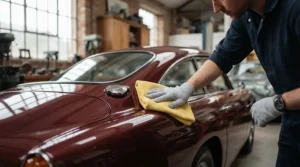
Britain is properly tough on paint. Gritters, tree sap, motorway grime and a climate that rarely lets a car dry out all chip away at the clear coat. A well-applied ceramic coating for cars gives that clear coat a sacrificial shield. Its party trick is that it is hydrophobic, so water sheets and beads off instead of clinging on. Wax needs topping up every few months, according to Auto Express’s group test, whereas modern coatings can last anywhere from one to three years.
Here’s the catch: the market is swimming in “10-year” promises. Those figures come from marketing departments, not from a February on the A1. So this guide does the unglamorous bit for you. We’ve narrowed the field to seven real products, from a spray costing under £10 to prosumer systems that demand proper prep. Each is weighed on real specs, independent test results and the themes that surface in user reports.
Along the way you’ll get a straight-talking DIY ceramic coating walkthrough, honest numbers on curing time and coating durability, a look inside a typical ceramic coating kit, and tailored advice on ceramic coating for daily drivers. All prices are ranges captured at the time of research, so check current price before buying. Let’s get your paintwork some armour.
Ceramic Coating for Cars at a Glance: Quick Comparison Table
Short on time? This table puts all seven contenders side by side. The star ratings come from Auto Express’s group test, which covered only some of these products.
| Product | Price range | Type | Auto Express rating | Best For |
|---|---|---|---|---|
| VP Ceramic-Eaze | Under £10 (250ml) | Wipe-on spray coating | 4.5 stars | Tight budgets and first-timers |
| Shelby Ceramic Coating | Around £40 (50ml) | Wipe-on sealant | 5 stars | Best all-round DIY value |
| Diamond Protech Body Kit | Mid-£60s | Prep plus gloss coat kit | 4.5 stars | Beginners wanting everything in one box |
| Sonax PROFILINE Ceramic Coating Evo | £110–£120 | Three-stage system | 4.5 stars | Maximum bead from a consumer system |
| CarPro CQuartz UK 3.0 | Check current price | Silica-quartz coating | Not in that test | Cold, wet climates and enthusiasts |
| Gtechniq Crystal Serum Light | From the mid-£50s (30ml) | Prosumer ceramic | Not in that test | Longest claimed protection |
| Gyeon Q2 Mohs EVO | Check current price | Polysilazane coating | Not in that test | Single-coat, outdoor-friendly application |
Looking at the comparison above, Shelby Ceramic Coating delivers the strongest value for most people, while VP Ceramic-Eaze is the lowest-risk way to try ceramic coating for cars at all. If you think in years rather than months, the prosumer trio of CarPro CQuartz UK 3.0, Gtechniq Crystal Serum Light and Gyeon Q2 Mohs EVO justifies a bigger outlay, provided you’re willing to polish and prep properly. Sonax PROFILINE Ceramic Coating Evo is the one for people who enjoy the process as much as the result.
💬 Just one click — help others make better buying decisions too!😊
Top 7 Ceramic Coating for Cars: Expert Analysis
Where possible, the notes below draw on Auto Express’s ceramic coating group test. There, coatings went onto a polished scrap bonnet, sat outside for six months and were judged on beading, swirls, value and ease of use. For products outside that test, the analysis leans on manufacturer specifications and the themes that recur in retailer and user feedback, flagged as such throughout.
1. VP Ceramic-Eaze — best budget spray for first-timers
VP Ceramic-Eaze proves that ceramic coating for cars doesn’t have to cost a small fortune. A 250ml bottle lands well under £10, roughly a meal deal with change left over.
Auto Express reports that it goes on with a pad, buffs off with a microfibre cloth and needs only about five minutes to cure before you finish the wipe-down. In practice, that short window removes the flash-timing panic that trips up many first-time DIY ceramic coating attempts. VP quotes about a year of protection, so think of it as a hardy sealant with ceramic chemistry rather than a multi-year shield.
Based on the spec comparison, it suits anyone who wants to learn the wipe-on, wipe-off rhythm before risking a pricier bottle. Beading in the independent test was not far off the best, which is striking at this price. For ceramic coating for daily drivers parked on the street, an annual re-coat is cheap enough to become a spring ritual.
A caveat on evidence: there wasn’t a large pool of verifiable customer reviews to summarise, so the picture rests mainly on the group test, where it earned 4.5 stars.
Pros:
- ✅ Remarkably cheap for a 250ml bottle
- ✅ Short cure before buffing suits beginners
- ✅ Near-best water beading in independent testing
Cons:
- ❌ Claimed protection is only around one year
- ❌ Little verifiable customer-review data
Price range: under £10, which makes it excellent value as a low-risk entry point.
2. Shelby Ceramic Coating — group-test winner for value
Shelby Ceramic Coating took the top spot in Auto Express’s latest round-up for a simple reason. It delivers almost everything the pricier options do for around £40.
The 50ml bottle includes an applicator and, per the test, treats two cars with a single coat. The liquid dries in roughly 20 seconds before you buff with a damp cloth, and it turns rain-repellent after about 20 minutes. That speed is a gift in a country where a dry afternoon is a rarity. It does mean working one small section at a time, otherwise the film grabs before you reach it.
What most buyers overlook is how narrow the gap at the top is. Auto Express judged Sonax’s bead slightly better, yet the difference was hard to spot by eye. For most DIY motorists, the saving makes Shelby Ceramic Coating the rational choice. It’s also a handy stand-in for a full ceramic coating kit when all you want is one bottle and an applicator.
Beyond the 5-star group-test result, there weren’t enough verifiable customer reviews to summarise crowd sentiment, so treat the independent result as the main evidence.
Pros:
- ✅ Top-rated in an independent UK group test
- ✅ Rain-repellent within roughly 20 minutes
- ✅ One bottle treats about two cars
Cons:
- ❌ Fast drying punishes slow, sprawling application
- ❌ Long-term durability data is thinner than for prestige brands
Price range: around £40, which is strong value for the performance.
3. Diamond Protech Body Kit — most complete beginner kit
Most coatings assume you own a drawer full of supplies. The Diamond Protech Body Kit assumes you don’t.
Per Auto Express, it bundles a 100ml prep product and a 50ml gloss coat, plus gloves, so “ceramic coating kit” means exactly that here. The car is usable after about an hour, a short curing time next to the overnight regimes of prosumer products. The test called protection exceptional, with beading beaten only by Sonax and on a par with the Shelby winner.
On paper, the included prep step is the real value. Bonding depends on a clean, residue-free panel, and a purpose-made prep liquid in the box replaces guesswork. In the mid-£60s range, you’re paying a noticeable premium over Shelby Ceramic Coating for that convenience. It’s a sensible route for a first DIY ceramic coating on a new car when you’d rather not hunt down gloves and prep liquid separately.
The 4.5-star group-test score is the main verifiable signal here. Large-scale customer-review data wasn’t available to summarise.
Pros:
- ✅ Gloves and prep liquid included in the box
- ✅ Car usable after roughly an hour
- ✅ Beading on a par with the group-test winner
Cons:
- ❌ Costs noticeably more than the top-rated Shelby
- ❌ Two-product system means extra steps
Price range: mid-£60s, which is fair value if you need the supplies.
4. Sonax PROFILINE Ceramic Coating Evo — best bead, biggest commitment
Where others chase convenience, Sonax PROFILINE Ceramic Coating Evo chases results. Auto Express found it gave the best protection and bead in its test.
It’s a three-stage system: 100ml Prepare, 75ml Basecoat and 40ml Glosscoat. The layered approach likely explains why the tester called application time-consuming and said the car must stay dry for at least four hours. Four dry hours is a big ask on a British weekend, so this is a garage-or-forecast-checking job.
Here’s what to weigh. If coating durability and peak beading matter more than saving an afternoon, this is the strongest consumer system in that test. The price has jumped since the previous test, which knocked it off the top spot, and it now sits around the £110–£120 range. At that money it’s worth comparing against prosumer bottles like CarPro CQuartz UK 3.0. For ceramic coating for daily drivers, it’s probably overkill unless you enjoy the ritual.
Independent testing gave it 4.5 stars, but verifiable customer reviews were scarce, so the group test remains the evidence.
Pros:
- ✅ Best protection and bead in the group test
- ✅ Complete three-stage system in one purchase
- ✅ Strong choice for coating durability seekers
Cons:
- ❌ Time-consuming, multi-step application
- ❌ Four-hour minimum dry window after application
Price range: £110–£120, which is premium value only if you want the best bead.
5. CarPro CQuartz UK 3.0 — built for cold, wet British weather
Despite sounding like a postcode, the “UK” in CarPro CQuartz UK 3.0 refers to a formulation designed for cold, damp conditions.
CarPro states it contains 70% silica-quartz at 99.9% purity, resists pH 3 to 14 and now copes better with road-salt build-up. It quotes a deliberately conservative 18–24 months of real-world coating durability, though some retailers advertise much longer. The pH range matters because acidic bug removers and alkaline wheel cleaners won’t strip it as easily as wax. Retail listings cite a water contact angle of about 110°, comfortably hydrophobic by textbook standards.
The kit typically includes an applicator block and suede applicators. CarPro’s guidance is roughly 15ml per coat on an average car, so a 50ml kit stretches to about three coats. Keep it dry for around 24 hours and hold off washing for five to seven days, according to one detailing guide. Once opened, the bottle has a short shelf life of around six months or less, so buy it for one project.
Retailer-aggregated feedback repeatedly mentions a forgiving application and generous working time, plus multi-year performance when maintained with a topper.
Pros:
- ✅ Formulated for cold, damp UK conditions
- ✅ Forgiving, generous application window
- ✅ Reported durability of two years or more
Cons:
- ❌ Short shelf life once the bottle is opened
- ❌ Needs thorough polish and prep for best results
Price range: a reliable current UK price couldn’t be confirmed, so check current price. Value is strong if you’ll prep properly.
6. Gtechniq Crystal Serum Light — longest claimed protection
Gtechniq Crystal Serum Light (CSL) is the prosumer sibling of the accredited-detailer-only Crystal Serum Ultra. One UK stockist says it offers around 80% of Ultra’s performance, and Gtechniq claims up to five years of durability.
That five-year ceiling is a best-case figure. One retailer suggests daily-driven cars see closer to three to four years, while garaged cars reach the full term. Gtechniq advises letting the coating cure at least 12 hours before it gets wet and skipping washes for at least a week. This is a patient coating for a patient owner, applied in roughly 60cm by 60cm sections with residue removed immediately.
Based on the spec comparison, Gtechniq Crystal Serum Light suits owners who think in years. Two caveats appear in user and review-site feedback. Its standalone bead is less extreme than a dedicated topcoat, so many users layer Gtechniq EXO on top. And the manufacturer’s warranty reportedly requires an accredited detailer, so DIY application voids it. Reviewers consistently praise gloss and durability but grumble about the long first cure and the unforgiving residue removal.
Pros:
- ✅ Up to five years of claimed protection
- ✅ Deep gloss and strong wash-swirl resistance
- ✅ Pairs well with EXO for extra slickness
Cons:
- ❌ Twelve-hour minimum cure before any water
- ❌ Warranty reportedly void for DIY application
Price range: from the mid-£50s for 30ml, which is good value if you’ll keep the car for years.
7. Gyeon Q2 Mohs EVO — single-coat, outdoor-friendly polysilazane
Gyeon Q2 Mohs EVO swaps layers for simplicity, using fluoro-modified polysilazane chemistry that Gyeon says needs just one coat.
Gyeon quotes up to 36 months of protection from one layer and up to 48 months from two. Retailers add that it can be wiped off up to five minutes after application. It can also be applied outdoors in stable weather, out of direct sunlight, which is a rare perk for UK driveway detailers. The catch is the aftercare: retailer guidance says no water for 24 hours and no washing for 14 days.
Consumption is about 15–25ml per car and 40–50ml for an SUV, so a 50ml bottle is the safe size. User feedback is mixed in an instructive way. Several detailers call it the easiest coating they’ve used, while one reviewer found the wipe-off window tight, nothing like the five minutes claimed. Temperature and humidity probably explain the gap. Once opened, use the bottle within roughly six months.
Pros:
- ✅ Single-layer application with up to 36 months claimed
- ✅ Outdoor application allowed in stable weather
- ✅ Extreme beading and slick, glossy finish
Cons:
- ❌ Mixed reports on wipe-off timing
- ❌ Fourteen-day wait before the first wash
Price range: a reliable current UK price couldn’t be confirmed, so check current price. Expect it to sit well above the budget sprays.
DIY Ceramic Coating: A Step-by-Step Application Guide
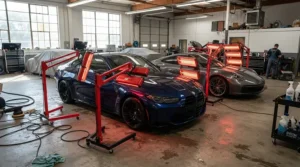
The coating gets the glory, but the preparation decides the result. A DIY ceramic coating locks in whatever is underneath, swirls and all. Auto Express polished its test bonnet before coating, and one retailer lists a polished surface as a requirement for Gtechniq’s CSL. Treat that as a hint about where the effort belongs.
- Wash and decontaminate. Use a quality shampoo, then iron remover and a clay bar to lift bonded grit.
- Correct the paint. A machine polish removes swirls so they don’t get sealed in. Skip this and you’ll be looking at them for years.
- Wipe down with a panel prep. Prep removes polishing oils so the coating can bond.
- Apply in small sections. Gtechniq suggests roughly 60cm by 60cm areas, using overlapping strokes and a bright, diffused light to inspect for residue.
- Wipe off promptly. Rotate cloths often, because curing coating in a dirty cloth leaves streaks.
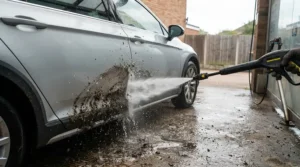
Common first-30-day mistakes include washing too early, using harsh detergents or automatic brush washes, and applying in direct sun. Keep the bottle out of your hand while you work, too, since body warmth can encourage premature curing. Wash used cloths promptly so residue doesn’t harden in them.
Curing Time: What Happens in the First Seven Days
Curing time is the least glamorous and most frequently ignored part of any ceramic coating for cars. Touch-dry isn’t cured. The surface can feel finished within minutes while the chemical bonding carries on for days. Different coatings ask for very different patience, so match the product to your parking situation.
| Product | Keep dry | Wait before first wash | Best For |
|---|---|---|---|
| VP Ceramic-Eaze | Check label | Check label | Quick weekend jobs |
| Shelby Ceramic Coating | Rain-repellent after ~20 mins | Check label | Unpredictable weather |
| Diamond Protech Body Kit | Car usable after ~1 hour | Check label | Short-window beginners |
| Sonax PROFILINE Ceramic Coating Evo | At least 4 hours | Check label | Garage owners |
| CarPro CQuartz UK 3.0 | ~24 hours | 5–7 days (guide-based) | Enthusiasts |
| Gtechniq Crystal Serum Light | At least 12 hours | At least a week | Garaged, patient owners |
| Gyeon Q2 Mohs EVO | 24 hours (retailer guidance) | 14 days (retailer guidance) | Outdoor-friendly application |
The fast products suit unpredictable British weather and street parking. The slow ones reward you with longer protection but demand a garage or a settled forecast. Where the table says “check label”, the source didn’t give a verifiable figure, so follow the product instructions rather than guessing. If rain catches an uncured car, blot it dry gently rather than letting droplets dry in place.
Real-World Scenarios: Which Ceramic Coating for Cars Fits Your Life?
Scenario 1: The street-parked commuter. You cover motorway miles daily, park outside and have a £50 budget. You don’t need a four-hour dry window you can’t guarantee, so choose a quick-curing option. Shelby Ceramic Coating (around £40) or VP Ceramic-Eaze (under £10) fits, with an annual re-coat as routine. This is ceramic coating for daily drivers at its most practical.
Scenario 2: The garage-kept enthusiast. Weekend washes, a polishing kit and a long ownership plan point towards Gtechniq Crystal Serum Light or Gyeon Q2 Mohs EVO. You have the dry space for the longer cure, and multi-year coating durability pays back the prep effort.
Scenario 3: The new-car owner starting from scratch. The paint is fresh, but you own no supplies. The Diamond Protech Body Kit removes the shopping list, and the paint likely needs less correction.
Scenario 4: The winter-salt worrier. If road salt is the main threat, CarPro CQuartz UK 3.0 was built with cold, wet, salty conditions in mind. Whichever you pick, set aside a free weekend rather than squeezing the job into an evening.
How to Choose Ceramic Coating for Cars
Choosing ceramic coating for cars comes down to matching the product to your tolerance for effort, not just to the brochure. Work through these steps:
- Be honest about prep. Prosumer coatings reward polishing and punish shortcuts, while budget sprays forgive more.
- Match curing time to your parking. Street parking calls for quick-curing products.
- Read durability claims sceptically. Manufacturer ceilings assume ideal conditions and light mileage.
- Check what’s included. A ceramic coating kit with gloves and prep saves hidden costs.
- Mind bottle size and shelf life. Opened bottles of several coatings last only about three to six months, so buy for one project.
- Budget for extras. Iron remover, polish, microfibres and gloves can add up.
- Consider warranty and removal. Some brands void warranties for DIY and are tough to remove if applied badly.
Ceramic Coating for Daily Drivers: What Actually Matters
A daily driver is a coating’s worst-case customer. It sees motorway stone peppering, salted winter roads, street parking and a revolving door of car washes. That changes the priorities. A forgiving application matters because you can’t always pick perfect weather. Salt and chemical resistance matters because that is the actual enemy. A cheap refresh matters because even the best coating loses ground on a commuter.
Retailer guidance suggests that daily-driven cars see shorter lifespans than garaged ones. One stockist puts Gtechniq’s CSL at three to four years for daily cars versus five for others, and a detailing blog suggests two to three years for CQuartz on a well-maintained daily driver. For ceramic coating for daily drivers, CarPro CQuartz UK 3.0 makes sense for its salt resistance, while Shelby Ceramic Coating and VP Ceramic-Eaze suit owners who’d rather re-coat yearly than fuss over cure windows. Maintenance habits matter more than the logo on the bottle.
Ceramic Coating Kit: What’s in the Box and What’s Missing
A ceramic coating kit sounds comprehensive, but contents vary wildly. CarPro CQuartz UK 3.0 typically ships with an applicator block and suede applicators. The Diamond Protech Body Kit adds a prep liquid and gloves, and the Sonax PROFILINE Ceramic Coating Evo is a three-bottle system. Gyeon Q2 Mohs EVO retailers list an applicator and a maintenance booklet.
What’s rarely included is the prep arsenal: iron remover, clay, polish, panel wipe, bright lighting and plenty of clean microfibres. Those can easily double the real cost of a DIY ceramic coating. Volume matters too. CarPro suggests roughly 15ml per coat for an average car, while Gyeon suggests 15–25ml per car and 40–50ml for an SUV. Smaller 30ml bottles run out fast on larger vehicles or when you want a second layer. If you’re coating an SUV or want a spare for wheels, buy the larger size.
Hydrophobic Coating: Beading vs Real Protection
Water beads are the shiny proof people post online, but a hydrophobic coating does more than perform party tricks. By definition, a surface is hydrophobic when water forms a contact angle above 90°. CarPro’s listed 110° for CQuartz UK clears that bar comfortably, while true superhydrophobic surfaces exceed 150°. Tighter, rounder beads usually mean less dirt clings and rinsing is easier.
But beading is a symptom, not the whole story. A coating can bead dramatically yet resist chemicals poorly, or bead modestly while shrugging off salt and wash marring. Auto Express judged Sonax’s bead slightly better than Shelby’s, yet the difference was hard to see. Gtechniq’s CSL, meanwhile, beads less extremely on its own than with a topcoat. As a rule, a hydrophobic coating needs regular, gentle washing to keep performing, because traffic film clogs the surface and mutes the effect. Judge a coating by how it performs after six months, not after six minutes.
Coating Durability: Marketing Claims vs British Reality
Coating durability claims range from one year to “10 years”, and the honest answer is “it depends”. Auto Express says modern coatings last from one to three years, and Jalopnik cites two to three years for off-the-shelf products versus three to five for professional ones. Against that backdrop, brand claims look generous. Gtechniq says up to five years for CSL, Gyeon says up to 36 months for one layer of Mohs EVO, and CarPro gives a deliberately conservative 18–24 months for CQuartz UK 3.0.
Four things decide where you land in those ranges:
- Quality of prep and application
- Mileage and parking
- Washing habits
- The winter you happen to get
Warranty terms deserve a read too, since some brands require accredited installation. Treat the headline number as a ceiling, plan around the lower end and be pleasantly surprised if it holds. Plain regular maintenance is the cheapest way to add coating durability.
Ceramic Coating for Cars vs Wax, Sealants and PPF
Ceramic coating for cars isn’t the only way to protect paint, and sometimes it isn’t the right one. Wax is cheap, warm-looking and quick, but it fades in months. Paint protection film (PPF) physically absorbs stone chips, which no liquid coating can.
| Option | Typical protection window | Effort | Best For |
|---|---|---|---|
| Wax | Months, needs regular topping up | Low, but frequent | Show cars and wax lovers |
| Sealant (budget spray types) | Months to about a year | Low | Quick, cheap protection |
| Ceramic coating | One to three years typically | Medium to high (prep) | Long-term gloss and easy cleaning |
| PPF | Years, handles stone chips | Professional install | Impact protection on high-mileage fronts |
The comparison shows ceramic coating for cars filling the middle ground. It lasts far longer than wax, needs more prep than a sealant and doesn’t stop chips like PPF. Many owners combine PPF on the front end with a coating over everything. Autoblog’s summary is worth remembering: a coating makes upkeep easier, not unnecessary. If you adore waxing as a hobby, or the car lives in a garage and rarely moves, wax may still win.
Long-Term Cost & Maintenance
Ceramic coating for cars looks pricier up front than a tub of wax, but the per-year maths can flip once you factor in time. Auto Express notes wax typically needs topping up every few months, while a coating can run one to three years.
| Approach | Typical outlay | Claimed protection | Best For |
|---|---|---|---|
| Budget spray (VP Ceramic-Eaze) | Under £10 | About 1 year (VP claim) | Annual re-coaters |
| Mid-range DIY (Shelby Ceramic Coating, Diamond Protech Body Kit) | Around £40 to mid-£60s | Not verified in this research | Value-focused DIYers |
| Prosumer (CarPro CQuartz UK 3.0, Gtechniq Crystal Serum Light, Gyeon Q2 Mohs EVO) | Check current price | 18–24 months to up to 5 years (brand claims) | Long-term owners |
| Professional install | Varies widely, so get written quotes | Often quoted at several years | Time-poor owners |
On that evidence, a budget spray re-applied annually is cheap per year but costs you labour each time. Prosumer coatings cost more up front but spread the effort over years. Factor in maintenance: coating-safe shampoo, clean microfibres and a periodic topper. The coating lowers the effort of washing but never removes the need for it.
Safety, Fumes and Wash-Water: A Practical Guide
Coatings are solvent-based chemistry, so treat them with respect. Work in a well-ventilated space and wear nitrile gloves, and check each product’s safety data sheet. One UK retailer’s spec sheet flags Gtechniq’s CSL as emitting strong fumes. Never leave coating-soaked cloths in a pile, because curing residue can stiffen them; Gtechniq advises soaking and washing cloths promptly.
Then there’s wash-water. GOV.UK’s guidance on pollution prevention lists vehicle washing among activities that can produce contaminated water. It’s aimed at businesses, but the principle applies on your driveway too: keep detergent-heavy run-off away from surface-water drains where you can. Use only the amount of shampoo you need, and check your local rules if you’re unsure. A careful, small-batch wash is better for you, your coating and your local watercourse.
Frequently Asked Questions
❓ How much does a ceramic coating kit cost in the UK?
❓ Can you apply ceramic coating outdoors on a driveway?
❓ Do you need to polish before applying ceramic coating?
❓ Can ceramic coating go over old wax or sealant?
❓ Does ceramic coating make paint scratch-proof?
Conclusion
The right ceramic coating for cars depends less on the logo and more on your life. If you want to dip a toe in without risk, VP Ceramic-Eaze under £10 is the sensible starter. For the best balance of performance, speed and price, the group-test winner Shelby Ceramic Coating is hard to beat. Prefer everything in one box? The Diamond Protech Body Kit removes the shopping list, while Sonax PROFILINE Ceramic Coating Evo rewards patience with the best bead in that test.
For the long game, CarPro CQuartz UK 3.0, Gtechniq Crystal Serum Light and Gyeon Q2 Mohs EVO offer the multi-year ambitions that justify serious prep. Their claimed coating durability varies from 18 months to five years, so plan for the lower end and treat the rest as a bonus.
Whichever you choose, remember the three truths of any DIY ceramic coating. Preparation decides the result, curing time is non-negotiable, and gentle, regular washing keeps the hydrophobic coating working. For ceramic coating for daily drivers, favour forgiving application and salt resistance over bragging rights. Pick your product, clear a weekend, and let British drizzle roll off your paint for a change.
✨ Your Paintwork Is Waiting!
🔍 Click any highlighted product name above to check current pricing and availability, and pick the coating that fits your garage, your budget and your patience. Your car (and your Saturday mornings) will thank you!
Recommended for You
- Paint Protection Product For New Cars: 7 Proven Picks (2026)
- Cutting Compound For Car Paint Correction: 7 Proven Picks (2026)
- Car Polish For Swirl Marks: 7 Best UK Picks (2026)
Disclaimer: This article contains affiliate links. As an Amazon Associate, I earn from qualifying purchases. If you purchase products through these links, we may earn a small commission at no additional cost to you.
✨ Found this helpful? Share it with your friends! 💬🤗
