
In This Article
Choosing the right nail gun can feel like navigating a minefield, especially when you’re standing in front of dozens of models at your local DIY shop or scrolling through Amazon at midnight. I’ve been there, staring at specifications that might as well be written in hieroglyphics, wondering whether I really need an 18-gauge brad nailer or if a finishing nailer would do the trick.

Here’s the reality: investing in a quality nail gun transforms your woodworking projects from tedious hammer-swinging marathons into precision-driven experiences. Whether you’re a chippy working on first fix carpentry, a keen DIYer tackling weekend home improvements, or someone who’s finally had enough of wonky architrave installations, there’s a nail gun out there that’ll make your life significantly easier.
The UK market in 2026 offers more options than ever before. Cordless battery-powered models have finally caught up with their pneumatic cousins in terms of power, whilst remaining blissfully free of tangled air hoses. Electric nail guns provide consistent performance without the faff of compressors or gas canisters. And if you’re a professional requiring maximum power for heavy-duty timber framing, pneumatic options remain unbeatable.
This comprehensive guide cuts through the marketing waffle to reveal the seven best nail guns available on Amazon.co.uk right now, covering budget-friendly options starting at under £50 through to premium professional-grade tools. We’ll also tackle the fundamentals: understanding nail gauges, choosing between cordless and pneumatic, and ensuring you’re actually buying the right tool for your specific needs.
Quick Comparison Table
| Nail Gun Model | Type | Nail Size | Weight | Price (£) | Best For |
|---|---|---|---|---|---|
| Stanley 0-TRE550 | Electric 2-in-1 | 6-15mm | 1.8kg | £46.99 | Budget DIY projects |
| Tacwise 181ELS Pro | Electric Brad | 15-35mm (18G) | 1.7kg | £68-80 | Home improvements |
| Tacwise 191EL Pro | Electric 2-in-1 | 15-35mm | 1.8kg | £105.95 | Semi-professional use |
| Einhell TE-CN 18 Li | Cordless 18V | 15-50mm (18G) | 2.4kg | £95-110 | Mobile DIY work |
| Tacwise Ranger EL-PRO | Cordless 18V 2-in-1 | 19-50mm | 3.0kg | £149.90 | Professional cordless |
| Makita DBN601RTJ | Cordless 18V LXT | 15-50mm (16G) | 2.2kg | £304-339 | Premium finishing |
| DeWalt DCN680D1 | Cordless 18V XR | 15-54mm (18G) | 2.4kg | £350-400 | Heavy-duty professional |
💬 Just one click – help others make better buying decisions too! 😊
Top 7 Nail Guns: Expert Analysis
1. Stanley 0-TRE550 2-in-1 Electric Stapler & Nail Gun
The Stanley 0-TRE550 represents brilliant value for money, especially if you’re just dipping your toes into powered fastening tools. This dual-function electric nail gun handles both staples and brad nails, making it incredibly versatile for lightweight DIY projects around the home.
Key Specifications:
- Fires 6-14mm Type-G staples and 12-15mm Type-J brad pins
- Hi/Lo power settings for different materials
- 100-nail capacity magazine
- 8-foot (2.4 metre) power cord
The tool’s flush-nose design proves particularly handy when working in tight corners—perfect for installing beading along awkward window frames or securing fabric to upholstery projects. I appreciate the Hi/Lo power lever, which prevents you from driving nails too deeply into softer materials like pine whilst still delivering enough oomph for MDF or plywood.
UK buyers consistently praise its performance on fence panel repairs and light construction work. One reviewer mentioned strengthening flimsy trellis panels, transforming them from wobbly disasters into “solid as a rock” structures using 14mm staples. However, some users report occasional jamming issues, particularly with third-party nails, so sticking with genuine Stanley fasteners is advisable.
✅ Pros:
- Outstanding price point (under £50)
- Dual staple and nail functionality
- Easy jam-clearing mechanism
❌ Cons:
- Shorter power cable requires extension lead
- Occasional jamming with non-Stanley nails
Price Range: £46.99-£52.99 | Amazon UK Availability: In stock with next-day delivery
2. Tacwise 181ELS Pro Electric Brad Nailer
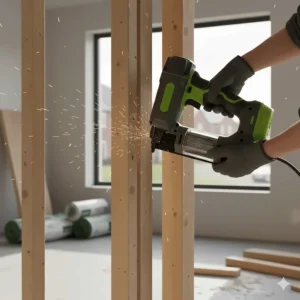
For those seeking a dedicated brad nailer without the budget-busting price tag, the Tacwise 181ELS Pro hits the sweet spot. This lightweight (1.7kg) electric nail gun excels at second fix carpentry, delivering professional results for architrave, skirting boards, and crown moulding installations.
Key Specifications:
- Fires 18-gauge (Type 180) nails from 15-35mm
- 30 nails per minute firing speed
- LED work light and magazine indicator
- 2.4 metre extended power cable
- Interchangeable UK/EU plug
The tool’s anti-dry fire mechanism prevents those embarrassing blank shots that can damage your work surface. I particularly rate the quick-release nose gate—when jams do occur (rarely, in my experience), clearing them takes seconds rather than the frustrating minutes you’ll spend with cheaper alternatives.
UK tradespeople and keen DIYers report excellent performance on softwood and plywood, with nails driving flush into 18mm plywood without issues. The LED work light genuinely makes a difference in poorly lit loft spaces or under-stair cupboards. However, the power cable, whilst longer than the Stanley, still necessitates an extension lead for most jobs.
✅ Pros:
- Lightweight and manoeuvrable
- Excellent value for money
- LED work light for confined spaces
❌ Cons:
- Power cable still relatively short
- Occasional pressure needed to sink nails fully in hardwood
Price Range: £68-80 | Amazon UK Availability: In stock with free delivery
3. Tacwise 191EL Pro 2-in-1 Electric Staple/Nail Gun
Stepping up to semi-professional territory, the Tacwise 191EL Pro combines the versatility of the Stanley with significantly improved build quality and performance. This robust tool belongs in the kit of any serious DIYer or light-trade professional tackling multiple project types.
Key Specifications:
- Dual-functionality: 100 Type 91 staples (15-30mm) or 100 Type 180 nails (15-35mm)
- 30 nails per minute firing speed
- 1.8kg ergonomic design
- Enhanced motor and driver blades
- Supplied with 2,000 staples and 2,000 nails
The 191EL’s all-metal quick-release magazine sets it apart from budget options, delivering smoother operation and fewer jams. With both staples and nails at your disposal, you can tackle everything from upholstery projects to fixing MDF panels without switching tools.
UK buyers who’ve upgraded from the 181ELS consistently mention improved driving force—this tool sinks nails with less pressure, reducing arm fatigue during extended sessions. One reviewer cleverly addressed the nose assembly vibration issue (the three screws can work loose) by applying sellotape over the screws, a simple preventative measure that saves frustration.
✅ Pros:
- True 2-in-1 versatility
- Robust construction suitable for daily use
- Excellent customer service from Tacwise UK
❌ Cons:
- Nose assembly screws may loosen (easily fixed)
- Still requires mains power connection
Price Range: £105.95 | Amazon UK Availability: In stock with free UK delivery
4. Einhell TE-CN 18 Li Power X-Change Cordless Nail Gun
Breaking free from power cables, the Einhell TE-CN 18 Li introduces the freedom of cordless operation without sacrificing performance. Part of Einhell’s excellent Power X-Change ecosystem, this 18V nailer works with any batteries you might already own from their range.
Key Specifications:
- 18-gauge brad nails (15-50mm)
- 60 shots per minute firing speed
- Single and serial shot modes
- Depth adjustment dial
- Compatible with all Einhell 18V batteries
- Supplied with 500 nails
The tool’s electronic shot control lets you switch between single-shot precision (ideal for architrave) and rapid serial firing (perfect for long skirting board runs). This flexibility genuinely speeds up work, particularly on those satisfying days when everything’s coming together nicely.
UK buyers who’ve switched from DeWalt to Einhell consistently praise the tool’s performance. Whilst it occasionally struggles to sink nails perfectly flush in MDF (a common challenge with cordless nailers), adjusting the depth setting resolves this. Battery life impresses—one 2.5Ah battery handles a day’s worth of domestic work, though professionals would benefit from keeping a spare charged.
✅ Pros:
- Cordless freedom of movement
- Compatible with extensive Power X-Change ecosystem
- Excellent value for cordless technology
❌ Cons:
- Slightly heavier than corded alternatives
- May require depth adjustment for perfect results in MDF
Price Range: £95-110 (body only) | Amazon UK Availability: Next-day delivery available
5. Tacwise Ranger EL-PRO 18V Cordless 2-in-1 Nail Gun
The Tacwise Ranger EL-PRO represents Tacwise’s flagship cordless offering, delivering professional performance that genuinely rivals pneumatic nail guns—minus the tangled air hoses and noisy compressor.
Key Specifications:
- Fires 100 Type 91 staples (19-40mm) or 100 Type 180 nails (20-50mm)
- 60 staples/nails per minute firing speed
- 18V 2.0Ah lithium-ion battery (400 shots per charge)
- Sequential and contact trip (bump) firing modes
- LED work light and depth control adjustment
- Recoilless design reduces user fatigue
The recoilless operation deserves particular mention—this isn’t marketing hyperbole. The tool genuinely minimises kickback compared to cheaper cordless alternatives, making it significantly more comfortable during all-day use. The depth control wheel lets you fine-tune nail placement without tools, adapting instantly as you move between different timber thicknesses.
UK professionals working on furniture upholstery, roofing, fencing, and insulation jobs consistently rate this tool highly. One carpenter mentioned achieving 150 staples without a single misfire after upgrading from a problematic cheaper model. The supplied carry case properly protects your investment during transit, though the non-marking nose protector would be a welcome addition to prevent surface damage on delicate work.
✅ Pros:
- True recoilless professional performance
- Dual sequential/bump firing modes
- Excellent 400-shot battery life
❌ Cons:
- Heavier than corded alternatives (3.0kg)
- Higher price point than budget cordless options
Price Range: £149.90 | Amazon UK Availability: In stock with free delivery
6. Makita DBN601RTJ 18V LXT Brushless Finishing Nailer
When you’re ready to invest in professional-grade equipment, the Makita DBN601RTJ delivers premium performance that justifies its premium price. This 16-gauge finishing nailer belongs in the kit of serious tradespeople who demand consistent, reliable results day after day.
Key Specifications:
- 16-gauge straight finish nails (15-50mm)
- Pneumatic spring mechanism for authentic feel
- Up to 1,000 nails per 5.0Ah battery charge
- Anti-dry fire mechanism
- Tool-less depth adjustment
- Supplied with 2x 5.0Ah batteries, charger, and Makpac case
The pneumatic spring mechanism distinguishes Makita’s approach from competitors. Rather than using battery power alone, an internal sealed air cylinder stores energy, delivering the feel and performance of traditional pneumatic nailers without the compressor. This translates to consistent nail placement in both softwoods and hardwoods with minimal recoil.
UK joiners and carpenters particularly appreciate the slim nose design, which provides excellent visibility when positioning nails precisely. The tool-less jammed nail clearing system proves invaluable—simply flip the nose plate, remove the offending nail, and you’re back to work in seconds. At 2.2kg, it’s impressively lightweight for its power output, reducing fatigue during overhead work like crown moulding installation.
✅ Pros:
- Premium build quality and reliability
- Pneumatic spring mechanism delivers authentic feel
- Impressive 1,000 nails per battery charge
❌ Cons:
- Significant investment (£300+)
- 16-gauge nails may be overkill for lightweight applications
Price Range: £304-339 (with batteries and charger) | Amazon UK Availability: Professional tool suppliers and Amazon
7. DeWalt DCN680D1 18V XR Brushless Brad Nailer Kit
Topping our list, the DeWalt DCN680D1 represents the pinnacle of cordless brad nailer technology available in the UK market. This brushless masterpiece delivers professional results that rival—and in some cases surpass—pneumatic alternatives.
Key Specifications:
- 18-gauge brad nails (15-54mm)
- Brushless motor technology for efficiency
- Tool-free depth adjustment and jam clearing
- Sequential and bump firing modes
- 20V MAX (18V nominal) Li-ion battery system
- Supplied with 2.0Ah battery, charger, and kit bag
The brushless motor isn’t just marketing fluff—it genuinely extends runtime and tool life whilst delivering more consistent power output. DeWalt’s engineering prowess shines through in details like the anti-dry fire mechanism (preventing blank shots that damage work surfaces) and the flush-nose design that allows precise nail placement in tight corners.
UK professionals consistently rank this as their go-to cordless brad nailer. One reviewer comparing it directly against the competing Makita model noted the DeWalt’s superior performance in bump mode, allowing up to four nails per second when installing long runs of skirting board. The tool’s balance and ergonomics receive universal praise, with many mentioning reduced fatigue during all-day use compared to pneumatic alternatives.
The only real downside? The official DeWalt TSTAK storage case costs an arm and a leg. Most users opt for the included kit bag, which, whilst less protective, keeps the tool adequately safe for site work.
✅ Pros:
- Brushless motor delivers unmatched efficiency
- Rivals pneumatic performance without compressor
- Outstanding build quality and reliability
❌ Cons:
- Premium price point (£350-400)
- Official storage case sold separately at high cost
Price Range: £350-400 (kit with battery and charger) | Amazon UK Availability: In stock with next-day delivery for Prime members
Understanding Nail Gun Types & Gauges
Before you commit your hard-earned cash to a specific model, understanding the fundamental differences between nail gun types prevents expensive buying mistakes. The world of nail guns broadly divides into three categories: framing nailers (first fix), finishing nailers (second fix), and brad/pin nailers (precision work).
Framing Nailers (First Fix)
Framing nailers fire the largest nails—typically 50-90mm long with diameters between 2.8-3.1mm. These workhorses tackle heavy-duty construction: timber frame erection, joist fixing, stud walls, decking, fencing, and roof battening. In the UK market, 34-degree angled magazines predominate, allowing better access into tight corners whilst maintaining structural strength.
According to the HSE’s woodworking guidance, framing nailers account for the highest number of workplace incidents due to their power and the large fasteners involved. Proper training and safety equipment—particularly eye protection—remain absolutely essential when operating these tools.
Finishing Nailers (Second Fix)
Finishing nailers use 15-gauge or 16-gauge nails (approximately 1.6-1.8mm diameter), ranging from 15-64mm in length. These tools excel at tasks where nail visibility matters: architraves, skirting boards, tongue-and-groove panelling, crown mouldings, and window casings.
The choice between straight and angled magazines depends on your typical working environment. Angled magazines provide superior access in confined spaces (think under stairs or tight bathroom installations), whilst straight magazines offer slightly better nail capacity and easier magazine loading.
Brad Nailers (Precision Work)
Brad nailers fire 18-gauge nails (approximately 1.2mm diameter), typically 10-50mm long. These thin fasteners suit delicate trim work, lightweight boards, and mouldings where you’re keen to avoid splitting the material. The resulting holes are often small enough that filling becomes optional—a genuine time-saver on large projects.
Understanding Nail Gauge Measurements
The gauge system initially confuses many UK buyers accustomed to metric measurements. Here’s the crucial point: higher gauge numbers indicate thinner nails. An 18-gauge brad nail is significantly thinner than a 15-gauge finishing nail, despite the higher number.
This inverse relationship stems from the American Wire Gauge (AWG) system, where the gauge number represents how many times the original metal stock was drawn through progressively smaller dies. More draws equal thinner wire—hence the counter-intuitive numbering.
For UK buyers, here’s a practical conversion:
- 15-gauge: 1.8mm diameter (finishing work, crown moulding)
- 16-gauge: 1.6mm diameter (general finishing, architrave)
- 18-gauge: 1.2mm diameter (brad nails, delicate trim)
- 23-gauge: 0.6mm diameter (pin nails, cabinet making)
Cordless vs Pneumatic vs Electric: Which Power Source?
The power source debate generates passionate opinions amongst professionals and DIYers alike. Each system offers distinct advantages depending on your typical projects, working environment, and budget constraints.
Cordless Battery-Powered Nail Guns
Modern cordless technology has transformed nail guns from underpowered curiosities into legitimate professional tools. The latest generation models from Makita, DeWalt, and Einhell deliver power comparable to pneumatic alternatives whilst eliminating troublesome air hoses.
Advantages:
- Complete freedom of movement around job sites
- No compressor noise disturbing neighbours
- Quick setup—charge battery, load nails, work
- Compatible with existing battery ecosystems (massive cost saving)
Disadvantages:
- Higher initial purchase cost
- Battery runtime limits (though modern Li-ion offers 400+ shots)
- Slightly heavier than pneumatic equivalents
- Battery replacement costs after 2-3 years
Best For: Mobile site work, domestic projects, professionals working in occupied buildings where compressor noise would be problematic.
Pneumatic (Air-Powered) Nail Guns
Pneumatic nail guns remain the professional’s first choice for heavy-duty applications requiring sustained power output. Operating between 70-120 PSI, these tools deliver unmatched driving force for hardwoods and thick structural timber.
Advantages:
- Maximum power for demanding applications
- Lightweight tool design (air hose carries the weight)
- Lower purchase cost than cordless equivalents
- Unlimited runtime (no batteries to charge)
Disadvantages:
- Requires air compressor (additional cost, noise, maintenance)
- Air hoses create trip hazards and limit mobility
- Setup time and workspace requirements
- Compressor noise may breach residential area limits
Best For: Workshop environments, heavy-duty construction, professionals completing high-volume work where maximum power justifies the compressor investment.
Electric Corded Nail Guns
Electric nail guns occupy the middle ground, offering consistent power without compressor hassles whilst remaining more affordable than cordless options.
Advantages:
- Consistent power output (no battery fade)
- Lower purchase cost than cordless
- No compressor required
- Lightweight design
Disadvantages:
- Power cable limits mobility
- Requires nearby mains power
- Extension leads add bulk and trip hazards
- Less powerful than pneumatic alternatives
Best For: Workshop use, domestic DIY projects, situations with reliable mains power access where mobility isn’t paramount.
Essential Safety Considerations
The Health and Safety Executive (HSE) investigates numerous nail gun incidents annually, with analysis revealing five common incident categories that all users should understand and actively prevent.
The Five Critical Risk Scenarios
- Operator positioning errors: Placing yourself in the line of fire whilst holding components creates severe injury risk. Always position your body and supporting hand clear of the nail trajectory.
- Accidental discharge during maintenance: Removing jammed nails without first disconnecting the air supply (or removing the battery/gas canister) accounts for a shocking number of injuries. Make disconnection your automatic first step.
- Safety feature defeat: Some operators intentionally bypass safety mechanisms to speed work, dramatically increasing accident risk. Never defeat or disconnect safety features—if the tool feels too slow, you’re using the wrong tool for the job.
- Double-firing in bump mode: Contact trip (bump) firing modes allow rapid-fire operation but increase accident risk. The HSE recommends sequential trigger mode for construction applications using large nails.
- Deflected nails and flying debris: Nails can deflect off knots in timber or previous fasteners, whilst splinters eject at high velocity. Eye protection remains absolutely essential—the vast majority of eye injuries would have been prevented by safety glasses.
Proper Personal Protective Equipment (PPE)
UK regulations under the Personal Protective Equipment at Work Regulations 1992 require employers to provide appropriate PPE. For self-employed workers and DIYers, the same standards apply:
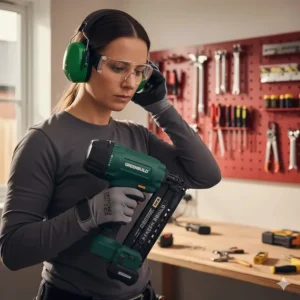
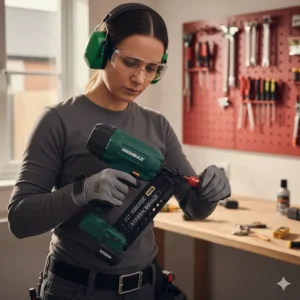
- Safety glasses or goggles: Non-negotiable. Standard prescription glasses don’t provide adequate protection.
- Ear defenders: Particularly important for pneumatic nail guns and extended use.
- Anti-vibration gloves: Reduce upper limb disorder risks during prolonged operation.
- Steel-toe boots: Protect against dropped tools and deflected fasteners.
Training and Competency
Professional operators should receive formal training covering tool-specific operation, maintenance procedures, and emergency protocols. Many UK training providers offer CPD-accredited nail gun courses satisfying Provision and Use of Work Equipment Regulations (PUWER) 1998 requirements.
For DIY users, thoroughly reading the manufacturer’s manual isn’t just sensible—it’s essential. Understanding your specific model’s safety features, proper operation, and maintenance requirements prevents the majority of incidents.
Nail Gun Buying Guide: Key Factors
Choosing the optimal nail gun involves balancing multiple factors against your specific requirements. This decision framework helps identify the perfect tool for your needs rather than simply buying what looks impressive in the shop.
Project Type Assessment
First Fix/Structural Work:
Framing nailers firing 50-90mm nails tackle timber frame construction, decking, fencing, and heavy-duty applications. Pneumatic power remains king here, though premium cordless options like the Milwaukee M18 or Hikoki NR1890 now match pneumatic performance for site work.
Second Fix/Interior Finishing:
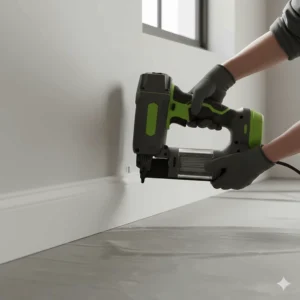
Finishing nailers (15-16 gauge) or brad nailers (18 gauge) suit architrave, skirting boards, panelling, and mouldings. Cordless options excel here—the mobility advantage outweighs any minor power compromise, particularly when working throughout multiple rooms.
Delicate Trim/Cabinet Making:
Pin nailers firing 23-gauge headless pins provide virtually invisible fastening. These specialised tools suit picture framing, cabinet assembly, and holding glued components whilst adhesive cures.
Nail Length and Gauge Requirements
Calculate required nail length using the industry rule of thumb: nail length should equal 2.5-3 times the thickness of material being fastened. Fixing 18mm architrave to timber stud walls? You’ll need 45-54mm nails minimum for adequate penetration and holding power.
Verify your chosen nail gun accommodates your required range. Some models covering 15-50mm won’t drive nails shorter than 20mm—problematic if your project involves 15mm beading alongside 45mm skirting boards.
Power Source and Mobility
Choose Cordless If:
- Working across multiple rooms or properties
- Mains power access limited or inconvenient
- You own compatible batteries from the same ecosystem
- Compressor noise would disturb neighbours
Choose Pneumatic If:
- Operating primarily in workshop environment
- Requiring maximum power for hardwoods/structural work
- Already own suitable compressor
- Budget constraints favour lower tool costs
Choose Electric Corded If:
- Working in fixed workshop location
- Budget conscious but need consistent power
- Don’t require mobility beyond workshop area
- Avoiding battery ecosystem commitments
Magazine Capacity and Design
Larger capacity magazines reduce reloading frequency—crucial for professionals charging by the job rather than hourly. A 100-nail capacity lets you complete typical architrave installation without reloading, maintaining work rhythm.
Angled magazines provide superior visibility and access in confined spaces, though some users find straight magazines easier to reload and judge remaining capacity.
Weight and Ergonomics
Weight significantly impacts user fatigue during extended use. Corded electric nailers typically weigh 1.5-2.0kg, cordless models 2.0-2.5kg, whilst pneumatic tools often weigh less (the compressor carries the burden).
Test the tool’s balance before purchase if possible. A well-balanced 2.5kg tool causes less fatigue than a poorly balanced 2.0kg alternative, particularly during overhead work like crown moulding installation.
Depth Adjustment Capability
Quality nail guns offer tool-free depth adjustment, letting you modify nail penetration without stopping work. This proves invaluable when alternating between materials—sinking nails flush in plywood whilst countersinking in softwood, all without reaching for screwdrivers.
Sequential depth settings (click-stop adjustment) provide more consistent results than continuous dials, particularly for less experienced users.
Maintenance Tips for Longevity
Proper maintenance dramatically extends nail gun lifespan whilst maintaining consistent performance. Unlike many power tools where maintenance involves complex procedures, nail guns require relatively simple routine care.
Daily Maintenance Routine
For Pneumatic Models:
- Apply 3-4 drops of pneumatic tool oil into air inlet before each work session
- Check airline filter for moisture accumulation
- Wipe exterior clean of sawdust and debris
- Inspect nose guard mechanism for damage
For Cordless Models:
- Wipe battery contacts with dry cloth
- Remove dust from magazine and nose area
- Check battery charge level before storage
- Store batteries separately in moderate temperatures
For Electric Corded Models:
- Inspect power cable for damage or fraying
- Clean ventilation slots to prevent motor overheating
- Check plug connections for tightness
- Remove accumulated sawdust from body
Weekly Maintenance (Professional Use)
Drive Channel Cleaning:
Remove magazine and use compressed air to blow out accumulated debris from the drive channel. Sawdust accumulation here causes jamming and inconsistent nail placement.
Magazine Mechanism Check:
Verify magazine spring operates freely without binding. Apply light machine oil to pivot points if movement feels stiff.
Nose Guard Inspection:
Examine nose guard for bending or damage from accidental drops. A bent nose guard may prevent proper safety mechanism engagement, creating serious injury risk.
Monthly Maintenance
Deep Cleaning:
Disassemble magazine following manufacturer’s instructions. Clean all components with denatured alcohol, removing built-up residue and old lubricant. Reassemble with fresh lubrication on pivot points.
O-Ring Inspection (Pneumatic Only):
Check O-rings for dry rot, cracking, or flattening. Replace annually or when visible deterioration occurs. Using incorrect lubricants accelerates O-ring degradation—always use proper pneumatic tool oil.
Battery Health Check (Cordless Only):
Test battery runtime under typical working conditions. Degraded batteries delivering less than 70% of new performance should be replaced before they fail mid-project.
Storage Best Practices
Short-Term (Daily):
- Store in dry location away from moisture
- Engage safety lock if fitted
- Remove nail strips to prevent spring fatigue
- Keep dust cap fitted over nose assembly
Long-Term (Seasonal):
- Apply liberal pneumatic oil and cycle mechanism several times
- Remove battery and store separately at 40-60% charge
- Store in protective case if available
- Document last use date for maintenance scheduling
Troubleshooting Common Issues
Frequent Jamming:
- Verify you’re using correct gauge and length nails
- Check drive channel for debris accumulation
- Inspect for bent nails in magazine
- Consider switching to manufacturer’s branded fasteners
Nails Not Driving Flush:
- Increase air pressure (pneumatic) in 5 PSI increments
- Check battery charge level (cordless)
- Adjust depth setting deeper
- Verify you’re not using nails too long for material thickness
Inconsistent Firing:
- Clean and lubricate drive mechanism
- Check air hose for leaks (pneumatic)
- Inspect trigger mechanism for damage
- Replace worn O-rings (pneumatic)
Choosing Between Brands: Stanley, Tacwise, Makita, DeWalt
Brand selection extends beyond superficial preferences—different manufacturers excel in specific areas, with distinct philosophies shaping their product lineups.
Stanley: Budget-Friendly Reliability
Stanley targets the mass-market DIY segment with affordable, straightforward tools emphasising value over advanced features. Their nail guns suit occasional home improvers tackling weekend projects rather than daily professional use.
Strengths: Competitive pricing, widespread availability, decent warranty support
Limitations: Lower build quality than premium brands, fewer advanced features
Best For: DIY enthusiasts, light domestic use, budget-conscious buyers
Tacwise: The UK Professional’s Choice
Tacwise occupies a unique position as a British brand understanding UK market requirements. Their extensive range covers everything from budget electric models through to professional-grade cordless tools, with customer service consistently praised by UK tradespeople.
Strengths: Excellent value for money, comprehensive range, responsive UK customer support
Limitations: Less brand cachet than premium manufacturers
Best For: UK professionals, serious DIYers, anyone valuing responsive local support
Makita: Premium Japanese Engineering
Makita’s reputation for reliability and longevity justifies premium pricing. Their brushless cordless technology leads the industry, whilst the LXT battery ecosystem offers professionals unmatched versatility across their entire tool range.
Strengths: Exceptional build quality, industry-leading battery technology, extensive professional lineup
Limitations: Significantly higher purchase cost
Best For: Professional tradespeople, those already invested in Makita LXT ecosystem
DeWalt: The Professional Standard
DeWalt dominates professional construction site use, with their distinctive yellow tools representing industry standards. Their XR brushless range combines cutting-edge technology with practical design informed by extensive professional feedback.
Strengths: Unmatched professional features, excellent battery runtime, comprehensive ecosystem
Limitations: Premium pricing, some features wasted on DIY applications
Best For: Professional contractors, those requiring maximum performance and reliability
Maximising Value: When to Buy and Where
Timing purchases strategically saves considerable money, particularly on premium brands where discounts of 20-30% appear during key sales periods.
Best Times to Buy
Black Friday (Late November):
Amazon UK’s Black Friday deals typically include substantial discounts on power tools. Professional-grade nail guns from Makita and DeWalt often see £50-100 reductions, whilst mid-range Tacwise models might drop by £20-30.
January Sales:
Retailers clearing winter stock offer excellent deals on cordless tools. Watch for bundle deals including batteries and chargers—these represent better value than body-only purchases.
Spring (March-April):
Tool retailers preparing for the busy DIY season often run promotions. Manufacturers launching new models discount previous generations significantly.
Amazon Prime Day (July):
Whilst traditionally weaker for tools than Black Friday, Prime Day occasionally features impressive deals on specific models. Set price alerts on desired products weeks beforehand.
Where to Buy in the UK
Amazon.co.uk:
Offers competitive pricing, rapid delivery, and generous return policies. Prime members enjoy next-day delivery on most items. Verify seller authenticity—”Sold by Amazon” or official manufacturer stores reduce counterfeit risk.
Screwfix:
Reliable for professional-grade tools with convenient Click & Collect from 600+ UK locations. Trade account holders access additional discounts.
Toolstation:
Competitive pricing on Makita and DeWalt ranges, with extensive Click & Collect network. Loyalty card scheme offers worthwhile discounts for regular buyers.
Specialist Tool Retailers:
Shops like D&M Tools and Power Tool World provide expert advice and often price-match online competitors. Their staff actually understand the products they’re selling—invaluable for first-time buyers navigating specifications.
Bundle Deals vs Body-Only
When to Buy Bundles:
- First purchase in a battery ecosystem
- Don’t own compatible batteries
- Kit includes appropriately sized batteries (minimum 4.0Ah for cordless nailers)
- Bundle price approaches or undercuts separate component costs
When to Buy Body-Only:
- Already own compatible batteries
- Bundle batteries too small for serious use
- Significant price difference favours body-only purchase
- Planning to upgrade to higher-capacity batteries anyway
✨ Don’t Miss These Exclusive Deals!
🔍 Take your woodworking projects to the next level with these carefully selected nail guns. Click on any highlighted item to check current pricing and availability on Amazon.co.uk. These tools will help you create authentic professional results your clients and family will love!
FAQ
❓ What size nail gun do I need for skirting boards?
❓ Can I use any brand of nails in my nail gun?
❓ Do cordless nail guns have enough power for hardwood?
❓ How many nails can I fire per battery charge?
❓ Are nail guns dangerous for DIY users?
Conclusion: Making Your Decision
Selecting the right nail gun fundamentally comes down to honestly assessing your typical projects and working environment rather than chasing impressive specifications that you’ll rarely use. A professional chippy tackling first and second fix work across multiple properties requires different tools than a weekend DIYer installing architrave in their spare bedroom.
For budget-conscious DIYers starting out, the Stanley 0-TRE550 delivers remarkable value at under £50, handling lightweight domestic projects with surprising competence. Its 2-in-1 versatility means you’re not locked into a single fastener type, providing flexibility as your skills and ambitions develop.
Serious DIYers and emerging tradespeople should consider the Tacwise 181ELS Pro or Einhell TE-CN 18 Li. The Tacwise offers excellent value in a corded package, whilst the Einhell provides cordless freedom at a competitive price point. Both deliver professional results without the premium brand price tag.
Established professionals shouldn’t compromise—the Makita DBN601RTJ and DeWalt DCN680D1 represent genuine investments in your trade. Their superior build quality, consistent performance, and comprehensive warranties justify premium pricing through years of reliable daily use. The frustration of cheaper tools failing mid-project quickly erases any initial savings.
Remember that the nail gun itself represents just one element of a complete fastening system. Factor in ongoing costs for appropriate fasteners, maintenance supplies, and potentially batteries or compressor requirements depending on your chosen power source. A £150 cordless nail gun requiring £80 worth of batteries to function properly costs more than a £200 kit including everything needed to work.
Whatever your choice, prioritise safety training and proper PPE. The UK’s Health and Safety Executive provides comprehensive guidance on nail gun safety that every user should review. Your eyes, hands, and overall wellbeing deserve protection regardless of whether you’re a professional or DIY enthusiast.
Recommended for You
- 7 Best Cordless Angle Grinder UK 2026
- 7 Best Angle Grinders UK 2026
- 7 Best Sliding Mitre Saws UK 2026
Disclaimer: This article contains affiliate links. If you purchase products through these links, we may earn a small commission at no additional cost to you. Prices shown are approximate and may vary.
✨ Found this helpful? Share it with your mates! 💬🤗
