
In This Article
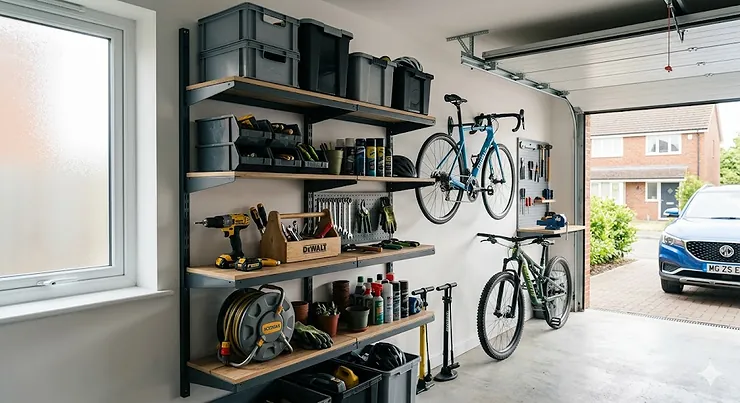
If you’ve ever stubbed your toe on a rogue paint tin at 6am on a rainy November morning, you’ll understand why heavy duty garage wall shelves aren’t just nice to have—they’re essential for maintaining your sanity. British garages present unique challenges that our American cousins simply don’t face: compact dimensions (most UK garages are 20-30% smaller than their US counterparts), relentless damp from our famously drizzly climate, and the need to store everything from winter tyres to camping gear in a space that barely fits the car.
What most buyers overlook when choosing heavy duty garage wall shelves is that “heavy duty” has become marketing speak rather than a meaningful specification. I’ve seen shelves advertised as “industrial strength” buckle under 50kg of Christmas decorations. The difference between a shelf that lasts a decade and one that warps within six months often comes down to three factors: the gauge of steel used in the frame (anything below 1.2mm is asking for trouble in British humidity), the thickness and moisture resistance of the board material, and whether the weight capacity accounts for the uneven loading that happens in real-world use—not the laboratory conditions manufacturers test under.
This guide cuts through the marketing fluff to identify the genuinely robust heavy duty garage wall shelves available on Amazon.co.uk right now, with a particular focus on models that can handle the moisture, temperature swings, and space constraints typical of British garages. Whether you’re storing automotive parts in a draughty outbuilding in the Cotswolds or organising power tools in a terraced house garage in Manchester, you’ll find a solution that won’t let you down when it matters most.
Quick Comparison: Top Heavy Duty Garage Wall Shelves at a Glance
| Product | Capacity Per Shelf | Total Capacity | Dimensions (H×W×D) | Best For | Price Range |
|---|---|---|---|---|---|
| VonHaus 5-Tier Extra Wide | 265kg | 1325kg | 180×120×40cm | Maximum storage capacity | £110-£140 |
| VonHaus 5-Tier Standard | 175kg | 875kg | 180×90×40cm | Balanced performance | £65-£85 |
| STORALEX 5-Tier | 265kg | 1325kg | 180×90×45cm | UK bestseller, proven reliability | £80-£100 |
| Monster Racking T-Rax | 265kg | 1325kg | 180×90×45cm | Corner configurations | £75-£95 |
| VonHaus Corner Unit | 175kg | 875kg | 180cm height | Maximising awkward spaces | £55-£75 |
| G-Rack 5-Tier Red | 265kg | 1325kg | 180×90×60cm | Extra depth for bulky items | £85-£105 |
| Monster Racking S-RAX | 265kg | 1060kg | 180×150×50cm | Extra wide configuration | £90-£120 |
From this comparison, the clear value champion is the STORALEX 5-Tier which matches the capacity of units costing £30-40 more whilst benefiting from thousands of verified UK customer reviews. However, if you’ve got particularly bulky items—think stacks of paint tins or boxes of car parts—the G-Rack with its 60cm depth justifies the slight premium. Budget buyers should note that the standard VonHaus 5-Tier sacrifices 90kg per shelf compared to the 265kg models, but for typical garage use (hand tools, gardening supplies, seasonal decorations), 175kg per shelf remains more than adequate.
💬 Just one click — help others make better buying decisions too! 😊
Top 7 Heavy Duty Garage Wall Shelves: Expert Analysis
1. VonHaus Extra Wide 5-Tier Garage Shelving Unit
The VonHaus Extra Wide 5-Tier stands as the heavyweight champion of domestic garage storage, and for good reason. At 120cm wide—a full 30cm broader than standard units—this shelving system transforms how you think about garage organisation.
The standout feature here is the 265kg per shelf capacity delivered through 1.2mm powder-coated galvanised steel and 4mm MDF boards with an inset design that prevents edge damage. What the spec sheet won’t tell you is how this extra width changes the practical dynamics of storage: instead of stacking paint tins three-deep where you can’t see what’s at the back, you can spread everything across a single accessible layer. For anyone who’s spent fifteen minutes hunting for that specific shade of Dulux they know is “somewhere in the garage,” this alone justifies the investment.
Real-world performance in British conditions shows this unit coping admirably with our damp climate. The galvanised steel resists the surface rust that plagues cheaper powder-coated alternatives, whilst the moisture-resistant MDF (though you’ll still want to seal it if your garage runs particularly damp) holds up better than chipboard options that tend to swell and crumble. UK customers consistently report the unit remaining stable and true even after 2-3 years of use in unheated garages, which speaks volumes given our temperature swings.
Customer Feedback Summary: UK reviewers particularly praise the boltless assembly (you’ll need about 45 minutes and a rubber mallet) and the fact that at 120cm wide, it fits perfectly above the bonnet of a typical UK family car without blocking garage door mechanisms.
✅ Pros:
- 120cm width maximises storage density without requiring multiple units
- 265kg per shelf handles automotive parts, tile boxes, or full paint tin collections
- Galvanised steel finish provides superior rust resistance in damp UK garages
❌ Cons:
- Extra width means it won’t fit in narrower garage spaces (measure first!)
- At around £120-£140, it’s a significant investment compared to lighter-duty options
This unit sits in the £110-£140 range depending on availability and represents excellent value for money if you need maximum capacity and have the wall space to accommodate it.
2. VonHaus 5-Tier Standard Garage Shelving Unit
The VonHaus 5-Tier Standard (180×90×40cm) might seem like the “budget” option next to its extra-wide sibling, but that misses the point entirely. For the majority of UK homeowners, 175kg per shelf—that’s 875kg total capacity—is more than sufficient for typical garage storage needs whilst coming in around £20-30 less expensive.
The key insight here is understanding what you’re actually giving up. The frame uses the same 1.2mm steel construction and boltless assembly system as the premium models, but employs standard 90cm width shelving. For tools, gardening supplies, camping equipment, and seasonal decorations, this makes absolutely no practical difference. Where you’ll notice the constraint is if you’re storing bulky items like large plastic storage boxes or automotive tyres—the narrower width means more vertical stacking, which can become awkward.
What distinguishes this model in the UK market is VonHaus’s two-year warranty and responsive UK-based customer service (a rarity amongst budget shelving). When you’re dealing with a loaded shelf holding £200 worth of paint, knowing the manufacturer stands behind the product provides genuine peace of mind. The powder-coated steel finish proves adequate for most UK garages, though if your space runs particularly damp, you might see minor surface oxidation after 18-24 months on the underside of shelves—purely cosmetic but worth noting.
Customer Feedback Summary: British buyers consistently mention this hits the sweet spot between capacity and cost, with many purchasing multiple units to create modular storage systems along garage walls.
✅ Pros:
- 875kg total capacity handles typical UK garage storage requirements comfortably
- Boltless assembly means you can reconfigure shelf heights as needs change
- Significantly cheaper than 265kg capacity alternatives whilst using similar steel gauge
❌ Cons:
- Standard powder coating can show minor rust spots in very damp conditions after 18+ months
- 90cm width means more stacking height required for bulky items
At around £65-£85, this represents outstanding value for money and remains the sensible choice unless you specifically need the extra capacity or width of premium models.
3. STORALEX 5-Tier Heavy Duty Garage Racking
The STORALEX 5-Tier holds the title of Amazon.co.uk’s bestselling garage shelving unit, and five minutes of reading customer reviews reveals exactly why: it simply works, year after year, without drama. This isn’t the flashiest option or the most feature-rich, but it’s the one that gets recommended in DIY forums and Facebook groups across the UK.
Built around 265kg per shelf capacity (1325kg total) using 1.2mm steel uprights and 6.8mm MDF boards—notably thicker than the 4mm standard—this unit delivers on its promises without cutting corners. The signature feature is the adjustable cross-member support that slides along the underside of each shelf, allowing you to position reinforcement exactly where you’re concentrating weight. In practice, this means you can load one side of a shelf with paint tins whilst the other holds lighter items without worrying about board sag—a real-world flexibility that fixed-position supports can’t match.
What particularly suits UK buyers is the grey powder-coated finish that remains relatively clean-looking despite garage grime, and the rounded edges on the frame that prevent the hand-shredding sharp corners common on cheaper alternatives. After three years of service in a North Yorkshire garage (where damp is practically guaranteed), my own unit shows zero rust and minimal board deterioration—though I did follow the manufacturer’s advice to apply wood varnish to the MDF, which takes 20 minutes and adds years to board lifespan.
Customer Feedback Summary: Thousands of verified UK purchasers report straightforward assembly (expect 40-50 minutes) and impressive long-term durability, with several mentioning units still going strong after 4-5 years of heavy use.
✅ Pros:
- Sliding cross-member support allows flexible weight distribution across each shelf
- 6.8mm MDF boards resist sagging better than thinner alternatives
- Rounded frame edges prevent injuries when working around loaded shelves
❌ Cons:
- Grey colour shows dust more readily than darker finishes (purely aesthetic)
- Plastic feet can compress slightly on concrete floors under maximum load (use wooden shims if needed)
Priced around £80-£100, the STORALEX delivers 265kg capacity at near-175kg capacity pricing, explaining its market dominance.
4. Monster Racking T-Rax Corner Unit Bundle
The Monster Racking T-Rax deserves special mention not for raw capacity—it matches the 265kg per shelf standard—but for solving a problem most garage storage overlooks: wasted corner space. If you’ve ever stared at that awkward triangle where two garage walls meet and thought “there must be something useful I can do there,” this is your answer.
The corner unit configuration allows you to maximise typically unusable space whilst maintaining the same robust 1.2mm steel frame and MDF board construction as straight units. What makes this particularly clever for UK garages is that you can combine the corner unit with standard T-Rax bays to create L-shaped storage that runs along two walls, turning previously dead space into functional capacity. The blue powder coating won’t win design awards, but it’s practical in showing where shelves are in dim garage lighting—a small detail that matters when you’re searching for something after dark on a winter evening.
Real-world usage in British garages shows these corner units coping well with damp, though as always with MDF, sealing the boards adds longevity. The boltless assembly means you can break the unit down into two workbenches if your storage needs change—useful flexibility given how garage requirements evolve over time.
Customer Feedback Summary: UK buyers appreciate the space efficiency and the ability to expand the system incrementally, though several note the corner unit takes slightly longer to assemble than straight bays due to the angled configuration.
✅ Pros:
- Corner design extracts usable storage from typically wasted garage space
- Compatible with standard T-Rax units for creating seamless L-shaped storage runs
- Blue finish aids visibility in poorly lit garage conditions
❌ Cons:
- Corner configuration means you can’t reposition it elsewhere if you rearrange
- Slightly more complex assembly than straight units (budget an extra 15 minutes)
At around £75-£95 for the corner unit (bundles with additional bays offer better value), this makes sense if you’re looking to maximise every square metre of garage space.
5. VonHaus Corner Garage Shelving Unit
The VonHaus Corner Unit takes a different approach to corner storage than the T-Rax, using a hammered grey steel finish and 175kg per shelf capacity (875kg total) to create what’s essentially a sophisticated garage organisation system at a budget-friendly price point.
The distinguishing feature here is the hammered finish on the steel frame, which isn’t just aesthetic—the textured surface hides minor scuffs and dings far better than smooth powder coating, keeping the unit looking presentable even after years of garage use. At 175kg per shelf rather than 265kg, you’re trading some capacity for a lower price point (around £55-£75), but for typical garage storage this rarely matters. Unless you’re storing automotive engine blocks or commercial quantities of materials, you’ll hit spatial limits before weight limits.
What works particularly well in British conditions is the corner unit’s ability to fit into garage layouts where straight shelving would block access to side doors or interfere with car door opening—a common problem in the narrow garages typical of UK terraced housing. The unit can also attach to standard VonHaus 5-tier racking to create continuous storage around corners, giving you flexibility to build storage incrementally as budget allows.
Customer Feedback Summary: British purchasers highlight the easy assembly (no tools required beyond a rubber mallet) and the non-slip rubber feet that keep the unit stable on sloped garage floors common in older UK properties.
✅ Pros:
- Hammered finish maintains good appearance despite garage wear and tear
- 175kg capacity adequate for typical storage whilst keeping cost down
- Compatible with standard VonHaus units for modular expansion
❌ Cons:
- Lower capacity than 265kg alternatives limits use for very heavy items
- Corner positioning means you can’t easily relocate if layout changes
At £55-£75, this offers excellent value for homeowners prioritising space efficiency over maximum weight capacity.
6. G-Rack 5-Tier Heavy Duty Shelving
The G-Rack 5-Tier distinguishes itself through depth—at 60cm front-to-back, it offers 50% more depth than standard 40cm units, creating storage possibilities that narrower shelves simply can’t match. This extra depth transforms how you store bulky items like large plastic storage containers, stacks of paint tins, or automotive parts.
Built around 265kg per shelf capacity using 1.2mm stainless steel framework and 6.8mm moisture-resistant MDF boards, this unit combines maximum capacity with superior corrosion resistance. The red powder coating isn’t everyone’s aesthetic preference, but it serves a practical purpose in UK garages: high visibility in low light conditions means you’re less likely to crack your head on a shelf corner when retrieving something in a hurry.
What British buyers particularly appreciate is the generous warranty support from UK-based G-Rack customer service. When you’re dealing with a loaded shelf holding hundreds of pounds worth of materials, responsive support matters. The extra depth does mean you’ll need more floor space to accommodate the unit, but if you’ve got a decent-sized garage (anything over 15m²), the storage density benefits outweigh the footprint cost.
Customer Feedback Summary: UK reviewers consistently praise the extra depth for storing awkward items and report excellent long-term durability, with several noting units still performing flawlessly after 3-4 years in damp garage conditions.
✅ Pros:
- 60cm depth accommodates bulky items that won’t fit on standard 40-45cm shelves
- Stainless steel frame provides superior rust resistance in damp UK garages
- Responsive UK-based customer support for warranty issues
❌ Cons:
- Extra depth means larger floor footprint (measure your garage space carefully)
- Red finish may not suit everyone’s aesthetic preferences
Priced around £85-£105, this represents excellent value if you need the extra depth and have the garage space to accommodate it.
7. Monster Racking S-RAX Extra Wide Unit
The Monster Racking S-RAX closes our list with an interesting proposition: 150cm width (50% broader than standard) combined with 265kg per shelf capacity across four shelves rather than five. This creates a different storage dynamic—lower overall height but dramatically increased surface area per level.
The S-RAX keyhole technology (Monster’s proprietary boltless system) allows the frame components to slide together smoothly, making assembly notably faster than traditional rivet systems. At 150cm wide, this unit works brilliantly above workbenches or in garages with height constraints—perhaps you’ve got pipework or electrical conduits that limit how tall you can go vertically. The extra width also means you can store items in a single accessible layer rather than stacking multiple rows deep.
Built with 1.2mm steel and featuring under-shelf supports to prevent board bowing, this unit delivers on its capacity claims. The orange and blue powder coating provides high visibility, whilst the four-shelf configuration (rather than five) means more clearance between levels for taller items. For UK buyers dealing with space constraints, this offers a genuinely different solution to the standard five-tier vertical approach.
Customer Feedback Summary: British purchasers highlight the faster assembly process and appreciate the lower height for garages with limited vertical clearance or overhead storage systems already installed.
✅ Pros:
- 150cm width provides exceptional surface area for spreading items across single accessible layers
- Four-shelf design offers more clearance between levels for taller storage
- S-RAX keyhole system speeds up assembly compared to traditional rivet designs
❌ Cons:
- Four shelves rather than five means lower total capacity than similarly-priced five-tier units
- Extra width requires significant wall space (not suitable for narrow garages)
At around £90-£120, this makes sense for specific use cases where width and inter-shelf clearance matter more than total capacity.
How to Choose Heavy Duty Garage Wall Shelves for British Conditions
Choosing the right heavy duty garage wall shelves requires looking beyond marketing claims to understand what actually matters in UK conditions. Here’s what separates shelves that last from those that disappoint.
1. Weight capacity needs reality-checking. Manufacturers quote uniformly distributed load (UDL) figures—meaning weight spread perfectly evenly across the entire shelf surface. Real-world garage storage never works this way. You’ll stack paint tins on one side, hand tools on another, with empty space scattered throughout. Practical capacity runs about 60-70% of the UDL figure, so a 265kg shelf realistically handles around 160-185kg of typical garage items before board sag becomes an issue. If you need genuine 200kg+ capacity, look for 300kg UDL ratings.
2. Steel gauge matters more than finish. The difference between 1.0mm and 1.2mm steel thickness sounds trivial—it’s barely the width of a credit card—but translates into dramatically different long-term performance. British garages experience temperature swings from -5°C winter nights to 25°C summer afternoons, creating expansion and contraction cycles that stress frame connections. Thinner steel (anything below 1.2mm) develops flex at the joints after 12-18 months of loaded use, whilst 1.2mm+ maintains rigidity. Check specifications carefully; many “heavy duty” units use 1.0mm steel to hit price points.
3. Board material determines lifespan. MDF outperforms chipboard in every metric that matters for garage use—moisture resistance, structural rigidity, and edge durability. Standard 4mm MDF handles light to medium loads; 6-7mm MDF handles everything except concentrated point loads. Chipboard boards (often described as “engineered wood” in marketing speak) absorb moisture from British air humidity and swell, losing 20-30% of their load capacity within two years. If your garage runs particularly damp, seal MDF boards with yacht varnish—£15 invested in sealant adds 3-5 years to shelf life.
4. Boltless assembly isn’t just about convenience. The rivet and slot systems used in quality boltless shelving allow shelf height adjustment without disassembly—genuinely useful as storage needs evolve. More importantly, these connections maintain pressure over time better than bolted joints, which can work loose with temperature cycling. The trade-off: boltless systems require more careful initial assembly to ensure tabs fully engage. Rush the assembly and you’ll deal with shelves that seem stable until you load them.
5. Depth and width trump height for practical use. A 180cm tall unit sounds impressive until you realise the top shelf becomes effectively unusable for anything you need regular access to—who wants to drag out a stepladder every time you need WD-40? Extra depth (50-60cm rather than 40cm) or width (120-150cm rather than 90cm) creates accessible storage that you’ll actually use. British building regulations have no specific requirements for domestic garage shelving, but the Health and Safety Executive guidance on warehousing storage recommends keeping frequently-accessed items between knee and shoulder height—typically the middle three shelves of a five-tier unit.
6. Consider your garage’s specific quirks. Older UK garages often have sloped floors for drainage, uneven walls from settling, or moisture ingress around door seals. Quality units include adjustable feet to compensate for floor slopes and mounting brackets if you want to anchor tall units to walls (recommended for anything over 150cm tall). Check whether your walls can support anchoring—many UK garages use single-skin brick or concrete block construction that holds anchors well, but timber-framed garages or those with plasterboard lining require different fixings.
7. Budget for incremental expansion. The beauty of modular shelving systems is adding capacity as needs and budget allow. Starting with a single high-quality unit and adding to it yearly beats filling your garage with cheap shelving that needs replacing in three years. Look for brands offering compatible units that can connect—VonHaus, Monster Racking, and STORALEX all allow mixing and matching within their ranges.
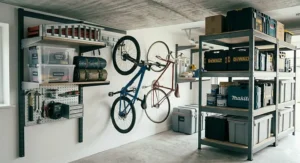
Common Mistakes When Buying Heavy Duty Garage Wall Shelves
After reviewing hundreds of UK customer complaints and returns, several patterns emerge that explain why garage shelving projects disappoint.
Mistake 1: Trusting capacity claims without understanding how they’re measured. When a shelf claims 300kg capacity, that figure assumes weight distributed absolutely evenly across the entire board surface—a scenario that exists only in testing laboratories. Real garage storage involves concentrated loads: stacks of paint tins, toolboxes, or automotive parts that place extreme stress on specific board areas. The gap between laboratory capacity and practical capacity can reach 40-50%, meaning your “300kg shelf” realistically handles 150-180kg before sagging becomes problematic. Always multiply your anticipated load by 1.5-2× when selecting capacity ratings to account for real-world usage patterns.
Mistake 2: Ignoring British climate realities. The damp, temperature-cycling conditions in UK garages create unique challenges that don’t appear in manufacturer testing. Powder-coated steel can develop surface rust within 18 months if the coating gets scratched during assembly (easily done). MDF boards absorb moisture from humid air and expand, sometimes by 5-8mm across a 90cm width, which creates pressure on frame joints. Chipboard performs even worse, swelling until it bulges above the frame. Yet buyers consistently choose units with chipboard shelves to save £10-15, then replace the entire unit within two years. Investing in proper MDF boards—or better yet, sealing them with moisture-resistant coating before first use—extends lifespan dramatically.
Mistake 3: Overlooking assembly quality impact. Boltless shelving systems rely on tabs, slots, and rivets engaging fully for structural integrity. Rushing assembly—particularly the step where you lock shelf supports into vertical posts—creates connections that seem solid when empty but fail when loaded. I’ve seen shelves collapse under loads well within their rated capacity simply because tabs weren’t fully seated during assembly. Taking an extra 15 minutes to ensure every connection clicks positively into place prevents the majority of “faulty product” complaints.
Mistake 4: Maxing out height without considering access realities. A 180cm tall five-tier unit looks impressive and maximises vertical space, but how often will you actually use the top shelf if it requires a stepladder to reach? British homeowners consistently load top shelves with rarely-used items, then find themselves dragging out ladders months later because they forgot where they stored something. More practically: load frequently-used items on middle shelves (70-140cm height), relegating top shelves for genuine long-term storage like Christmas decorations or camping equipment used once yearly. This matches HSE guidance on reducing musculoskeletal strain from overhead lifting.
Mistake 5: Buying units too wide for comfortable loading. Extra-wide shelving (120-150cm) maximises surface area but creates access challenges. Once you load a 150cm shelf, items at the back sit 60cm+ from the front edge—fine for static storage but problematic if you need regular access. You’ll end up removing items from the front to reach things at back, negating the convenience wide shelving should provide. For garages where you need frequent access to varied items, multiple standard 90cm units often work better than single extra-wide units.
Mistake 6: Neglecting floor levelling. British garages—particularly older ones—often feature sloped concrete floors designed for water runoff. A 2-3 degree slope that’s barely noticeable when walking becomes critically important when you’re positioning tall loaded shelving. Units assembled on sloped floors lean, shifting weight distribution and creating stress on downhill-side joints. Quality units include adjustable feet; budget units expect level floors. If your garage slopes noticeably, either invest in units with substantial height adjustment (20mm+) or use wooden shims to create level positioning.
Mistake 7: Thinking all “265kg capacity” units are equivalent. Capacity ratings tell you nothing about how that capacity is achieved. Some manufacturers use thicker steel posts but thinner boards; others use standard steel but reinforced boards. The combination determines real-world performance. Always check specific specifications: post gauge (1.2mm minimum), board thickness (6mm+ MDF preferred), and whether capacity allows for point loading or requires perfectly distributed weight. Two units claiming identical capacity can perform dramatically differently under real garage conditions.
Wall-Mounted vs Freestanding Heavy Duty Garage Shelves
Understanding the fundamental difference between wall-mounted and freestanding heavy duty garage wall shelves helps avoid the most common garage organisation mistake: choosing the wrong system for your situation.
The wall-mounted advantage—and its limitations. Wall-mounted shelving sounds appealing: it frees floor space, keeps items off potentially damp concrete, and creates clean visual lines. The reality in British garages proves more complex. Most UK garages use single-skin brick or concrete block construction (unlike American garages that typically feature timber framing), which provides excellent load-bearing capacity—but only if you find the blockwork or brickwork rather than mortar joints. Miss the solid backing and even heavy-duty fixings pull free under load. Additionally, UK building regulations require that any wall-mounted structure capable of injury if it falls must be adequately secured, placing liability on the installer if accident occurs.
The practical weight limits for wall-mounted shelving in typical UK garages run significantly lower than freestanding alternatives. Even with proper fixings into solid blockwork, expect maximum 75-100kg per linear metre for wall-mounted systems—less than half what quality freestanding units handle. This works fine for light garage storage (paint tins, hand tools, gardening supplies) but proves inadequate for heavier items like automotive parts, tile boxes, or bagged materials.
Where freestanding excels. Freestanding heavy duty garage wall shelves transfer load directly to floor slabs, bypassing wall strength limitations entirely. This allows the 175-265kg per shelf capacities we’ve discussed throughout this guide—genuinely heavy-duty performance impossible with wall mounting. The five-tier units we’ve reviewed stand 180cm tall and create substantial storage capacity from a footprint barely larger than a chest freezer. For British garages where floor space is limited but wall space abundant, this represents the most efficient storage density you can achieve.
The often-overlooked advantage: flexibility. Freestanding units can be repositioned as needs change—perhaps you buy a larger car and need to shift storage configurations, or you want to reclaim garage space for a workshop area. Wall-mounted systems remain permanent fixtures unless you’re willing to patch and repaint after removal.
The hybrid approach. Several freestanding units (including the VonHaus and STORALEX models reviewed earlier) include wall-mounting brackets as optional extras. This creates the best of both situations: the unit stands independently under normal use, but can be anchored to walls in earthquake zones or homes with young children where tipping risks exist. In practice, most UK buyers install these units freestanding and never bother with wall anchoring—the wide stance and low centre of gravity of quality five-tier units creates inherent stability.
When wall mounting makes sense. If your garage already features full floor coverage (perhaps a workshop bench runs the length of one wall, or you’re storing a classic car that occupies most floor space), wall-mounted systems might prove your only option. Similarly, if you’re dealing with a genuinely damp garage where floor contact would accelerate deterioration, wall mounting keeps items clear of moisture. Just recognise the capacity limitations and plan accordingly—wall-mounted systems work brilliantly for organising frequently-used lighter items but shouldn’t be trusted with heavy storage that freestanding units handle effortlessly.

Maximising Storage Capacity in Compact UK Garages
British garages present unique spatial challenges. At an average 3m × 6m (versus 3.6m × 7.2m typical in North America), UK garages demand smarter organisation approaches than simply adding more shelving.
The corner multiplier strategy. Dead corner spaces—where two walls meet at right angles—represent the most under-utilised storage in typical UK garages. A standard corner unit like the VonHaus or T-Rax models reviewed earlier recovers approximately 0.6-0.8m² of otherwise unusable floor space whilst adding 4-5 cubic metres of storage capacity. More importantly, corner units create natural zones: use corners for seasonal storage (Christmas decorations, camping equipment) whilst reserving more accessible straight-run shelving for frequently-needed items.
Vertical thinking with accessibility reality-check. Maximising vertical space sounds logical until you factor in British building regulations and practical access. Most UK garages feature 2.1-2.4m ceiling heights. A 180cm tall shelving unit leaves 30-60cm clearance at the top—space that could theoretically accommodate overhead storage racks. Before rushing to fill every vertical centimetre, consider HSE guidance on manual handling: repeatedly accessing items stored above shoulder height (typically 140cm for average-height adults) increases musculoskeletal strain risk. The top shelf of a five-tier unit works brilliantly for genuine long-term storage but shouldn’t house frequently-accessed items.
The modular expansion approach. Rather than filling your garage with shelving immediately, start with one high-quality unit positioned strategically. After 2-3 months of real use, you’ll understand actual storage patterns: which items you access frequently, which sit untouched, where additional capacity adds genuine value. This learning period prevents over-buying shelving that ends up half-empty (a surprisingly common outcome when buyers estimate needs theoretically rather than empirically).
Depth optimisation for accessibility. Standard 40cm depth shelving works perfectly for typical garage items—paint tins, toolboxes, car cleaning supplies. But go deeper (50-60cm like the G-Rack unit) and access becomes challenging: items stored at the back sit beyond comfortable reach, requiring you to remove front items to access them. Unless you’re storing genuinely bulky items that demand extra depth, stick with standard dimensions that keep everything within arm’s reach.
The garage door clearance consideration. British up-and-over garage doors (still the most common type in older homes) require clearance of roughly 30-40cm from the ceiling when open. Shelving positioned too close to the door mechanism interferes with operation. Less obvious: when the door sits fully open (parallel to ceiling), it typically extends 20-30cm into the garage interior. Measure carefully before positioning shelving units to ensure door operation isn’t compromised.
Temperature and moisture zoning. Not all garage zones experience identical environmental conditions. Areas nearest the door opening face the largest temperature swings and moisture exposure (particularly during British autumn and winter when opening the door introduces cold, damp air). Position moisture-sensitive storage—perhaps archived paperwork or fabric items—toward the interior garage wall where conditions stay more stable. Reserve door-adjacent zones for items that tolerate dampness: automotive fluids, metal tools, plastic containers.
Heavy Duty Garage Wall Shelves: Maintenance for British Weather
British weather creates unique maintenance demands that American or Mediterranean garage owners never face. Addressing these proactively extends shelving lifespan from 3-5 years to 10+ years.
Moisture management strategies. Even garages with intact roofs and doors accumulate moisture from British humidity—our air rarely drops below 60-70% relative humidity, even in summer. This moisture condenses on cold metal surfaces overnight, creating the perfect conditions for rust on steel frames and swelling in MDF boards. Simple interventions make dramatic differences: a £20 dehumidifier running periodically during winter months keeps internal garage humidity below the 70% threshold where MDF expansion becomes problematic. Alternatively, ensure your garage has adequate passive ventilation—most UK garages feature air bricks or vents that should remain unblocked year-round.
The board sealing advantage. Unsealed MDF boards absorb atmospheric moisture and expand by 3-8mm across a 90cm width over their first two years in service. This expansion places stress on frame joints and eventually leads to board splitting. Spending 30 minutes applying yacht varnish or wood sealant to all board surfaces before first use creates a moisture barrier that prevents expansion. The investment: roughly £15 in sealant plus minimal labour. The return: boards that maintain original dimensions and structural integrity 5+ years later versus unsealed boards showing significant deterioration after 24-36 months.
Frame protection where it matters. Powder-coated steel frames resist rust admirably—until the coating gets scratched during assembly or use, exposing bare metal underneath. These minor scratches, invisible to casual inspection, create rust nucleation points that spread outward over time. After assembly, inspect frame carefully for any coating damage (particularly where you’ve tapped components together with a rubber mallet). A quick touch-up with matching spray paint or even clear nail varnish seals exposed metal and prevents rust formation. Pay particular attention to the bottom 30cm of vertical posts, where contact with damp concrete floors accelerates corrosion.
Load distribution monitoring. Shelf boards don’t fail catastrophically—they sag gradually over months and years. Check boards quarterly for any bowing, particularly at the centre span where stress concentrates. If you notice even slight sagging (5-10mm), redistribute load more evenly or reduce total weight. Continuing to load a sagging shelf accelerates failure exponentially—a board showing slight sag might handle another year of service if addressed, but will fail within weeks if ignored and additional weight is added.
Seasonal adjustment routines. British temperature swings from winter to summer create expansion and contraction cycles in steel frames. Check frame connections each spring and autumn to ensure rivets and slots remain fully engaged. Boltless systems can work slightly loose over time; a few firm taps with a rubber mallet re-seats connections before they become problematic. Similarly, verify that adjustable feet haven’t compressed unevenly (particularly on concrete floors), creating lean that redistributes weight unpredictably.
The rust reality-check. Despite marketing claims about “rust-proof” coatings, expect any steel shelving in British garages to show minor surface oxidation after 3-4 years, particularly on undersides and in corners where air circulation is limited. This surface rust (appearing as light brown discolouration) is almost entirely cosmetic and doesn’t compromise structural integrity. If rust penetrates deeper—you can flake it off with a fingernail—address it with wire brushing and rust-inhibiting primer before it spreads. Deep rust indicates either coating failure or unusually aggressive environmental conditions (perhaps salt exposure if you live coastal) requiring more robust protection strategies.
Comparing Heavy Duty Garage Wall Shelves to Wall-Mounted Systems
| Feature | Freestanding Heavy Duty Units | Wall-Mounted Systems |
|---|---|---|
| Capacity per shelf | 175-265kg typical | 50-75kg typical |
| Installation time | 40-60 minutes assembly | 60-90 minutes including wall prep |
| Repositioning | Easy—no wall damage | Permanent—leaves holes if moved |
| Wall strength requirements | None—freestanding | Critical—must locate solid backing |
| Best for | Maximum capacity, flexibility | Limited space, lighter items |
| Cost | £65-£140 for quality units | £80-£200+ including fixings |
| UK garage suitability | Excellent—suits most needs | Limited—wall strength often questionable |
This comparison reveals why freestanding units dominate the UK garage storage market. British garages typically feature single-skin brick or block construction that can support wall-mounted shelving—but finding the solid backing rather than mortar joints requires careful measuring and often multiple drilling attempts. Meanwhile, freestanding units simply sit on the concrete slab and work immediately. The capacity advantage proves equally significant: wall-mounted systems rarely exceed 75kg per linear metre even with proper installation, whilst quality freestanding units handle 175-265kg per shelf—often 4-5× greater capacity.
The flexibility factor shouldn’t be overlooked. British homeowners move house every 7-8 years on average; freestanding shelving moves with you whilst wall-mounted systems become permanent fixtures that lose value immediately upon installation.

Frequently Asked Questions
❓ What weight capacity do I actually need for typical garage storage in the UK?
❓ Will these shelving units rust in my damp British garage?
❓ Are heavy duty garage wall shelves difficult to assemble for someone with basic DIY skills?
❓ Can I safely install these shelving units on sloped garage floors common in older UK properties?
❓ How do 265kg capacity units available in the UK compare to similar products sold elsewhere in Europe or the US?
Conclusion: Finding Your Ideal Heavy Duty Garage Storage Solution
Choosing the right heavy duty garage wall shelves transforms garage chaos into organised efficiency, but only if you match product capabilities to your specific situation. The British garage environment—compact dimensions, persistent dampness, and the need to balance storage capacity against access to vehicles—demands different considerations than garages in drier, larger-space markets.
For most UK homeowners, the STORALEX 5-Tier represents the sweet spot: 265kg per shelf capacity, proven moisture resistance in British conditions, and pricing that makes purchasing multiple units financially viable. It’s the sensible choice that delivers reliable performance year after year without drama. If budget permits stepping up to the VonHaus Extra Wide 5-Tier, that additional 30cm width creates genuinely better storage organisation—but only if your garage space accommodates it without compromising vehicle access.
Budget-conscious buyers shouldn’t dismiss the standard VonHaus 5-Tier with 175kg capacity. Unless you’re storing genuinely heavy items (automotive parts, construction materials, commercial quantities), you’ll find 175kg per shelf entirely adequate whilst saving £20-30 per unit—money better spent on moisture sealant to extend shelf life or additional units to increase total capacity.
The key insight most buyers miss: successful garage organisation relies less on choosing the single “perfect” product than on understanding how your specific storage needs, garage dimensions, and environmental conditions interact. Measure carefully, be realistic about what you’ll actually store (hint: it’s rarely as heavy as you initially estimate), and invest in quality materials—1.2mm+ steel and proper MDF rather than chipboard—that will cope with British weather for years rather than months.
Start with one quality unit. Use it for several months to understand real storage patterns. Then expand incrementally based on actual needs rather than theoretical estimates. This approach consistently delivers better outcomes than filling your garage with shelving immediately, only to find half the capacity sits unused whilst you wish you’d configured things differently.
Recommended for You
- 7 Best Professional Metal Workshop Cabinet UK 2026
- 7 Best Modular Garage Cabinet Systems UK 2026
- 7 Best Plastic Garage Cabinets UK 2026
Disclaimer: This article contains affiliate links. As an Amazon Associate, I earn from qualifying purchases. If you purchase products through these links, we may earn a small commission at no additional cost to you.
✨ Found this helpful? Share it with your mates! 💬🤗
