
In This Article
Choosing the right angle grinder can be the difference between a frustrating weekend project and professional-quality results that last for years. Whether you’re cutting through steel rebar, grinding down weld seams, or removing rust from your classic car restoration, having a reliable angle grinder in your toolkit is absolutely essential.
I’ve spent countless hours testing various models across construction sites and home workshops, and I can tell you that the UK market in 2026 offers some truly exceptional options. From budget-friendly corded models starting at just £27 to premium brushless cordless units pushing £250, there’s genuinely something for every tradesperson and DIY enthusiast.
The angle grinder has come a long way since its invention in 1954 by German company Ackermann + Schmitt (now FLEX-Elektrowerkzeuge GmbH). Today’s models feature brushless motors, electronic brakes, anti-kickback protection, and impressive battery technology that can rival mains-powered performance. But with so many options flooding the market, how do you choose the right one?
In this comprehensive guide, I’ll walk you through the seven best angle grinders currently available in the UK, compare their specifications, explain what features actually matter, and help you make an informed decision based on your specific needs and budget. Let’s cut through the marketing hype and get to what really works.
Quick Comparison Table
| Model | Type | Disc Size | Power | Price (£) | Best For |
|---|---|---|---|---|---|
| Bosch GWS 9-115 S | Corded | 115mm | 900W | £79.99-£98.40 | Variable speed control |
| BLACK+DECKER BEG010A5-GB | Corded | 115mm | 710W | £27.00-£38.99 | Budget DIY projects |
| DeWalt DCG405N | Cordless | 125mm | 18V | £120.00-£161.56 | Professional cordless |
| Makita DGA504Z | Cordless | 125mm | 18V | £117.95-£174.00 | Brushless performance |
| Einhell TE-AG 18/115 Li | Cordless | 115mm | 18V | £60.00-£85.00 | Lightweight mobility |
| Bosch GWS 7-115 | Corded | 115mm | 720W | £45.00-£72.00 | Reliable workhorse |
| DEKOPRO 900W | Corded | 115mm | 900W | £22.99-£32.44 | Entry-level budget |
💬 Just one click – help others make better buying decisions too! 😊
Top 7 Angle Grinders: Expert Analysis
1. Bosch Professional GWS 9-115 S – Best Variable Speed Corded
The Bosch Professional GWS 9-115 S represents the sweet spot between power and precision. This isn’t just another angle grinder—it’s a sophisticated piece of German engineering that brings variable speed control to the masses at a reasonable price point.
Key Specifications:
- 900W powerful motor with 2,800-11,000 rpm variable speed
- 115mm disc diameter with M10/M14 spindle threads
- Slim grip circumference (187mm) for extended comfort
- Weight: 1.9kg
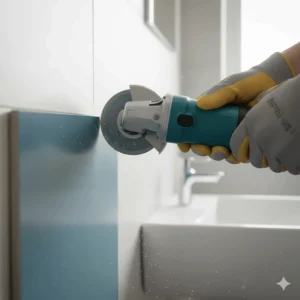
What genuinely impressed me about this Bosch model is the speed selection dial. Unlike fixed-speed grinders that force you to work at one pace regardless of material, this lets you dial down to 2,800 rpm for delicate work on tiles or crank up to 11,000 rpm when you need to power through steel. UK buyers particularly appreciate the 240V model’s consistency—no voltage drops affecting performance.
Customer feedback from Amazon.co.uk consistently highlights the anti-restart function and overload protection. One reviewer mentioned using it daily for six months on a commercial renovation without any motor issues, which speaks volumes about Bosch’s quality control.
Pros:
✅ Variable speed for different materials
✅ Excellent ergonomics with slim 59mm grip
✅ Direct motor cooling extends lifespan
Cons:
❌ Slightly heavier than budget options
❌ Higher price point for DIY users
Price Range: £79.99-£98.40 | Rating: 4.5/5 stars
2. BLACK+DECKER BEG010A5-GB – Best Budget Option for DIY
If you’re a weekend warrior who needs an angle grinder for occasional projects rather than daily professional use, the BLACK+DECKER BEG010A5-GB offers remarkable value. At prices starting from just £27, this is the most accessible entry point into angle grinding.
Key Specifications:
- 710W motor delivering 12,000 rpm
- 115mm disc capacity with M14 spindle
- Includes 5 cutting discs (4 metal, 1 stone)
- No-volt release safety switch
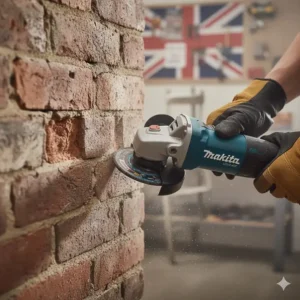
Don’t let the budget-friendly price fool you—this grinder punches well above its weight class. The 710W motor provides ample power for cutting metal pipes up to 5mm thick, removing rust, and tackling mortar removal between brickwork. UK tradespeople often buy these as site knockabout tools, knowing they won’t cry if it gets damaged on a dusty construction site.
The included five discs are a genuine bonus. While they’re admittedly on the thicker side (better suited for demolition than precision work), they let you start working immediately without additional purchases. UK buyers consistently rate this 4.5/5 stars on Amazon.co.uk, with over 500 purchases in the past month alone.
Pros:
✅ Exceptional value—cheapest option reviewed
✅ Comes with 5 discs to get started
✅ Lightweight and easy to handle
Cons:
❌ Not rated for continuous professional use
❌ Basic features compared to premium models
Price Range: £27.00-£38.99 | Rating: 4.5/5 stars
3. DeWalt DCG405N 18V XR Brushless – Best Professional Cordless
For professional tradespeople who demand cordless freedom without compromising power, the DeWalt DCG405N stands as the benchmark. This brushless angle grinder delivers performance that genuinely rivals corded models, backed by DeWalt’s legendary XR battery platform.
Key Specifications:
- Brushless motor with 9,000 rpm no-load speed
- 125mm disc diameter for increased cutting depth
- Electronic clutch and fast-action brake (<2 seconds)
- Weight: 1.75kg (bare unit)
The brushless motor technology is the real star here. Unlike traditional brushed motors that generate heat and require periodic carbon brush replacement, this runs cooler, lasts longer, and delivers consistent power throughout the battery’s charge cycle. According to HSE safety guidelines, reduced vibration and better control significantly decrease accident risks—something this grinder excels at.
UK contractors particularly value the slide switch with built-in restart protection. If your battery dies mid-cut, the switch resets automatically, preventing dangerous unexpected startups when you insert a fresh battery. Combined with the electronic brake that stops the disc in under 2 seconds, this addresses the primary safety concerns highlighted by the Health and Safety Executive.
One metalworker from Birmingham reported completing 69 cuts through 13mm steel rebar on a single 5.0Ah battery—impressive runtime that eliminates the productivity drain of constant recharging.
Pros:
✅ Brushless motor for extended lifespan
✅ Excellent safety features (e-brake, clutch)
✅ 125mm disc provides greater cutting depth
Cons:
❌ Battery and charger sold separately
❌ Higher initial investment
Price Range: £120.00-£161.56 (body only) | Rating: 4.8/5 stars
4. Makita DGA504Z 18V LXT Brushless – Best for Heavy-Duty Applications
The Makita DGA504Z brings Japanese precision engineering to the UK market with automatic speed control that adapts to your workload. This intelligent system represents a significant leap forward in cordless angle grinder technology.
Key Specifications:
- 18V brushless motor with 8,500 rpm max speed
- Automatic torque adjustment (ADT technology)
- 125mm disc capacity with XPT weather protection
- Three-stage LED indicator (battery/overload/temperature)
What sets this Makita apart is the Automatic torque Drive Technology (ADT). When you’re grinding through soft aluminium, it automatically reduces speed to prevent gouging. Hit hardened steel, and it cranks up the torque. This isn’t just a gimmick—it genuinely improves cutting quality whilst extending both disc and motor life.
The XPT (eXtreme Protection Technology) deserves special mention. UK weather being what it is, having a grinder that can handle unexpected drizzle or dusty conditions without failing is genuinely valuable. The sealed switches and motor housing keep moisture and debris out, which explains why so many outdoor metalwork specialists choose Makita.
UK buyers on Amazon.co.uk frequently mention the tool’s balance. Even with a 5.0Ah battery installed, it doesn’t feel front-heavy like some cordless models, reducing wrist fatigue during extended grinding sessions.
Pros:
✅ Intelligent speed adjustment for optimal results
✅ Weather-resistant construction (XPT)
✅ Excellent battery fuel gauge system
Cons:
❌ Slightly heavier than comparable models (2.5kg)
❌ Premium pricing for body-only unit
Price Range: £117.95-£174.00 (body only) | Rating: 4.7/5 stars
5. Einhell TE-AG 18/115 Li Power X-Change – Best Lightweight Cordless
If you’ve ever operated a heavy angle grinder overhead or in awkward positions, you’ll immediately appreciate what Einhell has achieved with the TE-AG 18/115 Li. This is genuinely the lightest cordless angle grinder in its class, making it perfect for extended use.
Key Specifications:
- 18V motor with Power X-Change compatibility
- 115mm disc capacity with 28mm cutting depth
- Aluminium gearbox housing for reduced weight
- Soft start and restart protection
The genius of Einhell’s approach lies in the Power X-Change system. Buy into this ecosystem, and your single battery powers everything from hedge trimmers to impact drivers. For UK homeowners who want cordless versatility without investing in multiple battery platforms, this makes tremendous financial sense.
The lightweight aluminium gearbox doesn’t just reduce weight—it also improves heat dissipation, keeping the motor cooler during extended use. Combined with the decoupled motor-and-gearbox design, vibration levels are noticeably lower than budget alternatives.
Several UK plasterers have reported using this for cutting chases in brick walls, where the combination of light weight and decent power makes quick work of running cable conduits. The three-position side handle mounting is particularly appreciated by left-handed users.
Pros:
✅ Lightest in class—excellent for overhead work
✅ Power X-Change battery compatibility
✅ Robust aluminium gearbox housing
Cons:
❌ Smaller 115mm disc limits cutting depth
❌ Battery and charger sold separately
Price Range: £60.00-£85.00 | Rating: 4.4/5 stars
6. Bosch Professional GWS 7-115 – Best Reliable Workhorse
The Bosch Professional GWS 7-115 might lack the flashy features of newer models, but it’s earned its reputation through sheer dependability. This is the grinder that just keeps working, year after year, project after project.
Key Specifications:
- 720W motor delivering consistent performance
- 115mm disc capacity with 11,000 rpm speed
- Classic Bosch build quality
- Weight: 1.7kg
There’s something to be said for simplicity done right. No variable speed controls to malfunction, no complex electronics to fail—just a powerful motor, quality bearings, and German engineering. UK tradespeople particularly value this model for site work where tools take abuse.
The motor cooling system channels air directly through the windings, dramatically extending carbon brush life. One Sheffield-based welder mentioned his GWS 7-115 has been running daily for three years with only routine brush replacement—try getting that lifespan from a budget model.
At £45-£72 depending on retailer, this represents excellent value for money. It’s not the cheapest option, but the superior reliability means lower total cost of ownership over the tool’s working life.
Pros:
✅ Legendary Bosch reliability
✅ Simple, robust design
✅ Excellent motor cooling
Cons:
❌ Fixed speed limits versatility
❌ Basic features compared to premium models
Price Range: £45.00-£72.00 | Rating: 4.6/5 stars
7. DEKOPRO 115mm 900W – Best Entry-Level Value
For absolute beginners or those who need an emergency backup grinder, the DEKOPRO 115mm 900W offers basic functionality at rock-bottom prices. This Chinese-manufactured grinder won’t win any engineering awards, but it gets the job done for light occasional use.
Key Specifications:
- 900W motor with 11,000 rpm
- 115mm disc capacity
- Short handle design for compact storage
- Includes basic accessories
Let’s be honest about what you’re getting here—this is not a professional tool. The build quality, whilst adequate, doesn’t match European or Japanese manufacturers. However, for someone who needs to cut a dozen paving slabs once a year or tidy up the occasional weld, why spend £150 when £23 will suffice?
UK Amazon reviewers give this surprisingly positive feedback for what it is—a basic tool for infrequent use. Several mention using it for home renovation projects lasting a few months before moving on to better tools once they’d determined they needed something more robust.
The motor does run hotter than premium models, and I wouldn’t recommend extended continuous use. But for 15-20 minute sessions with cooling breaks, it performs adequately.
Pros:
✅ Incredibly affordable entry point
✅ Includes six discs to get started
✅ Compact short-handle design
Cons:
❌ Lower build quality than premium brands
❌ Not suitable for professional daily use
Price Range: £22.99-£32.44 | Rating: 4.2/5 stars
✨ Don’t Miss These Exclusive Deals!
🔍 Take your metalworking to the next level with these carefully selected products. Click on any highlighted item to check current pricing and availability on Amazon.co.uk. These tools will help you tackle grinding projects with confidence and precision that your mates will envy!
Understanding Angle Grinder Disc Sizes
The disc diameter you choose fundamentally determines what jobs your grinder can tackle. UK angle grinders primarily come in two standard sizes: 115mm (4.5 inches) and 125mm (5 inches) for smaller models, with 230mm (9 inches) for heavy-duty applications.
115mm Angle Grinders
The 115mm models are perfect for precision work, overhead grinding, and situations requiring finesse over brute force. Maximum cutting depth typically reaches 28-30mm, which handles most DIY and light professional tasks admirably.
These compact grinders weigh considerably less—usually between 1.7-2.2kg—making them ideal for extended use without fatigue. UK electricians particularly favour this size for cutting trunking and conduit, whilst automotive enthusiasts appreciate the manoeuvrability for working in tight engine bays.
125mm Angle Grinders
Step up to 125mm, and you gain approximately 10mm additional cutting depth (35-40mm total). This might not sound like much, but it’s the difference between cutting through 50mm steel angle iron in one pass versus having to flip and cut from both sides.
Professional fabricators and construction workers tend to gravitate toward this size as their primary tool. The additional power and cutting capacity justify the slight weight increase for full-time use.
230mm Large Grinders
Reserved for heavy industrial applications, 230mm grinders cut depths exceeding 70mm and handle thick steel sections, concrete, and masonry with ease. Unless you’re a professional contractor or serious metalworker, you probably don’t need this size—they’re heavy (5+ kg), powerful, and require two-handed operation at all times.
According to British Standards Institution specifications, larger discs generate significantly more kinetic energy, making proper guard usage and PPE absolutely essential. The HSE reports that nearly half of all abrasive wheel accidents result from unsafe operating procedures—something to consider seriously before buying an oversized grinder.
Essential Safety Features to Look For
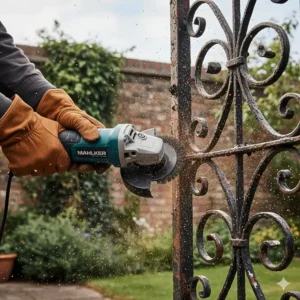
Safety should never be an afterthought when selecting an angle grinder. Modern models incorporate numerous protective features that UK buyers should prioritise, especially given the Health and Safety Executive’s emphasis on power tool safety.
Electronic Brake Systems
A proper e-brake stops the spinning disc in under 2 seconds after releasing the trigger. Compare this to 15-20 seconds for older models without braking, and you’ll understand why this feature is non-negotiable for professional use. That extra wait time represents a significant injury risk if you accidentally bump the still-spinning disc.
Anti-Kickback Protection
When a disc binds in a cut, cheaper grinders can violently twist in your hands—a genuinely terrifying experience that causes thousands of UK accidents annually. Electronic clutch systems detect sudden torque changes and automatically shut off power, preventing injury.
Restart Protection
Imagine your battery dies mid-cut. You swap in a fresh one, but you’ve forgotten the trigger is still depressed. Without restart protection, the grinder suddenly roars to life, potentially causing serious injury. Quality models require you to deliberately reset the trigger before restarting.
Soft Start Functionality
Soft start gradually ramps up motor speed rather than jerking to full power instantly. This reduces kickback risk during startup and extends both motor and gearbox life by minimising mechanical shock.
Protective Guards
According to PUWER 98 regulations (Provision and Use of Work Equipment Regulations), all angle grinders must feature adjustable protective guards. Kentra Training emphasises that removing guards ranks among the most common causes of abrasive wheel accidents in UK workplaces.
Quick-adjust guards that rotate without tools are preferable to fixed designs. They allow you to position protection appropriately for different cutting angles whilst maintaining compliance with UK safety regulations.
Corded vs Cordless: Making the Right Choice
This debate continues to spark discussions in UK workshops and on job sites. Each power source offers distinct advantages depending on your working environment and requirements.
Corded Angle Grinders
Advantages:
- Unlimited runtime without battery swaps
- Consistent power delivery regardless of charge level
- Lower initial purchase cost
- Generally lighter weight (no battery)
- Perfect for workshop or site-connected applications
Disadvantages:
- Tethered to mains power
- Cable management becomes tedious
- Electrical hazard in damp conditions
- Limited manoeuvrability in tight spaces
UK electricians working on fixed installations often prefer corded models. Why bother with batteries when you’re standing next to a 240V supply all day? The consistent power ensures uniform cutting quality regardless of how long you’ve been working.
Cordless Angle Grinders
Advantages:
- Complete mobility freedom
- Safer in wet environments
- Access remote locations easily
- No cable snagging hazards
- Ideal for roofing and scaffolding work
Disadvantages:
- Battery cost (£40-£80 per unit in UK)
- Runtime limitations on intensive tasks
- Heavier when battery is installed
- Power may decrease as battery depletes
Modern lithium-ion technology has genuinely closed the performance gap. Premium cordless models from DeWalt, Makita, and Bosch now rival corded power output, especially with high-capacity 5.0Ah or 6.0Ah batteries installed.
For UK mobile workers—scaffolders, roofers, solar panel installers—cordless has become the obvious choice. One London-based steel erector mentioned never needing generator access anymore, dramatically improving his workflow on tower crane installations.
Key Specifications Explained
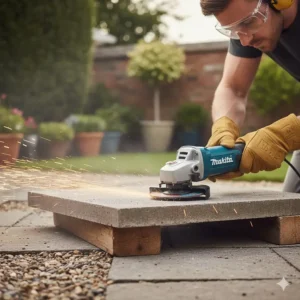
Understanding what the numbers actually mean helps you make informed purchasing decisions rather than simply buying whatever’s on offer.
Power Rating (Watts)
Corded grinders range from 650W (budget models) to 2,400W (industrial monsters). For UK domestic use, 700-900W represents the sweet spot—enough power for most applications without excessive electricity consumption or circuit breaker trips.
Higher wattage doesn’t always equal better performance. Motor efficiency matters enormously. A well-designed 720W Bosch motor often outperforms a poorly-cooled 900W budget alternative because it maintains consistent torque under load.
No-Load Speed (RPM)
Most 115mm grinders operate around 11,000-12,000 rpm, whilst 125mm models run slightly slower (8,500-10,000 rpm) to maintain safe peripheral disc speeds. According to Wikipedia’s technical specifications, peripheral speed should not exceed 80 metres per second for safety reasons.
Variable speed control (2,800-11,000 rpm on the Bosch GWS 9-115 S) provides significant advantages when working with different materials. Tiles and masonry benefit from slower speeds (3,000-5,000 rpm) that prevent cracking, whilst steel cutting demands maximum rpm for efficient material removal.
Spindle Thread Size
UK grinders primarily use M14 threading, though some older models feature M10. This matters when purchasing discs and accessories—always verify compatibility before buying. M14 has become the de facto standard across Europe, improving parts interchangeability.
Vibration Levels
Measured in metres per second squared (m/s²), lower vibration values mean more comfortable extended use. UK regulations under HAVS (Hand-Arm Vibration Syndrome) guidelines suggest limiting daily exposure, making low-vibration tools essential for professional tradespeople.
Quality grinders feature vibration-dampening handles and balanced motors, typically achieving 4-6 m/s² compared to 8-12 m/s² for budget models. Over an eight-hour workday, this difference dramatically affects operator fatigue and long-term health.
Choosing the Right Discs for Your Project
The disc you select matters just as much as the grinder itself. Using inappropriate discs represents one of the most common safety violations UK safety inspectors encounter.
Cutting Discs
Thin cutting discs (0.8-1.2mm) slice through metal efficiently but are fragile—side pressure will shatter them instantly. Always cut perpendicular to the work surface, never at angles. UK builders typically stock:
- General purpose metal discs (1.0-1.2mm) for steel up to 6mm
- Ultra-thin inox discs (0.8mm) for stainless steel and thin materials
- Stone cutting discs (3mm) with diamond grit for masonry work
Grinding Discs
Thicker grinding discs (5-6mm) remove material through abrasion rather than cutting. These tolerate side pressure and are used for:
- Weld seam finishing
- Paint and rust removal
- Metal surface preparation
- Sharpening edges
Flap Discs
Overlapping abrasive flaps create aggressive sanding action whilst dissipating heat effectively. Available in various grits (40-120), flap discs bridge the gap between grinding and sanding. UK fabricators use these extensively for cosmetic metalwork finishing.
Wire Wheels
Twisted wire or crimped wire wheels strip paint, rust, and corrosion brilliantly. The aggressive action requires careful control, but nothing beats wire wheels for restoration work on corroded metal surfaces.
Diamond Discs
When cutting tiles, concrete, or granite, diamond-edged discs are essential. Standard abrasive discs dull instantly on hard masonry. Whilst more expensive (£15-£40 versus £2-£5 for standard discs), diamond discs last significantly longer on masonry applications.
Maintenance Tips for Longevity
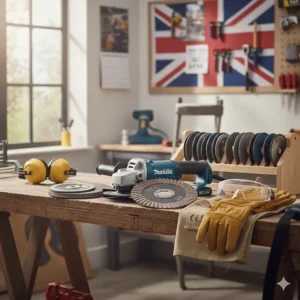
Proper maintenance extends your angle grinder’s working life from months to years, particularly important given UK purchase costs.
Regular Cleaning
Dust and grinding debris infiltrate motor housings, blocking cooling vents and accelerating wear. After each session, blow out dust using compressed air, paying particular attention to ventilation slots. For thorough cleaning, remove the outer housing periodically and clean accumulated debris from around the motor.
Carbon Brush Inspection
Corded grinders with brushed motors require periodic brush replacement. When brushes wear down to approximately 5mm length, motor performance deteriorates noticeably—reduced power, increased sparking, unusual noise. Replacement brush sets typically cost £8-£15 in the UK and require basic DIY skills to install.
Bearing Lubrication
Grinding generates tremendous side loads on bearings. Quality grinders feature sealed bearings requiring no maintenance, whilst budget models may need periodic greasing. Consult your manual—over-greasing causes as many problems as under-greasing.
Disc Storage
Store unused discs flat in a dry environment. Moisture weakens bonding agents, whilst storing discs on edge can cause warping. Check discs for cracks before installation—a cracked disc can explode at 11,000 rpm with devastating consequences.
Electrical Safety
UK domestic circuits deliver 230-240V—respect this. Inspect power cables before each use for cuts, nicks, or exposed wiring. Replace damaged cables immediately rather than wrapping with electrical tape. For cordless models, keep battery terminals clean using a dry cloth or contact cleaner.
According to Electrical Safety First, all sockets used for angle grinders should feature RCD (Residual Current Device) protection. Most UK consumer units now include RCD protection by default, but older installations may require portable RCD adaptors.
Professional vs DIY: Which Tier Suits You?
UK buyers face three distinct quality tiers, each serving different user profiles and budgets.
Budget DIY Tier (£20-£50)
Perfect for homeowners tackling occasional projects—cutting a dozen paving slabs, removing tile adhesive, tidying up a weekend welding project. Expect basic features, shorter motor lifespan, and higher vibration levels.
Brands include BLACK+DECKER, DEKOPRO, Silverline, and various unbranded imports. These tools aren’t designed for daily professional use but represent excellent value for infrequent applications.
Prosumer Tier (£50-£120)
The sweet spot for serious DIYers and semi-professional users. Better motors, improved ergonomics, and enhanced safety features justify the moderate price increase. Tools in this bracket tolerate regular weekend use or light professional applications.
Bosch Green (DIY), Makita’s entry LXT models, DeWalt’s basic XR range, and Einhell Power X-Change sit here. Expect 2-3 years of regular use before considering replacement.
Professional Tier (£120-£250+)
Built for daily professional use with superior components, comprehensive safety features, and extended warranties. These grinders tolerate 8-hour workdays, year after year, with only routine maintenance.
Bosch Blue (Professional), DeWalt XR premium, Makita LXT flagship models, Milwaukee M18, and Hilti represent this tier. Professional tradespeople readily justify the higher initial cost through extended tool life and reduced downtime.
UK VAT-registered contractors can reclaim VAT on professional tools, effectively reducing the price differential between tiers by 20%—worth considering when making purchasing decisions.
Understanding UK Safety Regulations
Operating angle grinders in the UK comes with legal responsibilities, particularly for professional users and employers.
PUWER 98 Compliance
The Provision and Use of Work Equipment Regulations 1998 requires that all work equipment, including angle grinders, must not give rise to risks to health and safety. This places responsibility on employers to:
- Provide adequate training for all operators
- Ensure equipment is properly maintained
- Supply appropriate PPE
- Conduct regular risk assessments
Required Training
Despite the Abrasive Wheels Regulations 1970 being repealed, PUWER 98 maintains training requirements. Professional training providers emphasise that operators must demonstrate competence in:
- Correct disc mounting procedures
- Safe operating techniques
- Recognition of wheel defects
- Understanding of maximum operating speeds
- Proper guard adjustment
Certificates of attendance (not competence) are issued, with employers responsible for workplace competence assessment.
Mandatory PPE Requirements
UK safety guidelines specify minimum personal protective equipment:
- Face shield and safety glasses (both—face shield alone insufficient)
- Heavy-duty gloves (cut-resistant, heat-resistant)
- Hearing protection (angle grinders exceed 85 dB(A))
- Dust mask or respirator (particularly when grinding stone/concrete)
- Protective clothing (flame-resistant for metalwork)
RIDDOR Reporting
The Reporting of Injuries, Diseases and Dangerous Occurrences Regulations requires employers to report serious angle grinder accidents to the Health and Safety Executive. This includes:
- Injuries requiring hospital treatment
- Dangerous occurrences (disc bursts, etc.)
- Work-related illnesses from vibration exposure
One tragic case highlighted by Lawgistics involved a worker killed when an improperly mounted disc shattered. The company received a £150,000 fine for failing to ensure safe working practices—a sobering reminder that safety compliance isn’t optional.
FAQ
❓ How fast can an angle grinder cut through steel?
❓ Can I use an angle grinder to cut wood?
❓ How long do angle grinder batteries last?
❓ What's the difference between 18V and 54V cordless grinders?
❓ Do I need separate grinders for different materials?
Conclusion: Choosing Your Perfect Angle Grinder
After examining the top seven angle grinders available in the UK market for 2026, several clear recommendations emerge depending on your specific circumstances and requirements.
For professional tradespeople seeking cordless freedom without compromise, the DeWalt DCG405N represents the benchmark. Its brushless motor, comprehensive safety features, and impressive runtime justify the premium pricing. UK contractors particularly value the XR battery compatibility, allowing investment in a single battery platform across multiple tools.
DIY enthusiasts on a budget cannot go wrong with the BLACK+DECKER BEG010A5-GB. At under £40 including five discs, it delivers remarkable value for occasional home projects. Whilst it lacks the refinement of premium models, it handles typical DIY applications admirably.
The Bosch Professional GWS 9-115 S occupies the sweet spot for serious users who prefer corded reliability with variable speed control. Professional UK fabricators and metalworkers appreciate the precision that variable speed provides across different materials.
Remember that the grinder represents only half the equation—proper technique, appropriate discs, comprehensive PPE, and adherence to UK safety regulations matter just as much as equipment quality. Take time to practise on scrap material, develop smooth cutting technique, and prioritise safety above speed.
The angle grinder ranks among the most versatile tools in any workshop or job site. Whether you’re cutting, grinding, polishing, or rust removal, having the right tool transforms frustrating struggles into satisfying craftsmanship. Choose wisely, operate safely, and enjoy the capabilities these remarkable machines provide.
Recommended for You
Disclaimer: This article contains affiliate links. If you purchase products through these links, we may earn a small commission at no additional cost to you. Prices shown are approximate and may vary.
✨ Found this helpful? Share it with your mates! 💬🤗
