

In This Article
It’s 7:40 on a wet Tuesday morning. You’re crouched beside a front tyre with a gauge in your hand and a small decision to make. Do you trust the glowing digits or the swinging needle? That quiet standoff is the whole digital vs analogue tyre pressure gauge debate in miniature, and it matters more than most of us admit.
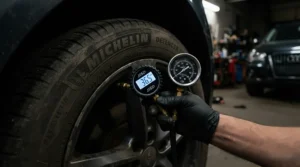
The stakes aren’t trivial. Highways England research found that only one in six drivers remembered to check their tyres before a long journey. It also found that one in five motorway breakdowns trace back to worn or incorrectly inflated tyres. A decent gauge is the cheapest insurance policy in your glovebox. The Highway Code’s advice, echoed by DVSA guidance, is to check weekly and when the tyres are cold.
So which wins? Based on recent UK road tests, manufacturer specs and the patterns in owner reviews, neither is a clean victory. Digital tends to win on reading precision and ease of use after dark. Analogue wins on battery dependency (it has none) and long-haul durability. Below you’ll find seven real gauges across budget, mid-range and premium, plus a plain-English guide to choosing between them. 🔧
Quick Comparison: Digital vs Analogue Tyre Pressure Gauge at a Glance
| Factor | Digital gauge | Analogue gauge |
|---|---|---|
| Accuracy | Often within about 0.5-1psi in UK road tests | Roughly 0.5-2psi depending on the model |
| Reading precision | Numeric readout in 0.1-0.5psi steps | Needle on a scale, 0.5-2psi increments by model |
| Power | Coin-cell battery required | None; fully mechanical |
| Ease of use | Easy to read; backlit models suit the dark | Needs a clear dial; some are fiddly one-handed |
| Best for | Beginners, night checks, keyring convenience: Ring RTG4, Halfords Digital | Rare-use reliability, no flat-battery worries: Draper 69924, Goodyear Portable |
Read the table as tendencies, not laws. A cheap digital gauge can be sloppier than a good dial, and a good dial can match a digital unit. What separates them in daily life is usually the boring stuff. Can you read it in the dark? Will it work after a year in the boot?
The Ring RTG4 shows the digital upside: a backlight, a torch and a decimal readout. The Draper 69924 shows the analogue upside: a big dial and nothing to go flat. If you check pressures rarely, the analogue trade-offs tend to favour you. If you check often, or in poor light, digital starts to earn its keep. Keep that frame in mind as we go through the picks.
💬 Just one click — help others make better buying decisions too!😊
Top 7 Digital vs Analogue Tyre Pressure Gauge Picks: Expert Analysis
A quick transparency note first. The verdicts below are built from published UK road tests, manufacturer specifications and the patterns in retailer reviews, not from personal ownership. Where I couldn’t verify a large pool of owner reviews, I say so rather than invent one.
1. Draper 69924 — the easiest analogue dial to read at a glance
The standout feature is the dial itself. The graphics are large and uncluttered, so the needle reads in about a second, even with cold hands in poor light.
The 5-100psi range is generous for a car, where most tyres sit in the low-to-mid 30s. A wide-range gauge spreads its scale thinner, so small differences are harder to spot than on a 0-60psi dial. The canted, rotating chuck and flexible rubber hose are the practical stars. They help the head seat squarely on awkward alloy-wheel valves, and a good seal is half of an accurate reading.
Based on the spec comparison, this suits the driver who checks every few weeks and wants a gauge that is never flat when needed. What Car? made it a five-star Best Buy and openly preferred analogue for occasional use. What the spec sheet won’t tell you is that you still need to read the needle square-on. Viewing it from an angle can shift the apparent reading.
I couldn’t verify a big pool of owner reviews for this exact model. The clearest independent verdict is What Car?’s, which lists less accuracy than digital, no storage case and a bulkier body as the trade-offs.
Pros:
- ✅ Large, clear dial that is quick to read
- ✅ Rotating chuck and hose seat well on valves
- ✅ No battery to fail or replace
Cons:
- ❌ Less accurate than top digital units
- ❌ Bulky, with no protective case
Prices vary by retailer, so check current price. It sits in the budget-to-mid bracket, which is strong value for a tool with nothing to wear out.
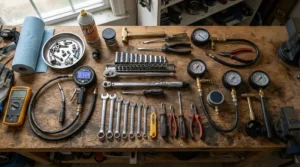
2. Goodyear Portable Tyre Pressure Gauge — pocket-sized analogue with its own case
The hook here is compactness. It comes in a small plastic case that slots straight into a glovebox, which is exactly where gauges get forgotten.
The 0-60psi range looks limiting, but for cars it’s a feature. With the same dial sweep spread across fewer psi, the increments are finer and the needle moves more visibly per pound. The 45-degree connector stuck to test valves without drama, though the short, solid neck is trickier on deep-dish wheels than the Draper 69924.
On the analysis side, this is the “set it and forget it” pick for small-car owners. Autocar named it a best buy at around £15, and What Car? gave it five stars for feel and ease of connection. The honest limit is that 0-60psi won’t cover higher-pressure van, trailer or caravan tyres.
Verified customer-review volume for this model was thin in my research, so I’ll lean on those independent tests rather than imply a consensus. What the testers flagged was the shorter neck and a dial that isn’t the largest.
Pros:
- ✅ Compact, with a protective case
- ✅ Finer needle resolution at car pressures
- ✅ Connector fits valves easily
Cons:
- ❌ Tops out at 60psi
- ❌ Short neck is awkward on recessed valves
Expect to pay around £15 (check current price). It’s good value if your tyres live comfortably under 60psi.
3. Accu-Gage — the battery-free needle that holds its reading
The signature trait is a needle that stays put once you pull the gauge off the valve. You can read it calmly, rather than racing a screen that times out.
The version reviewed by MBR was the 0-30psi model, with a 45mm display and 0.5psi increments. A bleed button lets you trim the pressure on the spot. Other ranges exist, and the 0-60psi option is the more sensible one for cars. Check the valve fitting on the version you buy, because the 0-30psi model reviewed is Presta-only, and car valves are Schrader.
Here’s my read. This is the premium analogue for people who care about reading precision but refuse battery dependency. It’s a favourite in the mountain-biking world, and the logic transfers: low pressures reward fine increments. The catch is bulk, plus sealant clogging if you use it with tubeless bike tyres.
Reviewer sentiment is strongly positive on accuracy, no batteries and the pleasing feel of use. A minority of owner reports describe individual units reading well out against a second gauge. That’s why cross-checking any gauge matters.
Pros:
- ✅ Needle holds the reading after removal
- ✅ Bleed button for fine adjustments
- ✅ Zero battery dependency
Cons:
- ❌ Chunky body takes more pocket space
- ❌ Range and valve type need careful choosing
Around £25-£30 at the time of research (check current price). It’s premium money, but a keeper for fussy checkers.
4. Ring RTG4 — the keyring digital with a built-in torch
Its headline trick is living on your keys, so the gauge is always with you. It also has a backlit screen and an LED torch for finding valves in the dark.
The spec sheet reads 0-99psi in PSI, bar and kPa, powered by two CR1620 coin cells, at roughly 28g and 90mm long. That’s a very wide range in a very small body. In practice the torch and backlight solve the most irritating part of roadside checking, which is not seeing what you’re doing.
The case for it is clear. Auto Express named it a Best Buy in both 2018 and 2024 and described its accuracy as faultless in testing, with the reading staying on screen long enough to note it down. It suits commuters, parents and anyone who just wants quick, regular checks.
Retailer reviews skew positive, averaging roughly four stars at the time of research. The common complaints are needing to press firmly to get a seal, and a protective battery tab to remove before first use. A small minority report poor valve contact or battery-contact faults.
Pros:
- ✅ Award-winning accuracy in UK road tests
- ✅ Backlight and torch for night checks
- ✅ Tiny and keyring-friendly
Cons:
- ❌ Needs a firm press to seal on valves
- ❌ Coin cells add small running costs
Typically in the £7-£15 range, depending on retailer. It’s superb value if you accept the battery.
5. Halfords Digital Tyre Pressure/Tread Gauge — digital pressure plus tread depth
The standout is two jobs in one body. It measures pressure and tread depth, so a single pocket gadget covers two of the Highway Code’s weekly checks.
Specs are 5-99psi, switchable between psi, bar, kPa and kg/cm2, with a stated accuracy of ±1% and a CR2032 battery. How far ±1% helps depends on whether it’s quoted against the reading or the full scale. That’s anywhere from about 0.3psi to 1psi at 32psi, which is still tighter than the ±2psi quoted for Halfords’ basic dial gauge. Expert Reviews picked it as its best digital option.
My analysis says this is the sensible all-rounder for a household. What Car? gave it four stars but flagged a short chuck that is harder to seat on valves, no backlight and a slightly cheap feel. If your valves are deep-set, factor that in.
Customer-review data I could verify was limited, so I’m relying on the two independent tests above rather than implying a mass verdict.
Pros:
- ✅ Pressure and tread depth in one tool
- ✅ Tight stated accuracy of ±1%
- ✅ Easy-to-swap CR2032 battery
Cons:
- ❌ Short chuck is harder to seat
- ❌ No backlight on the screen
Around £12 (check current price). That’s solid value for the combined features.

6. Sealey TSTPG11 — a British-brand digital with tread-depth tool
The hook is a sensible, workshop-flavoured combo: pressure and tread depth from a respected British tool brand.
Auto Express listed it at four stars with a price of around £10. I haven’t verified a full pressure range or accuracy figure from a manufacturer sheet, so check the current spec before buying. The tread-depth function is the real practical extra. The legal minimum is 1.6mm across the central three-quarters of the tyre, and a gauge that measures it saves you guessing.
For analysis, this suits budget-conscious drivers who want a no-fuss digital with a second function. Sealey’s reputation for sturdy garage kit counts for something here. The wider lesson from road tests is that a combined gauge is only as good as its weaker function, so test the pressure reading against a second gauge occasionally.
I couldn’t find a trustworthy volume of customer reviews specific to this model, so there’s no aggregated sentiment to report. I’d rather say that than fabricate one.
Pros:
- ✅ Pressure and tread depth together
- ✅ Respected British tool brand
- ✅ Very low price for a combined gauge
Cons:
- ❌ Needs battery care like any digital
- ❌ Full spec needs checking before purchase
Around the £10-£12 mark (check current price). It’s good value if its pressure range fits your tyres.
7. Topeak Smartgauge D2 — premium digital with a valve-swapping head
Its headline feature is the Smarthead, which switches between Schrader (car and motorbike) and Presta valves at the flick of a switch.
MBR’s testers rate it accurate to 0.5psi, and the readout steps in 0.5psi increments. That’s worth remembering. A digital display doesn’t automatically mean finer resolution. The 68g body is light, though the reviewer found it bulky and easy to switch on by accident in a bag.
My analysis: this is the premium digital for households that mix cars and bikes. It’s built with cyclists in mind, so check the pressure range suits your tyres. MBR called it a go-to product, and that praise rests on accuracy and the valve flexibility.
Verified reviews for car use specifically were thin, so treat it as a cross-over pick rather than a car-first tool.
Pros:
- ✅ Accurate to 0.5psi in testing
- ✅ Switches between Schrader and Presta
- ✅ Lightweight with a clear display
Cons:
- ❌ Bulky and easy to switch on by accident
- ❌ Dearer than most car-first digital gauges
Around £30 at the time of research (check current price). That’s premium money, justified only if you need the dual-valve versatility.
Top 7 Compared Side by Side
| Gauge | Type | Range | Power | Price range | Independent verdict | Best For |
|---|---|---|---|---|---|---|
| Draper 69924 | Analogue | 5-100psi | None | Check current price | 5/5 (What Car?) | Easy dial legibility |
| Goodyear Portable | Analogue | 0-60psi | None | Around £15 | 5/5 (What Car?) | Small-car glovebox kit |
| Accu-Gage | Analogue | Various ranges | None | £25-£30 | 10/10 (MBR) | Fussy, battery-free precision |
| Ring RTG4 | Digital | 0-99psi | 2× CR1620 | £7-£15 | 5/5 (Auto Express, 2024) | Keyring convenience |
| Halfords Digital | Digital | 5-99psi | CR2032 | Around £12 | 4/5 (What Car?) | All-round household use |
| Sealey TSTPG11 | Digital | Check spec | Battery | £10-£12 | 4/5 (Auto Express) | Tread-check combo |
| Topeak Smartgauge D2 | Digital | Check spec | Battery | Around £30 | 9/10 (MBR) | Car-and-bike households |
The pattern is clear when you scan the verdict column. The strongest scores go to both ends of the spectrum, battery-free dials and well-reviewed digital keyrings, with the middle ground being a matter of features. If you want one gauge, the Ring RTG4 is the best-value digital and the Draper 69924 is the best-value analogue. Premium buyers should note that the Accu-Gage and the Topeak Smartgauge D2 are priced for niche strengths, and a typical driver won’t use either to its full potential.
What Is a Digital vs Analogue Tyre Pressure Gauge? The Type of Tyre Pressure Gauge Explained
A digital vs analogue tyre pressure gauge comparison comes down to how the reading is produced and shown. An analogue gauge uses a mechanical element, usually a Bourdon tube, to swing a needle across a dial. A digital gauge uses an electronic sensor and shows a number on an LCD, powered by a small battery.
That’s the headline, but the type of tyre pressure gauge you pick has more branches than two. There are digital gauges, dial gauges with a hose, and slim pencil or stick gauges. There are also gauges built into foot pumps and inflators. Pencil gauges are cheap and tiny, but their sliding scales are tough to read with precision. Dial gauges sit in the middle, while digital models offer decimal readouts and unit switching.
Each type of tyre pressure gauge suits a different habit. Dial gauges reward occasional users because there’s nothing to go flat. Digital models reward frequent checkers who like numbers and backlights. Built-in pump gauges are convenient, but Auto Express road tests found some read a couple of psi low, so treat them as a convenience, not a reference.
The Bourdon mechanism dates to the mid-19th century and remains the commonest in mechanical gauges. That longevity is itself a hint about analogue gauge reliability. The design is simple, robust and cheap to replace. Digital designs trade that simplicity for readability and convenience.

Digital Tyre Gauge Accuracy: What UK Road Tests Actually Show
Let’s start with the claim most buyers care about. Are digital gauges more accurate? In UK road tests, the best digital units land within about half a psi of the reference at the usual 20, 25 and 30psi test points. In one Auto Express comparison, a digital and analogue combination was 0.5psi adrift at 20psi and spot on at 30psi. A weaker unit in another test was a full psi out, which is still fine for road use but shows the spread.
Digital tyre gauge accuracy is usually quoted as a percentage, and the small print matters. IEEE’s overview of pressure gauges explains that accuracy is normally stated against the full-scale range. Classes run from very tight laboratory grades up to roughly 3-5% for robust trend-monitoring gauges. A 0-100psi dial with 2% full-scale accuracy could be 2psi out even at 32psi. That is the real-world meaning of a wide range.
That’s why the Halfords Digital and its ±1% claim make sense as a starting point, while a basic dial quoted at ±2psi sits a tier lower. What Car? agrees on direction: analogue gauges can be reliable, but digital units are often more accurate because they read to the decimal.
Here’s the practical sting, though. Tyre pressure shifts by roughly 1psi for every 5-6°C of temperature change. A gauge that is 0.5psi out is effectively as good as the weather allows. Beyond that, digital tyre gauge accuracy is a nice-to-have, not a safety cliff.
Analogue Gauge Reliability: Why Old-School Keeps Winning Reviews
Analogue gauge reliability starts with mechanical simplicity. A Bourdon tube is a curved metal spring that tries to straighten under pressure, and gears turn that tiny movement into a needle sweep. No chips, no screen, no battery. That’s why such gauges survive vibration, cold and years in a toolbox.
What Car? leaned on exactly this logic when ranking analogue models above digital ones. A tyre gauge is used occasionally, so having no battery to go flat after a year of neglect is a genuine relief. Autocar’s testing echoed the point, saying the analogue models felt as if they would last longer. That matches what the Draper 69924 and Goodyear Portable deliver.
Reliability isn’t absolute, though. A dropped dial can bend its mechanism or knock the zero point. Cheap units can drift, and repair is rarely worthwhile when a replacement costs a few pounds. A simple test is to check whether the needle rests at zero when off the valve. Then compare the reading against a second gauge now and then.
Analogue models also suffer from parallax and coarse increments. The Accu-Gage solves some of this with a larger dial and a needle that holds position. Even so, analogue gauge reliability is mostly about endurance, not precision. If your priority is a tool that works in five years without thought, this is the type to favour.
Reading Precision: Decimal Points vs Needle Sweeps
Reading precision is where digital gauges look strongest on paper. A screen that says 32.4psi feels more trustworthy than a needle between two lines. Yet resolution and accuracy are different things. A gauge can show tenths of a psi and still be half a psi wrong.
MBR’s testers note that, for bicycle tyres, digital gauges aren’t necessarily more accurate than analogue, though they can read in tenths. The Topeak Smartgauge D2 is a useful reality check. It’s accurate to 0.5psi and reads in 0.5psi steps, so it isn’t giving you tenths at all.
On dials, increments vary. Basic units may step in 1-2psi, while the Accu-Gage reads to 0.5psi with a 45mm display, comparable to many digital models. A 0-60psi dial like the Goodyear Portable gives finer visual spacing at car pressures than a 5-100psi dial.
Remember the temperature point above. If tyres shift by 1psi across a 5-6°C change, then chasing 0.1psi precision is mostly theatre. For cars, a gauge that reads reliably to half a psi is plenty. Reading precision matters most for lower-pressure uses like bicycles, motorbikes and light-weight trailers, where each psi is a bigger percentage change.
Battery Dependency: The Flat-Cell Problem (and How to Dodge It)
Battery dependency is the digital gauge’s honest weakness. Coin cells such as the CR2032 in the Halfords Digital or the twin CR1620 cells in the Ring RTG4 are cheap, but they fail at awkward moments. A gauge used twice a year can easily outlast its battery’s patience.
What Car?’s test illustrates the issue. The AA AA1634 claims a 12-month battery life but earned two stars, partly because online customers reported it didn’t last that long. The E-Smarter was criticised for a fiddly battery compartment. What Car? also suggests carrying spare batteries.
A few habits reduce the risk. Choose a model with auto-off so the screen can’t drain itself in a pocket. Keep a spare coin cell in your glovebox taped to the case. Remove the protective tab on new gauges, because several Ring RTG4 owners report confusion over exactly that. Finally, consider owning a battery-free analogue gauge as your backup, because a dead digital screen leaves you guessing.
Battery dependency doesn’t make digital a bad choice. It makes it a managed one. If you check pressures weekly, as the Highway Code recommends, your gauge is in regular use and the battery question is mostly moot.
Ease of Use: Which Gauge Wins in the Dark, in the Rain and on Cold Fingers?
Ease of use isn’t about display type alone. It’s about whether the head seats on the valve first time, whether you can read the result in poor light, and whether you can do it one-handed.
Digital gauges generally win on reading. What Car? points out that digital readouts are easier to read, so you’re less likely to take a wrong measurement. Expert Reviews likewise calls digital models great for novices because the number is unambiguous and units are switchable. Backlights and nozzle torches, like the Ring RTG4‘s, make night checks genuinely pleasant.
Analogue gauges win on connection. The flexible hose and canted chuck on the Draper 69924 are praised for seating on valves reliably. By contrast, the short chuck on the Halfords Digital made it harder to seat, according to What Car?. A gauge that doesn’t seal on the valve produces a hissing, unreliable reading, whatever the display.
Think about your real environment. If you check on a dark driveway, favour a backlight. If your valves are awkward, favour a hose and angled head. Ease of use is the quiet decider between two otherwise similar gauges, and it’s the one buyers most often overlook.
Digital vs Analogue Tyre Pressure Gauge vs Forecourt Air Machines and TPMS
A fair comparison shouldn’t ignore the alternatives. A personal gauge competes with the forecourt air machine and, on newer cars, the dashboard tyre pressure monitoring system.
| Option | Accuracy and reading | Convenience | Cost | Best For |
|---|---|---|---|---|
| Digital gauge | Decimal readout, often within 0.5-1psi | Pocketable, battery-powered | Low | Frequent checks: Ring RTG4 |
| Analogue gauge | Needle reading, 0.5-2psi by model | Pocketable, no battery | Low | Occasional checks: Draper 69924 |
| Forecourt air machine | Varies; gauges can be worn or unreliable | Needs a trip and often payment | Free to a small fee | Emergency top-ups |
| Dashboard TPMS | Warns of significant drops, not fine tuning | Automatic | Built into the car | Background safety net |
The table shows why a personal gauge still matters. A forecourt machine is a convenience, not a reference, and some units are poorly maintained. Dashboard systems are valuable, but they generally flag a substantial loss of pressure, not the small shortfalls that quietly cost fuel and tyre life.
The best approach is layered. Use TPMS as an early warning, a personal gauge for weekly precision checks, and a forecourt machine only for topping up. In that mix, the digital vs analogue tyre pressure gauge question is really “which one do I keep in the car?”
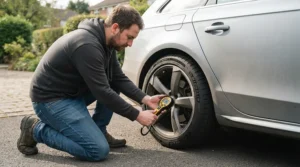
How to Choose a Digital vs Analogue Tyre Pressure Gauge: 6 Steps
- Match the range to your tyres. Cars sit comfortably within 0-60psi, so a Goodyear Portable works. Vans, trailers and caravans need a higher ceiling, like the Draper 69924 at 100psi.
- Decide how you’ll read it. If you check in poor light or want a number, go digital. If you rarely check and want zero fuss, go analogue.
- Weigh battery dependency honestly. Digital needs a spare cell and a habit. Analogue needs nothing.
- Check valve access. Look for a canted head or a flexible hose, because a poor seal ruins any gauge.
- Confirm units. UK drivers mostly use psi and bar, so make sure the gauge reads both.
- Add extras only if you’ll use them. Tread-depth tools like the Sealey TSTPG11 and bleed buttons are useful, but they shouldn’t compromise core accuracy.
Follow those six steps and the choice usually makes itself. Most households do best with one battery-free analogue for the boot and one digital keyring for quick checks.
✨ Ready to Upgrade Your Glovebox?
🔍 Take your tyre care to the next level with these carefully selected gauges. Click on any highlighted item to check current pricing and availability. These tools will help you check pressures with confidence before every journey! 🚗
Long-Term Cost and Maintenance: What a Gauge Really Costs Over Five Years
Gauges look cheap, but ownership cost is worth a minute’s thought. A £12 gauge used weekly for five years is roughly 260 checks, which works out at under 5p a check. Even a premium model is pennies per use if you actually use it.
| Gauge | Typical price range | Ongoing cost | Lifespan outlook | Best For |
|---|---|---|---|---|
| Draper 69924 | Check current price | None | Long | Low-maintenance owners |
| Goodyear Portable | Around £15 | None | Long | Small-car glovebox kit |
| Ring RTG4 | £7-£15 | Coin cells | Medium | Frequent quick checks |
| Halfords Digital | Around £12 | CR2032 cell | Medium | Pressure plus tread checks |
| Topeak Smartgauge D2 | Around £30 | Battery | Medium to long | Car-and-bike households |
The trend is predictable. Analogue gauges have almost no running cost and tend to outlast electronics, though a drop can end their accuracy. Digital models cost slightly more in batteries but give you better reading precision. Neither is expensive enough to justify a lesser gauge.
Maintenance is minimal. Keep gauges in their case, avoid dropping them, replace coin cells at the first sign of a dim screen, and check against a second gauge twice a year. For a tool that protects tyre life and fuel economy, that is superb value.
Practical Usage Guide: Getting Accurate Readings Every Time
A good gauge in sloppy hands still gives a poor reading. Here’s the routine that turns a cheap tool into a reliable one.
Before you start. Find your recommended pressures in the handbook, the fuel-filler flap or the door sill. Check tyres cold, meaning before driving or after under two miles. Heat raises pressure and misleads readings, as DVSA guidance warns.
The reading. Remove the dust cap, press the head squarely onto the valve and hold firm until any hiss stops. Take the reading, then repeat once. Two matching readings are your confidence check. On analogue models, look at the needle straight on to avoid parallax.
Adjust in small steps. Add or release air in short bursts and re-check. Overshooting and then bleeding air wastes time.
Verify your gauge. Once or twice a year, compare it against a second gauge at 20-30psi, the same test points used in Auto Express’s latest UK gauge roundup. A difference of more than about 1psi means one of them is suspect.
Maintain it. Store the gauge in its case, replace coin cells promptly, and don’t leave it on a hot dashboard. Refit the valve dust caps afterwards. They keep grit out of the valve and are an easy habit to forget.
Real-World Scenarios: Which Gauge Matches Which Driver
The weekend commuter. A small hatchback, a monthly check and a glovebox with limited space. The budget is around £15 and the setting is a dim driveway. The Goodyear Portable is the logical match: compact, no battery and fine resolution at car pressures. The caveat is the shorter neck on deep-dish wheels.
The night-shift parent. Checks happen on a street under poor lighting, often in a rush, perhaps weekly. A backlit screen and a torch matter more than long-term durability. The Ring RTG4, at around £7-£15, fits the bill and lives on the keyring. A spare coin cell lives in the glovebox.
The caravanner or van driver. Higher pressures, heavier loads and a strong case for a gauge with headroom. Here the Draper 69924 at 100psi, or the Halfords Digital at 99psi, make more sense than 0-60psi models. Pair it with a quick tread-depth check, since heavy loads wear tyres faster.
The car-and-bike household. Mixed valves and mixed pressures. The Topeak Smartgauge D2, at around £30, handles both valve types, while the Accu-Gage suits the bike-focused member of the household. In each case, the decision comes from usage frequency, environment and valve type, not from brand loyalty.
Problem and Solution Guide: Common Gauge Frustrations
Problem: air hisses when you press the gauge on.
The head isn’t seated squarely. Re-press firmly and straight-on, and favour a gauge with a canted head or flexible hose if the problem repeats. This is the most common complaint with compact digital models.
Problem: two readings differ every time.
Check the seal first, then temperature. If the gauge still wobbles by more than about 1psi, compare it against a second unit. Persistent drift suggests replacing it.
Problem: the digital screen is blank or dim.
It’s almost always the battery. Replace the coin cell, check the contacts, and remove any protective tab on new gauges. If it still fails, keep a battery-free analogue gauge as a backup.
Problem: the analogue needle doesn’t rest at zero.
A knock has probably shifted the mechanism. Cheap dials are rarely worth repairing, so treat it as a sign to replace, or at minimum cross-check against another gauge.
Problem: pressures look different on a cold morning.
That’s physics, not faulty equipment. Tyre pressure falls with temperature, so measure cold and adjust to the handbook figure at the same temperature each time.

Frequently Asked Questions
❓ How long does a digital tyre pressure gauge battery last?
❓ Can I check my tyre pressure gauge is accurate at home?
❓ Is a £10 digital gauge good enough for a car?
❓ Which tyre pressure gauge is best for caravans and vans?
❓ Should I check tyre pressure when the tyres are warm?
Conclusion
After weighing the road tests, the specs and the review patterns, the verdict in the digital vs analogue tyre pressure gauge contest is a fair split. Digital wins on reading precision, ease of use in the dark and extras like tread depth. Analogue wins on battery dependency, long-term durability and the sheer comfort of a tool that is always ready.
For most UK drivers, the smartest move is to own one of each. Keep a battery-free analogue like the Draper 69924 or Goodyear Portable in the boot as your reference. Put a Ring RTG4 or Halfords Digital in your pocket or on your keys for quick weekly checks. Pick the Accu-Gage if you’re a fussy, battery-free perfectionist, and the Topeak Smartgauge D2 if cars and bikes share your garage. The Sealey TSTPG11 suits anyone who wants a no-nonsense tread-check combo.
Whichever you choose, the habit matters more than the hardware. Check cold, check weekly, and cross-check your gauge now and then. A few pounds and two minutes a week protect your tyres, your fuel bill and your safety.
✨ Ready to choose your gauge?
🔍 Pick the style that fits your habits, click through to check current pricing and availability, and make your next tyre check your most accurate yet. Safe miles! 🚗
Recommended for You
- Tyre Pressure Monitor For Caravans: 7 Essential Picks (2026)
- Tyre Pressure Monitor System: 7 Best Picks For UK Drivers (2026)
- Budget Tyre Inflator: 7 Best Picks That Won’t Let You Down (2026)
Disclaimer: This article contains affiliate links. As an Amazon Associate, I earn from qualifying purchases. If you purchase products through these links, we may earn a small commission at no additional cost to you.
✨ Found this helpful? Share it with your friends! 💬🤗
