
In This Article
A car polish for swirl marks is a mildly abrasive liquid or paste that levels out the fine, circular scratches sitting in your clear coat, using micro-abrasives to physically smooth the surface rather than just masking the damage. If you’ve ever caught your bonnet under a streetlight and seen a spiderweb of hairline scratches swimming across the paint, you already know the feeling — it’s the automotive equivalent of finding out your favourite jumper has a moth hole. Swirl marks are usually the legacy of a lifetime of poor washing technique: dirty sponges, circular hand-washing, and the odd trip through a brush car wash that treats your paintwork like a bramble hedge. The good news is that automotive paint is applied in several layers, with a clearcoat that forms a glossy, transparent coating on top of the colour, and it’s this sacrificial top layer that’s actually holding the damage — not the colour underneath. That distinction matters, because it means most swirl marks are entirely fixable with the right product and a bit of patience — as Wikipedia’s overview of automotive paint explains, this clearcoat layer is specifically engineered to take the daily damage so the colour underneath doesn’t have to.
This guide cuts through the marketing fluff and looks at seven genuinely capable products for UK drivers, from budget hand-applied liquids to proper machine-polishing compounds. We’ll dig into what each one is actually good at, who should buy it, and where the real trade-offs lie — because “removes swirls” on a bottle label means very different things depending on how deep the damage actually goes.
Quick Comparison Table
| Product | Type | Application | Best For |
|---|---|---|---|
| Farécla G3 Pro Scratch Remover | Liquid swirl remover | Hand or machine | Budget-friendly light correction |
| Autoglym Paint Renovator | All-in-one restorer | Hand or machine | Faded, tired daily-driver paint |
| Meguiar’s Ultimate Compound | Cutting compound | Hand or DA machine | Moderate swirls and oxidation |
| Meguiar’s Ultimate Polish | Finishing polish | Hand or DA machine | Post-compound gloss refinement |
| Chemical Guys VSS Scratch and Swirl Remover | One-step polish | Hand or machine | Black and dark-coloured cars |
| Bilt Hamber Cleanser Polish | Fine abrasive polish | Hand or machine | Enthusiast-grade light correction |
| Meguiar’s M205 Ultra Finishing Polish | Finishing polish | DA or rotary machine | Final-stage swirl-free gloss |
Even at a glance, there’s a clear pattern here: this isn’t a one-product category. Budget liquids like the Farécla G3 Pro Scratch Remover are built for light, everyday swirling and work fine by hand, while something like Meguiar’s M205 Ultra Finishing Polish is really a machine-only tool for the last, most stubborn haze once heavier cutting has already happened. Choosing between them comes down to how bad your swirling actually is and whether you’re willing to invest in a dual-action polisher — which, as we’ll cover later, changes what’s realistically achievable.
💬 Just one click — help others make better buying decisions too!😊
Top 7 Car Polishes for Swirl Marks: Expert Analysis
1. Farécla G3 Pro Scratch Remover — best budget hand-applied swirl fixer
The Farécla G3 Pro Scratch Remover has been a fixture of UK garages for years, and it’s the product most likely to already be sitting in your dad’s shed. It uses diminishing abrasive technology, meaning the particles break down and get finer as you work them in, which is exactly what you want for a hand-applied product — less risk of leaving fresh micro-marring behind while you’re trying to remove the old stuff. On paper this means it’s gentler than a true cutting compound, and that’s borne out in practice: it handles light-to-moderate swirling and hedge-scrape scratches well, but heavier defects need repeat passes or a machine to really shift. Reviewers consistently report strong results on light swirls and scuffs when applied with a foam applicator pad, though a handful note it does little for deeper scratches that have gone through the clear coat. What most first-time buyers overlook is that this is a liquid, not a paste, so it’s easy to overapply — a little goes further than the bottle suggests, and working smaller sections gives better control.
Pros:
- ✅ Genuinely effective on light swirls without a machine
- ✅ Diminishing abrasives reduce marring risk for beginners
- ✅ Long-standing UK reputation and wide availability
Cons:
- ❌ Limited cut for deeper or heavier swirl patterns
- ❌ Can require several passes on neglected paintwork
Priced in the £10-£15 range for a 500ml bottle, the Farécla G3 Pro Scratch Remover is one of the most cost-effective entry points into paint correction going — check current price before buying, as retailer promotions shift regularly.
2. Autoglym Paint Renovator — best all-in-one for tired, faded paint
If Farécla is the shed staple, Autoglym Paint Renovator is the one sitting on the shelf at nearly every UK supermarket and Halfords. It’s formulated as a one-step abrasive polish with fillers, meaning it doesn’t just cut down existing swirl marks — it also helps disguise the ones it can’t fully remove, at least temporarily. Here’s what to weigh: the filling action gives an instant “wow” improvement on faded, sun-damaged paint, but because some of that improvement comes from filling rather than levelling, results can soften slightly after a few washes unless you follow up with a sealant or wax. Reviewers frequently praise how much brighter faded reds and blacks look immediately after use, and it’s become something of a go-to for older daily drivers that have never seen a proper detail. Based on the formulation, it’s best suited to genuinely tired paintwork rather than a car that’s already in decent condition — on healthier paint, a dedicated swirl remover will get you further with less product wasted.
Pros:
- ✅ Dramatic instant improvement on faded, oxidised paint
- ✅ Works well by hand — no machine required
- ✅ Widely available across UK retailers
Cons:
- ❌ Filling effect can diminish gradually with washing
- ❌ Less aggressive cut than dedicated cutting compounds
Expect to pay somewhere around £12-£18 for a standard bottle, making the Autoglym Paint Renovator a sensible mid-range pick for anyone reviving a car that’s been neglected for a season or two.
3. Meguiar’s Ultimate Compound — best cutting compound for moderate swirls
When the damage is a bit more than surface-deep, Meguiar’s Ultimate Compound is where a lot of UK detailers start. This is a proper cutting compound rather than a gentle swirl remover, designed to physically level moderate defects, light oxidation, and water-etching before a finishing polish takes over. The micro-abrasive formula means it’s aggressive enough to genuinely reduce swirl depth rather than just hiding it, and it works whether you’re going in by hand with real elbow grease or, more realistically, with a dual-action polisher. What most buyers overlook about a compound like this is that it’s a means to an end — it’s meant to be followed by a finishing polish, not used alone if you want a truly glassy result, because cutting compounds by nature leave behind their own fine micro-marring that a finer polish then refines away. Aggregated review sentiment is strongly positive on its cutting power for the price, with plenty of owners reporting it shifted swirls that lighter products couldn’t touch.
Pros:
- ✅ Genuine cutting power for moderate paint defects
- ✅ Performs well by hand or with a DA polisher
- ✅ Trusted, widely reviewed formula with proven results
Cons:
- ❌ Leaves fine marring that needs a finishing polish after
- ❌ Too aggressive for very soft or freshly repainted panels
At around £14-£20 for a 450ml bottle, the Meguiar’s Ultimate Compound offers serious correction potential without the price tag of a professional-only product.
4. Meguiar’s Ultimate Polish — best finishing polish for post-compound gloss
Following on from a cutting compound, Meguiar’s Ultimate Polish is designed to do the opposite job: refine, not cut. It’s a finer, less abrasive formula built to erase the hazing a compound can leave behind and bring back true depth and gloss ahead of waxing. The spec sheet won’t tell you this, but user reports suggest it’s genuinely gentle enough for regular maintenance use too, not just as a second step — some owners use it every few months on paint that’s already in good shape just to keep fine towel marks and light swirling at bay. It’s worth noting this product has very little cutting ability of its own, so applying it directly to heavier swirl marks without a compound stage first will mostly just add shine without addressing the actual defects underneath. Reviewers commonly describe the finish as “wet-look” glossy, and it’s frequently paired with the Ultimate Compound above as a genuine two-step system.
Pros:
- ✅ Excellent gloss and clarity as a finishing step
- ✅ Gentle enough for regular maintenance polishing
- ✅ Pairs naturally with Meguiar’s Ultimate Compound
Cons:
- ❌ Minimal cutting ability on its own against real swirls
- ❌ Best value only realised as part of a two-step process
You’re looking at roughly £14-£19 for the Meguiar’s Ultimate Polish, which makes the two-step Meguiar’s combo a genuinely strong mid-range paint correction kit.
5. Chemical Guys VSS Scratch and Swirl Remover — best for black and dark paint
Dark cars are brutally unforgiving when it comes to swirl marks — every hairline scratch throws light back at you like a disco ball — and Chemical Guys VSS Scratch and Swirl Remover has built a reputation specifically for tackling that problem. The formula is engineered to cut moderate swirling while finishing down clean, without the hazy residue that cheaper all-in-ones can leave on darker finishes. Here’s what to weigh: it’s more forgiving with machine application than by hand, and a dual-action polisher with a cutting pad will get noticeably better, more consistent results than working it in with a microfibre cloth. Testimonials suggest owners find it particularly effective specifically on black paint, where the improvement is easiest to see and hardest to fake. It’s a US-formulated product widely stocked through UK Amazon listings, so availability isn’t an issue, though it sits a notch above the budget end of this list.
Pros:
- ✅ Strong reputation specifically for dark and black paint
- ✅ Finishes down clear with minimal hazing
- ✅ Works by hand, though machine application excels
Cons:
- ❌ Pricier than comparable UK-brand alternatives
- ❌ Best results require a polishing machine
Priced in the £18-£25 range depending on bottle size, the Chemical Guys VSS Scratch and Swirl Remover earns its premium on dark-coloured cars where lesser polishes tend to leave telltale haze.
6. Bilt Hamber Cleanser Polish — best simple polish for enthusiast-level results
British brand Bilt Hamber has quietly built a cult following among detailing enthusiasts, and the Bilt Hamber Cleanser Polish is exactly the kind of no-nonsense product that reputation is built on. It’s a fine, low-dusting abrasive polish that contains a string of light fillers to address surface-level scratches, swirl marks and other minor imperfections, without the syrupy fragrance or filler-heavy gimmicks some competitors lean on. Based on the spec comparison against other entries here, it sits closer to the gentle end — brilliant for maintaining paint that’s already reasonably healthy, less suited to hammering out genuinely deep swirl patterns in one pass. What most buyers overlook is that its simplicity is the whole point: no wax, no sealant baked in, just a clean, honest polish that plays well whatever you choose to protect the paint with afterwards. Reviewers consistently rate it highly for ease of use by hand, and it’s become something of a quiet favourite for owners who want results without a garage full of separate products.
Pros:
- ✅ Low-dusting, easy-to-work formula
- ✅ British brand with strong enthusiast reputation
- ✅ Genuinely simple, no unnecessary additives
Cons:
- ❌ Gentler cut — not ideal for heavy swirl correction alone
- ❌ Best applied using a machine polisher for consistency
At around £15-£20 for a 500ml bottle, the Bilt Hamber Cleanser Polish rewards a bit of technique with results that punch well above its unassuming packaging.
7. Meguiar’s M205 Ultra Finishing Polish — best pro-grade finishing polish
Sitting at the premium end of this list, Meguiar’s M205 Ultra Finishing Polish is a genuinely professional-grade finishing polish, and it shows the moment you use it — this one is not really designed for hand application at all. It’s built to remove the last tiny swirls and towel marks left behind after a compounding stage, leaving a deep, mirror-like gloss that’s noticeably clearer than most finishing polishes at this price point. The spec sheet’s real story is in the abrasive technology: it’s engineered to break down fully under machine agitation, refining the surface without adding new marring, which is precisely what a final polishing stage needs to do. Reviewers consistently describe results as “show car” quality when used correctly with a dual-action or rotary polisher and a finishing pad, though several note that skipping a compounding stage first on heavily swirled paint leaves it working far too hard for what it’s designed to do.
Pros:
- ✅ Exceptional final-stage gloss and clarity
- ✅ Minimal-marring formula ideal after compounding
- ✅ Professional-grade results with the right machine
Cons:
- ❌ Requires a polishing machine for proper results
- ❌ Not intended as a standalone swirl-removal product
Expect to pay around £20-£28 for the Meguiar’s M205 Ultra Finishing Polish, a price that reflects its position as the finishing touch of a proper two-stage paint correction, rather than a quick fix on its own.
Machine Polishing for Beginners: A Practical Usage Guide
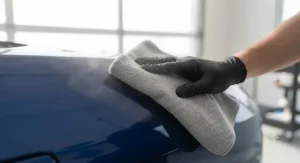
Buying the right polish is only half the job — how you apply it decides whether you actually fix the swirl marks or just move them around. Start with a two-bucket wash and a proper decontamination step (clay bar or a chemical iron remover) before you touch any polish, because bonded contamination trapped under a pad is one of the fastest ways to create fresh scratches while trying to remove old ones. Apply a small amount of car polish to your cloth or foam pad and gently spread it around your paintwork, working in overlapping passes rather than one long smear — Halfords’ own polishing guide recommends checking that the product has cured to the point where it wipes away clean before buffing off, rather than rushing the step.. A common first-30-days mistake is buying a compound, machine, and finishing polish all at once and trying to correct the whole car in a single weekend; in reality, panel-by-panel practice on less visible areas (boot lid, roof) builds the muscle memory you need before you tackle the bonnet and doors everyone actually looks at. Keep pads clean between sections, and always taper off (“burnish”) your final pass with the machine at low speed and light pressure to remove any last haze.
Who Needs What: Three Real-World Driver Profiles
Picture three very different UK driveways. First, there’s the daily commuter with a five-year-old hatchback that’s been through more automatic car washes than they’d like to admit — faded, dull, moderately swirled all over. For them, Autoglym Paint Renovator applied by hand on a Sunday afternoon delivers the biggest visible transformation for the least effort, and it’s forgiving enough that a first attempt won’t end in tears.
Second, the enthusiast with a black hatchback who washes carefully but still can’t shake that hazy, cobweb look under direct sunlight — the curse of every dark car owner. This is exactly where Chemical Guys VSS Scratch and Swirl Remover or Bilt Hamber Cleanser Polish earn their keep, paired ideally with a budget dual-action polisher rather than bare hands, since dark paint shows every inconsistency a hand application can leave behind.
Third, the classic-car or pride-and-joy owner prepping for a show or a sale, chasing genuinely swirl-free, mirror-flat paint. For them, the two-stage combination of Meguiar’s Ultimate Compound followed by Meguiar’s M205 Ultra Finishing Polish — both run through a proper machine — represents the closest a driveway detail gets to a professional paint correction, assuming the patience and pad-cleaning discipline to match.
How to Choose a Car Polish for Swirl Marks
Picking the right product comes down to matching abrasiveness to actual paint condition, not brand loyalty. Work through these steps in order:
- Assess swirl severity in direct sunlight — light hazing needs a gentle polish; deep, visible scratching needs a genuine cutting compound first.
- Check your paint colour — dark colours show every defect, so prioritise a swirl remover proven on black over an all-purpose formula.
- Decide on hand or machine application — hand suits light correction and beginners; a dual-action polisher unlocks proper two-stage correction.
- Match compound to polish — a cutting stage almost always needs a finishing polish afterwards to remove its own fine marring.
- Factor in paint hardness — softer paints (common on some Japanese and Korean models) correct faster but also swirl faster, so go gentler.
- Budget for protection afterwards — a wax or sealant applied post-polish slows the return of new swirl marks considerably.
- Read aggregated review sentiment, not star ratings alone — recurring themes about hazing, dusting, or marring tell you far more than a headline score.
Paint Correction Stages Explained
“”Paint correction” sounds like industry jargon, but it just describes the structured process of removing surface defects in stages rather than one product doing everything at once. As Wikipedia’s entry on auto detailing notes, detailing is about restoring the exterior to its original blemish-free finish through a mix of decontamination, compounding, and polishing — and within that broader process… Skipping stages is the single biggest reason DIY correction disappoints people — jumping straight to a finishing polish like M205 on heavily swirled paint simply doesn’t have the cutting power to shift the damage, while over-using an aggressive compound on light swirling risks removing more clear coat than necessary. Most daily-driven UK cars with typical wash-induced swirling sit comfortably in the medium stage, which is exactly why products like Meguiar’s Ultimate Compound paired with Meguiar’s Ultimate Polish cover the vast majority of real-world cases without needing anything more aggressive.
Cutting Compounds vs Finishing Polishes: What’s the Difference
| Feature | Cutting Compound | Finishing Polish |
|---|---|---|
| Abrasive size | Larger, more aggressive | Fine, low-abrasion |
| Best for | Moderate-to-heavy swirls, oxidation | Final gloss, removing haze |
| Example | Meguiar’s Ultimate Compound | Meguiar’s M205 Ultra Finishing Polish |
| Leaves marring? | Yes — needs a follow-up polish | No — designed to finish clean |
| Best For | Correcting visible defects | Refining an already-corrected surface |
The practical takeaway here is that these two product types are genuinely complementary rather than competing — a compound does the heavy lifting and a finishing polish cleans up after it, and using either one alone tends to leave you with half a result. Buyers chasing a single “does everything” bottle are usually better served by a one-step product like Chemical Guys VSS Scratch and Swirl Remover, accepting a slightly lower ceiling on heavy correction in exchange for simplicity.
Common Mistakes When Removing Swirl Marks
Even with the right bottle in hand, technique trips up more people than product choice. The most frequent error is skipping decontamination — washing a swirled car and going straight to polish traps grit under the pad, which reintroduces fresh scratches while you’re busy removing old ones. A close second is using too much pressure with a machine polisher, mistaking effort for cutting power when in fact heat and pad speed do the real work. Reapplying compound to an already-dry pad is another classic misstep, since a starved pad grips and drags rather than gliding, increasing marring risk. Plenty of owners also skip a finishing polish entirely after compounding, wondering why their “swirl-free” paint still looks slightly hazy under direct light — that haze is the compound’s own fine marring, waiting for a finer product to erase it. Being an all-in-one product rather than a specialist polish means some formulas simply won’t cut heavier swirls and scratches, so setting realistic expectations for a one-step product avoids a lot of frustration on genuinely damaged panels.
Machine Polishing vs Hand Application
There’s a persistent myth in UK detailing forums that machine polishing is only for professionals, but a budget dual-action polisher has become genuinely accessible for home use over the past few years. Hand application still has its place — it’s cheaper, lower-risk for beginners, and perfectly capable of handling light swirling with products like Farécla G3 Pro Scratch Remover or Autoglym Paint Renovator. Where it falls short is consistency: human arms simply can’t maintain the even pressure and speed a machine delivers across a whole panel, which is why deeper correction with compounds like Meguiar’s Ultimate Compound or finishing polishes like Meguiar’s M205 Ultra Finishing Polish genuinely need machine assistance to reach their full potential. Reviewers who’ve tried both consistently note that machine-applied results finish more evenly and with noticeably less arm fatigue, even if the upfront cost of a polisher and pads adds £60-£100 to the overall project.
Long-Term Cost & Maintenance
Swirl mark removal isn’t a one-and-done job unless you also change how the car gets washed afterwards — polish out the defects without addressing the cause, and they’ll be back within a few months. Cost-per-use works heavily in favour of the compound-and-polish combinations here: a 450ml bottle of Meguiar’s Ultimate Compound typically corrects an entire hatchback several times over, working out at a few pounds per full correction once you account for pad and consumable costs. The genuinely overlooked long-term saving is switching to a two-bucket hand wash or a foam-lance pre-wash instead of brush car washes, which are one of the single biggest causes of fresh swirling in the first place. A light maintenance polish every six to twelve months with something gentle like Bilt Hamber Cleanser Polish, combined with a wax or ceramic sealant for UV and scratch resistance, keeps paint looking corrected for years rather than needing a full compound stage repeated annually.
Frequently Asked Questions
❓ What causes swirl marks on car paint?
❓ Can you remove swirl marks without a machine polisher?
❓ Does car polish permanently remove swirl marks?
❓ How often should you polish a car to prevent swirl marks?
❓ Is a cutting compound safe for all car paint colours?
Conclusion
Swirl marks look dramatic under a streetlight, but they’re rarely as permanent as they feel standing in the driveway squinting at your bonnet. As this guide’s spread of products shows, the right fix depends entirely on how deep the damage actually runs and how much time you’re willing to invest — a gentle hand-applied liquid like Farécla G3 Pro Scratch Remover solves plenty of everyday cases, while a proper two-stage combination like Meguiar’s Ultimate Compound and Meguiar’s M205 Ultra Finishing Polish tackles the paintwork that’s genuinely earned its scars. Whichever route you take, remember that the causes of swirl marks in the first place are almost always washing technique, so pairing any polish with a gentler wash routine afterwards is what actually makes the results stick. Take your time, work in manageable sections, and don’t be afraid to start with the gentlest product that could plausibly do the job — you can always go a stage heavier, but you can’t put clear coat back once it’s gone.
Recommended for You
- Liquid Wax vs Paste Wax For Cars: 7 Proven Picks (2026)
- Paste Wax For Black Cars: 7 Deep-Gloss Picks For 2026
- All-In-One Polish And Wax: 7 Best Picks for UK Cars (2026)
Disclaimer: This article contains affiliate links. As an Amazon Associate, I earn from qualifying purchases. If you purchase products through these links, we may earn a small commission at no additional cost to you.
✨ Found this helpful? Share it with your friends! 💬🤗
