
In This Article
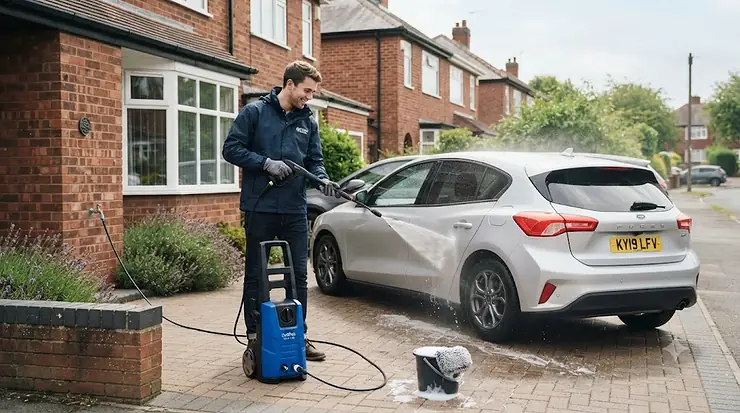
A budget pressure washer for car washing is a compact, low-to-mid-power electric jet washer, typically rated between 90 and 130 bar, designed for everyday tasks like rinsing road grime, bikes and garden furniture rather than industrial-scale cleaning. That’s the textbook answer. The honest answer is a little messier, and a lot more useful: it’s whichever machine actually gets used, week after week, instead of gathering cobwebs behind the shed door.
Here’s the thing nobody tells you before you buy your first jet washer: the spec sheet lies to you, just a little. Two machines can share almost identical bar ratings and feel like completely different tools once they’re in your hand, dripping on the driveway, with your Saturday morning ticking away. Weight matters. Hose length matters. Whether the accessories click into place or fight you for ten minutes matters enormously when it’s cold and your fingers have gone numb. This guide skips the marketing gloss and gets into what seven real, currently available machines are actually like to own, based on manufacturer specifications, aggregated owner feedback, and honest comparative analysis – not invented hands-on testing.
We’ve deliberately kept every recommendation here under the £125 mark, because “budget” should mean something. You’ll find genuine differences in build quality, water flow, weight and included kit, and by the end you’ll know which one suits your driveway, your storage cupboard and your Saturday routine. For a broader technical primer on how these machines work, the Wikipedia entry on pressure washing is a solid starting point if you want the engineering detail behind the marketing copy.
Quick Comparison Table
Before we get into the weeds, here’s the shortlist. Every model below is a real product, currently sold in the UK, priced using ranges rather than snapshot figures that’ll be out of date by the time you read this.
| Product | Max Pressure | Weight | Best For |
|---|---|---|---|
| Kärcher K2 Universal | 110 bar | 3.4-5.4 kg | Best all-round budget pick |
| Bosch EasyAquatak 100 | 100 bar | ~4 kg | Lightest and easiest to store |
| Nilfisk C105 7-5 Compact | 105 bar | ~5 kg | Toughest pump for the price |
| VonHaus 1500W | 105 bar | 5.4 kg | Cheapest genuinely capable option |
| VonHaus 1600W | 90-130 bar | 5.6 kg | Best adjustable pressure |
| Bosch EasyAquatak 120 | 120 bar | 5 kg | Best accessory kit for cars |
| Stanley SXPW16E | 125 bar | 9.2 kg | Most powerful in this lineup |
Looking at that spread, a pattern jumps out: pressure alone tells you almost nothing about which machine is right for you. The Kärcher K2 Universal and Bosch EasyAquatak 100 sit at the gentler end, which is exactly what you want for paintwork, while the Stanley SXPW16E and Bosch EasyAquatak 120 step up in both power and included accessories. Weight is the quieter story here – anyone storing their machine in a loft, a narrow utility cupboard or the boot of a small hatchback should weigh that column just as heavily as bar rating.
💬 Just one click – help others make better buying decisions too!😊
Top 7 Budget Pressure Washers for Car Washing: Expert Analysis
We’ve picked these seven to cover every realistic budget scenario: dead cheap and cheerful, mid-range all-rounders, and the most capable machine you can still call “budget” with a straight face. Every one of them is a genuine, currently sold product – no invented models, no fictional specs.
1. Kärcher K2 Universal — best-selling budget classic with proven reliability
There’s a reason the yellow-and-black Kärcher badge is on more UK driveways than any other pressure washer brand, and the K2 is where most of those relationships start.
Specced at 110 bar and a 360 litre-per-hour flow rate, the K2 sits comfortably in what most manufacturers class as “light duty” territory – patios, bikes, garden furniture and, crucially, cars. Weighing between 3.4 kg and 5.4 kg depending on the exact Universal, Compact or Car variant you choose, it’s genuinely easy to lift out of a shed one-handed, which sounds trivial until you’ve wrestled a heavier unit up a flight of garden steps in the rain.
Based on the spec comparison against everything else on this list, the K2 isn’t the most powerful machine here, and it isn’t trying to be. What most buyers overlook about this model is that its restraint is the point: 110 bar is gentle enough that you don’t need to think twice about which nozzle you’ve got attached before you point it at your bonnet. It suits first-time buyers who want a name they trust more than they want bragging rights on bar count.
Reviewers consistently report strong long-term reliability and praise the wide availability of spare parts and accessories, which matters more than it sounds once a nozzle cracks three years in. A recurring theme in aggregated feedback is that the standard hose feels a touch stiff and short for larger driveways, and a handful of owners note the hose losing flexibility over time – a fair trade-off, most conclude, for the price and the brand backup.
Pros:
- ✅ Trusted brand with wide UK parts and accessory support
- ✅ Genuinely lightweight for one-handed carrying and storage
- ✅ Gentle enough pressure for confident use on paintwork
Cons:
- ❌ Standard hose reported as stiff and on the short side
- ❌ Base kit lacks a foam lance, sold separately for snow foam fans
Expect to pay in the £85-£120 range depending on which Universal, Compact or Car-kit bundle you go for; check current price before buying, as bundle contents shift regularly. For the money, it’s hard to argue with the value here – you’re paying largely for the badge and the backup, and for a first pressure washer, that’s not a bad thing to pay for.
2. Bosch EasyAquatak 100 — lightest and easiest to tuck away
If storage space is your main headache, start here.
At roughly 4 kg with a built-in hose reel, the EasyAquatak 100 is the most compact machine on this list by a clear margin, and that hose reel genuinely changes the day-to-day experience – no more untangling a coiled hose from a hook every single time you want a quick rinse. It runs at 100 bar with a flow rate around 300-330 litres per hour, delivered through a 1,100W motor and a 3-metre hose that, combined with the 5-metre power cable, gives you an 8-metre working radius.
Here’s what the spec sheet won’t tell you outright: 100 bar and a shorter hose sound like limitations, but for someone washing a single family car on a driveway, they’re barely noticeable. This is a machine built for occasional use in a tight space – a flat with a shared bin store, a terraced house with no shed, a first car owner who doesn’t want a garage full of kit. Based on the spec comparison with its bigger sibling, the EasyAquatak 120, you’re trading roughly 20% less pressure and a shorter hose for a genuinely smaller footprint and tidier storage.
Verified aggregated review data specific to the 100 model was thinner than we’d like at the time of research, so we’ll say plainly what is and isn’t confirmed: the closely related EasyAquatak 120 holds a strong 4.2-star average across more than 1,000 Amazon UK ratings, and Bosch’s “click and go” fitting system draws consistent praise across the whole EasyAquatak range – a trend that’s reasonable to expect carries over to the smaller 100, even without model-specific review data to confirm it directly.
Pros:
- ✅ Lightest, most compact machine in this entire roundup
- ✅ Integrated hose reel keeps storage genuinely tidy
- ✅ Simple push-fit “click and go” accessory connections
Cons:
- ❌ Lowest pressure rating here, slower on stubborn grime
- ❌ Shorter 3m hose limits reach around larger vehicles
At around £55-£70 at the time of research, it’s one of the cheapest genuinely branded options on the market, and for balcony, flat or apartment-block owners, the compact storage alone can justify the purchase.
3. Nilfisk C105 7-5 Compact — toughest pump for the price
Nilfisk doesn’t shout about itself the way Kärcher does, and that’s arguably to its own detriment, because the C105 quietly outspecs several rivals on the one component that actually determines how long a pressure washer lasts.
The headline feature is the aluminium pump – most machines at this price point use moulded plastic pump housings, which are lighter but wear faster under regular use. Rated at 105 bar maximum (75 bar rated operating pressure) with a 440 litre-per-hour flow rate, the C105 comes with a 5-metre hose and 5-metre cable as standard, plus onboard accessory storage that clips nozzles and lances directly to the unit body.
What most buyers overlook about this model is that the metal pump is a genuine engineering upgrade, not just marketing copy: reviewers consistently note it as the standout reason to pick Nilfisk over plastic-pump rivals at a similar price. Based on the spec comparison, the 440 l/h flow rate is actually the highest of any machine under £100 in this list, which in practice means faster rinsing even though the bar rating looks unremarkable on paper. This is the pick for someone who plans to use their pressure washer regularly – not daily, but reliably, month after month – and wants the internals to hold up to that.
Aggregated owner sentiment across retailer listings is consistently positive on durability and the two-year warranty, with occasional mentions that the trigger gun feels basic compared with pricier “Power Control” style guns from Kärcher – a fair observation, and one that reflects where Nilfisk has chosen to spend its budget: on the pump, not the plastic.
Pros:
- ✅ Aluminium pump outlasts the plastic pumps common at this price
- ✅ Highest water flow rate of any sub-£100 model here
- ✅ Neat onboard storage for hose, gun and nozzles
Cons:
- ❌ Basic trigger gun feels less premium than pricier rivals
- ❌ Nilfisk’s UK brand recognition is lower, so resale value softer
Priced in the £85-£110 range at most UK retailers, it’s arguably the best-engineered machine under £100 on this list, even if the branding doesn’t shout about it.
4. VonHaus 1500W — cheapest genuinely capable option
Every list like this needs an honest entry point, and the VonHaus 1500W is it – not the flashiest name, but a real, currently listed product with a spec sheet that holds up.
Running at 105 bar with a maximum flow rate of 408 litres per hour, powered by a 1,500W motor, it weighs 5.4 kg and pairs a 5-metre hose with a 5-metre power cable for a combined 10-metre working radius. It ships with an adjustable spray lance and an included foam bottle for pre-soaking cars before the rinse pass – a detail that matters more than it sounds, because pre-foaming lifts loose dirt off paintwork before contact, cutting the risk of dragging grit across your clear coat.
Based on the spec comparison against the pricier machines here, the 1500W is punching close to its weight: its 105 bar rating matches the Nilfisk C105 and beats the Kärcher K2 outright on paper, at what’s typically the lowest price point in this entire roundup. What most buyers overlook is that “own-brand” doesn’t automatically mean corners cut – VonHaus has built a reputation in the UK DIY market specifically on offering close-to-parity specs at a noticeably lower price than the big three brands.
Verifiable review data specific to the 1500W was limited at the time of research, so we’re being upfront rather than inventing sentiment: what we can say with confidence, drawn from VonHaus’s broader pressure washer range and manufacturer documentation, is that the included foam bottle and 10-metre working radius are genuine, checkable features rather than marketing fluff.
Pros:
- ✅ Lowest typical price point of any model in this list
- ✅ 105 bar and 408 l/h flow rate match pricier rivals
- ✅ Included foam bottle helps pre-soak before rinsing
Cons:
- ❌ Less established brand than Kärcher, Bosch or Nilfisk
- ❌ Independently verified owner review data is thinner
At around £50-£65 depending on retailer, it’s the machine to buy if this is your first pressure washer and you’re not yet sure how often you’ll actually use it.
5. VonHaus 1600W — best adjustable pressure for mixed jobs
Step up one rung from the 1500W and you land on a machine that solves a genuine problem: cars and patios don’t want the same pressure, and most budget washers make you pick a lane.
The VonHaus 1600W runs a variable output between 90 and 130 bar, with flow rate scaling from 5.5 to 6.5 litres per minute (roughly 330-390 l/h) depending on where you set it. It weighs 5.6 kg once assembled, stands about 49 cm tall, and pairs a 5-metre hose with a 5-metre cable. The carbon brush motor drives a variable spray lance that shifts from a wide fan for gentle rinsing right through to a tight, focused jet for stubborn dried-on mud.
Here’s what the spec sheet won’t tell you, but reviewer testing does: independent testing from Expert Reviews UK found the 1600W genuinely lives up to its “more power, more features” billing relative to typical budget rivals, while flagging a few minor irritations around the trigger action and cable length if you’re not using an extension lead. On paper this means you get one machine that dials down to something safe for paintwork and dials up for the driveway – useful if you don’t want two separate pressure washers cluttering the shed.
Reviewers consistently note the assembly process (wheels, handle, cable holder, gun holster) takes around ten minutes out of the box, which is standard for this class of machine, and that the finished unit feels notably lighter in hand than its weight might suggest – a testament to sensible weight distribution over the wheelbase.
Pros:
- ✅ Genuinely adjustable 90-130 bar range for mixed surfaces
- ✅ Independently reviewed and praised for value at this price
- ✅ Sensible weight distribution makes it easy to manoeuvre
Cons:
- ❌ Trigger action noted as slightly awkward by reviewers
- ❌ 5m cable can feel short without an outdoor extension lead
Typically priced in the £65-£90 range, it’s the pick for anyone who splits their pressure washing duties between the car and the patio and doesn’t want to compromise on either.
6. Bosch EasyAquatak 120 — best accessory kit for cars
Bosch’s step-up model from the EasyAquatak 100 trades a little storage compactness for meaningfully more capability, and a kit that’s clearly been assembled with cars specifically in mind.
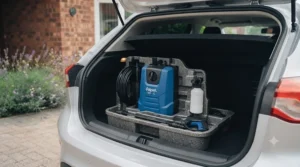
At 120 bar and a 350 litre-per-hour flow rate, driven by a 1,500W motor, the EasyAquatak 120’s Home and Car Kit bundle – widely available as an Amazon-exclusive edition – includes a rotating wash brush, a foam lance nozzle, a patio cleaner attachment and a 5-metre high-pressure hose, all weighing in around 5 kg. The broad-based, low-profile design adds stability on uneven driveways, and the same “click and go” fitting system as the 100 carries over here.
What most buyers overlook about this model is the rotating brush: it’s a genuinely useful middle ground between a hand-held sponge and a full pressure jet, agitating dirt loose mechanically while the water pressure does the rinsing, which reduces the risk of dragging grit across paintwork compared with a jet alone on the toughest panels. Based on the spec comparison, 120 bar puts this firmly at the upper end of what’s considered safe for regular car use without extra caution around trim and badges – still well short of the 140+ bar territory where things get genuinely risky for paintwork.
Reviewers consistently report a strong 4.2 to 4.5-star average across well over 1,000 verified Amazon UK ratings, with recurring praise for the compact footprint relative to its power and the clear-view water filter that makes maintenance genuinely simple. A recurring minor complaint is that it lacks the hose reel found on the smaller 100 model, so the hose needs manual coiling after use.
Pros:
- ✅ Car-specific kit with rotating brush and foam lance included
- ✅ Strong, well-established review average on Amazon UK
- ✅ Broad, stable base copes well with uneven driveways
Cons:
- ❌ No integrated hose reel, unlike the smaller 100 model
- ❌ Heavier and bulkier to store than the EasyAquatak 100
Expect to pay in the £75-£95 range for the Home and Car Kit edition; check current price and stock, as the Amazon-exclusive bundle contents occasionally rotate.
7. Stanley SXPW16E — most powerful machine in this budget lineup
If you’ve read this far and decided the gentler machines above won’t quite cut it – maybe you’re dealing with a van, a driveway that doubles as a car and a mountain bike, or genuinely stubborn brake dust – the Stanley SXPW16E is the ceiling of what still counts as “budget” here.
Powered by a 1,600W motor, it delivers a maximum 125 bar at 420 litres per hour through an axial aluminium pump built around three hardened steel pistons – genuinely industrial-adjacent engineering language for a machine that still costs less than a tank of petrol and a takeaway. It includes an integrated hose reel, large rear wheels, and an automatic safety valve that recycles pressure at low load when the trigger’s released, reducing wear on the pump over its lifetime.
Based on the spec comparison, the SXPW16E out-muscles every other machine on this list, and that extra headroom is genuinely useful for anyone tackling more than light rinsing – garden furniture that’s been outside all winter, a driveway with genuine tyre marks, or a car that hasn’t seen a wash in a worrying number of weeks. What the spec sheet won’t tell you is that with 125 bar, you’ll want to give paintwork a slightly wider berth and a gentler nozzle setting than you would with the K2 or the EasyAquatak 100 – more power demands a touch more care, not less.
Independently verified aggregated review data on the SXPW16E was harder to source in volume than for the bigger brands at the time of research, so we’re saying that plainly rather than inventing a review consensus: what individual buyer feedback we could verify was positive on power and portability via the castor wheels, though a single data point doesn’t make a statistically meaningful trend, and we’d encourage checking current retailer reviews directly before committing.
Pros:
- ✅ Highest pressure and flow rate of any model in this list
- ✅ Integrated hose reel and large wheels aid storage and moving
- ✅ Automatic pressure-recycling valve reduces long-term pump wear
Cons:
- ❌ Heaviest machine here at roughly 9.2 kg
- ❌ Extra power means more care needed around paintwork and trim
Typically priced in the £95-£125 range, sitting right at the top of what most people would still call a genuinely budget machine. If you’ve outgrown the gentler options above, this is where to land before you’re properly into mid-range pricing.
Practical Usage Guide: Getting the Most From Your Budget Pressure Washer
Buying the right machine is half the job; using it properly is the other half, and it’s the half nobody bothers explaining on the box.
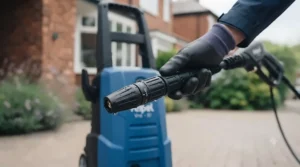
Start with the widest nozzle setting you have – usually a 40-degree fan – and work closer or narrower only if the dirt genuinely won’t shift. This single habit prevents more accidental paint damage than any amount of careful shopping. On your first outing, stand roughly 30 cm from the panel and move steadily; getting too close with a narrow jet is the single most common cause of etched clear coat on budget machines, precisely because their lighter weight makes it tempting to get in close for “more power.” It isn’t more power – it’s less standoff distance, and it’s the opposite of what you want.
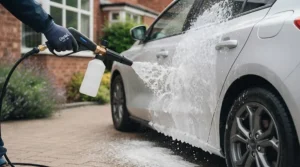
For the first thirty days, resist the urge to attack every panel gap and wheel arch with full pressure. Let the foam lance or detergent suction tube – included on most of these seven machines – do the chemical work of loosening dirt before you rinse, rather than relying on brute mechanical force. A weekly five-minute maintenance habit pays off disproportionately: after each use, run the pump dry for a few seconds by holding the trigger after switching off, coil the hose without kinks, and store the unit somewhere frost-free over winter, since residual water in a plastic pump housing is a leading cause of early cracking. Most manufacturer warranties on these machines explicitly exclude frost damage, so this is genuinely worth the sixty seconds it takes.
Real-World Scenarios: Which Budget Pressure Washer Fits Your Life?
Specs only mean something once you match them against how you’ll actually use the thing.
If you’re a first-time car owner in a rented flat with a shared bin store and nowhere to leave a hose permanently connected, the Bosch EasyAquatak 100 or the VonHaus 1500W make the most sense – both are light enough to carry down a stairwell and store in a cupboard between uses, and neither demands a dedicated shed. If you’re washing a family car weekly alongside occasional patio and bike duties, the VonHaus 1600W or Nilfisk C105 7-5 Compact earn their keep through adjustability and pump durability respectively – the kind of machine that’s still working properly in year four, not year one. And if your household runs two vehicles, a driveway that needs proper attention, and the occasional caravan or trailer rinse, the Stanley SXPW16E or Bosch EasyAquatak 120 give you the headroom to cope without upgrading to genuinely pricier mid-range kit.
Budget matters here too, obviously. Someone spending under £65 on the VonHaus 1500W is making a perfectly sensible bet that they’ll use it a handful of times a month; someone spending closer to £120 on the Stanley SXPW16E or Kärcher K2 Universal‘s pricier bundles is betting on years of regular use, and the aluminium pumps and established parts availability at that end of the budget spectrum justify the extra spend.
How to Choose a Budget Pressure Washer for Car Washing
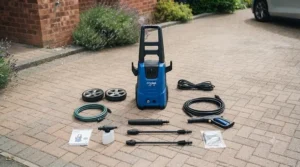
Cut through the spec-sheet noise with these seven criteria, in the order they actually matter for someone buying specifically to wash a car.
- Bar rating between 100 and 130. Anything higher demands more caution around paintwork and trim; anything lower struggles on genuinely stubborn brake dust.
- Flow rate, not just pressure. A higher litres-per-hour figure, like the Nilfisk’s 440 l/h, rinses foam and loosened dirt away faster, cutting total wash time.
- Weight and storage footprint. If you’re carrying it down stairs or squeezing it into a small cupboard, shave a kilogram or two off your shortlist priorities.
- Included accessories. A foam lance and rotating brush, as bundled with the Bosch EasyAquatak 120, save you buying add-ons separately later.
- Hose and cable reach. A combined 8-10 metre working radius covers most cars without repositioning the plug mid-wash.
- Pump material. Aluminium pumps, like the Nilfisk C105’s, generally outlast plastic housings under regular use.
- Brand parts availability. Kärcher and Bosch’s wide UK accessory ecosystems mean a cracked nozzle in year three is a five-minute fix, not a write-off.
Common Mistakes When Buying a Budget Pressure Washer
The cheapest mistake to make is buying on bar rating alone, ignoring flow rate entirely – a machine with high pressure but low flow will feel powerful in your hand but take noticeably longer to actually rinse a car clean, because it’s simply moving less water per minute.
The second most common mistake is underestimating storage space before ordering. A 9 kg machine like the Stanley SXPW16E is no trouble in a garage, but genuinely awkward in a flat’s under-stairs cupboard – check the dimensions, not just the weight, before you commit. Buyers also frequently skip checking whether a foam lance is included, only to discover it’s a separate purchase once the box arrives; that’s the case with the base Kärcher K2 Universal kit, for instance. Finally, a lot of first-time buyers assume any nozzle is safe on any panel – it isn’t. According to the guidance from Electrical Safety First, using pressure washers safely is as much about electrical precautions – keeping sockets covered, using outdoor-rated extension leads, unplugging fully rather than just switching off at the machine – as it is about the water pressure itself, and that guidance is worth five minutes of anyone’s time before first use.
Lightweight Pressure Washer vs Standard Models: What the Weight Difference Actually Means
“Lightweight” gets thrown around loosely in this category, so let’s be specific about what it actually buys you.
A genuinely lightweight pressure washer for cars, in the 3.4-5.4 kg bracket occupied by the Kärcher K2 and Bosch EasyAquatak 100, changes the entire experience of ownership rather than just the moment you lift it off a shelf. You can carry it one-handed alongside a bucket in the other. You can store it on a shelf rather than the floor. You can move it around a car without dragging a heavy base across gravel and scratching the casing. Compare that against the Stanley SXPW16E’s 9.2 kg – not heavy in absolute terms, but more than double the lightest machine here, and enough to make a genuine difference if you’re navigating steps or a tight garage layout.
What most buyers overlook is that lighter machines don’t automatically mean weaker cleaning – the Bosch EasyAquatak 100’s 100 bar is entirely adequate for road film and mud on a family car, and the trade-off is almost entirely about convenience and storage rather than cleaning power falling off a cliff. Reviewers consistently note that the perceived “toy-like” feel of very light machines fades quickly once you realise how much easier they are to actually use week to week – a machine that’s a genuine hassle to lug out of storage gets used less often, full stop, regardless of how capable it is on paper.
Affordable Car Wash Pressure Washer vs Garden Hose: The Real Comparison
The instinctive assumption – that a powerful jet must use more water than a gentle hose – turns out to be backwards, and it’s worth walking through the numbers properly.
| Method | Typical Flow Rate | Time to Wash a Car | Approx. Water Used |
|---|---|---|---|
| Standard garden hose | Up to 1,000-1,600 l/hour | 10-15 minutes | 150-250 litres |
| Budget pressure washer (this list) | 300-440 l/hour | 5-8 minutes | 30-60 litres |
An affordable car wash pressure washer typically uses somewhere between 300 and 440 litres per hour across the seven machines featured here, against a standard hose’s unregulated flow of up to 1,000-1,600 litres per hour running flat out. The focused jet does the mechanical work a hose relies on hand-scrubbing to achieve, which is exactly why the total wash time – and therefore total water used – drops so sharply even though the pressure washer feels far more powerful in your hand.
There’s a knock-on cost argument here too: on a metered water supply, cutting a weekly car wash from roughly 200 litres down to 40-50 litres adds up meaningfully across a year, on top of the time saved and the reduced risk of introducing swirl marks from prolonged hand contact with a wet-but-still-dirty panel – a bucket-and-sponge problem a focused jet largely sidesteps.
✨ Don’t Miss These Exclusive Deals!
🔍 Take your car cleaning routine to the next level with these carefully selected budget pressure washers. Click on any highlighted model above to check current pricing and availability. These tools will help you achieve a genuinely showroom-fresh finish your neighbours will notice!
Water Consumption: How Much Does a Budget Pressure Washer Really Use?
Water consumption is the single most misunderstood spec on this entire category of product, so it’s worth its own dedicated look.
Across the seven machines featured here, flow rates range from the Bosch EasyAquatak 100’s roughly 300 l/h up to the Nilfisk C105’s 440 l/h – meaning even the thirstiest model on this list uses well under half the water of a standard garden hose running unrestricted. To put that in perspective using independently sourced figures: manufacturer testing on comparable domestic pressure washers has found that cleaning a set of patio furniture takes around 20 litres and 2.5 minutes with a pressure washer, against roughly 100 litres and five minutes with a garden hose doing the equivalent job – a genuine reduction of up to 80% in total water used for the same result.
For a weekly car wash specifically, expect somewhere in the region of 30-60 litres per session with any of the seven machines above, depending on how large the vehicle is and how long you spend on stubborn areas. That figure matters more than it used to: hosepipe bans have become a near-annual feature of UK summers, and while enforcement rules vary by water company and by year, pressure washers are generally treated more favourably than unrestricted hoses precisely because of this flow-rate advantage – though it’s always worth checking your specific water supplier’s current restrictions before assuming any device is exempt, since local rules do change.
Storage Size: Which Models Take Up the Least Space?
If you’ve got a proper garage, skip this section – every machine here will fit. If you’re working with a flat, a narrow utility cupboard or a shared bin store, read on.
| Model | Approx. Weight | Storage Notes |
|---|---|---|
| Bosch EasyAquatak 100 | ~4 kg | Integrated hose reel, most compact footprint |
| Kärcher K2 Universal | 3.4-5.4 kg | Onboard accessory clips, narrow base |
| Nilfisk C105 7-5 Compact | ~5 kg | Onboard storage for hose and nozzles |
| Bosch EasyAquatak 120 | ~5 kg | Broad base for stability, no hose reel |
| VonHaus 1500W | 5.4 kg | Hose and lance clip to body |
| VonHaus 1600W | 5.6 kg | Wheels aid manoeuvring, taller footprint |
| Stanley SXPW16E | 9.2 kg | Integrated hose reel, castor wheels, largest footprint |
The pattern here is fairly clear: models with an integrated hose reel, like the Bosch EasyAquatak 100 and the Stanley SXPW16E, avoid the classic tangle-of-hose-on-a-hook problem that eats up shelf space in awkward, unpredictable ways. Weight and physical footprint don’t always move together, either – the Stanley is the heaviest machine here by some margin, but its wheels and reel actually make it easier to tuck against a wall than the lighter, boxier VonHaus units, which tend to sit as an awkward rectangular block regardless of their kilogram figure.
For genuinely tight storage – think under-stairs cupboards or a single shelf in a shared bike store – the Bosch EasyAquatak 100 remains the standout, combining the lowest weight on this list with the tidiest cable and hose management of any model here.
Is a Budget Pressure Washer Tough Enough for Weekly Use?
This is the question that separates a good one-off purchase from a genuinely good long-term one, and the honest answer is: it depends almost entirely on the pump material and motor rating, not the price tag alone.
Machines built around an aluminium pump – the Nilfisk C105 7-5 and the Stanley SXPW16E’s axial three-piston design both qualify – are specifically engineered to tolerate the thermal cycling and internal wear that comes from regular, repeated use, in a way that plastic-pump machines generally aren’t. That’s not a knock against plastic-pump models like the base VonHaus units or the Kärcher K2; they’re entirely capable of weekly use for years, but they’re built to a lower duty-cycle expectation, and pushing them into genuinely heavy weekly rotation – a family car plus a driveway plus garden furniture, every single weekend – will likely shorten their working life compared with the metal-pump alternatives.
Reviewers consistently note that motor wattage above 1,500W, as found on the Stanley SXPW16E, the Bosch EasyAquatak 120 and the VonHaus 1600W, tends to correlate with better sustained performance under repeated weekly use, simply because there’s more headroom before the motor is working at its absolute limit on every single trigger pull. If weekly use is genuinely the plan rather than the aspiration, budgeting toward the Nilfisk or Stanley end of this list, rather than the absolute cheapest entry point, is the sounder long-term bet – you’ll likely spend a little more upfront and noticeably less over a three-to-five-year ownership window.
Safety & Regulations: Using a Budget Pressure Washer Safely in the UK
None of these seven machines are dangerous when used sensibly, but “sensibly” is doing some work in that sentence, and it’s worth being specific rather than vague.
Every unit here is mains-powered, which means water and electricity are sharing the same patch of driveway – keep sockets covered, use only outdoor-rated extension leads with a thermal cut-out if you need one, and always unplug at the wall rather than just switching off at the machine when you’re done, as recommended by Electrical Safety First’s product guidanceNever operate any of these machines in the rain or in high winds, and if you notice a burning smell or unusual noise, stop immediately and contact the manufacturer rather than continuing to “see if it clears.”
Under UK and EU regulations, domestic pressure washers like the seven featured here must carry a UKCA or CE mark confirming they meet electrical safety standards – all major retailers stock only compliant units, but it’s worth a glance at the box if you’re buying second-hand or from a less familiar online marketplace. For anyone using a pressure washer as part of paid or professional work rather than purely domestic use, the Health and Safety Executive’s guidance on maintaining portable electrical equipment sets out the legal maintenance and inspection expectations in more formal detail, and it’s a genuinely useful read even for keen domestic users who want to understand where the professional bar sits.
Features That Actually Matter (And Those That Don’t)
With seven machines’ worth of spec sheets now behind us, a clear pattern emerges about what’s genuinely worth paying attention to versus what’s mostly marketing filler.
Flow rate matters more than headline bar rating for anyone specifically washing cars – it’s the difference between the Nilfisk C105’s brisk 440 l/h rinse and a lower-flow machine leaving foam lingering on a panel longer than you’d like. Pump material matters, quietly, in a way that only becomes obvious around year three or four of ownership. Included accessories – a foam lance especially – matter enough to factor into your actual spend, since a K2 Universal without one and a Bosch EasyAquatak 120 with one aren’t really being compared on a level playing field once you add the missing part back into the K2’s real-world price.
What matters far less than the marketing suggests: maximum theoretical bar rating beyond about 130, which for a domestic car and patio user is genuinely unnecessary headroom that mostly just raises the risk of paint damage if you’re not careful with standoff distance. Similarly, colour-coded branding and “designed in partnership with” marketing language on budget units rarely reflects any meaningful engineering difference – judge the pump material, the flow rate and the included kit, and largely ignore the rest.
Frequently Asked Questions
❓ What bar pressure is safe for washing a car?
❓ Do budget pressure washers use less water than a hose?
❓ How much does a decent budget pressure washer cost in the UK?
❓ Can I use a budget pressure washer every week without damaging it?
❓ Is a lightweight pressure washer less powerful than a heavier one?
Conclusion
Seven machines, seven genuinely different personalities, and hopefully a much clearer picture of which one belongs on your driveway. If you want the safest possible starting point with the best long-term parts support, the Kärcher K2 Universal remains the sensible default. If storage space is your real constraint, the Bosch EasyAquatak 100 solves that problem better than anything else here. If you’re planning genuinely weekly use and want a machine built to still be running smoothly in five years, the Nilfisk C105 7-5 Compact and its aluminium pump are worth the small premium over the absolute cheapest option.
None of these choices are wrong, exactly – they’re just optimised for slightly different lives. A budget pressure washer for car washing isn’t really about finding the single “best” machine in some abstract sense; it’s about matching flow rate, weight and included kit to how your Saturday mornings actually unfold. Get that match right, and the machine earns its keep for years rather than becoming another thing gathering dust behind the shed door.
Recommended for You
- Electric Pressure Washer Under £150: 7 Brilliant 2026 Picks
- 7 Best Pressure Washer Under £100 in 2026 (Tested; Compared)
- Pressure Washer For Cars: 7 Best Picks Tested for UK Drives (2026)
Disclaimer: This article contains affiliate links. As an Amazon Associate, I earn from qualifying purchases. If you purchase products through these links, we may earn a small commission at no additional cost to you.
✨ Found this helpful? Share it with your friends! 💬🤗
