
In This Article
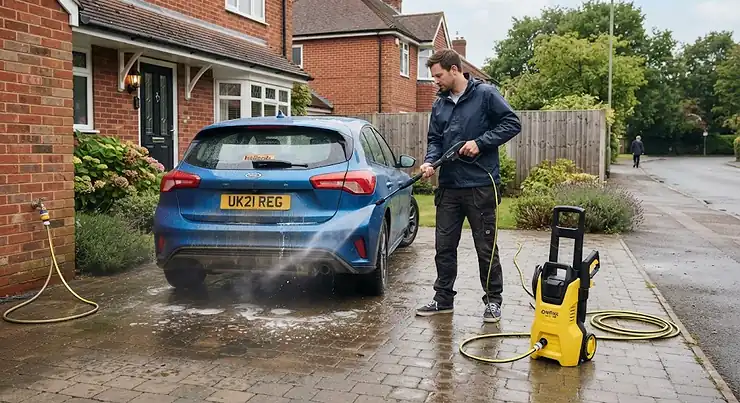
There’s a particular kind of guilt that comes from watching your car go from “gleaming Sunday morning” to “collecting a fine layer of A-road grime” in about four days flat. If you’re reading this, you’ve probably already worked out that a bucket, a sponge and sheer stubbornness aren’t cutting it anymore — and honestly, they never really did the job safely in the first place. Dragging a soaked sponge over baked-on brake dust doesn’t wash your paintwork so much as sand it, one gritty pass at a time.
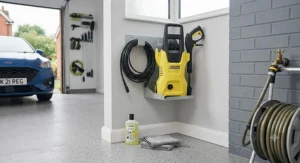
A pressure washer for cars solves that problem by letting water — not your wrist, and not a mitt full of trapped grit — do the heavy lifting. It’s a machine that forces water through a nozzle at high pressure, typically somewhere between 100 and 160 bar for domestic models, to lift dirt off a surface before anything touches the paint. The best models balance enough pressure to shift road film with a wide enough flow rate to rinse it away cleanly, without blasting so hard that they strip wax or chip old paintwork.
This guide isn’t a rewrite of an Amazon listing. We’ve pulled together real specifications, genuine aggregated review sentiment (properly labelled as such — no invented five-star raves here), and the sort of comparative reasoning you won’t find on a product page: which of these seven pressure washers actually suits a Fiesta on a driveway versus a Transit van at a rural cottage, what bar pressure and flow rate mean in the real world, and where the compromises genuinely lie. Whether you’re weighing up a car pressure washer buying guide from scratch or you already know your Kärchers from your Nilfisks, there’s something below worth reading before you spend your money.
What Is a Pressure Washer For Cars?
A pressure washer for cars is an electric or battery-powered machine that pressurises mains-fed water — typically to somewhere between 100 and 160 bar — and delivers it through a narrow nozzle to lift dirt, road salt and brake dust off bodywork without the abrasive contact of a traditional wash mitt. As the general definition of pressure washing explains, the volume of water a machine moves is expressed in litres per minute and is designed into the pump itself, which is exactly why flow rate matters just as much as pressure for a genuinely thorough car wash. Most domestic units plug into a standard 13A socket and connect to an outdoor tap via a garden hose.
Quick Comparison Table
| Model | Bar Pressure | Flow Rate | Weight | Best For |
|---|---|---|---|---|
| Kärcher K2 Horizontal | 110 bar | 360 l/h | 3.5 kg | Budget-conscious first-timers |
| Bosch UniversalAquatak 135 | 135 bar | 450 l/h | 6.9 kg | All-rounder for cars and patios |
| Kärcher K4 Power Control | 130 bar | 420 l/h | 11.5 kg | Most UK households |
| Nilfisk Core 140 | 140 bar | 480 l/h | 9.6 kg | Best value-for-power mid-ranger |
| Kärcher K5 Power Control Flex Car & Home | 145 bar | 500 l/h | 13.4 kg | Serious, frequent detailers |
| Sealey SV20 Cordless Kit | 20 bar (pump-fed, cordless) | Battery-run | 4.8 kg (unit) | Washing away from mains power |
| Kranzle K1050 TST | 160 bar | 590 l/h | 26 kg | Professional-grade, home-storage friendly |
A quick glance at this table tells its own story: there isn’t a single “best” home pressure washer for vehicles, because the right machine depends entirely on how often you wash and where you do it. The Kärcher K2 Horizontal and Bosch UniversalAquatak 135 cover the “I wash my car every few weekends” crowd without demanding garage space, while the Kranzle K1050 TST sits in a different category entirely — built more like a detailer’s tool than a homeowner’s gadget. Note the flow rate figures matter as much as bar pressure here; a machine that’s high on pressure but low on litres per hour will still take longer to rinse a full-size estate car clean.
💬 Just one click — help others make better buying decisions too!😊
Top 7 Pressure Washers For Cars: Expert Analysis
1. Kärcher K2 Horizontal — lightest and cheapest way into pressure washing
The standout here is the weight: at 3.5kg, the Kärcher K2 Horizontal is genuinely light enough to lift one-handed into a cupboard under the stairs, which matters more than it sounds like it should for anyone in a flat or a house without a garage. Its 110 bar pressure and 360 litres-per-hour flow rate sit at the entry end of the domestic scale, but that’s not automatically a downside for car cleaning — lower pressure is actually gentler on paintwork and trim than the more aggressive mid-range machines, provided you’re not relying on it to also strip a driveway.
On paper, the K2 is the machine Kärcher UK’s most recommended domestic pressure washer range is built around, and its Vario Power spray lance lets you twist between a fan spray for panels and a narrower jet for wheel arches. What most buyers overlook about entry-level units like this is that they’re not underpowered so much as specialised — they’re built for the “wash the car every couple of weekends” crowd rather than anyone tackling algae-covered block paving. Based on the spec comparison with the rest of this list, the K2 is the machine to buy if your cleaning routine begins and ends with the car and maybe the bikes.
Reviewers consistently report that the K2 is straightforward to store and set up out of the box, with the horizontal, low-profile design making it easy to tuck away — a genuinely popular point across owner feedback. A recurring theme in aggregated review sentiment is that buyers moving up from a garden hose are impressed by how much quicker the car comes up clean, though a minority of reviews mention the shorter cable and hose length compared with pricier siblings as mildly limiting on a larger driveway.
Pros:
- ✅ Among the lightest domestic pressure washers on the market
- ✅ Compact horizontal design stores in tight spaces
- ✅ Gentle enough pressure for regular paintwork maintenance
Cons:
- ❌ Shorter hose and cable reach than mid-range models
- ❌ Underpowered for driveways or heavily soiled patios
Expect this one to sit in the sub-£150 range, and given how rarely anyone in this bracket wants to spend more, it represents a genuinely sound value pick for anyone whose pressure washing needs begin and end with vehicles.
2. Bosch UniversalAquatak 135 — best balance of power and included accessories
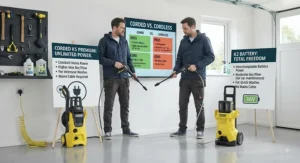
The Bosch UniversalAquatak 135 earns its spot here on the strength of its accessory bundle: a 3-in-1 nozzle combining fan jet, rotary jet and point jet in a single head, plus a dedicated detergent nozzle, all included as standard rather than sold separately. Its 135 bar pressure and 450 litres-per-hour flow rate put it a notch above the K2 in raw output, backed by a 1,900W motor that Bosch’s own testing pairs with a 7-metre high-pressure hose — genuinely useful reach if you’re washing a car parked away from the nearest outdoor tap.
In practice, that 3-in-1 nozzle means you’re not fumbling to swap attachments mid-wash: twist from a wide fan for bonnet and roof panels to a tighter rotary jet for wheel arches without disconnecting anything. Here’s what to weigh: the UniversalAquatak 135 is pitched as a genuine multi-surface tool (Bosch markets it for patios and garden furniture too), so if your household also has a patch of decking or a mossy path to deal with, it does double duty in a way the more car-focused K2 doesn’t.
Aggregated customer sentiment around the UniversalAquatak range is broadly positive on build quality and ease of assembly, with the pivoting, height-adjustable handle repeatedly mentioned as a nice practical touch for storage. The main friction point raised in reviews is around the quick-coupling nozzle system occasionally needing a firm push to seat properly when swapping attachments — a minor gripe rather than a dealbreaker, but worth knowing before you unbox it expecting a silky-smooth click every time.
Pros:
- ✅ 3-in-1 nozzle covers most car-cleaning jobs without swapping tools
- ✅ Generous 7-metre hose for reaching cars parked further from the tap
- ✅ Height-adjustable, foldable handle for easier storage
Cons:
- ❌ Nozzle coupling can require a firm push to seat correctly
- ❌ Heavier than the K2 at just under 7kg
Typically found in the low-to-mid £100s, this is the machine we’d point a first-time buyer towards if they want one pressure washer to competently handle both the car and the patio.
3. Kärcher K4 Power Control — the UK’s default mid-range choice, for good reason
The Kärcher K4 Power Control is the pressure washer most UK households end up owning, and the reason isn’t marketing — it’s the genuinely useful Power Control dial built into the trigger gun, which shows the current pressure setting on an LCD display so you can dial down for bodywork and up for concrete without guesswork. At 130 bar and 420 litres per hour, driven by a water-cooled 1,800W motor, it sits comfortably above entry-level units while staying well short of professional-grade output.
What most buyers overlook about the K4 is that its real advantage over cheaper machines isn’t raw pressure — it’s control. Being able to twist from a gentle setting for a soft-top roof or matte wrap to a firmer setting for stubborn tar spots on the sills, without swapping lances, is the kind of everyday convenience that spec sheets undersell. Based on the spec comparison with the Nilfisk Core 140 below, the K4 trails slightly on both bar pressure and flow rate, but its dirt-blaster and Vario Power lances (both included) give it more out-of-the-box versatility for a mixed driveway-and-car routine.
Aggregated review sentiment on the K4 is genuinely mixed in an instructive way. Long-time Kärcher owners frequently cite decades of brand loyalty and reliability, and independent reviewers have rated it highly for its all-round balance of cleaning power, convenience and price for a domestic machine. That said, a recurring thread across review platforms flags occasional durability concerns after a year or more of use, along with a handle that some owners feel doesn’t lock as firmly as they’d like, and assembly instructions that a fair few buyers describe as fiddly on first unboxing. Reviewers consistently note that these gripes rarely put people off the machine once it’s set up and running.
Pros:
- ✅ On-gun pressure display removes the guesswork for delicate panels
- ✅ Included dirt-blaster and Vario Power lances cover most tasks
- ✅ Widely regarded as the best all-round balance of price and power
Cons:
- ❌ Some owners report durability issues after extended use
- ❌ Assembly is fiddlier than the simpler K2
Sitting in roughly the £150-£220 range depending on the bundle, the K4 is the safe, sensible middle-of-the-road pick — the pressure washer you buy when you genuinely don’t want to think about it too hard.
4. Nilfisk Core 140 — more bar and flow rate than the K4, for less outlay
The Nilfisk Core 140 is the pressure washer that keeps coming up in car-cleaning forums specifically because it out-specs the market-leading K4 while typically costing less. At 140 bar and 480 litres per hour, it edges ahead of the Kärcher on both key figures, and Nilfisk fits it with an aluminium pump — a genuinely meaningful detail, since Nilfisk is the only manufacturer in this class using aluminium rather than the more common composite or brass-lined alternatives, which independent reviewers link to longer service life under regular use.
Here’s what to weigh: the Core 140 comes in a Powercontrol version and a pricier In-Hand Powercontrol version with an 8-metre hose (two metres longer) and pressure adjustment built into the gun itself rather than the lance. For anyone regularly washing a larger vehicle — an estate, an SUV, a van — that extra hose length genuinely changes the experience, letting you walk a full lap of the car without dragging the unit across the drive. Based on the spec comparison above, this is arguably the strongest pressure-per-pound proposition on this list.
Aggregated owner feedback is consistently strong on build quality and value, with reviewers repeatedly describing it as “practical, affordable and reliable” and specifically recommending the In-Hand version for larger vehicles. A common thread among long-term Nilfisk owners switching from other brands is surprise at how well-built the unit feels for the price, though a handful of reviews note that the bundled foam applicator underperforms compared with dedicated snow-foam lances, prompting some owners to buy a separate foam gun.
Pros:
- ✅ Higher bar pressure and flow rate than the market-leading K4
- ✅ Aluminium pump construction linked to better long-term durability
- ✅ In-Hand version offers gun-mounted pressure control and longer hose
Cons:
- ❌ Bundled foam applicator is a known weak point versus dedicated foam guns
- ❌ In-Hand Powercontrol version costs meaningfully more than the base model
Typically priced in the £150-£250 range depending on version, the Core 140 rewards anyone willing to do five minutes of comparison shopping instead of defaulting straight to the obvious Kärcher.
5. Kärcher K5 Power Control Flex Car & Home — for owners who wash weekly, not occasionally
The Kärcher K5 Power Control Flex Car & Home is Kärcher’s step-up model, built for buyers who’ve outgrown the K4’s ceiling. At 145 bar and 500 litres per hour, it’s the most powerful conventional corded machine on this list short of the professional-grade Kranzle, and the “Car & Home” bundle specifically pairs it with accessories angled at vehicle care rather than pure driveway-blasting duty.
What most buyers overlook about stepping up to a K5 is that the gain isn’t really about scrubbing power for the car itself — 130 bar versus 145 bar makes little visible difference on painted panels — it’s about speed and stamina. The higher flow rate rinses suds off a full-size vehicle noticeably faster, and the more robust motor is built to run longer sessions without the thermal cut-outs that can interrupt cheaper units mid-wash. On paper, this makes the K5 the sensible upgrade for anyone washing weekly rather than monthly, or anyone regularly tackling two vehicles in one session.
Independent testing and aggregated review sentiment consistently place Kärcher’s K5 line among the higher-rated machines in the brand’s range, with owners frequently citing the flexibility of switching between the dirt-blaster lance for wheels and arches and the gentler Vario Power lance for bodywork. The trade-off reviewers most commonly flag is size and weight — at over 13kg, this isn’t a machine you’re lifting one-handed into an understairs cupboard, and a fair few buyers mention needing dedicated garage or shed storage.
Pros:
- ✅ Highest pressure and flow rate of the corded Kärcher range on this list
- ✅ Built for longer, more frequent washing sessions without overheating
- ✅ “Car & Home” accessory bundle specifically tailored to vehicle care
Cons:
- ❌ Significantly heavier and bulkier than the K2 or K4
- ❌ Overkill for anyone washing less than fortnightly
Expect to pay somewhere in the £250-£350 range for the K5 depending on bundle, making it the natural next step once you’ve decided a K4 simply isn’t quite enough machine for your routine.
6. Sealey SV20 Cordless Kit — the one that works without a mains socket nearby
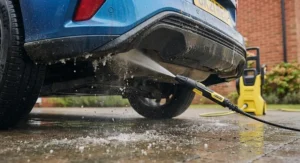
The Sealey SV20 Cordless Kit solves a problem none of the corded machines above can: what happens when there’s no convenient plug socket, whether that’s washing a car on a driveway with an awkward layout, cleaning a caravan before a trip, or hosing mud off a mountain bike before it goes in the boot. Running on the same rechargeable battery platform as a wide range of Sealey’s other cordless tools, it trades outright pressure for genuine portability.
Based on the spec comparison with the corded machines on this list, the SV20 isn’t trying to out-power a K5 or a Kranzle — its appeal is entirely about where and when you can use it. Reviewers note the kit ships with a rotating collar offering six spray patterns, plus a dedicated snow-foam adapter, all packed into a carrying bag alongside the battery and charger. What most buyers overlook about cordless pressure washers generally is that they’re pump-fed from a bucket or water container rather than mains pressure, so you’re trading some flow rate and continuous run time for the freedom to use it absolutely anywhere.
Aggregated review sentiment describes the SV20 as straightforward to assemble, with a push-and-turn lance fitting and rotating collar that owners find intuitive once set up, though the high-pressure hose is repeatedly described as arriving tightly wound and initially stiff before it “beds in” with use. This is a genuinely useful secondary machine for anyone who already owns Sealey’s cordless tool ecosystem, rather than a first and only pressure washer for someone who exclusively washes a car on a driveway with a tap two metres away.
Pros:
- ✅ No mains socket required — genuinely portable for away-from-home washing
- ✅ Shares batteries with a wide range of other Sealey cordless tools
- ✅ Six spray patterns plus a dedicated snow-foam adapter included
Cons:
- ❌ Lower sustained pressure and flow than mains-fed alternatives
- ❌ Hose reportedly stiff and awkward straight out of the box
Pricing varies significantly depending on whether you already own compatible batteries, but as a bare unit it typically sits in a similar bracket to the mid-range corded machines above — worth it specifically for the portability, not for outright cleaning power.
7. Kranzle K1050 TST — the professional detailer’s machine, built to be rebuilt
The Kranzle K1050 TST sits in a different category entirely from everything else on this list, and the price tag — typically upwards of £650 — reflects that immediately. This is pretty much a professional detailer’s pressure washer, fitted with wheels and a hose reel that make it surprisingly home-storage friendly despite its industrial pedigree, delivering up to 160 bar of pressure through a brass water pump engineered specifically for longevity rather than a lightweight composite one.
Here’s what to weigh: the brass pump construction and the fact that Kranzle builds this machine to be rebuildable — with replaceable internal components rather than a disposable pump assembly — is the entire justification for the price gap over the Kärcher and Nilfisk machines above. On paper, this means a K1050 bought today could realistically still be running in a decade with the odd service, where a domestic unit is more commonly replaced outright when a seal fails. That’s a genuinely different value proposition, and one that only makes financial sense for someone using the machine often enough, or professionally enough, to make the rebuildability worth paying for upfront.
Given its position at the professional end of the market, aggregated review sentiment for the K1050 skews heavily towards detailing and valeting professionals rather than casual domestic reviewers, with recurring praise for the selection of metal lances available for different cleaning scenarios and consistent output under sustained daily use. The honest caveat here is that verified consumer review volume for genuinely professional-tier equipment like this is naturally much lower than for mass-market domestic machines, simply because far fewer households buy one — so treat any specific star rating with more caution than you would for a K4 or a Core 140.
Pros:
- ✅ Rebuildable brass pump designed for genuine long-term durability
- ✅ Wheeled, hose-reel design keeps a professional-grade unit storable at home
- ✅ Wide selection of metal lances for different cleaning scenarios
Cons:
- ❌ Price sits well above anything else on this list
- ❌ Overkill for anyone washing fewer than one or two cars regularly
At around £650-£750, the K1050 only earns its keep for serious enthusiasts or anyone running a small detailing side-business — for everyone else, the K5 above will do 90% of the job for a third of the outlay.
Home Pressure Washer For Vehicles: Practical Usage Guide
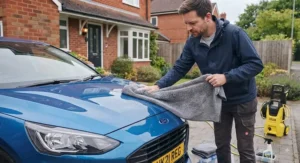
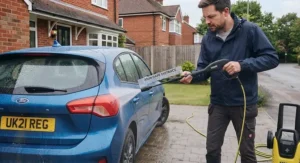
Getting a new pressure washer for car cleaning working well from day one is less about the machine and more about technique, and this is exactly the sort of practical detail Amazon listings never cover. First, always start with the widest fan-jet setting and the lance held at least 30cm from the panel, working your way closer only if the dirt genuinely isn’t lifting — going straight in with a narrow jet at close range is the single most common cause of swirl marks and, in rare cases, actual paint damage on older or already-scratched bodywork. Second, rinse from the top of the car downwards, so dirt and grit are carried away from panels you’ve already cleaned rather than dragged back across them.
In terms of maintenance, the water inlet filter is the part most owners forget entirely — check and rinse it every few washes, because a clogged filter is the leading cause of pressure loss that owners mistake for a failing pump. After each use, disconnect the hose and let the unit drain fully before storage, particularly through a UK winter, since residual water left in the pump can freeze and crack seals. A common mistake in the first 30 days is skipping the detergent nozzle’s dedicated pre-wash step; applying a snow-foam or shampoo pre-wash at low pressure before rinsing loosens grime chemically rather than relying on brute mechanical force, which is gentler on paintwork over the long run. Finally, resist the urge to use hot water through a domestic pressure washer unless the manufacturer specifically permits it — most of these units, including several on this list, are rated for cold water only, and running warm water through them can damage internal seals. Before you plug in for the first time, it’s also worth double-checking your outdoor socket setup — guidance from Electrical Safety First recommends every outdoor electrical circuit be protected by an RCD, since a damaged cable near standing water is a genuine hazard, not a theoretical one.
Real-World Scenarios: Which Pressure Washer Suits You?
Picture three genuinely different UK households, because the “best” machine changes completely depending on who’s asking. Consider a first-year university student, £120 to spend, washing a ten-year-old hatchback in a shared driveway roughly once a month — for that budget and that frequency, the Kärcher K2 Horizontal is the obvious call: light enough to store in a shared hallway cupboard, and there’s no sense spending on power that’ll rarely get used. Now picture a family of four in a semi-detached house with two cars, a static caravan parked round the side, and a weekly wash-and-wax routine — here, the Nilfisk Core 140 or Kärcher K4 Power Control make far more sense, with enough flow rate and hose length to get through two vehicles without the whole afternoon disappearing.
Finally, imagine someone running a small mobile valeting sideline out of a rural cottage with no reliable mains socket near the customer’s driveway — for that specific problem, raw power matters less than the Sealey SV20 Cordless Kit‘s freedom to work anywhere with a water source, even if it means accepting lower sustained pressure. None of these three answers is “better” in the abstract; each is correct for the specific mix of budget, frequency and environment it’s matched to, which is precisely the kind of context-dependent advice a generic spec sheet can’t give you.
How to Choose a Pressure Washer For Cars
- Match bar pressure to your actual surface, not the biggest number available. Anything from 100-140 bar is genuinely plenty for painted bodywork; higher figures mainly help with driveways and patios, not paint.
- Prioritise flow rate for larger vehicles. A higher litres-per-hour figure rinses suds off an SUV or estate car noticeably faster than a high-bar, low-flow alternative.
- Check hose length before you buy, not after. An 8-metre hose lets you walk a full lap of most cars without repositioning the unit; a 4-metre hose often can’t.
- Weigh up storage realistically. A 26kg professional unit is a poor fit for a flat with no shed, however tempting the spec sheet looks.
- Look for adjustable pressure control on the gun or lance. Being able to soften the jet for delicate trim without swapping attachments genuinely changes day-to-day usability.
- Factor in nozzle attachments included as standard, since a rotary or 3-in-1 nozzle bundled free saves a further £15-£30 buying one separately later.
- Consider pump material if you’ll use it weekly or more. Aluminium or brass pumps, as found on the Nilfisk and Kranzle models above, are consistently linked to longer service life under frequent use than budget composite pumps.
Bar Pressure and Flow Rate Explained
The cleaning power of a pressure washer, or jet wash, is determined by two main figures working together, and understanding both is the difference between buying on spec-sheet bragging rights and buying what actually suits your driveway. Bar pressure measures the raw force of the water hitting the surface — useful for breaking the bond between dirt and paint — while flow rate, measured in litres per hour, measures how much water is actually being delivered to rinse that loosened dirt away. A machine with high bar pressure but a low flow rate can feel powerful in short bursts but will take noticeably longer to fully rinse a large panel clean, because there simply isn’t enough volume of water moving through the nozzle.
For cars specifically, the two figures matter in slightly different proportions than they do for driveways. Paintwork rarely needs more than 130-145 bar to shift road film and brake dust safely, so once you’re within that range, flow rate becomes the more meaningful differentiator between models — it’s the reason the Nilfisk Core 140‘s 480 l/h genuinely outperforms the Kärcher K4‘s 420 l/h in practice, even though the bar-pressure gap between them is small. Reviewers consistently note this is also why nozzle attachments matter so much: a rotary or fan-jet nozzle spreads the same flow rate over a wider area, effectively trading concentrated force for coverage speed, which is exactly what you want on a bonnet or roof panel rather than a stubborn patch of driveway moss.
Nozzle Attachments: What Each One Actually Does
Every pressure washer on this list ships with some combination of nozzle attachments, and knowing what each does in practice saves a lot of trial and error on your first wash. A fan-jet or “0/25/40-degree” nozzle spreads water across a wider arc at lower concentrated force — this is your default setting for bodywork, roof panels and glass, and the one you should reach for first every single time. A rotary or “turbo” nozzle spins a concentrated jet in a tight circle, combining the coverage of a fan spray with punchier cleaning force, making it genuinely effective on wheel arches, alloy wheels and tar spots on lower sills, but it’s also the attachment most likely to mark delicate trim or old paintwork if used carelessly.
A dedicated detergent or foam nozzle draws shampoo or snow foam from a bottle at low pressure, coating the car in suds that chemically loosen dirt before you switch back to a rinse nozzle — skipping this step and going straight to high-pressure rinsing on a filthy car is precisely the shortcut that causes fine scratching. Point or “pencil” jets, included on some of the pricier models here like the Bosch UniversalAquatak 135‘s 3-in-1 head, deliver the narrowest, most concentrated stream and should be reserved for genuinely stubborn spots such as dried mud in wheel arch liners, never for open panels. What most buyers overlook is that the nozzle you choose matters as much as the machine’s bar rating in determining whether a wash is safe for the paint — the same pump behind a fan-jet nozzle and a pencil-jet nozzle can produce a completely different real-world risk to your bodywork.
Common Mistakes When Buying a Pressure Washer For Car Cleaning
The single most common mistake is chasing the highest bar-pressure figure on the shelf on the assumption that more power automatically means a better wash — as covered above, anything past roughly 145 bar buys you very little extra for painted bodywork and mostly just adds weight, cost and storage headaches. A closely related error is ignoring flow rate entirely, ending up with a machine that has an impressive-sounding bar figure on the box but takes twice as long to rinse a full car simply because it’s not moving enough water per minute.
Another recurring pitfall, borne out in aggregated review sentiment across several of the models above, is underestimating hose and cable length before buying, then discovering the unit can’t comfortably reach round a car parked on a longer driveway without repositioning mid-wash. Buyers also frequently skip checking whether a nozzle sold as “included” actually covers foam application, only to find — as with the Nilfisk Core 140’s bundled applicator — that a separate foam gun is needed for genuinely good suds coverage. Finally, a mistake specific to cordless models like the Sealey SV20 is assuming battery-powered performance will match a mains-fed unit litre-for-litre; it won’t, and buying cordless purely for perceived convenience rather than a genuine need for portability usually means paying more for less sustained pressure.
Pressure Washer For Car Cleaning vs Traditional Bucket-and-Sponge Washing
| Factor | Pressure Washer | Bucket & Sponge |
|---|---|---|
| Risk of swirl marks | Low, if used correctly | High — traps grit against paint |
| Water usage per wash | Lower overall (targeted, faster) | Higher (frequent refilling, hose top-ups) |
| Time per wash | Faster for full exterior | Slower, especially for larger vehicles |
| Upfront cost | £100-£750+ | Under £30 |
| Best For | Regular washing without paint damage | Occasional touch-ups, spot cleaning |
The table above makes the core trade-off obvious: a pressure washer costs more upfront but removes the single biggest risk factor in traditional car washing, which is dragging trapped grit across paint with a wash mitt. It’s a common misconception that hand-washing with a hose is “gentler” simply because there’s no motor involved — in reality, a domestic hose lacks the force to properly lift dirt before contact, meaning the sponge itself does most of the abrasive work. For anyone washing more than a couple of times a month, the time saved alone tends to justify the initial outlay within a single UK winter of road-salt season.
What to Expect: Real-World Performance
Specs on a box rarely translate directly into what a wash actually feels like, so here’s the honest translation. A 110-130 bar machine like the K2 or K4 will visibly lift standard road film and light brake dust within one or two passes at a sensible distance, but genuinely baked-on tar spots or months-old bird droppings may still need a pre-soak with detergent rather than pressure alone — no domestic machine turns that into a single-pass job. Stepping up to 140-160 bar, as with the Nilfisk Core 140, Kärcher K5 or Kranzle K1050, mainly shows up as speed rather than a dramatically “cleaner” result — the same job gets done, just with fewer passes and less standing around.
Flow rate differences are more noticeable on larger vehicles: rinsing a full-size estate or SUV with a 360 l/h machine versus a 500 l/h one is a genuinely different experience in terms of how long you’re stood there with a hose in hand. What the spec sheet won’t tell you, but reviewers note repeatedly, is that noise level varies more between models than you’d expect from wattage figures alone, with some higher-powered units running noticeably quieter than their predecessors thanks to improved motor engineering — worth bearing in mind if you’re washing early on a weekend in a terraced street.
Long-Term Cost and Maintenance
Total cost of ownership for a pressure washer isn’t just the sticker price — it’s sticker price plus the likelihood of needing repairs or a replacement pump over the machine’s realistic lifespan. Budget composite-pump units like the K2 typically cost less upfront but are more commonly replaced outright rather than repaired if a seal or valve fails after a few years of use, which is a perfectly reasonable trade-off for someone washing occasionally. Mid-range machines with aluminium pumps, such as the Nilfisk Core 140, sit in the middle: a moderately higher upfront cost that aggregated reviews link to noticeably longer service life under regular weekly use.
At the top end, the Kranzle K1050’s brass, genuinely rebuildable pump changes the maths entirely — replacement parts and servicing are readily available specifically because Kranzle designs the machine to be serviced rather than binned, meaning the effective cost-per-year over a decade of heavy use can actually undercut buying two or three cheaper machines in succession. For most UK households washing a car every one to four weeks, though, a mid-range machine in the £150-£350 bracket realistically offers the best balance between upfront cost and years of reliable service before replacement becomes necessary.
Safety, Regulations and Compliance Guide
Before buying, it’s worth knowing that mains-fed pressure washers are subject to genuine legal restrictions in the UK that a hosepipe-only owner might not expect. Under the Water Industry Act 1991, Section 76, as amended by the Flood and Water Management Act 2010, water companies can issue Temporary Use Bans — commonly known as hosepipe bans — during periods of water shortage, and a mains-connected pressure washer is legally treated the same as a hosepipe for this purpose. As Ofwat, the water regulator, confirms, breaching a ban can carry a fine of up to £1,000, so it’s genuinely worth checking your water company’s current notices before assuming your new pressure washer is fine to use during a dry summer; a unit fed from a water butt rather than the mains tap is typically unaffected by these restrictions.
Electrical safety matters just as much as water compliance. Because pressure washers combine mains electricity with large volumes of water at close range, using one without a residual current device (RCD) protecting the socket is a genuine and well-documented risk — guidance from Electrical Safety First recommends an RCD on every outdoor electrical circuit, since without one, damage to a cable during use could prove fatal. If your outdoor socket isn’t already RCD-protected, a plug-in RCD adaptor is a cheap and sensible addition alongside any of the machines reviewed above. It’s also worth checking any model you’re considering for UKCA or CE marking, confirming it meets current UK product safety standards, and always using an outdoor-rated extension lead, fully uncoiled, if the supplied cable doesn’t reach your socket.
Features That Actually Matter (And Those That Don’t)
Marketing copy on pressure washer boxes tends to emphasise headline bar-pressure figures above almost everything else, but as covered earlier, that number matters far less for car cleaning than flow rate, nozzle quality and gun-mounted pressure control once you’re within the 110-160 bar range common to domestic machines. Features that genuinely earn their keep include an on-gun pressure display or adjustment dial (as on the K4 and K5), a bundled detergent or foam nozzle that actually produces usable foam rather than a thin rinse, and hose length beyond the bare minimum — all three directly change how easy and safe a wash is in practice.
Features that sound impressive but rarely change the outcome for a typical car-washing routine include very high maximum bar ratings above 150, since domestic paintwork simply doesn’t need it and most of that extra force is wasted or, worse, risks damage if used carelessly at close range. Similarly, “auto-stop” functions that pause the motor when the trigger is released are a genuinely useful energy-saving feature but are sometimes marketed as a headline selling point when in reality most modern domestic machines include some version of it as standard. The honest takeaway: read past the big numbers on the box and look specifically at flow rate, hose length and included nozzles before comparing prices.
Frequently Asked Questions
❓ Is 100 bar enough pressure washer for a car?
❓ What bar pressure is best for washing a car without damaging paint?
❓ Can you use a pressure washer during a hosepipe ban in the UK?
❓ How often should you pressure wash a car in the UK?
❓ Do cordless pressure washers work as well as corded ones for car cleaning?
Conclusion
There’s no single correct answer to “which pressure washer for cars should I buy” — and if anything, that’s the most useful thing to take from this guide. The Kärcher K2 Horizontal and Bosch UniversalAquatak 135 cover casual, occasional washers who mainly care about not damaging a car’s paint and not needing a shed to store the thing. The Kärcher K4 Power Control and Nilfisk Core 140 sit squarely in the sweet spot most UK households actually need, trading a little extra outlay for genuinely useful pressure control and better flow rate. Step up to the Kärcher K5 Power Control Flex Car & Home if you’re washing weekly or handling two vehicles, reach for the Sealey SV20 Cordless Kit specifically if mains access is the problem you’re solving, and only consider the Kranzle K1050 TST if you’re washing often enough, or professionally enough, that a rebuildable brass pump genuinely pays for itself over a decade.
Whichever you choose, the underlying advice stays consistent: match bar pressure and flow rate to your actual surface and vehicle size rather than the biggest number on the box, use the right nozzle for the job, respect the water and electrical safety rules covered above, and let the water — not a scrubbing arm — do the work of getting your car properly clean.
✨ Don’t Miss These Exclusive Deals!
🔍 Take your car-cleaning routine to the next level with the pressure washers featured above. Click through on any highlighted model to check current pricing and availability on Amazon UK. The right machine will help you keep your car looking genuinely showroom-fresh, without the elbow grease or the paint swirls.
Recommended for You
- Wash and Wax Kit vs Separate Products: 7 Picks 2026
- Interior Car Cleaning Kit: 7 Best Picks to Stop the Mess in 2026
- Car Interior Detailing Kit for Leather Seats: 7 Best Picks (2026)
Disclaimer: This article contains affiliate links. As an Amazon Associate, I earn from qualifying purchases. If you purchase products through these links, we may earn a small commission at no additional cost to you.
✨ Found this helpful? Share it with your friends! 💬🤗
