
In This Article
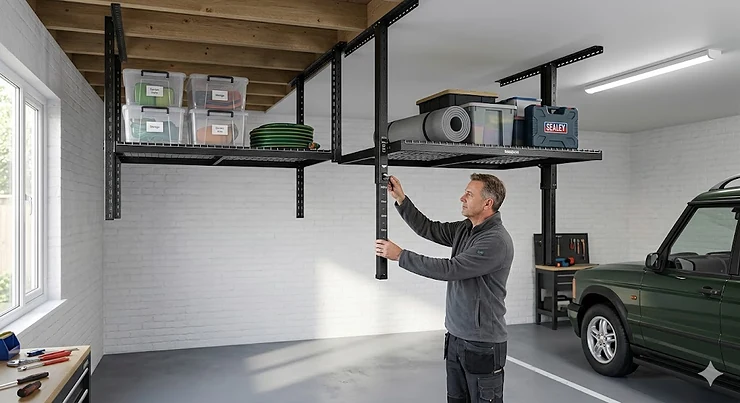
If you’re like most British homeowners, your garage has become a dumping ground for Christmas decorations, camping gear, and everything that doesn’t quite fit in the house. The problem? Floor space disappears fast, especially in the compact garages typical of UK properties. The solution sits directly above your head: that vast expanse of unused ceiling space.
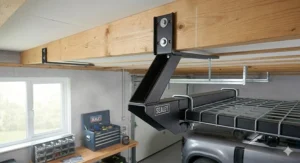
A ceiling storage rack garage system transforms wasted overhead area into valuable storage real estate. Rather than stacking boxes on the floor and playing Tetris every time you need the car, you’re utilising vertical space that would otherwise sit empty. What most UK buyers overlook about ceiling storage is how it actually increases your usable garage area — not by expanding the footprint, but by thinking three-dimensionally. When properly installed into ceiling joists, these racks can safely support 100-360 kg, enough to store seasonal items, sporting equipment, tools, and those bulky suitcases you only need twice a year.
The British climate adds an extra layer of consideration. Our damp, wet weather means rust resistance matters more than in drier climates. Steel racks need proper powder-coating treatment to survive the moisture that seeps into unheated garages during autumn and winter months. Additionally, UK homes typically feature smaller garage spaces compared to North American properties — making every centimetre of overhead storage genuinely valuable. According to UK Government building regulations, ceiling joists must meet specific load-bearing requirements, which directly impacts how much weight your overhead storage can safely handle.
This guide covers seven ceiling storage rack garage options available to UK buyers, with real-world performance insights you won’t find on product listings. We’ve researched products available through Amazon.co.uk, verified UK compatibility, and included price ranges in pounds sterling. Whether you’re working with a standard 2.4-metre ceiling or need adjustable drop heights for awkward garage door clearances, you’ll find practical recommendations that suit British properties and budgets.
Quick Comparison: Top Ceiling Storage Rack Garage Options
| Product | Size | Weight Capacity | Height Range | Price Range (£) | Best For |
|---|---|---|---|---|---|
| FLEXIMOUNTS 4×8 Classic | 2.4m x 1.2m | 340 kg | 56-102 cm drop | £150-£200 | Adjustability & value |
| SafeRacks 4×8 Heavy Duty | 2.4m x 1.2m | 270 kg | 61-114 cm drop | £180-£220 | Fixed height install |
| SunsGrove 4×8 HD | 2.4m x 1.2m | 360 kg | 56-102 cm drop | £170-£210 | Maximum capacity |
| HyLoft 45×45 | 114 cm x 114 cm | 110 kg | Fixed height | £80-£120 | Compact spaces |
| Edsal MuscleRack | 120 cm x 120 cm | 180 kg | Adjustable | £60-£90 | Budget option |
| MonsterRax 4×8 | 2.4m x 1.2m | 270 kg | 61-114 cm drop | £160-£200 | Mesh design |
| Gladiator GearLoft 2×4 | 1.2m x 0.6m | 135 kg | Fixed height | £100-£140 | Modular expansion |
From the comparison above, the FLEXIMOUNTS and SunsGrove models deliver the strongest capacity-to-price ratio for UK garages with standard 2.7-3 metre ceiling heights. If you’re dealing with lower ceilings (2.1-2.4 metres), the HyLoft compact option prevents head clearance issues whilst still providing meaningful storage. Budget-conscious buyers should note that the Edsal MuscleRack sacrifices some capacity but still handles typical British garage storage needs — seasonal totes, sports equipment, and camping gear — without breaking the bank.
💬 Just one click — help others make better buying decisions too! 😊
Top 7 Ceiling Storage Rack Garage Systems: Expert Analysis
1. FLEXIMOUNTS 4×8 Classic Series — The Versatile Champion
The FLEXIMOUNTS 4×8 has earned its position as Amazon.co.uk’s consistent bestseller for good reason: it balances capacity, adjustability, and reasonable pricing in a package that suits most British garages. This isn’t the flashiest option, but it’s the one that gets installed, loaded, and forgotten about — which is precisely what overhead storage should do.
At 2.4 metres by 1.2 metres, this rack provides 2.88 square metres of overhead platform space. The adjustable drop range from 56 to 102 cm means you can customise clearance for your specific garage door travel arc or ceiling height. What the spec sheet won’t tell you: that adjustability becomes crucial when you discover your garage has that awkward 2.5-metre ceiling height where fixed-height racks leave you either banging your head or wasting vertical space.
The 340 kg weight capacity handles substantial loads — think multiple Christmas tree boxes, a full set of camping gear, several large plastic storage totes, and your collection of paint tins. The integrated grid design uses 14-gauge cold-rolled steel with powder-coating treatment, which resists the rust and corrosion inevitable in damp British garages. UK buyers consistently mention in reviews that the coating holds up through wet winters far better than cheaper alternatives that show surface rust within months.
UK Considerations: This model ships to the UK via Amazon.co.uk with delivery typically within 3-5 working days for Prime members. Check your ceiling joist spacing before ordering — this rack requires joists at 40 cm or 60 cm on centre, which matches standard UK construction. If your garage has 48 cm spacing (less common but found in some 1970s-80s builds), you’ll need additional mounting hardware.
Customer Feedback: British reviewers highlight the clear instructions (albeit with American terminology) and the solid feel once installed. Common complaint: the rack arrives as a hefty package requiring two people to manoeuvre. One Birmingham buyer noted, “Took an afternoon to install solo, but that’s more about the weight than complexity. Rock solid once up — haven’t thought about it since.”
Pros:
✅ Adjustable height suits varying ceiling configurations
✅ 340 kg capacity handles typical UK family storage needs
✅ Powder-coated finish resists British damp conditions
Cons:
❌ Requires specific joist spacing (check before purchase)
❌ Heavy package needs two-person installation
Price & Value: Available on Amazon.co.uk in the £150-£200 range depending on sales. At that price point, you’re getting a rack that genuinely delivers on its capacity claims and will still look presentable in five years. Worth every penny if you’re tired of paying £80-£120 monthly for that storage unit in town.
2. SafeRacks 4×8 Overhead Storage — Built to Last
The SafeRacks 4×8 represents the “buy once, install once, never think about it again” philosophy. Where FLEXIMOUNTS offers adjustability, SafeRacks provides a fixed-height solution engineered for owners who’ve measured their garage, know their clearances, and want a welded steel frame that won’t budge.
This rack comes in a two-pack configuration (important note: you’re buying two complete racks), with each unit rated at 270 kg capacity. That’s 540 kg total across both racks when distributed properly across your ceiling joists. The white powder-coat finish looks cleaner than black alternatives and helps you actually see what’s stored up there — rather helpful in dim British garage lighting conditions during winter months when you’re hunting for that specific box at 4 PM in fading daylight.
The 61-114 cm ceiling dropdown range positions this rack for garages with at least 2.7 metre ceilings. Anything lower and you’ll be ducking. The steel construction uses thicker gauge material than many competitors, which translates to less flex when loading. That rigidity matters when you’re placing heavy items overhead — wobbly racks make UK buyers nervous, and rightly so.
UK Context: SafeRacks products ship from Amazon.co.uk but often carry slightly longer delivery times (5-7 working days) compared to FLEXIMOUNTS. The two-pack format actually benefits UK buyers: most British garages benefit from paired installations above the garage door area and along the side wall, maximising that awkward space where you can’t park anyway.
Customer Feedback: Reviews from UK buyers emphasise the quality feel. A Surrey homeowner commented, “American product but feels properly engineered, not flimsy. Installed both units in one weekend. My wife was sceptical about ceiling storage but now she’s planning what else we can store up there.” The recurring theme: solid, confidence-inspiring installation.
Pros:
✅ Heavy-duty welded frame design
✅ White finish improves visibility in dimly-lit garages
✅ Two-pack format suits typical UK garage layouts
Cons:
❌ Fixed drop height requires accurate pre-measurement
❌ Not suitable for garages under 2.7m ceiling height
Price & Value: Typically £180-£220 on Amazon.co.uk for the two-pack. That’s roughly £90-£110 per rack, making it competitive pricing for the build quality. If you know you need two units anyway, this bundled approach delivers better value than buying singles.
3. SunsGrove 4×8 Heavy-Duty System — The Heavyweight Champion
When British buyers say “I need to store everything,” the SunsGrove 4×8 answers that call. This rack publishes a 360 kg manufacturer-listed capacity — the highest in the standard 2.4m x 1.2m category. That extra capacity comes from upgraded slat design: instead of thin wire grid common on budget racks, SunsGrove uses 5 cm wide powder-coated steel slats creating an integrated platform.
The practical difference? You can load this rack with denser items without worrying about deck flex. Think stored cabinetry from that kitchen renovation you’re planning, bulk paper goods from that Costco run, or those impossibly heavy boxes of books you haven’t sorted since the house move. The hammertone black finish hides minor scuffs better than gloss alternatives — relevant for UK garages where you’re brushing past it with muddy wellies and garden tools.
The 56-102 cm adjustable drop gives you the same flexibility as FLEXIMOUNTS whilst handling more weight. What you’re paying extra for is peace of mind when loading heavy items. No other mainstream rack available through Amazon.co.uk publishes a higher capacity specification.
UK Practicalities: This rack ships to most UK addresses within standard delivery windows. The heavier construction means the package weighs more (roughly 40 kg), so delivery to your garage directly rather than leaving it on the doorstep is advisable. Most couriers will accommodate if you’re home.
Customer Feedback: UK reviews consistently mention the sturdy feel. A Manchester buyer noted, “I was storing lighter stuff on my old rack and still worried. This one holds camping equipment, the tent trailer bits, and heavy storage bins without any flex. Properly rated for what it claims.” The extra capacity costs marginally more but eliminates that nagging doubt about whether the rack can handle the load.
Pros:
✅ 360 kg capacity tops the category
✅ Wide-slat deck design reduces flex under load
✅ Hammertone finish hides wear better than gloss
Cons:
❌ Heavier package complicates solo installation
❌ Slightly higher price point than competitors
Price & Value: £170-£210 on Amazon.co.uk. The premium over FLEXIMOUNTS (£20-£30) buys you that extra weight capacity. If you’re genuinely loading near 300+ kg, that premium is cheap insurance against ceiling repairs later.
4. HyLoft 45×45 Compact Storage — Perfect for Limited Spaces
Not every British garage offers 2.7+ metre ceiling clearance. Terraced houses, older properties, and converted garage spaces often feature lower ceilings where standard 2.4m racks create head clearance nightmares. The HyLoft 45×45 specifically targets these constrained UK spaces.
At 114 cm square, this compact rack provides 1.3 square metres of overhead storage — roughly half the footprint of full-size models. The 110 kg capacity suits lighter seasonal storage: Christmas decorations, camping sleeping bags, inflatable kayaks, sports equipment, and those bulky winter coats that consume wardrobe space nine months of the year. This isn’t the rack for storing your complete tool collection, but that’s not its purpose.
The white gloss finish reflects light in dim garages, making stored items more visible. The fixed-height design simplifies installation by reducing adjustment variables — you’re mounting brackets at specific positions rather than tweaking drop lengths. For UK buyers working alone, the lighter weight (approximately 12 kg packaged) makes solo installation genuinely feasible.
UK Suitability: This rack excels in British garage contexts: compact spaces, lower ceilings, and situations where you need storage but can’t sacrifice head clearance. It’s particularly well-suited for garages in Victorian terraces, where ceiling heights rarely exceed 2.2-2.4 metres and every centimetre matters.
Customer Feedback: UK reviews emphasise its role as a secondary storage solution. A Bristol buyer explained, “I have a larger rack in the main garage area, but this HyLoft fits perfectly above the side workbench where a full-size rack wouldn’t clear. Holds all my seasonal decorations without issue.” The compact size becomes a feature, not a limitation, when space is genuinely constrained.
Pros:
✅ Compact footprint suits low-ceiling UK garages
✅ Lighter weight enables solo installation
✅ White finish improves visibility in dim spaces
Cons:
❌ Limited 110 kg capacity restricts heavier storage
❌ Smaller platform requires selective item storage
Price & Value: £80-£120 on Amazon.co.uk. For the specific use case — compact garages needing supplementary overhead storage — this delivers solid value. Don’t expect it to replace floor storage entirely, but it successfully reclaims ceiling space where larger racks physically won’t fit.
5. Edsal MuscleRack Ceiling Storage — The Budget Champion
The Edsal MuscleRack represents the entry point for British buyers testing overhead storage without committing to premium pricing. At 120 cm square and 180 kg capacity, this rack handles typical family garage storage whilst keeping costs firmly in budget territory.
The adjustable height mechanism uses a straightforward bracket design rather than the more complex dropdown systems on pricier alternatives. You’re setting the height during installation and likely leaving it there permanently. The powder-coated steel construction provides basic rust resistance — adequate for heated or well-ventilated garages, though it won’t match the longevity of thicker coatings on premium racks in persistently damp conditions.
What you’re trading for the lower price: maximum capacity (180 kg vs 270-360 kg on premium models), adjustment refinement, and build quality. But here’s the reality for many UK households: if you’re storing Christmas decorations, camping gear, and seasonal sports equipment, you’re nowhere near 180 kg anyway. The MuscleRack handles that usage perfectly well.
UK Value Proposition: This rack particularly suits renters, first-time garage organisers, or those genuinely uncertain whether ceiling storage will work for their situation. The lower investment means less financial risk if you later decide overhead storage isn’t your preferred approach or if you move house within a few years.
Customer Feedback: British reviewers appreciate the straightforward functionality. A Leeds buyer noted, “No fancy features, but it does what it says. Holds my Christmas stuff and camping equipment. Saved me from renting storage space, so it’s paid for itself in two months.” The consistent theme: basic but functional.
Pros:
✅ Budget-friendly entry point (under £90)
✅ Adequate capacity for typical family storage
✅ Simple installation process
Cons:
❌ Lower capacity limits heavier item storage
❌ Basic powder coating less durable in damp conditions
Price & Value: £60-£90 on Amazon.co.uk. This price point makes overhead storage accessible to UK households on tighter budgets. You’re getting functional storage that works, even if it lacks the premium feel and capacity of higher-priced alternatives. Sometimes “good enough” genuinely is good enough.
6. MonsterRax 4×8 Overhead System — Mesh Design Alternative
The MonsterRax 4×8 offers an interesting alternative to solid platform designs: a wire mesh deck that prioritises airflow and visibility over maximum density. This 2.4m x 1.2m rack features 270 kg capacity with mesh grid construction that lets you see through to items stored above and allows air circulation around stored goods.
That airflow matters in British garages prone to dampness. Solid platform racks can trap moisture against stored items, particularly problematic for cardboard boxes containing fabric items like seasonal clothing or camping gear. The mesh design allows moisture to escape rather than condensing against a solid surface. Additionally, the see-through construction helps you identify stored items without pulling everything down — useful when you’re hunting for that specific decoration box in the Christmas storage collection.
The 61-114 cm ceiling dropdown positions this rack similarly to SafeRacks (in fact, MonsterRax and SafeRacks share manufacturing heritage — essentially the same rack under different branding). The grey powder-coat finish splits the difference between white and black alternatives, hiding dust better than white whilst maintaining better visibility than black.
UK Relevance: The mesh design’s airflow advantage particularly benefits unheated UK garages where temperature fluctuations create condensation. Stored cardboard boxes won’t develop that musty smell associated with trapped moisture. For British buyers storing fabric items, camping equipment, or anything vulnerable to mildew, this design choice delivers tangible benefits.
Customer Feedback: UK reviewers note the visual accessibility. A Cornwall buyer commented, “Can spot what I need from the floor without climbing up. The mesh lets light through so I’m not peering into dark shadows trying to find things. Small detail but makes a real difference in practical use.” That visibility advantage reduces the friction of actually using overhead storage — you’re more likely to store items properly when retrieval isn’t a hassle.
Pros:
✅ Mesh design allows airflow and visibility
✅ Reduces moisture trapping in damp garages
✅ 270 kg capacity handles substantial loads
Cons:
❌ Mesh grid less suitable for very small items
❌ Requires similar ceiling heights as SafeRacks
Price & Value: £160-£200 on Amazon.co.uk. The pricing aligns closely with SafeRacks (unsurprising given their shared origins). Choose MonsterRax if you value visibility and airflow; choose SafeRacks if you prefer solid platform construction. Both deliver equivalent structural performance.
7. Gladiator GearLoft 2×4 Storage Platform — Modular Flexibility
The Gladiator GearLoft takes a different approach: smaller modular units that you can deploy strategically rather than committing to one large overhead platform. At 1.2m x 0.6m per unit and 135 kg capacity, this rack targets UK buyers who want overhead storage in multiple ceiling zones rather than a single large installation.
The modular strategy suits British garages with irregular layouts: one unit above the garage door area, another along the side wall, perhaps a third in that awkward corner where the boiler sits. The fixed-height design simplifies installation by eliminating adjustment variables, though it requires accurate ceiling height assessment before purchase. The epoxy powder-coat finish in silver provides durability whilst maintaining a clean appearance.
What makes the GearLoft interesting is expandability. Install one unit initially to test overhead storage practicality, then add more units as your storage needs evolve. The standardised mounting system ensures consistent installation across multiple units. For UK buyers uncertain about committing to large-scale overhead storage, this staged approach reduces initial investment whilst maintaining future expansion options.
UK Application: This modular approach particularly suits irregularly-shaped UK garages where a single large rack won’t fit the space efficiently. Victorian and Edwardian properties often feature garage layouts that don’t accommodate standard rectangular racks — the GearLoft’s smaller footprint navigates these constraints.
Customer Feedback: British buyers appreciate the flexibility. A Glasgow buyer noted, “Started with two units, added a third six months later. They match perfectly and gave me storage where I actually needed it rather than forcing one big rack into the wrong location.” The modular strategy proves its worth when garage layouts don’t cooperate with standard approaches.
Pros:
✅ Modular units allow strategic placement
✅ Staged expansion reduces initial investment
✅ Smaller footprint suits irregular garage layouts
Cons:
❌ Per-unit capacity (135 kg) lower than full-size racks
❌ Total cost increases with multiple units
Price & Value: £100-£140 per unit on Amazon.co.uk. The modular approach means you’re paying premium pricing compared to single large racks, but you’re gaining placement flexibility. For UK garages where standard racks simply won’t fit the available ceiling space, that flexibility justifies the cost premium.
Practical Installation Guide for UK Garages
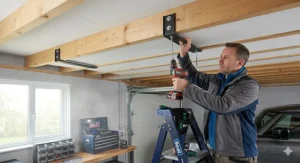
Installing a ceiling storage rack garage system in British properties requires attention to specific structural considerations. Our damp climate, older building stock, and compact garage designs create unique challenges that American installation guides often overlook.
Understanding Your Ceiling Structure
Before ordering any rack, you must identify your ceiling construction type. Most UK garages feature one of three configurations:
Timber Joist Ceilings (Most Common): Standard residential construction uses 50mm x 100mm or 50mm x 150mm timber joists spanning the garage width at 400mm or 600mm centres. These joists support both the ceiling and, in two-storey homes, the floor above. The joists represent your only secure mounting points — drywall alone cannot support overhead storage loads.
Trussed Roof Systems (1970s onwards): Many post-1970 UK homes use prefabricated roof trusses with thin timber chords. The bottom chord often measures just 50mm x 75mm. These trusses were engineered to support roof loads, not additional storage weight hanging below. UK building regulations specify that trusses must not be modified or loaded beyond their design parameters without structural assessment.
Concrete Ceilings (Flats and Conversions): Some garage spaces, particularly in converted buildings or flats, feature concrete ceilings. Standard lag bolts won’t work — you’ll need specialist concrete anchors rated for overhead loads. If you’re dealing with concrete, consult a structural engineer before proceeding.
Locating Ceiling Joists in British Garages
If your garage ceiling is finished with plasterboard (drywall), the joists sit hidden behind the surface. Use a stud finder designed for the UK market — these typically detect timber at standard British spacing intervals. Alternatively, measure 400mm or 600mm from a wall edge where joists typically run parallel to the garage door.
Many older UK garages feature exposed joists without ceiling finish. This simplifies installation by making joist locations obvious, though you’ll still need to verify joist condition. Check for water damage, wood rot, or insect damage. Soft, spongy wood cannot safely support overhead loads regardless of the rack’s rating.
Weight Distribution Fundamentals
Here’s what ceiling storage rack garage manufacturers won’t explicitly state: the rack’s capacity assumes your ceiling can handle it. British building standards typically allow 100 kg per square metre distributed load on residential ceiling joists. Concentrated loads (hanging a single heavy item from one point) create stress concentrations that joists weren’t designed to handle.
Proper weight distribution means spreading your stored items across the entire rack platform rather than stacking everything in one corner. Additionally, mount your rack to multiple joists — at minimum three, ideally four or more. This distributes the load across several structural members working together rather than stressing a single joist.
Accounting for British Weather Conditions
Our persistent damp climate creates unique challenges for ceiling storage installation:
Rust Prevention: Choose racks with quality powder-coating rather than painted finishes. Powder coating creates a more durable barrier against moisture penetration. Check coating quality on mounting hardware (lag bolts, washers) as well — these smaller components often corrode first in damp garages.
Condensation Management: Unheated garages experience temperature fluctuations that create condensation on stored items. Place items in sealed plastic totes rather than cardboard boxes where possible. The mesh-style racks (like MonsterRax) offer better airflow around stored goods, reducing condensation trapping.
Seasonal Expansion/Contraction: Timber joists expand and contract with humidity changes throughout the British year. After initial installation, check bolt tightness after the first winter-summer cycle. Settling and seasonal movement can loosen connections that were initially secure.
Installation Timeline for UK DIY
Most UK homeowners can complete ceiling storage rack installation over a weekend working at a reasonable pace:
Day 1 (2-3 hours): Locate and mark joist positions. Verify joist condition. Measure and mark rack mounting locations. Gather all tools and hardware. Pre-drill pilot holes. This preparation prevents rushed decisions during actual installation.
Day 2 (3-4 hours): Install mounting brackets. Lift rack into position (requires two people for full-size racks). Secure lag bolts. Level and adjust height (if applicable). Load test with gradual weight addition. The actual installation moves quickly if Day 1 preparation was thorough.
When to Hire Professional Installation
Consider professional installation if you encounter any of these situations:
- Ceiling height exceeds 3 metres (working overhead at height increases difficulty and risk)
- Uncertain joist condition or visible structural damage
- Trussed roof system requiring structural assessment
- Concrete ceiling requiring specialist anchors
- Physical limitations preventing safe overhead work
Several UK garage storage companies offer professional installation services ranging from £150-£300 depending on rack complexity and location. For many British homeowners, particularly those in older properties with uncertain structural integrity, this professional assessment provides valuable peace of mind.
How to Choose the Right Ceiling Storage Rack for Your UK Garage
Selecting the optimal ceiling storage rack garage system requires matching product capabilities to your specific British garage constraints. Here’s the decision framework that actually works in UK properties.
Ceiling Height Assessment
Measure the distance from your garage floor to the ceiling. Then subtract 200cm (minimum vehicle clearance) plus the rack’s ceiling dropdown distance. The remaining figure represents your effective usable storage height.
Example: Your garage has a 270cm ceiling. Your car bonnet sits at 140cm. A rack with 60cm ceiling dropdown leaves 70cm clearance above the car. That works. A rack with 100cm dropdown leaves just 30cm — barely enough to walk under, creating a constant head-banging hazard.
British garages typically feature 230-280cm ceiling heights. Any garage under 240cm requires careful rack selection focusing on compact models or those with minimal dropout. Standard 2.4m x 1.2m racks work best with 260cm+ ceiling heights.
Joist Spacing Verification
UK building practices changed over decades, creating variance in joist spacing across housing stock:
Pre-1960 Properties: Often feature 400mm centres or irregular spacing
1960-1990 Construction: Typically 400mm or 600mm centres
Post-1990 Builds: Usually standardised 600mm centres
Most ceiling storage racks accommodate 400mm or 600mm spacing. If your garage features 480mm spacing (occasionally found in 1970s-80s construction), verify the rack’s compatibility. Some manufacturers provide adapter brackets for non-standard spacing.
Weight Capacity Reality Check
Manufacturers publish maximum weight capacities assuming optimal conditions: perfect joist condition, proper installation, evenly distributed loads. Apply a safety factor by planning for 70-80% of published capacity in real-world UK garage conditions.
A 300kg-rated rack should handle 210-240kg comfortably in typical applications. This safety margin accounts for joist age, variable installation quality, and the reality that most people don’t distribute weight perfectly across the platform.
Storage Need Categories
Different storage types suit different rack configurations:
Seasonal Items (Christmas, camping, holiday gear): Any rack capacity from 100kg upwards. These items store long-term with infrequent access. Volume matters more than weight capacity. Choose larger platforms (2.4m x 1.2m) for bulky but light items.
Sports Equipment (bikes, kayaks, skiing gear): Requires 200kg+ capacity for families with multiple sets. Individual bikes weigh 10-15kg, but three bikes plus storage bins quickly accumulate. Consider racks with integrated hooks (like FLEXIMOUNTS with hooks) for hanging equipment below the platform.
Tools and Workshop Supplies: Needs 250kg+ capacity. Power tools, material stocks, and hardware collections create surprising weight. The SunsGrove 360kg model suits this application where density matters.
Archive Storage (records, books, accumulated possessions): Requires maximum capacity racks (300kg+). Books and paper documents create exceptional weight density. A single storage tote of books can exceed 20kg. Multiple totes quickly approach rack limits.
Garage Door Clearance Complications
British garages use three common door types, each creating different clearance challenges:
Up-and-Over Doors: The most common UK type. The door panel swings out then lifts overhead. Install ceiling storage racks forward of the door’s maximum travel point, typically 30-50cm inside the garage from the door. The door’s pivot mechanism consumes ceiling space during operation.
Sectional Doors: Increasingly common in newer UK homes. These doors track along the ceiling requiring clearance throughout their travel path. The ceiling storage rack must clear the track by at least 15cm to prevent collisions.
Side-Hinged Doors: Traditional style still found on older UK properties. These doors don’t affect ceiling space at all, simplifying rack installation. However, garages with side-hinged doors often feature lower ceiling heights, requiring compact rack selection.
Climate-Specific Considerations for British Conditions
The British climate influences rack selection in ways that American product descriptions don’t address:
Powder Coating Quality: Essential in our damp conditions. Reject racks with thin, painted finishes. Quality powder coating should feel slightly textured and show even coverage including on the underside of horizontal surfaces where moisture collects.
Hardware Corrosion Resistance: The lag bolts, washers, and mounting brackets matter as much as the rack frame. Stainless steel or zinc-plated hardware resists rust far better than standard steel. Some manufacturers skimp on hardware quality — check customer reviews for rust complaints.
Mesh vs Solid Platforms: In persistently damp UK garages, mesh platforms offer airflow advantages for stored items. Solid platforms risk trapping moisture against stored goods. However, solid platforms prevent small items falling through and create cleaner appearance. Choose based on what you’re storing and your garage ventilation.
Common Mistakes When Buying Ceiling Storage for UK Garages
British buyers repeatedly encounter these pitfalls when selecting ceiling storage rack garage systems. Learning from others’ expensive mistakes saves time, money, and potential structural damage.
Mistake #1: Ignoring Joist Condition in Older Properties
UK housing stock includes substantial proportions of pre-1960 construction where timber quality and joist sizing varied considerably. Modern racks assume consistent, sound timber joists. Victorian or Edwardian garage ceiling joists may have endured 80-100+ years of moisture exposure, creating hidden rot or insect damage.
A Nottingham buyer learned this the hard way: “Installed what should have been a straightforward rack. First major load caused visible sagging. Structural survey revealed 40% of joist thickness compromised by historic wood rot. The rack was fine — my 1920s garage joists weren’t.” The repair costs exceeded £800.
Solution: If your garage predates 1960, inspect joist condition before purchasing overhead storage. Look for soft spots, discolouration, or visible insect damage. When uncertain, consult a structural surveyor. A £150 survey prevents potential ceiling collapse.
Mistake #2: Underestimating Installation Complexity
American DIY culture creates product descriptions optimised for confident home installers. British buyers often lack equivalent workshop experience, particularly with overhead installations requiring power tools and precise measuring.
“The instructions assumed I owned a circular saw, cordless drill, and understood American lumber sizing conventions. I’m a teacher, not a carpenter,” explained a Southampton buyer who eventually hired professional installation after two failed attempts. The professional completed installation in three hours that had consumed an entire weekend of frustration.
Solution: Honestly assess your DIY capabilities before purchasing. If you’ve never installed anything overhead requiring lag bolts and structural mounting, budget for professional installation (£150-£300 depending on complexity). Many UK suppliers offer installation services worth the investment for first-time buyers.
Mistake #3: Overlooking Garage Door Clearance
The ceiling storage rack arrives. You install it according to instructions. Everything looks fine. Then you operate the garage door and discover it collides with your new rack during the opening cycle. This mistake plagues British buyers more than American customers because our compact garages offer less margin for error.
A Manchester buyer faced exactly this issue: “Measured ceiling height and thought I’d checked everything. Didn’t account for the up-and-over door’s travel arc. The door mechanism catches the front edge of the rack. Can’t use the door now without dismantling and repositioning the entire rack.”
Solution: Operate your garage door with the mechanism fully extended. Mark the maximum travel point on the ceiling using chalk or masking tape. Install racks at least 30cm beyond this point. For sectional doors, allow 15cm clearance from the track system.
Mistake #4: Buying US Voltage Equipment for UK Use
Some ceiling storage systems include motorised lifting mechanisms for easier loading. British buyers occasionally purchase these from American suppliers without verifying voltage compatibility. US equipment runs on 110V; UK mains provide 230V. The resulting damage isn’t covered under warranty.
Solution: Only purchase electrical garage equipment verified for UK 230V/50Hz operation. Check for UKCA marking or CE marking indicating British electrical safety compliance. Amazon.co.uk listings should specify UK compatibility, but verify before purchasing.
Mistake #5: Misunderstanding Weight Capacity
Manufacturers list maximum weight capacity. British buyers often interpret this as “normal operating weight” rather than “absolute maximum under perfect conditions.” The distinction matters enormously.
A Leeds family loaded their 270kg-rated rack with Christmas decorations, camping equipment, and stored furniture totalling approximately 240kg. Everything held initially. Over six months, subtle sagging developed. The joists, not the rack, were failing under sustained near-maximum load.
Solution: Plan for 70% of published capacity in real-world conditions. A 300kg-rated rack should handle 210kg comfortably with safety margin. This accounts for joist age, installation variance, and the reality that most people don’t distribute weight perfectly.
Mistake #6: Storing Inappropriate Items Overhead
Not everything belongs on ceiling storage, regardless of weight capacity. British buyers sometimes treat overhead racks as unlimited storage for any household item, creating both safety and practical access issues.
Never Store Overhead:
- Frequently needed items (you’ll resent ladder access)
- Hazardous materials (paints, chemicals, fuels)
- Temperature-sensitive items in unheated garages (electronics, photographs)
- Extremely heavy single items (distribute weight instead)
- Valuable or irreplaceable items (limited accessibility creates risk)
Solution: Reserve ceiling storage for bulky, light-to-moderate weight, infrequently accessed seasonal items. Christmas decorations, camping gear, and sports equipment represent ideal candidates. Daily-use items belong on wall-mounted storage or shelving at accessible heights.
Mistake #7: Neglecting Long-Term Maintenance
British buyers install ceiling storage racks and forget about them — until problems emerge. Our climate’s seasonal moisture fluctuations affect timber joists and hardware over time. Regular inspection prevents small issues becoming structural failures.
Solution: Inspect your ceiling storage twice yearly (spring and autumn). Check for:
- Rust on hardware or rack frame
- Joist sagging or visible deflection
- Loose lag bolts (retighten if necessary)
- Water staining indicating roof leaks
- Stored item condition (damp, mildew)
Ten minutes of inspection twice yearly prevents expensive repairs and potential ceiling collapse.
Understanding UK Building Regulations and Safety Standards
British ceiling storage installations must comply with specific regulations ensuring structural safety and building integrity. While DIY ceiling racks don’t typically require Building Regulations approval, understanding the underlying principles prevents installations that compromise your property’s structure.
Structural Load Requirements
UK Building Regulations Approved Document A specifies that domestic ceiling joists must support the ceiling’s dead load plus any additional imposed loads. For typical domestic construction, ceiling joists are designed for minimal imposed load (approximately 25kg per square metre) assuming only light items stored in loft spaces.
Adding ceiling storage increases the imposed load substantially. A 2.4m x 1.2m rack loaded to 270kg distributes approximately 93kg per square metre across the footprint — nearly four times the standard design load. This concentrated load requires careful attention to joist capability and connection quality.
When Structural Assessment Becomes Necessary
Several scenarios require professional structural assessment before installing ceiling storage:
Historic Properties (Pre-1940): Older construction used variable quality timber and sizing standards that don’t match modern specifications. Original ceiling joists may have deteriorated over decades. A structural engineer can assess whether existing joists safely accommodate overhead storage loads.
Post-1990 Trussed Roof Systems: Modern roof trusses use engineered designs where loads are carefully calculated. Adding weight to bottom chords (the ceiling level) introduces loads the truss wasn’t designed to handle. The Trussed Rafter Association recommends structural assessment before any modification or loading of trussed roofs.
Properties with Known Structural Issues: If your property has experienced settlement, structural movement, or previous structural repairs, consult a structural engineer before adding ceiling loads.
Liability Considerations for UK Homeowners
If your ceiling storage installation causes structural damage or, worse, injury, you bear responsibility. Home insurance typically covers accidental damage, but insurers may refuse claims if you’ve modified the property’s structure in ways that caused the damage. Additionally, if you later sell the property, you must disclose non-standard installations to potential buyers.
Professional installation by qualified contractors provides protection through their public liability insurance. If a professionally installed rack fails causing damage, their insurance covers remediation. DIY installations leave you entirely liable for any consequences.
Rental Property Considerations
If you’re renting your garage space, installing ceiling storage typically requires landlord permission. Most residential tenancy agreements prohibit structural modifications without written consent. Installing ceiling storage racks involves drilling multiple large holes into ceiling joists — definitively a structural modification.
Seek written permission before proceeding. Some landlords welcome improvements that add property value; others prefer tenants not modify the structure. Unauthorised installation risks security deposit forfeiture and potential liability for any structural damage.
Health and Safety Requirements
Whilst domestic garages don’t fall under workplace health and safety legislation, the same principles apply for safe overhead storage:
Fall Protection: Working at height (including standard stepladders) creates fall risk. Use stable, properly rated stepladders or scaffolding towers for installation. Never balance on vehicles, storage boxes, or makeshift platforms.
Lifting Assistance: Full-size ceiling racks weigh 35-50kg packaged. Attempting to lift and position these overhead creates back injury risk and drop hazards. Recruit assistance or use mechanical lifting equipment. Two people make installation dramatically safer and easier.
Electrical Safety: If your garage installation area includes electrical wiring or light fittings, verify cable routing before drilling. Drilling into concealed electrical cables can cause fatal electrocution. Use a cable detector to map wiring paths before any overhead drilling.
Long-Term Cost Analysis: Ceiling Storage vs Storage Units
British households face a persistent storage challenge: too much stuff, not enough space. Many UK families rent external storage units for £80-£150 monthly. Over time, these costs accumulate substantially. A ceiling storage rack garage system presents a compelling alternative from a financial perspective.
Storage Unit Economics for UK Households
The average self-storage unit rental in the UK costs approximately £110 monthly for a 50 square foot (4.6 square metre) space according to 2026 market data. Annual cost: £1,320. Over five years: £6,600. Many families rent storage units for far longer, with some maintaining units for decades whilst accumulating ongoing costs.
What do British families typically store in rental units? Survey data shows:
- Seasonal items (Christmas decorations, camping gear): 45%
- Furniture between moves or during renovations: 30%
- Archive storage (documents, photos, memorabilia): 15%
- Sports equipment and hobby supplies: 10%
Notice something? Nearly all these items suit ceiling storage perfectly. They’re infrequently accessed, moderately bulky, and relatively light. Yet British households pay monthly fees to store them elsewhere rather than utilising unused garage ceiling space.
Ceiling Storage ROI Calculation
Consider a FLEXIMOUNTS 4×8 rack purchased on Amazon.co.uk for £175:
Initial Investment:
- Rack: £175
- Installation materials (if DIY): £25
- Total: £200
Storage unit avoided:
- £110 monthly x 12 months = £1,320 annually saved
Payback period: 1.8 months
After less than two months, the ceiling rack has paid for itself. Every subsequent month represents pure savings. Over five years, you’ve saved £6,400 compared to ongoing storage unit rental — whilst keeping your items conveniently accessible in your own garage.
Additional Financial Benefits
Beyond direct storage cost savings, ceiling storage provides several overlooked financial advantages:
Eliminated Travel Costs: No more driving to storage facilities. For UK households making monthly storage visits, fuel costs (approximately £8-12 per round trip) add up. Annual savings: £96-144.
Time Value: Each storage facility visit consumes 1-2 hours including travel, searching for items, and return trip. British workers earning average hourly wages (£15-20) effectively pay an additional £180-480 annually in time costs.
Reduced Impulse Purchases: Having accessible storage in your garage means you actually know what you own. How many times have UK families repurchased items they already owned but couldn’t access in remote storage? Eliminating duplicate purchases saves money whilst reducing household clutter.
Property Value Addition: Properly installed garage storage systems modestly increase property value by demonstrating organised, functional garage space. Whilst ceiling racks won’t dramatically boost asking prices, organised garages photograph better and create positive impressions during property viewings.
When Storage Units Still Make Sense
Ceiling storage doesn’t suit every situation. Storage units remain the better choice for:
Climate-Controlled Item Storage: Valuable paintings, musical instruments, electronics, or documents requiring stable temperature and humidity. Most British garages experience significant seasonal temperature fluctuation and dampness.
High-Value Items: Anything irreplaceable or extremely valuable. Storage facilities offer security systems, insurance coverage, and environmental protection that home garages cannot match.
Temporary Between-Move Storage: If you’re relocating and need comprehensive storage for all household items during transition, storage units provide capacity ceiling racks can’t match.
Business Inventory: If you run a business requiring substantial product storage, commercial storage units offer accessibility, security, and capacity beyond residential garage capabilities.
Hybrid Approach for UK Households
Many British families discover an optimal middle path: ceiling storage for bulk seasonal items, storage units for climate-sensitive valuables. This hybrid reduces storage rental to the smallest unit necessary (saving £40-60 monthly) whilst reclaiming garage ceiling space for items that don’t require climate control.
A Norfolk family described their approach: “We moved Christmas decorations, camping equipment, and sports gear to ceiling storage. Kept our smallest storage unit (£65 monthly down from £120) for my husband’s vinyl record collection that needs stable conditions. We’re saving £55 monthly whilst actually improving access to the stuff we use regularly.”
FAQ: Ceiling Storage Rack Garage Questions
❓ Can I install a ceiling storage rack garage system in a rented property in the UK?
❓ What's the maximum weight I can safely store on overhead racks in a typical British garage?
❓ Do ceiling storage racks work with up-and-over garage doors common in the UK?
❓ Will overhead storage cause rust problems in damp British garages?
❓ How much does professional installation cost for ceiling storage racks in the UK?
Conclusion: Transform Your Garage with Smart Ceiling Storage
British garages deserve better than serving as dumping grounds for items that won’t fit elsewhere in your compact home. That unused ceiling space — typically 2-3 square metres in standard UK garages — represents valuable storage real estate you’re currently wasting.
A properly selected ceiling storage rack garage system transforms overhead space into functional storage whilst reclaiming floor area. Whether you’re storing Christmas decorations, camping equipment, seasonal sports gear, or those accumulated possessions that don’t justify monthly storage unit fees, ceiling racks provide accessible, organised solutions.
The key to success: matching the rack to your specific British garage constraints. Consider your ceiling height, joist spacing, garage door type, and stored item weight. Don’t assume American product descriptions account for UK building practices, our damp climate, or the compact garage dimensions typical in British properties.
For most UK households, the FLEXIMOUNTS 4×8 Classic Series or SunsGrove Heavy-Duty System deliver the optimal balance of capacity, adjustability, and value. Budget-conscious buyers find adequate functionality in the Edsal MuscleRack, whilst those with constrained ceiling heights benefit from the HyLoft 45×45 Compact option. Each serves specific needs within British garage contexts.
Installation requires attention to structural safety, proper joist mounting, and realistic weight distribution. If you’re uncertain about your DIY capabilities or your property’s structural condition, professional installation (£150-£300) provides expertise and liability protection worth the investment.
The financial case compels: ceiling storage eliminates ongoing storage unit rental costs (£80-£150 monthly for many British households), paying for itself within two months whilst providing convenient access to your belongings. Over five years, you’ll save £5,000-£9,000 compared to external storage rental — funds better allocated elsewhere in your household budget.
Your garage ceiling sits empty today. Tomorrow it could hold your seasonal storage, your camping equipment, your sports gear, and all those items currently cluttering your floor space. The transformation requires just one weekend and a modest investment that delivers value for years.
Recommended for You
- 7 Best French Cleat Systems UK 2026: Expert Garage Storage Guide
- 7 Best Slatwall System Garage UK 2026
- 7 Best Heavy Duty Garage Wall Shelves UK 2026
Disclaimer: This article contains affiliate links. As an Amazon Associate, I earn from qualifying purchases. If you purchase products through these links, we may earn a small commission at no additional cost to you.
✨ Found this helpful? Share it with your mates! 💬🤗
