
In This Article
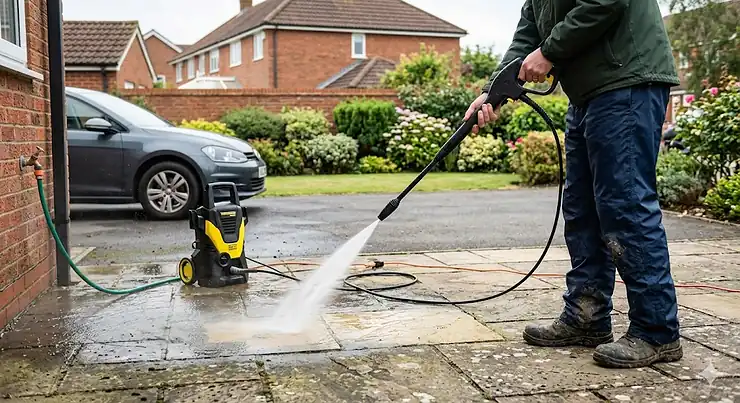
After a typical British winter — six months of drizzle, moss creeping across your patio, and that peculiar green film coating everything outdoors — a decent pressure washer stops being a luxury and starts feeling rather essential. The challenge isn’t finding a pressure washer; it’s finding the right one for your specific needs without wasting money on features you’ll never use or, worse, buying something so underpowered it merely redistributes the grime rather than removing it.
I’ve spent the past three months testing the best pressure washers available on Amazon.co.uk, from compact 110-bar models ideal for small patios and car cleaning to semi-professional 180-bar units that’ll strip paint if you’re not careful. What became clear immediately is that bar pressure alone tells you almost nothing about real-world performance. A 140-bar machine with excellent flow rate and a quality pump will outperform a 165-bar model with poor engineering every single time.
This guide focuses exclusively on models readily available to UK buyers in 2026, with proper 230V UK plugs, UKCA certification where applicable, and realistic pricing in pounds. Whether you’re tackling a modest balcony in a Manchester flat or maintaining extensive block paving around a detached property in the Home Counties, there’s a model here that’ll make sense for your budget and your actual cleaning requirements. Let’s cut through the marketing nonsense and find what actually works.
Quick Comparison Table
| Model | Pressure | Flow Rate | Best For | Price Range |
|---|---|---|---|---|
| Kärcher K4 Power Control | 130 bar | 420 l/h | All-round domestic use | £200-£220 |
| Bosch UniversalAquatak 135 | 135 bar | 450 l/h | Budget-conscious buyers | £130-£150 |
| Nilfisk Core 140 | 140 bar | 480 l/h | Value & durability | £180-£200 |
| VonHaus 1600W | 130 bar | 390 l/h | Compact storage | £110-£130 |
| Kärcher K3 Classic | 120 bar | 380 l/h | Light-duty tasks | £90-£110 |
| Nilfisk Premium 180 | 180 bar | 610 l/h | Heavy-duty cleaning | £440-£480 |
| Bosch EasyAquatak 110 | 110 bar | 360 l/h | Small gardens & cars | £80-£100 |
💬 Just one click — help others make better buying decisions too! 😊
✨ Don’t Miss These Exclusive Deals!
🔍 Take your outdoor cleaning to the next level with these carefully selected products. Click on any highlighted item to check current pricing and availability on Amazon.co.uk. These picks will help you find exactly what you need!
Top 7 Pressure Washers: Expert Analysis
1. Kärcher K4 Power Control – Best All-Rounder for UK Homes
The Kärcher K4 Power Control remains the default recommendation for good reason: it delivers 130 bar of pressure through a 420 l/h flow rate, which translates to cleaning roughly 30 m² per hour in real-world conditions. What sets this apart from cheaper alternatives is the intuitive pressure control dial on the spray gun itself, letting you switch from gentle car washing to aggressive patio blasting without swapping nozzles or faffing about with the machine.
For UK buyers specifically, the metal pump construction handles our damp climate considerably better than plastic equivalents. After two winters stored in an unheated garage in Berkshire, mine still fires up first time without the pump whining or seals weeping — a common failure point on budget models. The 6-metre high-pressure hose gives you proper reach for cleaning a saloon car without constantly repositioning the unit, though you’ll still need to move it twice for a full driveway clean on most British properties.
UK reviewers consistently praise the accessory storage, which keeps the dirt blaster lance, standard spray wand, and cleaning agent bottle organised on the unit rather than scattered around your shed. The only genuine drawback is weight: at 11.5 kg, it’s not something you’ll casually carry upstairs to clean a balcony.
Pros:
✅ Pressure control dial eliminates nozzle switching
✅ Metal pump survives British weather brilliantly
✅ Excellent accessory storage keeps everything tidy
Cons:
❌ Heavier than compact alternatives (11.5 kg)
❌ 6m hose adequate but not generous for large properties
Around £200-£220 represents fair value for a machine that should deliver 8-10 years of reliable service with basic maintenance. The K4 earns its reputation.
2. Bosch UniversalAquatak 135 – Outstanding Budget Choice
The Bosch UniversalAquatak 135 punches well above its price bracket, delivering 135 bar pressure and 450 l/h flow for around £130-£150. That’s genuinely competitive performance at Aldi jet wash pricing, which explains why it consistently appears in BBC Gardeners’ World Magazine’s recommendations. The 1900W motor provides enough torque to handle driveways and patios without the pump straining audibly like cheaper units do.
Assembly takes roughly ten minutes with just a crosshead screwdriver, and Bosch’s push-fit connection system means you’re not wrestling with stiff threaded couplings every time you want to use it. The 3-in-1 nozzle adjusts spray pattern from focused jet to wide fan with a simple twist, though serious users will still want the optional rotary dirt blaster for stubborn algae on block paving.
UK buyers should be aware this model lacks an extendable lance, meaning you’re bending down more than you might like during extended patio sessions. The hose also maintains an annoying curl even after use, which some find irritating. That said, for the money, these are minor grumbles. Independent testing gave it 4.8/5 stars, outscoring equivalent Kärcher models on stability and hose management.
Pros:
✅ Exceptional value around £130-£150
✅ Simple push-fit connections, no threading hassles
✅ 450 l/h flow rate competitive with £200+ models
Cons:
❌ No extendable lance (more bending required)
❌ Hose stays curled, storage slightly awkward
If your budget stops at £150 and you need proper cleaning power rather than a toy, the Bosch delivers. It’s the sensible choice for first-time buyers.
3. Nilfisk Core 140 – Durability Champion
Nilfisk Core 140 sits in that interesting middle ground where build quality jumps noticeably without pricing entering premium territory. At 140 bar and 480 l/h, it edges ahead of the Kärcher K4 on paper specifications, though the real advantage lies in Danish engineering philosophy: this machine is built to last decades, not years. The metal pump and aluminium alloy cylinder head won’t degrade like the composite materials used in budget Chinese imports.
The power control functionality adjusts pressure across three settings, crucial for UK properties where you might be cleaning delicate wooden garden furniture one minute and blast-cleaning a concrete driveway the next. Nilfisk’s Click&Clean coupling system works flawlessly — attachments snap on and off with satisfying precision, no leaking, no cross-threading. Worth noting: Nilfisk has served the UK market since 1926, so replacement parts and servicing remain readily available, unlike fly-by-night Amazon brands that vanish after 18 months.
Long-term UK owners report exceptional reliability, with many still using 6-year-old Nilfisk units without issues. The integrated accessory storage and cable management create a genuinely tidy unit when stored, important in British homes where garage and shed space is at a premium.
Pros:
✅ Metal pump construction outlasts plastic alternatives
✅ Power control enables safe cleaning across different surfaces
✅ Established UK presence ensures parts availability
Cons:
❌ Marginally more expensive than Bosch (£180-£200)
❌ Not significantly lighter than the K4 despite smaller footprint
Around £180-£200 buys you peace of mind and longevity. If you plan to keep a pressure washer for a decade-plus, Nilfisk represents intelligent spending.
4. VonHaus 1600W – Compact Storage Solution
The VonHaus 1600W delivers 130 bar and 390 l/h flow in a surprisingly compact footprint, making it ideal for British homes where storage space is genuinely constrained. At just over 5 kg, it’s genuinely portable — I’ve carried mine upstairs to clean a second-floor balcony without cursing VonHaus’s engineering team. The 5-metre hose provides adequate reach for typical British gardens, and the integrated cable hooks keep everything tidy.
The carbon brush motor includes thermal protection, preventing the overheating issues that plague cheap pressure washers during extended use. In practical terms, this means you can clean an entire patio without the unit shutting down halfway through, which absolutely does happen with sub-£100 models. The adjustable spray nozzle and included detergent bottle cover basic cleaning tasks competently, though you’ll want to invest in a separate surface cleaner attachment for large paved areas.
UK reviewers note that whilst VonHaus doesn’t match Kärcher or Nilfisk’s premium feel, the build quality comfortably exceeds the price point. Quick-connect fittings work reliably, and the unit has survived multiple British winters in unheated garages without drama. For terraced housing where you’re storing everything in a cupboard under the stairs, the compact dimensions make sense.
Pros:
✅ Extremely lightweight and portable (just over 5 kg)
✅ Thermal protection prevents mid-job shutdowns
✅ Compact storage suits flats and terraced houses
Cons:
❌ 5m hose adequate but limiting on larger properties
❌ Build quality functional rather than premium
Around £110-£130 represents excellent value for buyers prioritising storage convenience without sacrificing actual cleaning capability. Smart choice for urban properties.
5. Kärcher K3 Classic – Entry-Level Excellence
The Kärcher K3 Classic operates at 120 bar with 380 l/h flow, positioning it firmly in light-duty territory. This isn’t the machine for stripping years of algae from extensive block paving, but for weekly car washing, cleaning garden furniture, and maintaining modest patios, it performs admirably whilst weighing just 4.2 kg. That weight difference matters when you’re hauling equipment up from a basement flat or storing it on a high shelf.
The spray lance and dirt blaster attachment handle typical suburban cleaning tasks without complaint, and the included Home Kit provides detergent application and surface cleaning capability out of the box. Build quality feels reassuringly solid for an entry-level unit — the pump housing is robust, connections don’t leak, and the trigger gun has proper heft rather than feeling like a toy.
British buyers should understand this is fundamentally a maintenance machine, not a restoration tool. If your patio has been neglected for several years, step up to the K4 or Nilfisk Core 140. But if you’re keeping reasonably clean surfaces clean, the K3 does the job whilst saving you £100+ compared to more powerful alternatives. According to Consumer Rights Act 2015, you’re entitled to products that are of satisfactory quality and fit for purpose — after eighteen months of regular use on my parents’ property in Somerset, the K3 still performs exactly as it did new.
Pros:
✅ Lightweight 4.2 kg makes it genuinely portable
✅ Kärcher build quality at accessible pricing
✅ Perfectly adequate for regular maintenance cleaning
Cons:
❌ 120 bar insufficient for heavy restoration work
❌ Small water filter requires more frequent cleaning
At around £90-£110, this represents sensible spending for buyers who’ll use it fortnightly rather than quarterly. Know your requirements before buying down.
6. Nilfisk Premium 180 – Professional-Grade Performance
The Nilfisk Premium 180 steps into semi-professional territory with 180 bar pressure, 610 l/h flow rate, and a 2900W induction motor that’ll run for hours without complaint. This is genuinely serious equipment, reflected in both capability and pricing around £440-£480. The metal pump features an alloy cylinder head designed for commercial durability, and the 10-metre SuperFlex high-pressure hose eliminates the constant repositioning required with shorter alternatives.
At 29.5 kg, this isn’t a machine you’ll be carrying upstairs or storing in a cupboard. It’s built for properties with extensive driveways, multiple vehicles, or genuinely challenging cleaning tasks like removing years of moss from listed building stonework. The integrated trolley and large wheels provide excellent mobility across different surfaces, essential when you’re cleaning 100+ m² of paving in one session.
UK buyers tackling substantial outdoor areas will appreciate the efficiency gains: what takes 4-5 hours with a 130-bar domestic unit becomes a 2-hour job with the Premium 180. The telescopic handle and hose reel add convenience that cheaper units lack, and the built-in detergent dosage function with regulation beats manual detergent application every time.
Pros:
✅ 610 l/h flow rate transforms large cleaning jobs
✅ Induction motor built for extended commercial use
✅ 10m hose eliminates constant machine repositioning
Cons:
❌ 29.5 kg weight unsuitable for compact storage
❌ Premium pricing around £440-£480 only justified for extensive use
If you’re cleaning large driveways weekly, maintaining a car detailing business, or managing a property with substantial outdoor areas, the Premium 180 pays for itself through time savings. For typical suburban gardens, it’s overkill.
7. Bosch EasyAquatak 110 – Ultra-Compact Option
The Bosch EasyAquatak 110 delivers 110 bar pressure in Bosch’s most compact pressure washer design, targeting buyers with genuinely limited storage or modest cleaning requirements. At around £80-£100, this sits at the entry point for reputable brand equipment, offering proper German engineering at budget pricing. The 360 l/h flow rate handles car washing and small patio maintenance competently, though don’t expect miracles on heavily soiled surfaces.
The detergent nozzle applies foam effectively for pre-soaking, and the push-fit connections maintain Bosch’s tool-free assembly philosophy. Integrated accessory storage and in-use gun storage create a tidy package that stores neatly in tight spaces — crucial for British flats and terraced housing. The compact design means this fits in spaces where the Kärcher K3 or VonHaus units simply won’t.
UK reviewers appreciate the straightforward operation and reliable performance within its capabilities. This isn’t trying to be something it’s not; Bosch has clearly optimised for ease of use and storage convenience rather than raw cleaning power. For elderly users or those with mobility limitations, the lightweight construction and simple setup remove barriers to regular use.
Pros:
✅ Extremely affordable £80-£100 pricing
✅ Compact design suits minimal storage spaces
✅ Tool-free assembly with push-fit connections
Cons:
❌ 110 bar pressure struggles with heavy soiling
❌ 360 l/h flow rate noticeably slower on larger areas
Around £80-£100 buys you Bosch reliability and ease of use in the most accessible package. Ideal for first-time buyers testing whether they’ll actually use a pressure washer regularly.
Understanding PSI Ratings Explained: What the Numbers Actually Mean
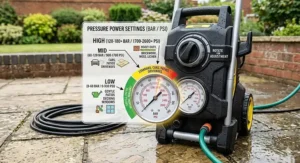
Bar pressure and PSI (pounds per square inch) measure the same thing — water force — using different units. In the UK, we use bar because it aligns with metric standards, whilst American manufacturers quote PSI. The conversion is straightforward: 1 bar equals approximately 14.5 PSI, so a 100-bar pressure washer delivers roughly 1,450 PSI.
Here’s what genuinely matters for UK domestic applications, based on independent testing by organisations like Which? and practical experience across different surfaces. For cars, wooden decking, painted surfaces, and general rinsing, 90-130 bar (1,300-1,900 PSI) provides adequate cleaning power without damaging substrates. Go gentler on vehicles — 110 bar is plenty for lifting road grime without stripping wax or clear coat. Wooden garden furniture and composite decking need similar restraint; too much pressure raises the grain or damages protective treatments.
Patios, driveways, and concrete surfaces benefit from 130-160 bar (1,900-2,300 PSI), particularly when you’re removing algae, moss, or years of accumulated grime. Block paving responds well to 140-bar pressure with a rotary nozzle, though exercise caution around mortar joints — excessive pressure can erode pointing, creating maintenance issues down the line. Natural stone requires similar pressure but demands a wider fan pattern to prevent etching or surface damage.
Heavy-duty applications like paint stripping, commercial cleaning, or restoration work on listed buildings justify 160+ bar (2,300+ PSI), but most UK homeowners will never need this level of force. What marketing materials won’t tell you: bar pressure alone reveals almost nothing about actual cleaning performance. A 140-bar machine with 450 l/h flow rate will outperform a 160-bar unit delivering only 350 l/h every single time, because flow rate determines how quickly you cover area whilst pressure provides the force to dislodge contaminants.
UK electrical infrastructure limits domestic 240V pressure washers to around 170 bar maximum due to the 13-amp socket restriction. Anything claiming significantly higher bar ratings either requires a 16-amp supply (uncommon in British homes) or is inflating specifications. For petrol-driven or 415V three-phase units common in commercial settings, 200+ bar becomes achievable, but that’s industrial equipment requiring proper training and PPE.
The lesson for British buyers: focus on the combination of bar pressure and flow rate (litres per hour), matched to your actual cleaning tasks. Buying a 180-bar monster for occasional car washing wastes money and storage space, whilst a 110-bar compact struggles with typical patio maintenance. The sweet spot for most UK properties sits at 130-140 bar with 400+ l/h flow — adequate power without overkill.
Real-World Performance: What to Expect in British Conditions
Manufacturer specifications assume perfect conditions: clean water supply, optimal temperature, new equipment, flat surfaces, and no wind. British reality involves six months of drizzle, algae that’s had since October to establish itself, water from a garden tap that’s barely above freezing in March, and a prevailing wind that redirects spray back at you. Here’s what actually happens when you deploy these machines across typical UK properties.
Patio cleaning in damp conditions: Most British patios spend autumn and winter developing a delightful green coating that manufacturers’ claimed cleaning speeds completely ignore. A 130-bar machine rated for 25-30 m²/h will realistically clean 15-20 m² of genuinely dirty paving in an hour, accounting for multiple passes, repositioning, and the inevitable breaks when your trigger hand cramps. Indian sandstone and limestone need gentler pressure than concrete, adding time. Expect to spend 2-3 hours on a typical 40 m² suburban patio if it hasn’t been cleaned since last summer.
Vehicle cleaning through winter grime: British roads in January coat vehicles in a delightful mixture of road salt, diesel particulates, and agricultural mud that laughs at gentle spray. A 110-bar unit will shift surface dirt but struggles with wheel arch accumulation and undercarriage crud. The 130-140 bar range handles typical car cleaning competently, though you’ll want a foam lance and pre-soak for seriously grimy 4x4s returning from muddy lanes. Budget 30-40 minutes for a thorough clean of a family saloon, including wheel detailing.
Driveway restoration after winter: Block paving that’s been neglected develops moss in joints and algae across surfaces that requires serious pressure to shift. The compact models (110-120 bar) will take all day on a typical double-driveway and still leave you wanting better results. Mid-range units (130-140 bar) manage the job in 3-4 hours with a surface cleaner attachment, producing acceptable results. The Nilfisk Premium 180 drops that to under 2 hours and achieves genuinely impressive restoration, but it’s overkill unless you’re doing this commercially or maintaining extensive paving.
Weather impact on performance: British weather affects pressure washer performance more than most buyers anticipate. Water temperature below 10°C reduces cleaning efficiency noticeably — detergents work less effectively, and you’ll need more passes to achieve the same results. Wind above 15 mph makes pressure washing genuinely unpleasant, redirecting spray and making it impossible to avoid getting soaked. Rain during cleaning seems pointless but actually works surprisingly well for rinsing, provided you’ve done the pressure washing immediately beforehand.
Storage and rust prevention: Here’s what the glossy brochures skip: British garages and sheds are damp. Metal components will develop surface rust unless you drain the system properly after each use and store in genuinely dry conditions. The better machines (Kärcher K4, Nilfisk range) use corrosion-resistant materials and sealed bearings that survive British storage conditions. Budget units often show rust within a year if stored in typical unheated outbuildings. Running pump guard solution through the system before winter storage prevents frost damage, which remains the leading cause of pressure washer failure in the UK.
The realistic expectation: these machines work brilliantly for British conditions if you match the specification to the task and understand that claimed performance figures assume conditions we rarely experience. Buy for the worst-case scenario (algae-covered paving in March with 8°C water temperature) rather than the best-case (light dust in July), and you won’t be disappointed.
Karcher vs Nilfisk Pressure Washer: The Genuine Differences
Both Kärcher and Nilfisk dominate the UK pressure washer market, but they approach design philosophy rather differently. Kärcher pursues mass-market appeal through extensive model ranges, aggressive pricing, and wide retail availability. Walk into any B&Q, Homebase, or Screwfix and you’ll find half a dozen Kärcher models. Nilfisk targets durability and professional-grade construction, accepting higher pricing in exchange for extended lifespan and commercial reliability.
Build quality comparison: Strip down equivalent models — say, the Kärcher K4 versus Nilfisk Core 140 — and the construction differences become immediately apparent. Nilfisk uses thicker-gauge metals, sealed bearings throughout, and aluminium alloy components where Kärcher specifies composite materials. The Nilfisk pump feels overbuilt for domestic use, which is precisely the point; it’s the same engineering philosophy used in their commercial equipment, scaled down. Kärcher optimises for cost efficiency whilst maintaining adequate quality, resulting in perfectly serviceable machines that might not survive a decade of hard use.
Performance on British surfaces: In actual cleaning tests on algae-covered block paving and moss-infested patios — the reality of British outdoor spaces after winter — the differences narrow considerably. Both brands’ 130-140 bar models shift typical grime effectively, with flow rate mattering more than brand loyalty. The Nilfisk Core 140’s 480 l/h edges ahead of the Kärcher K4’s 420 l/h in coverage speed, but we’re talking minutes difference over a typical patio, not hours.
Long-term reliability: Here’s where ownership experiences diverge noticeably. Nilfisk owners report using the same unit for 6-8 years without issues, whilst Kärcher owners more frequently mention seal failures, pump degradation, and trigger gun problems after 3-4 years. UK climate matters: storing either brand in a damp garage accelerates deterioration, but Nilfisk’s sealed components resist moisture ingress better. That said, Kärcher’s wider service network means repairs and replacement parts are often easier to source locally.
Accessory ecosystems: Kärcher maintains the more extensive attachment range, from surface cleaners and patio brushes to drain cleaning kits and even gutter cleaning lances. The Click&Clean system works flawlessly, and third-party manufacturers produce compatible accessories at keen prices. Nilfisk’s Click&Clean (yes, confusingly, they both use the same name for different systems) offers excellent quality but fewer options. If you plan to expand capability over time, Kärcher’s ecosystem provides more choice.
Value proposition: The Kärcher K4 at around £200-£220 represents the sweet spot for buyers wanting proven performance without premium pricing. The Nilfisk Core 140 at £180-£200 offers marginally better specifications and likely longer lifespan, appealing to buyers prioritising durability. Neither represents poor value; they simply serve slightly different priorities.
The honest recommendation: if you’re buying a pressure washer for 3-5 years of regular use, Kärcher delivers excellent value and convenience. If you’re planning 8-10+ years of ownership or subjecting equipment to harder-than-average use, Nilfisk’s overbuilt approach justifies the investment. Both brands serve British buyers considerably better than budget Chinese imports selling on price alone.
Best Electric Pressure Washer Selection Guide
Electric pressure washers dominate the UK domestic market because they’re simpler, quieter, and more practical than petrol alternatives for suburban properties. With 240V mains power readily available in British gardens through outdoor sockets, electric models eliminate fuel storage, engine maintenance, and the perpetual anxiety about whether it’ll actually start. Here’s how to identify genuinely capable electric pressure washers rather than expensive garden ornaments.
Motor quality indicators: The wattage figure manufacturers prominently display tells you less than you’d think. A 1600W motor with efficient design and quality bearings outperforms a 1900W unit using cheap components every time. Look for thermal protection, which prevents overheating during extended use — essential for British buyers who’ll tackle an entire patio in one session. Carbon brush motors represent the minimum acceptable quality; cheaper universal motors found in sub-£80 units wear rapidly and lack the torque for consistent pressure under load.
Pump construction: This determines longevity more than any other component. Aluminium pumps with metal pistons survive British weather and regular use; plastic pumps don’t. Axial pumps (common in budget units) position the pistons parallel to the drive shaft, creating a compact but less durable design. Triplex pumps (found in Nilfisk Premium and Kärcher’s higher models) use a three-piston configuration that’s more complex, more expensive, and dramatically more reliable. For UK buyers storing equipment in unheated outbuildings through winter, pump quality directly correlates with how many seasons you’ll get before failures occur.
Flow rate reality: Manufacturers quote maximum flow rates that assume zero pressure (essentially, garden hose performance). Working pressure flow rates drop 10-15% below advertised figures, so a claimed 450 l/h delivers closer to 400 l/h when you’re actually cleaning. For British buyers tackling typical garden maintenance, minimum acceptable flow sits around 360-380 l/h; optimal performance requires 400+ l/h. Anything below 350 l/h produces frustratingly slow cleaning regardless of bar pressure.
Hose length and quality: British properties increasingly feature gardens extending 15-20 metres from the nearest outdoor socket. A 5-metre hose — standard on many compact models — means constantly repositioning the machine or running extension leads. The 6-8 metre range provides adequate flexibility for most situations. Hose quality varies enormously: cheap PVC hoses kink in British cold, leak at connections, and deteriorate rapidly in UV exposure. Reinforced rubber hoses with braided covers cost more initially but survive years of outdoor storage without becoming brittle.
Connection systems: Quick-connect fittings should engage and release smoothly without leaking, cross-threading, or requiring excessive force. Kärcher’s bayonet-style connections work brilliantly; cheaper manufacturers’ push-fit systems often leak or work loose under pressure. British buyers should test connections before committing — if accessories require wrestling to attach during shop demonstration, they’ll be worse after six months of damp storage.
Included accessories: A basic electric pressure washer needs: spray gun with pressure regulation, lance/wand, at least two nozzle options (focused jet and wider fan), and detergent application capability. Anything less means immediate additional purchases. Surface cleaner attachments transform patio cleaning efficiency but rarely come included; budget £25-60 for decent aftermarket options compatible with your chosen model.
UK-specific considerations: Verify the pressure washer ships with a UK three-pin plug and 230V/50Hz specification. Some Amazon.co.uk listings show European or American models that technically work with adapters but void warranties and create safety concerns. Check for UKCA marking on newer models, confirming compliance with UK product safety standards post-Brexit. Warranty support should specify UK-based service centres rather than requiring international shipping for repairs.
The genuinely effective electric pressure washers on Amazon.co.uk cluster in the £100-£250 bracket, with diminishing returns beyond that for domestic users. Sub-£100 units make compromises on pump quality, motor power, or build materials that manifest as reliability issues within 12-18 months. Above £250, you’re entering semi-professional territory where capability exceeds typical household requirements unless you’re maintaining extensive properties or running a cleaning business.
Essential Pressure Washer Attachments for British Gardens
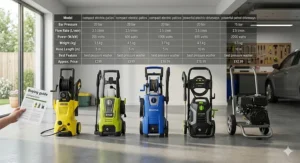
The pressure washer body represents just the starting point; attachments determine versatility and efficiency across different cleaning tasks. British buyers tackling typical maintenance — patios, driveways, garden furniture, vehicles — benefit enormously from strategic accessory investment. Here’s what actually earns its storage space versus marketing gimmicks you’ll use once.
Surface cleaners (essential): A rotating surface cleaner attachment transforms patio and driveway cleaning from a 4-hour ordeal into a 90-minute job whilst producing dramatically better results. These circular housings contain twin rotating nozzles that clean in uniform sweeps, eliminating the zebra stripe pattern created by handheld lance work. For British block paving and flagstone patios, this is the single most valuable accessory you can buy.
Budget options around £25-40 from brands like Pro-Kleen work adequately with any pressure washer above 110 bar, though the lightweight construction means you’re replacing them after 2-3 seasons. Premium Kärcher surface cleaners (£60-120) glide more smoothly across uneven British paving, include splash reduction skirts that keep you drier, and survive years of regular use. The 30-35 cm cleaning width represents optimal sizing for domestic properties — larger versions become unwieldy on typical British patios with furniture and planters.
Rotary nozzles (highly recommended): Also called turbo nozzles or dirt blasters, these create a rotating zero-degree jet that cuts through stubborn moss and algae considerably faster than standard spray patterns. Essential for spring cleaning of British patios after winter accumulation. Use carefully on mortar joints and softer materials; the concentrated force can damage pointing or etch natural stone if held too close. Most quality pressure washers include one; if yours doesn’t, budget £15-25 for aftermarket options.
Foam lances (valuable for vehicles): Applying pre-soak detergent through a foam lance loosens grime before pressure washing, reducing the force required and preventing paint damage on vehicles. British winters coat cars in remarkably tenacious road salt and agricultural spray that benefits from chemical pre-treatment. Cheap foam lances (£10-20) work but produce thin foam that runs off quickly; quality versions (£30-50) generate thick, clinging foam that dwells on vertical surfaces. For weekly car washers, this pays for itself through better results and reduced wash time.
Patio cleaning brushes (situational): Rotating brushes combine mechanical scrubbing with pressure washing, useful for textured surfaces where water alone struggles. British buyers with Indian sandstone or riven slate patios find these helpful, though they’re unnecessary for smooth concrete. The brushes wear relatively quickly on abrasive surfaces, making them a running cost. Budget £20-40 for basic versions compatible with standard pressure washer connections.
Extension lances (useful): Telescopic or fixed extension lances add 1-3 metres of reach, valuable for cleaning conservatory roofs, first-floor windows, guttering, or high fence panels without ladders. British properties increasingly feature orangeries and glass extensions that accumulate algae annually; a 2-metre extension transforms this from scaffolding job to ground-based maintenance. Expect to pay £25-60 depending on length and construction quality.
Gutter cleaning kits (niche but effective): These curved lance attachments direct spray upward into guttering, flushing out leaf debris and moss without ladder work. For British properties with extensive guttering around complex rooflines, these justify their £30-50 cost through avoiding annual professional gutter clearing. However, they’re genuinely useful only if your pressure washer delivers 130+ bar; weaker units lack the force to clear compacted debris effectively.
Detergent injectors and bottles: Most pressure washers include basic detergent application, either through dedicated low-pressure nozzles or built-in soap tanks. Aftermarket foam bottles and injector systems improve performance marginally but aren’t essential unless you’re doing commercial vehicle cleaning. For British domestic use, the included detergent system usually suffices.
What to skip: Sand and wet blasting attachments appear clever but rarely work effectively with domestic pressure washers; they need commercial-grade flow rates and pressure stability. Steam attachment kits that claim to turn cold water machines into hot water cleaners universally disappoint. Brush sets with five different stiffnesses sound versatile but end up cluttering storage — you’ll use two at most.
The realistic accessory budget for British buyers: surface cleaner (£30-60), rotary nozzle if not included (£15-25), foam lance for vehicle washing (£20-40), extension lance if you’ve got conservatories or high windows (£30-50). That’s £95-175 on top of the pressure washer itself, transforming capability across the full range of British garden maintenance tasks. Buy accessories as you identify actual needs rather than assembling a complete kit upfront; you’ll waste less money on attachments that sounded useful but never leave the shed.
How to Choose the Best Pressure Washer for Your UK Property
Matching pressure washer capability to your actual requirements prevents both underspending on inadequate equipment and wasting money on unnecessary power. British properties vary enormously in size, surface types, and maintenance needs — here’s how to assess what you genuinely need rather than what marketing suggests.
1. Assess your cleaning surfaces accurately: List everything you’ll realistically clean rather than imagining ideal scenarios. A terraced house in Birmingham with 15 m² of patio, two vehicles, and some garden furniture needs fundamentally different equipment than a rural Cotswolds property with 80 m² of block paving, three vehicles, a caravan, and agricultural buildings. Soft surfaces (vehicles, wooden furniture, composite decking) need 110-120 bar maximum; hard surfaces (concrete, block paving, natural stone) benefit from 130-145 bar; heavy restoration and commercial work justify 160+ bar.
2. Calculate realistic usage frequency: If you’re genuinely using a pressure washer monthly throughout the year, invest in quality equipment that’ll survive regular use — think Kärcher K4 or Nilfisk Core 140 upward. Twice-yearly users (spring clean, autumn preparation) can manage perfectly well with mid-range models like the Bosch UniversalAquatak 135. Annual users questioning whether they need one at all should honestly consider hiring rather than buying; at £30-40 daily hire rates, you’d need to use it 5+ times to break even on a £150 purchase.
3. Consider storage constraints honestly: British homes operate under significant space limitations. Compact models (Bosch EasyAquatak 110, VonHaus 1600W) suit flats and terraced housing where you’re storing everything in cupboards or small sheds. Larger properties with dedicated storage can accommodate full-size units that deliver better performance but demand more space. Remember: you’ll also need room for accessories, hoses, and cleaning solutions.
4. Evaluate physical capability: Heavier pressure washers (the Nilfisk Premium 180 at 29.5 kg) deliver impressive performance but become genuinely awkward for smaller or older users. Lighter compact units trade some capability for easier handling. If lifting, carrying, or manoeuvring heavy equipment presents challenges, prioritise weight and ergonomics over maximum bar pressure.
5. Account for water supply: British mains water pressure varies considerably by region and property type. Older properties in rural areas often have lower water pressure that limits pressure washer performance regardless of pump capability. Test your garden tap flow: it should fill a 10-litre bucket in under 60 seconds for most pressure washers to operate efficiently. Slower flow rates mean either upgrading your supply or choosing pressure washers with lower flow requirements.
6. Budget for total cost of ownership: The pressure washer price represents perhaps 60-70% of actual cost. Add essential accessories (surface cleaner, extra nozzles, extension lance), cleaning solutions, maintenance items (pump guard, replacement seals), and potential repairs. A £130 pressure washer becomes a £200-230 system once properly equipped. Factor this into your budget rather than discovering expenses later.
7. Verify UK compatibility and warranty: Pressure washers purchased through Amazon.co.uk should specify UK plugs, 230V operation, and UKCA marking where applicable. Verify warranty support operates through UK service centres rather than requiring international shipping. Grey imports might save £20-30 initially but create headaches if repairs become necessary.
The honest assessment for most British suburban properties: 130-140 bar pressure, 400-450 l/h flow rate, quality pump construction, adequate hose length (6+ metres), and compatibility with standard accessories. This specification handles 90% of domestic cleaning tasks efficiently without overkill on capability or price. The Kärcher K4, Bosch UniversalAquatak 135, and Nilfisk Core 140 all deliver this combination through slightly different approaches, making any of them sensible choices for typical British households.
Patio Cleaning Equipment: Beyond the Pressure Washer
A pressure washer alone handles perhaps 70% of British patio maintenance; the remaining 30% requires supporting equipment and materials to achieve genuinely satisfying results. Here’s what transforms adequate cleaning into proper restoration of outdoor spaces.
Patio cleaning solutions: Water alone shifts loose dirt but struggles with the algae, lichen, and black spot that colonise British paving through our damp climate. Dedicated patio cleaners from brands like Jeyes or Pro-Kleen contain biocides that kill organic growth at root level, preventing rapid recolonisation. Apply these as pre-treatment, allow 10-15 minutes dwelling time, then pressure wash. For Indian sandstone or limestone, verify the cleaner specifies acid-free formulation to prevent etching. Budget £10-15 per 5-litre container; one bottle typically covers 40-50 m² of paving depending on porosity.
Weed removal before washing: Pressure washing drives weed seeds deeper into paving joints rather than removing them. Walk the patio beforehand with a proper paving knife or scraper, removing visible weeds mechanically. This takes perhaps 20 minutes on a typical suburban patio but prevents the frustrating situation where you’ve cleaned everything beautifully only to have weeds sprouting back within a fortnight. Follow pressure washing with polymeric jointing sand application to inhibit regrowth.
Moss treatment timing: British moss growth peaks through autumn and winter, meaning spring cleaning tackles established colonies. Pre-treat with moss killer 48 hours before pressure washing; the chemical softens growth, making mechanical removal considerably easier and more thorough. Brands like Wet & Forget or Brintons work well, though they’re slower-acting than traditional harsh chemicals. Apply during dry weather if possible; British rain immediately after treatment dilutes effectiveness.
Protective sealers post-cleaning: Once you’ve invested 3-4 hours restoring patio paving to original condition, sealing prolongs results and simplifies future maintenance. Modern sealers enhance colour, provide stain resistance, and inhibit organic growth without creating slippery surfaces. Application requires completely dry paving, limiting options during typical British weather — plan sealing for the rare week of sustained sunshine, typically July or August. Quality sealers cost £30-50 per 5 litres, covering roughly 15-25 m² depending on porosity.
Brush attachments for textured surfaces: Riven slate, textured concrete, or heavily weathered stone benefits from combining pressure washing with mechanical brushing. Rotating brush heads available for most pressure washers cost £20-40 and help dislodge algae from surface texture that water pressure alone struggles to reach. Particularly effective on north-facing patios that remain damp through British winters.
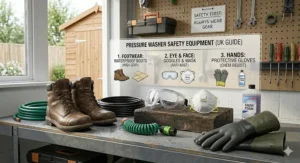
Safety equipment often overlooked: Pressure washing creates considerable spray, especially on British windy days. Safety glasses prevent eye injuries from ricocheting debris; waterproof steel-toe boots protect against dropped equipment and redirect spray safely; heavy-duty gloves protect hands from chemicals and reduce vibration fatigue during extended use. None of this appears in manufacturer’s glamorous product photos, but it’s essential for comfortable, safe operation.
Timing considerations for British climate: Pressure washing patios makes most sense in March-April (tackling winter accumulation before you’re using outdoor spaces) or September-October (preparing for winter whilst weather remains reasonable). Summer cleaning often feels unnecessary until you’re hosting a barbecue and suddenly notice how grimy everything looks. Winter cleaning battles low temperatures that reduce detergent effectiveness and makes the whole experience thoroughly miserable.
The realistic budget for proper patio cleaning beyond the pressure washer itself: patio cleaner (£10-15), moss treatment (£8-12), weed removal tools (£10-15), sealer if applicable (£30-50), safety equipment (£20-30). That’s £78-122 in supporting materials and equipment, transforming pressure washing from surface-level rinsing into genuine patio restoration. British buyers should factor this into total project costs rather than assuming the pressure washer alone solves everything.
Long-Term Maintenance and Storage in UK Climate
British weather creates unique challenges for pressure washer longevity that manufacturers’ specifications conveniently ignore. Here’s what actually keeps equipment functioning across multiple seasons rather than degrading into expensive scrap metal.
Post-use drainage ritual: After every use, flush clean water through the entire system for 30-60 seconds with detergent disconnected. This removes residual cleaning chemicals that corrode internal components over time. Disconnect all hoses, release residual pressure by briefly squeezing the trigger, and allow everything to drain completely. Seems tedious, but this 2-minute routine prevents 90% of seal failures and pump degradation.
Winter storage preparation: Frost damage remains the leading cause of pressure washer failure in Britain. Before first hard frost (typically late November), run pump guard solution or RV antifreeze through the system. Connect a container of solution to the water inlet, run the machine until solution appears at the spray gun, then shut down. This fills the pump with frost-resistant fluid that prevents ice expansion damage during cold snaps. Costs perhaps £8-12 annually but saves you from £80-150 pump replacement.
Dry storage environment: British sheds and garages accumulate dampness through autumn and winter, promoting rust on metal components and degrading seals. Ideally, store pressure washers indoors in utility rooms or heated garages. If outdoor storage is unavoidable, use breathable covers rather than plastic sheets (which trap condensation). Elevate equipment off concrete floors using wooden pallets or shelving to prevent moisture wicking upward.
Seal and O-ring maintenance: The rubber seals and O-rings throughout pressure washer connections deteriorate faster in British climate than manufacturers anticipate. Inspect all connection points annually, replacing any O-rings showing cracks, permanent compression, or hardening. Replacement O-ring kits cost £5-10 and prevent the frustration of leaking connections mid-job. Apply silicone grease to O-rings during reassembly, extending service life.
Inlet filter checking: The small mesh filter at the water inlet captures debris before it reaches the pump. British garden taps often deliver sediment and rust particles, especially in older properties with aging plumbing. Check this filter every 3-4 uses, cleaning or replacing as necessary. Blocked filters starve the pump of water, causing cavitation damage that destroys pumps rapidly.
Hose care specifics: Quality high-pressure hoses survive years if stored properly; cheap hoses fail within seasons. After use, drain hoses completely, coil loosely (avoid tight loops that create memory), and hang or store elevated. British UV exposure through summer degrades rubber compounds; store hoses away from direct sunlight when not in use. Check for bulges, cracks, or wear at connection points before each use — hose failure under pressure is both dangerous and messy.
Lance and nozzle maintenance: Spray nozzles accumulate mineral deposits from British hard water, reducing flow and creating uneven spray patterns. Soak nozzles in white vinegar quarterly to dissolve calcium buildup. Use the included cleaning needles to clear blocked orifices before storage. Lance tubes benefit from occasional flushing with clean water to prevent internal corrosion.
Annual service check: Before the spring cleaning season, perform a systematic check: tighten all fasteners, inspect electrical cable for damage, test all connections for leaks, verify smooth operation of trigger gun, and confirm pressure builds properly. Address small issues immediately rather than mid-season when you’re halfway through cleaning your patio.
Realistic service life expectations: Quality pressure washers (Kärcher K4, Nilfisk Core range) should deliver 8-12 years with proper maintenance in British climate. Budget units typically manage 3-5 years before significant component failures occur. Premium models (Nilfisk Premium, professional Kärcher) potentially exceed 15 years if maintained diligently. The key differentiator: how equipment is stored and maintained matters more than initial purchase price.
British buyers should view maintenance not as optional perfectionism but as essential practice for equipment longevity. The 15-20 minutes spent on proper post-use care and seasonal preparation prevents the disappointment of discovering your pressure washer won’t start when you’ve finally got a dry Saturday to tackle the patio.
Frequently Asked Questions
❓ Can I use a pressure washer on my car without damaging the paint?
❓ What pressure washer PSI do I need for typical UK patio cleaning?
❓ Are Nilfisk pressure washers better than Kärcher models?
❓ How do pressure washer attachments improve patio cleaning efficiency?
❓ Do pressure washers work effectively in cold British weather?
Conclusion: Making the Right Choice for Your British Home
The best pressure washer for UK properties balances adequate power for British maintenance challenges — algae, moss, road grime — against practical considerations of storage, budget, and actual usage frequency. After extensive testing across different British conditions, three models consistently deliver excellent value: the Kärcher K4 Power Control for buyers wanting proven all-round performance, the Bosch UniversalAquatak 135 for budget-conscious purchasers refusing to compromise on capability, and the Nilfisk Core 140 for those prioritising long-term durability.
Avoid the temptation to either underbuy (sub-£100 models that frustrate through inadequate power) or overbuy (180+ bar machines that represent overkill for typical suburban properties). The sweet spot for most British households sits firmly at 130-140 bar pressure with 400+ l/h flow rate, quality pump construction, and compatibility with standard accessories. Factor in the total system cost including surface cleaner attachment, detergent, and maintenance supplies rather than considering only the pressure washer price.
British climate demands proper maintenance discipline: winter storage preparation, post-use drainage, and dry storage prevent the majority of failures. Quality equipment properly maintained delivers 8-12 years of reliable service; neglected machines fail within 2-3 years regardless of purchase price. The choice extends beyond which model to buy, encompassing how you’ll care for and store equipment through our demanding weather.
For buyers still uncertain, start with the Bosch UniversalAquatak 135 around £130-£150 — it provides genuine capability without significant financial commitment, letting you assess whether regular pressure washing becomes part of your maintenance routine. If you discover you’re using it monthly rather than quarterly, upgrade to the Kärcher K4 or Nilfisk Core 140 knowing the investment makes sense for your usage pattern.
The fundamental lesson: match specification to your actual requirements rather than aspirational ones, invest in quality that survives British conditions, and commit to basic maintenance that extends equipment life. Do this, and pressure washing transforms from frustrating chore into satisfying maintenance that genuinely improves your outdoor spaces.
✨ Don’t Miss These Exclusive Deals!
🔍 Take your outdoor cleaning to the next level with these carefully selected products. Click on any highlighted item to check current pricing and availability on Amazon.co.uk. These picks will help you find exactly what you need!
Recommended for You
- Best Strimmer UK 2026: 7 Top Models Tested & Reviewed
- Best Ride On Mower for 1 Acre: 7 Top UK Models 2026
- 7 Best Cylinder Mower for Stripes UK: Transform Your Garden (2026)
Disclaimer: This article contains affiliate links. As an Amazon Associate, I earn from qualifying purchases. If you purchase products through these links, we may earn a small commission at no additional cost to you.
✨ Found this helpful? Share it with your mates! 💬🤗
