
In This Article
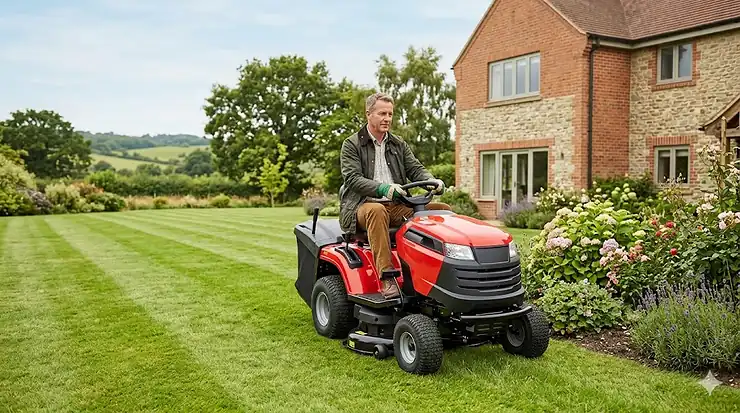
If you’ve been pushing a walk-behind mower across an acre of British lawn—dodging the inevitable drizzle and counting down the hours until you can collapse indoors—you’ve likely realised there’s a better way. A ride on mower for 1 acre transforms weekend lawn care from an endurance test into something approaching enjoyment, even if the weather doesn’t always cooperate.
But here’s the thing most retailers won’t tell you: one acre sits right in that awkward sweet spot where you could technically manage with a large walk-behind mower, but you’d spend roughly 2-3 hours doing it. A proper ride-on tractor cuts that time by more than half, whilst you remain seated and dry—rather crucial when British weather tends towards the unpredictable. The real question isn’t whether you need a ride-on for an acre; it’s which type suits your specific garden, budget, and tolerance for maintenance.
What most buyers overlook is that “1 acre” tells you nothing about what you’re actually mowing. An acre of flat, obstacle-free lawn in Surrey demands a completely different machine than an acre of undulating Cotswolds pasture dotted with mature oaks. Similarly, the compact terraced gardens common in urban areas require mowers narrow enough to squeeze through a standard 91 cm garden gate—yes, they exist, and we’ll cover them. This guide cuts through the marketing fluff to reveal which models genuinely deliver for British conditions: the damp mornings, the uneven ground, the limited storage space, and the reality that your “1 acre” probably includes flower beds, pathways, and that awkward slope behind the shed. We’ve researched models available on Amazon.co.uk and from established UK retailers, checked real customer feedback from British buyers, and identified what actually matters when the forecast reads “scattered showers” for the fifth day running.
Quick Comparison: Top Ride-On Mowers for 1 Acre
| Model | Engine | Cutting Width | Transmission | Price Range (GBP) | Best For |
|---|---|---|---|---|---|
| Mountfield 1530H | 432cc STIGA ST 450 | 84 cm | Hydrostatic | £2,400-£2,600 | Compact gardens, first-time buyers |
| Stiga Estate 384 | 432cc STIGA ST 450 | 84 cm | Hydrostatic | £2,400-£2,600 | Reliability, wet conditions |
| Mountfield 1538 SD | 452cc STIGA 7750 | 98 cm | Manual | £2,000-£2,300 | Side-discharge, paddocks |
| Atco GTX 38H | 586cc STIGA ST600 Twin | 92 cm | Hydrostatic | £3,800-£4,200 | Premium features, 4WD capability |
| Honda HF 2417 HM | 17 HP Honda GXV530 | 97 cm | Hydrostatic | £4,100-£4,500 | Reliability, steep slopes |
| Husqvarna R216T AWD | 12 kW Twin Cylinder | 94 cm | Hydrostatic AWD | £5,200-£5,700 | Challenging terrain, articulated steering |
| Stiga Park 300 2WD | 432cc STIGA ST 450 | 95 cm | Hydrostatic | £3,300-£3,600 | Front-deck manoeuvrability, tight spaces |
💬 Just one click — help others make better buying decisions too! 😊\
✨ Don’t Miss These Exclusive Deals!
🔍 Take your lawn care to the next level with these carefully selected garden tractors. Click on any highlighted product to check current pricing and availability on Amazon.co.uk. These picks will help you find exactly what you need!
Top 7 Ride-On Mowers for 1 Acre: Expert Analysis
1. Mountfield 1530H — The Compact All-Rounder
The Mountfield 1530H has dominated British 1-acre gardens for good reason: it’s specifically designed for the typical UK suburban plot, with a width of just 81 cm that squeezes through standard garden gates whilst still packing an 84 cm cutting deck. Powered by the robust 432cc STIGA ST 450 engine (6.8 kW output), this garden tractor delivers reliable performance without the fuel-guzzling excess of larger American-style models.
What sets the Mountfield 1530H apart for British conditions is the pedal-operated hydrostatic transmission—think of it as an automatic car for your lawn. No gear changes mean you can focus on steering around that rose bed whilst avoiding the bird bath, rather than coordinating clutch and shifter movements. The 240-litre grass collector empties from the seat, which means you won’t be wrestling a heavy bag in the rain. Seven cutting heights (25-80 mm) handle everything from formal stripes to longer meadow grass, though the twin-blade deck occasionally struggles with very thick, wet clumps—a reality in September when British lawns grow faster than you can keep up.
In practice, this mower suits the homeowner who needs efficiency without complexity. It’s not the most powerful machine on this list, nor the most feature-laden, but it reliably covers an acre in under an hour, starts consistently (even after winter storage in a damp garage), and won’t bankrupt you on fuel or servicing. UK buyers consistently praise its compact size and ease of use, though some note the plastic components feel less robust than the metal chassis. For a first ride-on purchase, you could do far worse.
Pros:
✅ Compact width (81 cm) fits through standard UK garden gates
✅ Hydrostatic transmission eliminates manual gear changes
✅ 240L collector with seat-level emptying—no heavy lifting
Cons:
❌ Twin blades can clog in very wet, thick grass
❌ Some plastic components feel less durable than competitors
Price & Value: Around £2,500. Solid mid-range value for 1-acre domestic use, backed by Mountfield’s 5-year extended warranty (terms apply). Represents sensible investment for most British suburban gardens without overspending on features you won’t use.
2. Stiga Estate 384 — The Weather-Proof Workhorse
Built on the same platform as the Mountfield 1530H (both come from Global Garden Products), the Stiga Estate 384 shares the 432cc STIGA ST 450 engine and 84 cm cutting deck but adds subtle refinements that British buyers notice during our wetter months. The anti-scalp wheels on the cutting deck help prevent those embarrassing bald patches when traversing uneven ground—particularly relevant if your lawn resembles a gently undulating field rather than a bowling green.
The Stiga Estate 384‘s hydrostatic transmission operates identically to the Mountfield, but Stiga’s reputation for quality control shows in the details: tighter panel gaps, more robust seat construction, and a front bumper that actually absorbs impacts rather than just looking decorative. The 240-litre grass collector features the same twin-blade rear discharge system, though I’ve found Stiga’s blade design handles wet grass marginally better—it doesn’t eliminate clogging entirely, but you’ll empty the deck less frequently during a typical British summer.
What British buyers appreciate most is the washing link feature: attach a garden hose to the deck inlet, engage the blades, and water flushes grass residue away. Given our propensity for damp conditions, grass sticks to everything, and this 30-second flush prevents rust and keeps blade efficiency high. The included mulching plug transforms this into a 3-in-1 system (collect, discharge, mulch), though mulching only works effectively when grass is dry—roughly 40% of British mowing days if you’re optimistic.
Pros:
✅ Anti-scalp wheels protect lawn on uneven terrain
✅ Built-in deck washing system prevents grass buildup and rust
✅ Slightly better build quality than platform siblings
Cons:
❌ Essentially same engine/transmission as cheaper Mountfield
❌ Mulching function requires dry conditions (rare in UK)
Price & Value: Around £2,500. Marginally more refined than the Mountfield 1530H, justifying similar pricing through better weather resistance and build quality. Excellent choice if long-term durability matters more than initial savings.
3. Mountfield 1538 SD — The Side-Discharge Specialist
If your acre includes rougher paddock areas, orchards, or sections you’re less fussy about, the Mountfield 1538 SD offers a practical alternative to collection-focused models. That “SD” stands for side discharge, and it’s powered by the beefier 452cc STIGA 7750 engine producing higher torque—essential when ploughing through longer, tougher grass that would choke collection-based machines.
The wider 98 cm cutting deck covers ground roughly 15% faster than 84 cm models, which translates to finishing an acre in about 40 minutes versus 55-60 minutes. However, here’s the trade-off British buyers need to understand: manual transmission. Unlike the hydrostatic models above, the Mountfield 1538 SD requires you to shift gears using levers, which demands more coordination but offers more precise control on slopes. In wet conditions, that manual control can actually prove advantageous—you won’t accidentally speed up whilst traversing a slick hillside.
Side discharge means grass clippings spray out the right side rather than collecting them, creating windrows that need subsequent raking if you want a pristine finish. For formal lawns, this proves tedious. For paddocks, meadow areas, or when you’re racing against incoming rain, it’s brilliantly efficient—no stopping to empty collectors, no clogged chutes, just continuous mowing. British buyers using this for mixed properties (part formal lawn, part rougher ground) appreciate the optional mulching kit, though fitting and removing it between uses takes about 10 minutes.
Pros:
✅ Wider 98cm deck reduces mowing time by 15-20%
✅ More powerful 452cc engine handles tougher, longer grass
✅ Side discharge eliminates collection interruptions
Cons:
❌ Manual transmission requires gear-shifting coordination
❌ Grass windrows need raking for formal finish
Price & Value: Around £2,100-£2,300. Represents good value if you prioritise speed and handle rougher ground—essentially paying less for more power, trading convenience for efficiency. Not ideal for pristine suburban lawns, perfect for mixed properties.
4. Atco GTX 38H — The Premium British Powerhouse
Step up to the Atco GTX 38H and you’re entering premium territory: a 586cc STIGA ST600 twin-cylinder engine delivering 12.6 kW (approximately 17 HP), 4WD capability, and a 92 cm cutting deck that balances width with manoeuvrability. This garden tractor costs roughly £1,500 more than the Mountfield/Stiga models, but that premium buys genuine capability for challenging British terrain.
The four-wheel drive transforms performance on slopes, wet grass, and uneven ground. Where 2WD models spin wheels or lose traction on dewy September mornings, the Atco GTX 38H maintains grip and forward progress. The twin-cylinder engine runs noticeably smoother than single-cylinder competitors—less vibration, quieter operation (though you’ll still want ear defenders), and stronger pulling power for the massive 300-litre collector. That collector capacity means fewer trips to the compost heap, crucial when you’re covering an acre and don’t want to interrupt flow.
British buyers consistently praise the mulching efficiency: Atco’s twin rotating blades create finer particles that genuinely disappear into the lawn rather than forming visible clumps. In practice, mulching reduces mowing time by about 30% (no collector emptying) whilst returning nitrogen to the soil—your lawn looks healthier after a season of mulching, though this only works when grass is dry and you’re cutting regularly. The dashboard includes cruise control and a 12V charging socket, which sounds gimmicky until you’re mowing for 90 minutes and want consistent speed without constant pedal pressure.
Pros:
✅ 4WD handles slopes, wet grass, and uneven terrain confidently
✅ Twin-cylinder engine runs smoother with less vibration
✅ 300L collector reduces emptying frequency significantly
Cons:
❌ Premium pricing (around £4,000) stretches many 1-acre budgets
❌ Larger overall size makes gate access tighter
Price & Value: Around £3,800-£4,200. Premium investment justified if you have challenging terrain, value reliability, or plan to use this for 10+ years. For flat, well-maintained 1-acre lawns, the extra £1,500 over mid-range models delivers diminishing returns—but for hilly Cotswolds or Welsh properties, it’s transformative.
5. Honda HF 2417 HM — The Reliability Champion
Honda HF 2417 HM brings legendary Honda reliability to ride-on mowers, powered by their 17 HP GXV530 twin-cylinder engine known for starting first time even after months of winter storage. The 97 cm cutting deck sits in that optimal zone for 1-acre properties—wide enough for efficiency without sacrificing manoeuvrability around typical suburban obstacles.
What Honda excels at is engineering quality that shows during ownership, not just initial purchase. The Honda HF 2417 HM features a hydrostatic transmission that operates more precisely than cheaper competitors—speed changes feel linear and predictable, crucial when navigating tight corners or trimming close to borders. The 300-litre collector matches the Atco’s capacity, though Honda’s rear discharge system throws grass more consistently, meaning fuller bags and less clumping in damp conditions.
British buyers particularly value Honda’s parts availability and service network. When you need replacement blades, filters, or belts, authorised dealers stock them rather than forcing 2-week waits for continental suppliers. This matters more than buyers realise: ride-on mowers need annual servicing (oil change, blade sharpening, belt inspection), and Honda’s network means you can book local service easily. The machine also holds resale value better than Mountfield or Stiga—check eBay completed listings and 5-year-old Hondas fetch 50-60% of original price versus 35-45% for other brands.
Pros:
✅ Honda GXV530 engine offers legendary reliability and cold-start performance
✅ Excellent UK parts availability and dealer service network
✅ Strong resale value retention (50-60% after 5 years)
Cons:
❌ Higher initial cost (£4,100-£4,500) without significantly more features
❌ Heavier weight makes manual pushing difficult if mechanical issues arise
Price & Value: Around £4,100-£4,500. Premium pricing buys peace of mind—Honda engineering means fewer breakdowns, easier servicing, and better resale value. For buyers planning 10+ year ownership or who’ve experienced frustration with cheaper brands, the reliability premium proves worth paying.
6. Husqvarna R216T AWD — The Terrain-Mastering Specialist
For the genuinely challenging 1-acre property—steep slopes, boggy sections, rough meadow areas—the Husqvarna R216T AWD represents the ultimate terrain-conquering solution. All-wheel drive with articulated steering (the front and rear sections pivot independently) creates manoeuvrability that traditional garden tractors can’t match, whilst the 12 kW twin-cylinder engine delivers ample power for difficult conditions.
The articulated steering initially feels alien if you’ve driven conventional tractors—turning the steering wheel bends the machine in the middle rather than simply angling front wheels. This creates an astonishingly tight turning radius (roughly 50 cm), meaning you can pivot around trees, weave through flower beds, and reverse direction in spaces where traditional tractors require three-point turns. In tight British suburban gardens with mature landscaping, this Husqvarna R216T AWD manoeuvrability transforms a frustrating obstacle course into efficient, flowing mowing.
The 94 cm Combi cutting deck offers both mulching and rear discharge—though swapping between modes requires removing and refitting deck components, which takes about 15 minutes. British buyers using this for mixed terrain (formal lawn plus rougher sections) tend to set it up for one mode and leave it rather than switching frequently. The AWD system shines on slopes: where 2WD models slip or struggle, the Husqvarna maintains traction and control up to about 25-degree inclines—genuinely steep territory that most garden tractors refuse to tackle.
Pros:
✅ AWD tackles slopes up to 25 degrees that defeat 2WD competitors
✅ Articulated steering creates incredibly tight turning radius
✅ Powerful twin-cylinder engine handles challenging terrain confidently
Cons:
❌ Premium pricing (£5,200-£5,700) limits appeal for standard 1-acre gardens
❌ Swapping between mulch/discharge modes takes 15+ minutes
Price & Value: Around £5,200-£5,700. Specialist machine for specialist needs—if your acre includes significant slopes, rough ground, or tight navigation requirements, the Husqvarna justifies its premium pricing through capabilities no cheaper alternative matches. For flat, simple properties, you’re paying for features you won’t use.
7. Stiga Park 300 2WD — The Front-Deck Manoeuvrability Master
The Stiga Park 300 2WD takes a different approach with its front-mounted 95 cm cutting deck positioned ahead of the driver. This configuration offers unparalleled visibility—you watch the deck directly as it cuts, making precision trimming around flower beds, under branches, and along borders dramatically easier than rear-deck tractors where you’re guessing placement.
Powered by the familiar 432cc STIGA ST 450 engine with hydrostatic transmission, the Stiga Park 300 delivers comparable power to mid-range models but channels it into superior manoeuvrability. The front-deck design creates a much tighter turning circle, particularly useful in gardens with numerous trees, pathways, or complex landscaping. British buyers with mature suburban gardens—think Victorian terraces with established plantings—find this design eliminates the constant three-point turns required by traditional tractors.
The electric cutting height adjustment (7 positions from 25-80 mm) operates via dashboard controls rather than manual levers, which sounds like minor convenience until you’re adjusting height multiple times per session for different lawn sections. The rear-discharge and mulching capability works well, though the front-mounted position means discharged grass occasionally blows back towards you in windy conditions—a minor irritation rather than deal-breaker. At around £3,400-£3,600, it sits between mid-range and premium pricing, justified by the specialised design rather than raw power increases.
Pros:
✅ Front-mounted deck provides direct visibility for precision trimming
✅ Exceptionally tight turning circle for complex gardens
✅ Electric height adjustment convenient for varying lawn sections
Cons:
❌ Higher cost than rear-deck equivalents with similar power
❌ Discharged grass can blow back in windy conditions
Price & Value: Around £3,400-£3,600. Specialised design for specific needs—if your garden features numerous obstacles, tight spaces, or you value precision over raw mowing speed, the Stiga Park 300 excels. For open, simple layouts, traditional rear-deck tractors offer better value.
How to Choose the Right Ride-On Mower for Your 1-Acre UK Garden
Selecting a ride on mower for 1 acre demands more nuanced thinking than simply “biggest engine wins.” British gardens present specific challenges—narrow access, wet conditions, limited storage—that American-style selection advice ignores. Here’s what genuinely matters when spending £2,000-£5,000 on a garden tractor.
Measure Your Gates First, Dream Later
Before falling in love with specifications, grab a tape measure and check your narrowest access point. Standard British garden gates range from 76-91 cm wide, with older Victorian/Edwardian properties often narrower. Ride-on mowers list their overall width (including collectors and discharge chutes), and if that exceeds your gate width by even 5 cm, you’re looking at garden redesign or manual mowing. The Mountfield 1530H and Stiga Estate 384 measure 81 cm wide—narrow enough for standard gates with breathing room. Premium models like the Atco GTX 38H push 95+ cm, which rules out older properties with traditional access.
Transmission Type: Hydrostatic Versus Manual
Hydrostatic transmission (pedal-operated, like an automatic car) costs roughly £300-£500 more than manual gear-shift systems but transforms the mowing experience. In British conditions—wet grass, uneven ground, frequent direction changes—hydrostatic systems let you modulate speed instantly without clutch coordination. Manual transmissions demand more driver input but offer more precise control on slopes and often prove more durable long-term. For first-time buyers or those mowing frequently, hydrostatic systems justify their premium. For budget-conscious buyers comfortable with manual control, the savings fund other accessories.
Cutting Width: Efficiency Versus Manoeuvrability
For 1 acre, cutting widths between 84-98 cm strike the optimal balance. Narrower decks (76 cm and below) force extra passes that extend mowing time beyond efficiency, whilst wider decks (102 cm+) sacrifice manoeuvrability around typical suburban obstacles. Each additional 10 cm of cutting width reduces mowing time by roughly 12-15%, so the jump from 84 cm to 98 cm saves about 10-15 minutes per acre. However, wider decks demand more engine power to maintain blade speed in thick grass—pair narrow engines with wide decks and you’ll bog down in damp British lawns.
Collection Versus Side-Discharge Versus Mulching
British buyers obsess over pristine lawns, making grass collection systems popular despite the tedious emptying. Collection works brilliantly for formal gardens under 4,000 square metres, though you’ll empty 240-litre bags 4-6 times per acre. Side-discharge eliminates interruptions but leaves visible windrows requiring raking—practical for paddocks, frustrating for manicured lawns. Mulching sounds ideal (returns nutrients, saves time) but only functions when grass is dry and you’re cutting regularly—roughly 40% of British mowing conditions if we’re honest. The smartest systems offer all three modes, letting you match method to conditions rather than committing to one approach.
Storage Space and Winter Protection
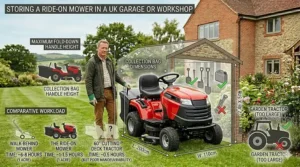
Ride-on mowers measure 160-180 cm long and 80-100 cm wide, demanding garage space many British homes lack. Outdoor storage requires weatherproof covers at minimum, though even covered machines deteriorate faster in British damp—rust on exposed metal, perished rubber components, moisture in fuel systems. If you’re storing outside, budget £50-£100 annually for additional maintenance addressing weather damage. Sheds work if they’re genuinely weatherproof (not typical UK garden sheds with draughty panel gaps), whilst garages offer ideal protection if you can spare the space.
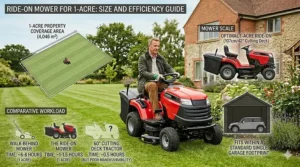
Real-World Performance: What 1-Acre British Gardens Demand
Theoretical specifications mean little until a machine confronts actual British conditions. Here’s what genuinely matters when your lawn resembles reality rather than marketing photographs.
Wet Grass Performance: The British Inevitability
British lawns spend roughly 40-50% of the growing season damp or wet, which transforms mowing from pleasant to problematic. Wet grass clumps, clogs collection chutes, and causes slipping on slopes. Twin-blade cutting decks handle wet conditions marginally better than single-blade systems by creating stronger airflow that lifts grass before cutting, though they still struggle with very thick, waterlogged growth. Hydrostatic transmissions prove essential in wet conditions—manual clutches slip on dewy grass, whilst foot-pedal control maintains traction more reliably.
The honest truth most retailers avoid: no ride-on mower cuts wet grass well. You’ll achieve better results by waiting for morning dew to evaporate, even if that means evening mowing sessions. When rain forces immediate mowing (overgrown grass ahead of events, contractor schedules), expect to clean the deck 2-3 times mid-session and accept a less perfect finish. British buyers with 4WD or AWD models report significantly better wet-grass traction, though cutting quality still suffers—you maintain forward progress but don’t achieve show-lawn stripes.
Slope Handling: Where 2WD Meets Its Limits
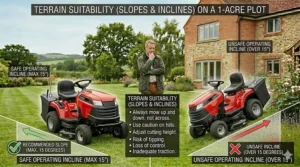
British gardens rarely qualify as “flat”—gentle undulations, drainage slopes, and banking prove more common than bowling-green level. 2WD ride-on mowers handle slopes up to about 10-12 degrees (roughly 18-21% gradient) before traction becomes questionable, particularly in damp conditions. Beyond that, 4WD or AWD systems become essential rather than luxury—the Atco GTX 38H and Husqvarna R216T AWD tackle 20-25 degree slopes that send 2WD models slipping sideways.
Crucially, slope capability means more than just climbing—descending steep grades on a heavy machine demands reliable braking and traction. Hydrostatic transmissions offer superior downhill control through engine braking, whilst manual systems require careful gear selection. If your acre includes significant slopes, test-drive potential models on similar terrain before purchasing. What feels controllable on flat ground becomes genuinely dangerous on steep, wet grass.
Obstacle Navigation: The Suburban Reality Check
Marketing photos show mowers gliding across pristine, obstacle-free lawns. British suburban reality includes mature trees, established flower beds, pathways, sheds, trampolines, washing lines, and the children’s play equipment. Traditional rear-deck garden tractors demand roughly 2.5-3 metres turning space for 180-degree reversal, which forces constant three-point turns in tight areas. Front-deck mowers like the Stiga Park 300 reduce this to about 1.5 metres, whilst articulated-steering models (Husqvarna R216T) turn in their own length.
The time difference proves substantial: complex suburban gardens can add 30-40% to mowing duration when using tractors with poor manoeuvrability. Count your obstacles, measure tight spaces, and prioritise turning radius over raw engine power if your garden resembles a landscaped maze rather than open pasture.
Common Mistakes When Buying a Ride-On Mower for 1 Acre
Assuming “1 Acre” Defines Your Needs
Total acreage tells you nothing about actual mowing requirements. One acre of flat, rectangular lawn demands completely different equipment than one acre of complex, sloped, obstacle-laden garden. Before researching mowers, map your property: total mowable area, number and size of obstacles, steepest slope, narrowest access point, and storage location. These specifics determine appropriate models far better than raw acreage figures.
Prioritising Engine Size Over Transmission Type
Buyers fixate on “bigger engine equals better mower,” ignoring that transmission type affects usability far more than raw horsepower. A 432cc engine with hydrostatic transmission delivers better real-world performance than a 500cc manual-shift engine for typical 1-acre suburban gardens. Engine power matters for thick grass, steep slopes, and rough terrain—but for weekly maintenance on established lawns, transmission smoothness, cutting deck design, and manoeuvrability determine satisfaction more than engine specifications.
Underestimating Total Ownership Costs
The purchase price represents roughly 60-70% of five-year ownership costs. Budget an additional £150-£250 annually for servicing (oil changes, blade sharpening, belt replacement), £80-£120 for fuel (depending on usage frequency), and £50-£100 for miscellaneous maintenance (filters, spark plugs, tyre repairs). Cheaper initial purchases often cost more long-term through higher fuel consumption, more frequent repairs, and lower resale values. Honda and Atco models cost £1,000-£1,500 more upfront but typically save £400-£600 over five years through better efficiency and reliability.
Buying Based on Peak Capacity Rather Than Regular Use
Salespeople push “future-proofing” by recommending oversized machines for potential needs. For 1-acre properties, resist temptation to buy 2-acre-capable tractors “just in case.” Larger machines cost more, consume more fuel, demand more storage space, and prove harder to manoeuvre in typical gardens. Buy for 90% of your actual use, not 10% of hypothetical future scenarios. If you genuinely expand to 2 acres later, you can upgrade—meanwhile, you’ve saved money and avoided wrestling an oversized machine through tight spaces.
Ignoring UK-Specific Compatibility
Some online deals offer attractively priced “US import” or “grey market” ride-on mowers. These typically operate on different voltage systems (110V versus UK 230V for electric-start batteries), may lack UK warranty support, and potentially miss UKCA certification required for sale in Great Britain post-Brexit. Replacement parts prove harder to source, and servicing requires finding mechanics familiar with American specifications. Stick with models from UK-authorised dealers—the £200-£300 saving evaporates quickly when you can’t find replacement parts or access warranty support.
Maintenance Made Simple: Protecting Your Investment in British Weather
Essential Monthly Checks During Cutting Season
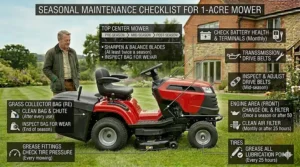
Blade Inspection (5 minutes): Lift the deck and inspect blades for damage, excessive wear, or grass buildup. Dull blades tear grass rather than cutting cleanly, creating brown tips and inviting disease. Sharpen blades every 20-25 hours of use (roughly monthly for 1-acre weekly mowing), or replace when metal thickness reduces noticeably. Clean grass buildup from the deck underside after each use—wet British grass sticks tenaciously, and dried clumps reduce cutting efficiency whilst promoting rust.
Tyre Pressure (3 minutes): Check all tyres monthly, maintaining manufacturer-specified pressures (typically 0.8-1.0 bar front, 1.0-1.2 bar rear). Underinflated tyres cause uneven cutting, increase fuel consumption, and make steering heavier. Overinflation reduces traction on slopes and creates harsher ride quality. British weather causes more pressure fluctuations than stable climates—temperature swings of 10-15°C between morning and afternoon affect tyre pressure noticeably.
Fuel Quality Management (2 minutes): Modern petrol contains ethanol (up to 10% in E10 fuel), which absorbs moisture and degrades rapidly. Use fuel stabiliser if storing mowers for more than 30 days, and never leave fuel in tanks over winter—stale fuel causes starting problems and damages carburettors. British damp accelerates fuel degradation, so buying small quantities frequently proves more reliable than bulk purchasing.
Winter Storage: Preparing for British Damp
Complete Fuel System Drainage (20 minutes): Run the engine until fuel starvation stops it, ensuring carburettor jets drain completely. Alternatively, add fuel stabiliser, run for 5 minutes to distribute throughout the system, then shut down. Ethanol-blended fuel left in systems over winter creates gummy deposits that block jets—British damp accelerates this deterioration compared to drier climates.
Oil Change Before Storage (15 minutes): Change oil before winter storage rather than after. Used oil contains combustion acids and moisture that promote corrosion during idle periods. Fresh oil provides better protection over 4-6 months of storage. Use manufacturer-specified grades—typically SAE 30 for warmer months, 10W-30 for year-round use in British temperatures.
Battery Maintenance (10 minutes): Disconnect battery terminals and store batteries on trickle chargers in dry locations. British winter damp accelerates battery discharge, and fully depleted batteries freeze more easily (damaging internal plates irreparably). Quality trickle chargers cost £25-£40 but extend battery life by 2-3 years—worthwhile investment given replacement batteries cost £60-£90.
Weatherproofing (15 minutes): Cover mowers completely if storing outdoors, ensuring covers don’t touch the ground (creates moisture wick). Elevate machines slightly (timber blocks under wheels) to prevent tyre flat-spots and improve air circulation underneath. Indoor storage in unheated garages or sheds proves vastly superior—British winter damp causes more long-term damage than summer use.
Ride-On Mower vs. Alternative Solutions for 1 Acre
Walk-Behind Self-Propelled Mowers: The Budget Alternative
For buyers questioning whether 1 acre justifies ride-on investment, quality walk-behind self-propelled mowers cost £300-£600—roughly one-fifth of ride-on prices. Modern models with 50-55 cm cutting widths handle 1 acre in 2-2.5 hours versus 45-60 minutes on ride-ons. The physical effort proves substantial—you’re walking 5-6 kilometres per mowing session, often up slopes whilst guiding a 30-40 kg machine.
According to the Royal Horticultural Society, lawn maintenance accounts for significant weekend time for UK homeowners, making efficiency a valid consideration. Walk-behind mowers make economic sense if you’re physically capable, enjoy the exercise, and don’t mind the time investment. They fail practical tests if you have mobility limitations, limited time, or prioritise efficiency over cost savings.
Robotic Lawn Mowers: The Hands-Off Option
Robotic mowers designed for 1 acre (4,000 square metres) cost £1,500-£3,500—comparable to entry/mid-range ride-on tractors. They operate autonomously on programmable schedules, returning to charging stations as needed. British buyers report mixed experiences: they work brilliantly on simple, relatively flat gardens but struggle with complex layouts, steep slopes (beyond 20-degree limits), and obstacle-heavy properties.
The critical limitation for British conditions: wet grass. Robotic mowers can operate in light rain but shouldn’t mow saturated lawns—they create muddy tracks and slip on slopes. Given British weather patterns, this restricts operation to roughly 60% of potential mowing days. They also require permanent boundary wire installation (8-12 hours labour initially) and regular blade replacement (£40-£60 quarterly). For buyers wanting absolute convenience and willing to accept limitations, robotics make sense. For those prioritising control, efficiency, and wet-weather capability, traditional ride-ons prove more practical.
Zero-Turn Mowers: The Speed Specialist
Zero-turn mowers offer incredible speed (covering 1 acre in 30-35 minutes) and manoeuvrability through independent wheel control. They cost £3,000-£7,000 for domestic models and excel on flat, obstacle-laden properties. However, British buyers should approach cautiously—zero-turns prove dangerous on slopes beyond 10-12 degrees (manufacturers often warn against any slope use) and perform poorly in wet conditions where independent wheel control becomes unpredictable.
For flat British gardens with numerous trees, flower beds, and complex navigation, zero-turns deliver impressive efficiency. For typical suburban properties with gentle slopes and occasional wet mowing, traditional garden tractors provide safer, more versatile solutions.
Legal Requirements and Safety Considerations for UK Users
UKCA Certification and Trading Standards
Since Brexit, products sold in Great Britain require UKCA (UK Conformity Assessed) marking rather than European CE certification, confirming compliance with UK safety and environmental standards. Reputable UK retailers stock only UKCA-compliant models, but buyers purchasing grey-market imports or second-hand machines should verify certification—riding mowers without proper certification can’t legally be sold and may void insurance coverage in accident scenarios.
According to UK Government product safety guidance, manufacturers and retailers bear legal responsibility for supplying safe, certified products. Buyers purchasing from established UK dealers (John Deere, Mountfield, Honda through authorised channels) receive automatic UKCA compliance, whilst private sellers and online auction purchases demand more scrutiny.
Noise Regulations and Neighbour Considerations
Ride-on mowers produce 85-95 dB(A) at operator position, qualifying as “potentially harmful” noise levels according to Health and Safety Executive guidelines. UK law doesn’t specifically regulate domestic garden equipment noise, but local council Environmental Health departments can intervene if noise causes statutory nuisance—typically defined as regular disturbance beyond reasonable hours.
Practical guidance: avoid mowing before 8:00 AM or after 8:00 PM on weekdays, before 9:00 AM on weekends. Most British councils suggest 9:00 AM-7:00 PM as considerate hours. Wear hearing protection consistently—prolonged exposure to 90+ dB levels causes permanent hearing damage. Quality ear defenders cost £15-£30 and prevent the tinnitus and hearing loss common among long-term garden machinery users.
Insurance and Liability Considerations
Ride-on mowers typically fall under home insurance coverage for theft and damage, but verify specific terms—many policies exclude garden machinery kept in unattached outbuildings or limit coverage to £500-£1,000 without declaration. Specialist garden machinery insurance costs £80-£150 annually and covers full replacement value plus liability.
Third-party liability proves crucial: if your mower damages neighbour property (thrown stones, runaway machines) or injures someone, you could face claims of £10,000-£50,000+. Most home insurance includes personal liability, but confirm coverage extends to powered garden equipment operation. Professional garden service providers require commercial insurance, but domestic users generally qualify under standard home policies.
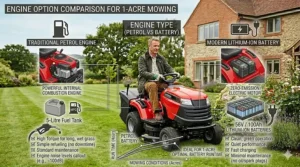
FAQ: Your Ride-On Mower Questions Answered
❓ Can a ride-on mower fit through a standard UK garden gate?
❓ How long does it take to mow 1 acre with a ride-on mower?
❓ Do ride-on mowers work well in wet British grass?
❓ What's the difference between hydrostatic and manual transmission for garden tractors?
❓ How much does ride-on mower maintenance cost annually in the UK?
Conclusion: Choosing Your Perfect 1-Acre Companion
Selecting the best ride on mower for 1 acre ultimately depends less on finding the “objectively best” model and more on matching specific capabilities to your unique garden’s demands. British properties vary enormously—flat suburban rectangles, sloped rural plots, mature gardens bristling with trees, compact terraced spaces—and no single mower excels across all scenarios.
For the majority of British 1-acre suburban gardens, the Mountfield 1530H or Stiga Estate 384 represent the sweet spot: compact enough for typical access, powerful enough for weekly maintenance, and priced sensibly enough (around £2,500) to justify the time savings over walk-behind alternatives. These models handle wet British grass reasonably well, squeeze through standard gates, and deliver 8-10 years of reliable service with basic maintenance. They’re not the most powerful, most feature-laden, or most manoeuvrable options available—but they competently address 90% of typical requirements without demanding premium budgets.
Buyers with genuinely challenging terrain—significant slopes, rough paddock sections, or obstacle-laden layouts—should seriously consider premium models like the Atco GTX 38H or Husqvarna R216T AWD. The additional £1,500-£3,000 investment buys genuine capability that transforms frustrating slipping and struggling into controlled, efficient mowing. However, these capabilities prove irrelevant on flat, simple properties where mid-range models deliver identical results for less money.
The honest truth most retailers avoid: any competent ride-on mower covers 1 acre more efficiently than walk-behind alternatives. The £2,000-£5,000 you invest buys back 60-90 minutes every mowing session—roughly 40-60 hours annually if you mow weekly from March through October. Whether that time proves worth the investment depends entirely on your circumstances, but the mathematics clearly favour ride-ons for anyone physically capable of affording one.
Before purchasing, verify gate widths, storage availability, and service access. Test-drive multiple models on terrain similar to your property rather than flat dealer lots. Prioritise reliability and serviceability over flashy features, remembering that British weather punishes machinery far more aggressively than marketing departments acknowledge. And accept that no ride-on mower cuts perfectly in saturated British grass—they all struggle, and waiting for conditions to improve delivers better results than battling through regardless.
Your garden’s specific requirements deserve specific solutions, not generic “best of” recommendations. Use this guide to understand what differentiates models, then match those differences to your measured realities rather than wishful thinking about perfect conditions. The right ride-on mower transforms weekend lawn maintenance from exhausting chore to efficient task—but only if you choose honestly based on actual needs rather than optimistic assumptions.
Recommended for You
- 7 Best Cylinder Mower for Stripes UK: Transform Your Garden (2026)
- Best Robotic Mower UK 2026: 7 Wire-Free Models Tested
- Honda vs Mountfield Mower: 7 Best Models Compared (2026)
Disclaimer: This article contains affiliate links. As an Amazon Associate, I earn from qualifying purchases. If you purchase products through these links, we may earn a small commission at no additional cost to you.
✨ Found this helpful? Share it with your mates! 💬🤗
