
In This Article
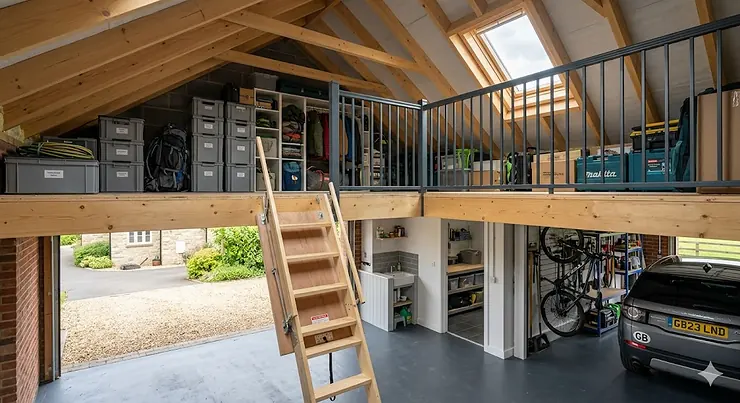
If you’re like most British homeowners, your garage has gradually morphed from a parking space into a dumping ground for everything from Christmas decorations to camping gear. What you might not realise is that there’s potentially 3-5 cubic metres of perfectly usable storage space floating above your car—completely wasted.
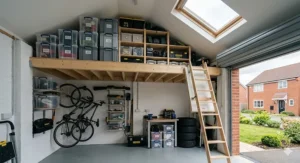
Garage loft storage solutions exploit that unused ceiling space, transforming the awkward void between your car roof and garage ceiling into organised, accessible storage. For UK homes—where compact living is the norm and every square metre counts—this isn’t just clever; it’s essential. Whether you’re in a semi-detached in Coventry or a terraced house in Newcastle, the principle remains: when floor space is precious, go vertical.
The British garage presents unique challenges. Most were built in an era when cars were smaller and storage needs were simpler. Combine that with our damp climate, limited space, and the fact that many UK garages double as workshops, and you’ll understand why proper overhead storage isn’t just about slinging a few boxes on a shelf. You need systems designed for British conditions—robust enough for our weather, compatible with UK construction standards, and clever enough to work within tight spatial constraints.
Quick Comparison Table: Top Garage Loft Storage Solutions
| Product | Type | Weight Capacity | Size | Best For | Price Range (GBP) |
|---|---|---|---|---|---|
| FLEXIMOUNTS 4×8 Overhead Rack | Ceiling-mounted rack | 272kg (600lbs) | 122 x 244 cm | Maximum capacity | £180-£250 |
| VonHaus 5-Tier Shelving | Freestanding shelving | 875kg total | 180 x 90 x 40 cm | Floor-to-ceiling storage | £70-£110 |
| FLEXIMOUNTS 3×8 Overhead Rack | Ceiling-mounted rack | 250kg (550lbs) | 91 x 244 cm | Narrower garages | £140-£190 |
| Jowkou 3x4ft Ceiling Rack | Compact ceiling rack | 180kg | 91 x 122 cm | Small garages | £80-£120 |
| Gr8 Home Bin Rack Brackets | Bracket system | Varies by configuration | Modular | Budget DIY | £30-£60 |
| VonHaus Corner Shelving | Corner freestanding | 875kg total | 180cm height | Awkward spaces | £60-£95 |
| HyLoft Adjustable Rack | Ceiling-mounted rack | 135kg | 120 x 120 cm | Light storage | £65-£95 |
From this comparison, the FLEXIMOUNTS 4×8 emerges as the heavyweight champion for serious storage needs, whilst the VonHaus 5-Tier offers exceptional value for those preferring traditional shelving. Budget-conscious buyers should note that the Gr8 Home Brackets deliver modularity at half the price, though they require existing bins and more DIY confidence. For compact British garages—where every centimetre matters—the Jowkou 3x4ft strikes the best balance between capacity and footprint.
💬 Just one click — help others make better buying decisions too! 😊
Top 7 Garage Loft Storage Solutions: Expert Analysis
1. FLEXIMOUNTS 4×8 Overhead Garage Storage Rack
The FLEXIMOUNTS 4×8 is rather like the Range Rover of garage storage—overbuilt, reassuringly solid, and utterly unflappable under load. With a 272kg (600lb) capacity and adjustable height from 56-102 cm, this creates up to 105 cubic feet of overhead storage that most UK homeowners didn’t know they had.
What sets this apart is the engineering: long ceiling brackets attach to two joists simultaneously (unlike cheaper models that mount to one), distributing weight across a broader area. This matters tremendously in British homes, where ceiling joists may be 30-50 years old and weren’t designed for heavy loads. The powder-coated cold-rolled steel construction handles our damp climate without the surface rust that plagues inferior racks within months.
UK buyers should verify their joist spacing—this works with standard ≤24-inch spacing or 48-inch spacing, which covers most British garages built from the 1970s onwards. The rack won’t fit metal joists, so older steel-frame garages need alternative solutions. Installation requires drilling into wooden joists or concrete ceilings; the included template helps, but you’ll want a decent cordless drill and about two hours.
The real-world benefit? You can store four large storage bins, a pile of winter tyres, and camping equipment overhead—freeing enough floor space to actually park your car. British buyers particularly value this in winter when the garage becomes the de facto storage shed for garden furniture escaping the rain.
Pros:
✅ Exceptional 272kg capacity handles serious storage needs
✅ Dual-joist mounting provides superior stability
✅ Adjustable height accommodates varying ceiling clearances
Cons:
❌ Requires competent DIY skills for safe installation
❌ Not compatible with metal joists found in some older garages
Price & Verdict: Around £180-£250. If you’re serious about reclaiming floor space and your garage has wooden joists or a concrete ceiling, this is the investment that pays dividends every time you open the garage door and see clear floor instead of clutter.

2. VonHaus 5-Tier Heavy Duty Garage Shelving
For those who prefer the reassurance of traditional shelving over suspended ceiling racks, the VonHaus 5-Tier delivers 875kg of total capacity across five adjustable shelves. Each shelf holds 175kg—enough for toolboxes, paint tins, and those mysteriously heavy boxes of “important stuff” we all accumulate.
This is a boltless assembly system, meaning you slot it together without power tools. The galvanised steel resists rust (essential in damp British garages), whilst the 4mm MDF shelves sit within the frame rather than resting on top—a detail that prevents warping and creates a cleaner aesthetic than cheaper units.
The flexibility is where this shines for UK buyers. You can configure it as a single tall unit (180 x 90 x 40 cm), split it into two separate shelving units, create a corner arrangement, or even fashion a makeshift workbench. For a terraced house in Manchester where the garage serves triple duty as workshop, storage, and bicycle parking, this adaptability is invaluable.
Worth noting: whilst this maximises vertical space brilliantly, it does consume floor space. If your garage is barely wider than your car, overhead ceiling storage might serve you better. But for those with a bit of width to spare, this offers accessible storage that doesn’t require climbing a ladder or lowering suspended racks.
Pros:
✅ No-tools boltless assembly takes under 45 minutes
✅ Rust-resistant galvanised steel suited to UK climate
✅ Versatile configuration options for different spaces
Cons:
❌ Requires floor space—not ideal for very narrow garages
❌ Height (180cm) may exceed clearance in some single garages
Price & Verdict: In the £70-£110 range. Exceptional value for those wanting robust, flexible storage without the complexity of ceiling-mounted systems. The VonHaus brand has earned trust among UK DIYers for durability.
3. FLEXIMOUNTS 3×8 Overhead Garage Storage Rack
Think of this as the FLEXIMOUNTS 4×8’s younger sibling—slightly smaller (91 x 244 cm), slightly lighter capacity (250kg), but otherwise equally well-engineered. For narrower British garages where the full 122cm width of the 4×8 model would eat into headroom, this 91cm version makes perfect sense.
The construction mirrors its larger cousin: powder-coated cold-rolled steel, long ceiling brackets spanning two joists, and height adjustment from 56-102cm. What you sacrifice in width and capacity, you gain in compatibility with tighter spaces. Many UK garages built in the 1960s-80s are barely 2.4-2.6m wide; the 3×8 rack fits these proportions without overwhelming the space.
Installation follows the same template-based approach. You’re still drilling into joists or concrete, still needing a couple of hours and reasonable DIY competence, but the lighter weight (compared to the 4×8) makes it slightly more manageable as a one-person installation if you’re determined.
British buyers using this for seasonal storage—summer garden cushions in winter, Christmas decorations in summer—appreciate that the 250kg capacity handles multiple large storage bins without worry. The 244cm length offers surprising capacity despite the narrower width.
Pros:
✅ Narrower profile suits compact British garages
✅ Same quality engineering as larger FLEXIMOUNTS models
✅ 250kg capacity still handles substantial storage loads
Cons:
❌ Reduced width limits capacity compared to 4×8 model
❌ Still requires proper joist mounting—no shortcuts
Price & Verdict: Around £140-£190. If space constraints rule out the 4×8 model, this delivers 80% of the capacity at roughly 75% of the price. A sensible choice for typical British garage dimensions.
4. Jowkou 3x4ft Garage Ceiling Storage Rack
For smaller garages or those who simply don’t need industrial-grade capacity, the Jowkou 3x4ft (91 x 122 cm) offers a more modest 180kg capacity that still handles a surprising amount of storage. This is the “Goldilocks” option for British homeowners—not too big, not too small, and priced in that sweet spot where it feels like a reasonable investment rather than a financial commitment.
The compact footprint makes this ideal for single garages or those awkward spaces above garage doors where larger racks won’t fit. You can install multiple units if needed, creating modular overhead storage that adapts to your garage’s specific layout. The adjustable height (similar range to other overhead racks) means you’re not sacrificing flexibility despite the smaller size.
What British buyers particularly appreciate is how this doesn’t dominate the space. In a compact garage where you’re also storing bicycles, a lawnmower, and attempting to park a car, a massive 4×8 rack can feel oppressive. The 3×4 provides meaningful storage whilst maintaining a sense of proportion.
Installation is simpler than larger racks purely due to reduced weight and dimensions. The same joist-mounting principles apply, but you’re handling more manageable components. First-time installers often find this less intimidating than tackling a full-size overhead rack immediately.
Pros:
✅ Compact dimensions ideal for smaller UK garages
✅ 180kg capacity adequate for typical storage needs
✅ More affordable entry point to overhead storage
Cons:
❌ Limited capacity compared to larger overhead racks
❌ May need multiple units for substantial storage requirements
Price & Verdict: In the £80-£120 range. This represents sensible overhead storage for those who don’t need maximum capacity. Perfect for flats with small garages or homeowners testing the overhead storage concept before committing to larger systems.
5. Gr8 Home Overhead Storage Bin Rack Brackets
Here’s where we enter proper DIY territory. The Gr8 Home system isn’t a complete rack—it’s a set of brackets that hold standard storage bins overhead. You buy the brackets, supply your own bins, and create a modular system tailored exactly to your needs. It’s brilliantly simple and wonderfully adaptable.
Each bracket set (typically sold in packs of 4-6) mounts to ceiling joists and creates rails that storage bins slide onto. The genius lies in the flexibility: add or remove bins as needs change, use different sized bins for different purposes, and expand the system incrementally without buying an entirely new rack.
This approach suits UK buyers with existing storage bins who don’t want to replace a perfectly functional container collection. It’s also ideal for those awkward garage layouts where off-the-shelf racks don’t quite fit. You can stagger bracket sets at different heights, create L-shaped configurations, or fill narrow strips of ceiling space that standard racks can’t exploit.
The catch? You need bins that fit the brackets (most standard utility bins work), and the total weight capacity depends on how many bracket sets you install and your joist spacing. It’s less plug-and-play than complete rack systems, requiring more planning and measurement. But for mechanically-minded homeowners, this DIY approach delivers custom storage at bargain pricing.
Pros:
✅ Exceptional value—often half the price of complete racks
✅ Modular design allows incremental expansion
✅ Works with existing storage bin collections
Cons:
❌ Requires separate purchase of compatible storage bins
❌ More planning needed compared to complete systems
Price & Verdict: Around £30-£60 for a bracket set. Brilliant value for DIY enthusiasts willing to invest time in planning. The budget savings can fund better quality storage bins or additional bracket sets for expanded capacity.

6. VonHaus Corner Garage Shelving Unit
Most garage storage ignores corners, leaving awkward triangular voids that accumulate dust and forgotten items. The VonHaus Corner Shelving transforms that wasted space into 875kg of usable storage across five shelves.
This isn’t overhead storage in the ceiling-mounted sense; it’s a floor-standing unit designed specifically for corner installation. The hammered grey finish resists scratches better than painted shelving, whilst the galvanised steel construction handles damp conditions without degrading—critical for UK garages that can feel positively tropical on humid summer days.
British homeowners with L-shaped or awkwardly proportioned garages particularly value corner shelving. It exploits space that would otherwise sit empty whilst keeping the centre of the garage clear for vehicles or workbench placement. The 180cm height maximises vertical storage without requiring ceiling mounting.
Assembly follows VonHaus’s typical boltless approach—no tools needed, slotted construction, adjustable shelf heights. You can install this in under an hour even if DIY isn’t your forte. The non-slip feet prevent movement whilst protecting floor surfaces from scratches.
Pros:
✅ Maximises typically wasted corner space
✅ 875kg total capacity matches full-size VonHaus units
✅ Hammered finish provides superior scratch resistance
Cons:
❌ Corner-specific design limits placement flexibility
❌ Requires adequate corner clearance to function properly
Price & Verdict: Around £60-£95. If your garage has a corner crying out for organisation, this purpose-built solution delivers exceptional capacity in a compact footprint. Far more effective than trying to shove rectangular shelving into triangular spaces.
7. HyLoft Adjustable Garage Ceiling Mount Storage Rack
The HyLoft represents the minimalist end of ceiling storage—a 120 x 120 cm rack with 135kg capacity designed for lighter, bulkier items rather than maximum weight. Think seasonal decorations, camping equipment, or those inflatable pool toys that consume disproportionate space for nine months of the year.
What distinguishes the HyLoft is the installation approach. The brackets are designed for easy mounting to standard joist spacing, with a simpler adjustment mechanism than industrial-grade racks. It’s not cutting corners; it’s acknowledging that not everyone needs to store anvil collections overhead.
For UK buyers, this works particularly well as supplementary storage alongside floor-based shelving. You might use VonHaus shelving for tools and heavy items, then add a HyLoft rack for lightweight seasonal storage. The white powder-coated finish suits garages with lighter colour schemes, creating a less industrial aesthetic than black racks.
The 135kg capacity limitation means you’re thinking carefully about what goes up there. Large but light items work perfectly; dense, heavy boxes don’t. British buyers using this for Christmas decorations, summer garden cushions, or camping gear report excellent results. Those trying to store automotive parts or heavy tool collections find it inadequate.
Pros:
✅ Simpler installation than heavy-duty industrial racks
✅ White finish offers aesthetic alternative to black racks
✅ 120 x 120 cm footprint fits above most garage doors
Cons:
❌ 135kg capacity limits usefulness for heavy storage
❌ Square format less space-efficient than rectangular racks
Price & Verdict: In the £65-£95 range. This serves a specific niche—lightweight seasonal storage—remarkably well. If that matches your needs, it’s excellent value. If you need serious capacity, look elsewhere.
Maximising Vertical Space: A Practical Installation Guide
Installing garage loft storage solutions properly makes the difference between convenient organisation and potential disaster. British garages present unique challenges—older construction, varying joist spacing, and that persistent dampness that makes every screw hole feel like an invitation for rot.
Pre-Installation Assessment
Before buying anything, spend twenty minutes in your garage with a tape measure and a ladder. Measure ceiling height at multiple points—many British garages aren’t perfectly level. Check joist spacing by tapping the ceiling until you locate joists (they sound solid rather than hollow). Standard UK spacing is typically 400-600mm, but older garages can vary wildly.
Most critically, assess joist condition. If your garage was built before 1990 and you’ve never inspected the ceiling structure, consider having a builder verify that joists can handle additional weight. According to UK building regulations, ceiling joists in most garages are designed for 25kg per square metre permanent load plus 180kg temporary load (one person). Adding overhead storage within these limits is typically safe, but exceeding them requires structural reinforcement.
Installation Best Practices for British Conditions
Use exterior-grade screws and fixings even for interior garage installation. British garages experience temperature swings and humidity levels that would shock items rated for “indoor use only.” The extra pound spent on corrosion-resistant fixings prevents the awkward scenario of your storage rack separating from the ceiling at 3am on a damp November night.
Drill pilot holes for every fixing. British softwood joists (common in post-war construction) can split if you force screws in without pre-drilling. Take the extra five minutes—split joists mean compromised load-bearing capacity and an expensive repair bill.
Install a spirit level on your phone if you don’t own a traditional one. Overhead racks that aren’t perfectly level will gradually shift stored items toward one end, creating dangerous weight concentration. What starts as a barely perceptible slope becomes a storage avalanche six months later.
Height Adjustment Strategy
Most adjustable overhead racks offer 56-102cm dropdown ranges. For British garages where you’re parking a car underneath, aim for minimum 2.1m clearance from floor to rack bottom. This accommodates most vehicles plus roof boxes, whilst leaving enough headroom that you won’t brain yourself walking underneath.
If you’re not parking underneath, drop the rack lower for easier access. Constantly climbing ladders to retrieve storage defeats the purpose of organised space. The ideal height lets you reach stored items with a small stepstool rather than a full ladder.

Storage Solutions for Different Garage Types
Single Garage (Up to 3m Width)
British single garages—the ones barely wide enough for a modern car—demand smart overhead solutions. The FLEXIMOUNTS 3×8 or Jowkou 3x4ft racks work best here, providing storage without overwhelming limited space. Position racks lengthwise along the garage to maintain maximum width clearance.
Combine overhead storage with wall-mounted solutions rather than floor shelving. Every centimetre of floor space matters when you’re trying to park a car and store anything else. Vertical walls offer mounting points for tools, bicycles, and garden equipment without consuming floor area.
Double Garage (3m+ Width)
Double garages allow the full FLEXIMOUNTS 4×8 rack plus additional shelving systems. Consider installing overhead racks above each parking space, creating dedicated storage zones. One side might hold seasonal items, the other workshop supplies.
The extra width permits mixing storage types—overhead racks for bulky items, VonHaus shelving along one wall for frequently accessed tools, corner units for awkward spaces. The goal is zoning: create distinct areas for different storage categories rather than random distribution.
Workshop Garages (No Vehicle Storage)
Without parking requirements, workshop garages can exploit every cubic metre. Install overhead racks at lower heights for easier access. Combine ceiling storage (for materials and completed projects) with robust floor shelving (for heavy tools and equipment).
Workshop garages benefit from modular systems like Gr8 Home brackets. As your workshop evolves, storage needs change. Modular brackets let you reconfigure without replacing entire systems. You might store lumber overhead initially, then shift to finished project storage as needs evolve.
Understanding UK Building Regulations for Garage Storage
British garages occupy a peculiar regulatory position—they’re part of your property but subject to different rules than living spaces. Understanding these regulations prevents expensive mistakes and potential safety hazards.
Structural Considerations
Standard UK ceiling joists in garages are typically designed for 25kg per square metre permanent load (like insulation or light storage) plus a 180kg temporary load (one person). This comes from British Standard BS5268, which governs timber structures. Overhead storage racks loaded with heavy items create permanent loads potentially exceeding original design parameters.
For habitable conversions (turning loft space into rooms), UK Building Regulations require floor joists rated for 1.5 kN/m² minimum—substantially stronger than typical garage ceiling joists. But for storage-only applications, the rules are more flexible. You’re not creating habitable space; you’re simply organising existing garage volume more efficiently.
The practical implication: distribute weight across multiple overhead racks rather than concentrating everything in one area. If you’re installing a single 4×8 rack loaded to its 272kg capacity, you’re adding roughly 23kg per square metre—within acceptable limits for properly installed racks on sound joists. Installing three such racks fully loaded in a small garage might exceed safe limits.
When Professional Assessment Matters
Garages built before 1960 may use construction methods and timber grades that don’t align with modern standards. Victorian or Edwardian garages converted from outbuildings can have ceiling structures never intended for overhead storage. If your garage predates 1960, or if you notice existing ceiling sag or crack patterns, have a structural engineer assess load-bearing capacity before installing overhead storage.
Professional assessment typically costs £150-£300—reasonable insurance against ceiling collapse and the attendant repair costs (potentially thousands of pounds). The engineer provides a written report specifying safe load limits, which also proves invaluable for insurance purposes should anything go wrong.
Planning Permission and Building Regulations
Installing garage storage systems within existing structures generally doesn’t require planning permission or Building Regulations approval. You’re not altering the building envelope, creating new structures, or changing the garage’s fundamental use.
However, if you’re boarding the loft space above the garage to create accessible storage (essentially creating a loft floor), Building Regulations may apply depending on intended use. Storage-only loft boarding often doesn’t require approval, but if you’re installing lighting, heating, or making it properly accessible with fitted stairs, regulations likely apply. Contact your Local Authority Building Control before starting such projects.
For detailed guidance on UK building regulations, consult the official UK Government planning portal.
Common Mistakes When Buying Garage Loft Storage Solutions
Mistake 1: Ignoring Joist Type and Spacing
Many British homeowners discover too late that their garage uses trussed rafters (triangulated roof structures) rather than traditional joists. Trussed rafters distribute loads differently than simple joists; mounting heavy racks to truss members without engineering calculations can compromise the entire roof structure.
Before purchasing any ceiling-mounted system, verify your ceiling structure type. If you have trussed rafters (common in post-1970 construction), consult the truss manufacturer’s specifications or hire a structural engineer to determine safe mounting points. This isn’t overcaution—it’s preventing your garage roof from gradually sagging into an expensive insurance claim.
Mistake 2: Overlooking Ceiling Height Requirements
British garages vary wildly in ceiling height. Post-war garages often have 2.1-2.4m ceiling heights; newer builds might reach 2.7m. When manufacturers specify “adjustable 56-102cm dropdown,” calculate what that means for your specific ceiling.
A 2.4m ceiling with a 102cm rack dropdown leaves 1.38m clearance below the rack. If you’re parking a vehicle (most UK cars are 1.4-1.5m tall), you’re scraping the paint every time you drive in. Always measure your tallest vehicle, add 10cm safety margin, then work backward to determine maximum safe rack dropdown.
Mistake 3: Buying Based Solely on Weight Capacity
A rack rated for 272kg sounds impressive until you realise that capacity assumes even weight distribution across the entire surface. Loading one corner with heavy items whilst leaving others empty creates stress concentration potentially exceeding design limits. British buyers often stack heavy paint tins on one end of a rack whilst leaving the other end barely loaded—precisely what manufacturers warn against.
The solution? Think of overhead racks as platforms for storage bins rather than jumbled item repositories. Fill bins evenly, distribute bins across the rack surface, and keep heavier bins toward the centre where joist support is strongest.
Mistake 4: Forgetting Access Requirements
That enormous 4×8 overhead rack stores a remarkable amount—until you need something from the back corner and realise you’ve created a three-dimensional Jenga puzzle. British buyers often load overhead racks with rarely-needed items (Christmas decorations, camping gear, winter tyres) without considering retrieval logistics.
Plan access before installation. If you can only reach the rack from one direction, don’t bury frequently-needed items at the back. Use clear storage bins so you can identify contents without removing everything. Label bin ends clearly—struggling to read upside-down labels whilst balanced on a stepladder is how accidents happen.
Mistake 5: Underestimating Installation Complexity
Manufacturers present overhead rack installation as simple weekend projects. For experienced DIYers, that’s accurate. For those whose tool collection consists of a flathead screwdriver and enthusiasm, it’s wildly optimistic.
Ceiling-mounted racks require drilling multiple holes into joists (often while standing on a ladder), lifting heavy steel frames overhead, and ensuring perfect level across multiple mounting points. British garages—with their varying joist spacing and sometimes questionable structural integrity—complicate matters further.
If you’re not confident drilling into ceiling joists, hire a handyman for £50-£100. The professional installation fee is substantially cheaper than repairing a fallen rack, damaged car, or broken ceiling.

Garage Loft Storage vs Traditional Floor Shelving
British homeowners often debate whether overhead ceiling storage or traditional floor shelving better serves their needs. The answer depends entirely on your specific circumstances and priorities.
Floor Shelving Advantages
Floor-based shelving offers unmatched accessibility. You can reach items without ladders or steptools—critical for those with mobility limitations or anyone who simply values convenience. The VonHaus 5-Tier shelving exemplifies this: five shelves of 175kg capacity each, all accessible at comfortable standing height.
British buyers with workshop garages particularly favour floor shelving for tools and equipment used daily. There’s visceral satisfaction in seeing your organised tool collection rather than having it buried in overhead bins. Floor shelving creates visual organisation that helps maintain discipline—when everything has a visible place, you’re more likely to return items properly.
The installation simplicity can’t be overstated. Boltless assembly means you slot components together without power tools, often in under an hour. No drilling into questionable ceiling structures, no risk of hitting electrical cables, no ladder work. You can install floor shelving solo on a Sunday afternoon without requiring engineering degrees or divine intervention.
Overhead Storage Advantages
Overhead storage excels at one critical task: maximising usable floor space in compact British garages. When your garage barely accommodates your car plus a lawnmower, surrendering floor space to shelving feels extravagant. Ceiling-mounted racks exploit vertical volume that would otherwise sit empty.
For seasonal storage, overhead racks are brilliant. Items used once or twice yearly (Christmas decorations, summer garden furniture, camping equipment) can live overhead without compromising daily garage functionality. You access them occasionally, so the ladder requirement doesn’t create constant inconvenience.
British buyers often combine both approaches: floor shelving for frequently accessed items (tools, current project materials, cleaning supplies) and overhead racks for seasonal or rarely-needed storage. This hybrid strategy maximises both floor space and accessibility, creating a genuinely organised garage rather than simply shifting clutter locations.
The Climate Factor
UK garages experience dramatic temperature and humidity swings. Summer sunshine can turn garages into sweatboxes; winter transforms them into refrigerators. Floor shelving places items in the temperature zone most affected by these swings (ground level stays cooler in summer, colder in winter). Overhead storage sits in the warmest zone year-round (heat rises), which can benefit temperature-sensitive items.
For long-term storage of moisture-sensitive items, overhead racks combined with sealed storage bins create better protection than floor shelving alone. The elevation reduces ground moisture exposure whilst sealed bins protect against condensation.
Essential Safety Considerations for UK Garages
Electrical Hazards
British garages often have electrical cables running through ceiling spaces, particularly if you’ve added lighting or power sockets since original construction. Before drilling anywhere, map cable routes using an electronic stud finder with cable detection capability. These cost £20-£50 and prevent the excitement of discovering live 240V cables with your drill bit.
If your garage has had electrical work done since original construction, obtain circuit diagrams if possible. Electricians sometimes route cables in unexpected paths, particularly when adding outlets to garage walls. The few minutes spent locating cables beats the hours spent repairing punctured cables or the potential consequences of electric shock.
Chemical Storage Conflicts
Many British homeowners store paint, solvents, fertilisers, and other chemicals in garages. Overhead storage above chemical storage creates potential hazards—leaking containers dripping onto items below, fumes accumulating in enclosed overhead spaces, or incompatible chemicals stored in close proximity.
Separate chemical storage from overhead racks. If you must store chemicals in the garage, dedicate a lower section of floor shelving with proper containment. Never store chemicals in overhead racks where leaks could contaminate everything below.
Weight Distribution and Load Limits
Exceeding rack load limits doesn’t necessarily cause immediate catastrophic failure. Instead, racks sag gradually over weeks or months, the steel deforming under sustained overload. By the time you notice obvious sagging, structural damage has occurred—the rack may fail suddenly when you add that one final storage bin.
Weigh loaded storage bins before placing them overhead. A bathroom scale works perfectly—weigh yourself holding the bin, then subtract your weight. Track total rack load in a notebook; when approaching manufacturer limits, stop adding weight. The few minutes spent weighing bins prevents the spectacular failure of an overloaded rack.
For more information on garage safety standards, visit the UK Health and Safety Executive website.
Maximising Storage with Smart Organisation Techniques
The Clear Bin Strategy
British buyers swear by clear plastic storage bins for overhead storage. Being able to identify bin contents from ground level eliminates unnecessary ladder climbing. You can scan your overhead storage and immediately spot the Christmas lights or camping stove without pulling down multiple bins.
Standardise bin sizes where possible. Uniform dimensions create more efficient rack utilisation and simplified logistics. Mixing random bin sizes creates wasted space and Tetris-like challenges every time you reorganise.
Colour-Coded Organisation
Assign colours to storage categories: blue for seasonal decorations, red for camping equipment, green for garden items. Add coloured tape to bin lids or purchase pre-coloured bins. This visual system lets you locate categories instantly rather than reading labels upside-down from a stepladder.
Weight-Based Distribution
Place heaviest items toward rack centres where joist support is strongest. Lighter items can occupy corners and edges. This distribution prevents stress concentration whilst maximising overall storage capacity.
Store frequently-needed lightweight items toward rack fronts and edges where they’re easiest to reach. Rarely-needed heavy items can occupy less accessible positions—you’ll manage the extra retrieval effort on the occasions you need them.
Seasonal Rotation
British weather drives distinct seasonal storage needs. Christmas decorations dominate December and January, then disappear until next year. Summer garden furniture and barbecue equipment reverse the pattern. Create a rotation system where seasonal items swap positions based on current relevance.
Keep current-season items accessible; store off-season items in less accessible positions. This requires planning—you can’t easily reorganise overhead racks—but annual rotation efforts reward you with perfectly positioned storage year-round.
Long-Term Cost Analysis: Is Overhead Storage Worth It?
British homeowners rightfully question whether spending £150-£250 on overhead storage delivers genuine value or simply represents expensive clutter relocation.
The Floor Space Premium
In British housing markets, every square metre commands significant value. If overhead storage lets you reclaim even 2 square metres of garage floor space, you’ve created room for a second vehicle, workshop area, or bicycle storage. For families where garage parking prevents street parking permits or charges, this could save £500-£1,500 annually in parking costs.
Even without direct financial savings, reclaimed floor space delivers lifestyle value. Being able to park both cars in a double garage instead of only one means not scraping ice on winter mornings. That’s worth something, even if accountants can’t quantify it neatly.
Opportunity Cost of Clutter
British homeowners spend an average £400-£600 annually on self-storage units according to industry figures. If garage loft storage eliminates self-storage need, the £200 investment pays for itself within 4-6 months. Even partial reduction in storage unit size delivers ongoing savings.
Beyond monetary costs, clutter carries mental taxation—the persistent low-level stress of disorganisation and the time wasted searching for misplaced items. Whilst difficult to quantify precisely, the psychological benefit of organised space has real value.
Durability and Longevity
Quality overhead racks from FLEXIMOUNTS or VonHaus should provide 15-20 years of service with minimal maintenance in typical UK garage conditions. Cheaper alternatives might need replacement within 5-7 years as rust and structural fatigue accumulate.
Amortised over 15 years, a £200 rack costs £13 annually. Compare that to the value of organised space, eliminated clutter stress, and reclaimed floor area. From this perspective, overhead storage represents one of the more cost-effective home improvement investments available.

FAQ: Your Garage Loft Storage Questions Answered
❓ Can I install overhead garage storage myself, or must I hire professionals?
❓ How much weight can typical UK garage ceiling joists safely support?
❓ Will overhead storage racks interfere with my garage door operation?
❓ Are overhead storage racks suitable for unheated British garages?
❓ Can I install overhead racks in a rented garage, or will they damage the structure?
Conclusion: Transforming Your Garage’s Wasted Potential
British garages have evolved from simple car shelters into multifunctional spaces serving as workshops, storage hubs, and overflow living areas. Yet most homeowners ignore the 3-5 cubic metres of vertical space floating uselessly above their cars. Garage loft storage solutions transform this oversight into opportunity.
The products reviewed here represent the best options for UK conditions in 2026. The FLEXIMOUNTS 4×8 delivers unmatched capacity for serious storage needs; the VonHaus 5-Tier offers exceptional value in traditional shelving; the Jowkou 3x4ft provides compact efficiency for smaller spaces. Budget-conscious buyers find excellent value in Gr8 Home Brackets, whilst those with specific spatial challenges benefit from VonHaus Corner units.
Beyond product selection, success requires understanding British building standards, recognising the limitations of ceiling joists designed for different purposes, and implementing smart organisation strategies that maintain long-term utility. The difference between successful garage storage and cluttered ceiling spaces lies in thoughtful planning rather than simply mounting racks and hoping for the best.
For most British homeowners, the investment ranges from £60-£250—modest compared to the value of reclaimed floor space, eliminated clutter stress, and the sheer satisfaction of opening your garage door to organised space rather than chaotic accumulation. Whether you’re parking both cars for the first time in years or finally creating that workshop you’ve planned, overhead storage represents the foundation of garage transformation.
The space above your car isn’t wasted anymore. It’s your garage’s hidden potential waiting for recognition.
Recommended for You
- 7 Best Garage Ceiling Pulley Systems UK 2026
- Best Ceiling Storage Rack Garage UK: 7 Expert Picks 2026
- 7 Best French Cleat Systems UK 2026: Expert Garage Storage Guide
Disclaimer: This article contains affiliate links. As an Amazon Associate, I earn from qualifying purchases. If you purchase products through these links, we may earn a small commission at no additional cost to you.
✨ Found this helpful? Share it with your mates! 💬🤗
