
In This Article
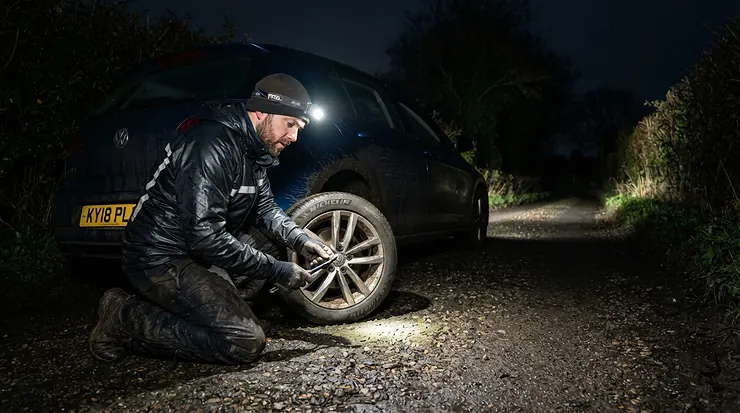
A tyre repair kit for emergencies is a compact set of sealant, foam or rubber plugs that temporarily seals a puncture so you can reach a garage safely. Most come as a sealant-and-compressor set, an aerosol can, or a plug-and-reamer toolkit. It’s a bridge to professional help, never a permanent fix.
Punctures are the unglamorous villains of motoring. The nail doesn’t care about your meeting, your dinner reservation or the drizzle. According to a National Highways release on gov.uk, around 40,000 breakdowns in the 12 months from June 2019 were recorded as tyre-related. And RAC research suggests only about 3% of new cars are now sold with a spare wheel. For most drivers, then, the real choice is a factory sealant bottle, a decent aftermarket kit, or a long wait on the verge.
That’s where a well-chosen tyre repair kit for emergencies earns its boot space. Below, we compare seven real products, from a few quid of foam to a premium sealant-and-compressor set. We translate every spec into what it means on a wet roadside. This guide draws on spec comparisons, published independent tests and aggregated reviewer themes rather than our own bench testing, and where evidence is thin we say so. We also cover temporary sealant, compact tyre repair kit options, run-flat limitations and wider breakdown preparedness.
Quick Comparison: Seven Kits at a Glance
| Kit | Type | Price range* | Compressor included? | Best For |
|---|---|---|---|---|
| Holts Tyreweld | Aerosol foam | £7–£12 | Not needed (self-inflating can) | Cheap glovebox backup for small tyres |
| Tyre Doctor Tyre Repair Kit | Plug-and-reamer | £10–£15 | No, bring a pump | Tiny boots, DIY-confident drivers |
| Ring Flat Tyre Sealant | Liquid sealant | £10–£15 | No, bring a compressor | Best independent test result on a budget |
| Laser Tools Emergency Tyre Repair Kit | Rope-plug kit | £15–£25 | No, bring a pump | Larger holes in calm conditions |
| Streetwize Emergency Tyre Puncture Repair Kit | Sealant + compressor | £25–£35 | Yes | Budget all-in-one |
| AirMan ResQ | Gel sealant + compressor | £35–£45 | Yes | Best all-rounder, cars with no spare |
| Continental ContiMobilityKit | Latex sealant + compressor | £50–£65 | Yes | Long shelf life, motorway-heavy driving |
Ranges reflect the time of research; prices may vary, so check current price before buying.
Look at the pattern: the cheapest options ask more of you in skill, mess or luck, while the pricier sets buy convenience and a better-engineered compressor. If you want an emergency puncture kit for cars with no spare wheel, the three compressor-equipped sets are the safest starting point. Drivers of cars on run-flat tyres should read the run-flat limitations section below before buying anything.
💬 Just one click — help others make better buying decisions too!😊
Top 7 Tyre Repair Kit for Emergencies Picks: Expert Analysis
1. Holts Tyreweld — cheapest self-inflating glovebox backup
The standout trick is the aerosol design. One can pushes foam and gas into the tyre together, so there’s no compressor, no 12V lead and no valve-core fiddling. Holts sells it in several sizes (Auto Express linked a 400ml version), so match the can to your tyre. Parkers reports a maker limit of up to 100 miles at no more than 50mph after repair.
A can holds only so much gas, though. Bigger tyres and bigger holes drain it before the tyre reaches a safe pressure. In Auto Express’s published test with a 4mm hole in the tread, a good deal of air and foam escaped before the hole sealed. The tyre ended up under-inflated when the can ran out, and the foam oozed stickily from the valve afterwards. The testers still judged it good enough to reach a safer spot or a garage air line. So it suits small tread punctures on small-to-medium tyres, and it’s a gamble on a heavy SUV.
On review sentiment, we couldn’t verify enough customer-review data to summarise it honestly. We lean instead on the independent 4-out-of-5 rating from that test.
Pros:
- ✅ No compressor or power socket needed
- ✅ Water-based foam that cleans away for a proper repair
- ✅ Very cheap and easy to stash
Cons:
- ❌ Struggled with a 4mm hole in testing
- ❌ Messy, sticky foam after use
Around £8 at the time of research (£7–£12 range; check current price). Excellent value as a backup, poor value as your only plan.
2. Tyre Doctor Tyre Repair Kit — pocket-sized plug kit for tiny boots
This is the minimalist’s compact tyre repair kit: a small pack of tools and plug strings that disappears into a door pocket. Parkers describes it as basic but capable across cars to trucks, and notes it takes some skill to use. In practice, a plug kit means finding the hole, reaming it, pushing a gummed plug through and trimming it flush. That’s easy in a garage and genuinely fiddly on a dark lay-by.
Plug repairs need no sealant, so there’s nothing sticky to wash out and nothing that expires in the boot. The trade-off is that you’ll need a pump or compressor to refill the tyre, and a bit of grip strength for the reamer. The honest verdict: great for people who’ve done a practice run at home, less great for a first-timer in the rain. As with every option here, a fitter should inspect the tyre from the inside afterwards.
For reviews, we couldn’t verify aggregated customer figures. Parkers’ assessment as an affordable, space-saving basic kit is our main evidence.
Pros:
- ✅ Genuinely tiny and light
- ✅ No sealant to expire or clean out
- ✅ Very low cost for reusable tools
Cons:
- ❌ Needs a separate pump or compressor
- ❌ Demands know-how and a steady hand
Around £13 in Parkers’ listing; expect a £10–£15 range at the time of research. A sensible, cheap supplement to a compressor you already own.
3. Ring Flat Tyre Sealant — the budget sealant an independent test would trust
In Auto Express’s 2026 round-up of tyre repair fluids, this was the only product the testers said they’d be confident using at the roadside and then trusting to get home. It rated 4.5 stars. The bottle resembles those in many factory-fitted kits and is pumped in by an electric compressor. So it’s really a rescue partner for a compressor, not a standalone kit. Positioning the puncture at the bottom of the wheel while filling helped the hole plug quickly, and the process was reported as mess-free.
What does that mean for you? If you already own a decent 12V compressor, this is a low-cost way to carry proven temporary sealant. Check that the bottle’s connector actually fits your inflator before relying on it. If you’d rather have everything bundled, Parkers reviews Ring’s Ring RTK6 set, which includes the Ring RAC610 compressor and claims repairs up to 6mm with up to 125 miles afterwards. It’s pricier and, in Parkers’ view, not the best value.
We couldn’t verify aggregated customer reviews, so our evidence is the independent test.
Pros:
- ✅ Top performer in an independent 4mm-hole test
- ✅ Quick, mess-free application
- ✅ Low price for a liquid sealant
Cons:
- ❌ Compressor not included
- ❌ Connector compatibility needs checking
Around £11 in the test; expect a £10–£15 range (check current price). Superb value if you own the compressor.
4. Laser Tools Emergency Tyre Repair Kit — rope plugs for bigger holes
Where foam and gel can fail on larger punctures, rubber bungs and glue keep working. This rope-style kit, similar to what breakdown crews carry, includes the essentials to plug a puncture, tighten a valve and check pressure. Auto Express had to enlarge its test hole with the supplied rasp, and it struggled to seat the sticky strip with the T-handled applicator. Once the plug was in, though, the re-inflated tyre was completely airtight.
That tells you the kit’s real character: more capable than most sealants on bigger damage, but unforgiving of haste. The testers said it’s not a process they’d want to attempt beside a busy road, and that matches common sense. This suits calm, safe places such as a quiet lay-by, a driveway or a farm gate. It’s a poor match for a hard shoulder with lorries thundering past.
For review sentiment, we couldn’t verify aggregated customer data, so the test report is our basis. The reviewers’ overall verdict was that the comprehensive kit could handle bigger tyre damage.
Pros:
- ✅ Airtight result in independent testing
- ✅ Handles larger damage than most sealants
- ✅ Includes valve and pressure essentials
Cons:
- ❌ Fiddly, effortful repair process
- ❌ Poor choice beside fast traffic
Around £18 at the time of research (£15–£25 range). Good value for competent DIYers who’ll practise first.
5. Streetwize Emergency Tyre Puncture Repair Kit — budget all-in-one with a compressor
The appeal is simplicity at a keen price: a sealant bottle, a compressor rated to 150 PSI and a carry case in one box. Retailer listings position it for cars, vans, caravans and bikes, and one B&Q listing claims the sealant lasts up to 60 puncture repairs. We’d treat that last figure as marketing, not a promise. A 150 PSI rating is also irrelevant to a car tyre at roughly 30-something PSI; what matters is how long the compressor can run without overheating, and that’s something a spec line won’t tell you.
We found no independent test of this kit, so it remains unproven. On paper it delivers the “sealant plus compressor” formula at around half the price of premium sets. If you pick it, check the listed sealant volume against your wheel size, and test the compressor at home so there are no surprises on the verge.
On reviews, we couldn’t verify aggregated customer sentiment, so please read recent buyer feedback on the listing before ordering.
Pros:
- ✅ Compressor, sealant and case in one box
- ✅ Much cheaper than premium sets
- ✅ Suitable for cars, vans and caravans
Cons:
- ❌ No independent test found
- ❌ Ambitious headline claims
Around £29 at the time of research (£25–£35 range; check current price). Reasonable value, provided you do a home trial run.
6. AirMan ResQ — the all-rounder carmakers rely on
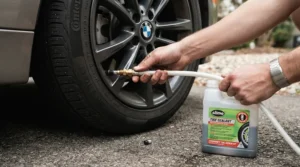
Parkers calls this arguably the best aftermarket option and notes that several manufacturers, including Ford, Volkswagen and Honda, recommend it. The kit pairs a 12V compressor with a 450ml water-based gel sealant that is pumped through the valve. It seals punctures up to 6mm, and a full repair takes around ten minutes. Car Magazine’s guide lists a maximum 125-mile drive afterwards, and says the sealant is TPMS-safe and washes out for a proper repair.
Wheel-size guidance varies by source, with some saying 20 inches and others 21. Check your listing against your car. Owners of smaller cars can look at the AirMan ResQ Pilot, which Parkers says handles wheels up to 17 inches with a 300ml bottle. That makes it a neat compact tyre repair kit for superminis. Remember that the sealant bottle has a use-by date and needs replacing after use.
Reviewers on retailer listings praise its ease of use. One reported success on a 20-inch rim despite losing about half the sealant, another said the sealant washed easily out of the rim at the tyre shop, and a Mercedes owner with no spare called it far cheaper than the manufacturer-branded kit. A recurring caveat is that you must buy extra sealant to reuse it.
Pros:
- ✅ Recommended by several carmakers
- ✅ Water-based sealant that washes out
- ✅ Simple, roughly ten-minute repair
Cons:
- ❌ Replacement sealant needed after use
- ❌ Wheel-size limits need checking
Around £36 RRP, with retailers typically in a £35–£45 range (check current price). Strong value for most cars without a spare.
7. Continental ContiMobilityKit — premium sealant with a five-year shelf life
The big sell is longevity. Continental’s factsheet quotes a sealant shelf life of up to five years, so it’s an excellent choice for a boot you rarely open. The kit combines a compact compressor with a 450ml latex-based sealant bottle, and you don’t have to remove the valve core. It seals nail-type punctures up to 6mm and lets you continue for up to 200 km (120 miles) at a maximum of 80 km/h (50mph). The quoted working temperature range is −30°C to +60°C, which matters in a British January.
What you’re paying for is OE-style engineering and a long shelf life. Parkers placed it at the premium end, bordering £60, and thought it better quality than value. Reviewer feedback is broadly positive: one owner reached a Kwik Fit that afternoon. But at least one reviewer reported a failed seal on a 4mm tread hole on a Range Rover Sport, and another noted that the bottle and tubing must be replaced after use.
Pros:
- ✅ Sealant shelf life up to five years
- ✅ No valve-core removal needed
- ✅ Wide operating temperature range
Cons:
- ❌ Most expensive kit here
- ❌ Bottle and tubing are single-use
Expect a £50–£65 range at the time of research (check current price). Worth it if long storage and brand pedigree matter.
✨ Ready to Be Prepared?
🔍 Take your breakdown preparedness to the next level with these carefully compared kits. Click any highlighted product name to check current pricing and availability. A little boot space now can save you hours on the verge later!
How to Use a Roadside Emergency Tyre Kit Safely
Using a roadside emergency tyre kit well is mostly about order of operations. Safety comes before repair, and the Highway Code’s breakdown rules put getting yourself and your passengers to a place of relative safety ahead of any attempt at fixing things. Organisations including the AA advise against working on a tyre beside a motorway; call for help instead.
- Get to safety. Pull into a lay-by, side road or car park if you can, switch on your hazards and keep passengers well away from traffic.
- Inspect the damage. Kits are for tread punctures up to roughly 6mm, never sidewall damage, blowouts or a damaged rim.
- Read your kit’s instructions. Some tell you to leave a lodged object in place, and others differ, so follow the label for your product.
- Position the hole at the bottom while filling a sealant, a trick that helped in Auto Express’s test.
- Inflate to the correct pressure shown in your car’s handbook or door-jamb sticker.
- Drive on gently for a few miles so the temporary sealant spreads, then stop and recheck pressure with a gauge.
- Keep it slow and short. The AA’s rule of thumb, reported by Parkers, is no more than 50mph and 50 miles; always follow your kit’s own limits.
- See a tyre professional promptly and tell them you used sealant; some brands advise removal within a few days.
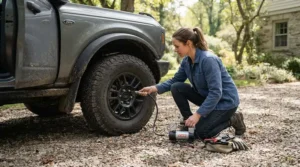
Problem → Solution: When Your Emergency Kit Isn’t Behaving
- The sealant pours straight out of the hole. The puncture may be too big. In Auto Express’s test, Slime Assist failed on a 4mm hole despite a 6mm claim, so don’t assume a label’s maximum is gospel. Switch to a plug kit such as the Laser Tools Emergency Tyre Repair Kit, or call for recovery.
- The pressure keeps dropping. Drive a few miles to spread the sealant, recheck, and repeat once. If it still falls, stop and call for help.
- The compressor stalls or smells hot. Let it rest and check your car’s 12V socket fuse rating against the compressor’s draw. Cheaper units may not handle long runs.
- Your tyre has sidewall damage or a bulge. No kit can fix this. Don’t drive on it.
- The bottle is out of date. Sealants have use-by dates; check yours twice a year and replace it before it expires.
- The TPMS light stays on. Recheck pressures, then have a fitter reset the system once the tyre is repaired or replaced.
Real-World Scenarios: Matching a Kit to Your Driving Life
The city commuter in a small hatchback. Budget around £40, a 15-mile daily loop and no spare. A Holts Tyreweld can in the glovebox gives a basic safety net, but a compressor set is more dependable. The AirMan ResQ (or the smaller AirMan ResQ Pilot for 17-inch wheels or smaller) is an easy, compact tyre repair kit to keep under a seat or in a boot well.
The family on a motorway-heavy holiday. The car is a large SUV on 19-inch wheels, loaded with luggage. Here a roadside emergency tyre kit has to be dependable and quick, and the premium Continental ContiMobilityKit makes sense with its long shelf life and 200 km post-repair allowance. Pair it with breakdown cover and a plan to avoid working on the hard shoulder.
The rural driver with farm-track hazards. Hawthorn clippings, flint and stray screws are common. A mix works well here: the Laser Tools Emergency Tyre Repair Kit for bigger holes, plus the Ring Flat Tyre Sealant and a compressor you already own. Practise the plug at home, on a Saturday, with a coffee.
The new driver on a tight budget. A full-size spare, a jack and a Tyre Doctor Tyre Repair Kit cost little. Learn the wheel-change first; Parkers notes a good spare beats any repair kit.
How to Choose a Tyre Repair Kit for Emergencies
- Check what your car already carries. If you have a good spare and tools, a kit is a backup; if not, it’s your main plan.
- Match the kit to your wheel size. Sealant volumes are sized to wheels, so a 17-inch set may not suit a 20-inch SUV.
- Decide how much hassle you’ll tolerate. Sealants are simple, plugs are skilful, and foam is cheapest but messiest.
- Look for a compressor you trust. For a complete emergency puncture kit for cars, a bundled compressor avoids compatibility guesswork.
- Read the post-repair limits. Look for the maker’s mph and mileage guidance, usually around 50mph and up to about 120 miles.
- Mind run-flat limitations. If your car has run-flats, check your handbook before assuming a kit will help.
Temporary Sealant vs Plug Kits: Which Approach Wins?
Temporary sealant is the headline act for good reason. You pump it through the valve, it coats the inside of the tyre, and the air does the rest. But it isn’t magic. Auto Express’s test showed several sealants failing on a modest 4mm hole, so brand and formulation matter enormously.
| Option | Speed | Skill needed | Mess | Best For |
|---|---|---|---|---|
| Gel sealant + compressor (e.g. AirMan ResQ) | Fast (about ten minutes) | Low | Low | Most drivers without a spare |
| Aerosol foam (e.g. Holts Tyreweld) | Very fast | Low | High | Cheap backup on small tyres |
| Plug kit (e.g. Laser Tools Emergency Tyre Repair Kit) | Slower | Medium–high | Low | Bigger holes, calm locations |
| Full-size spare | Moderate | Medium | None | Cars that have one and the tools |
| Breakdown call-out | Depends on wait | None | None | Anyone unwilling to work roadside |
The table shows why the best answer is often “both”. Sealant gets you moving when speed matters, while a plug kit handles damage that overwhelms sealant. The most capable setup for a driver with no spare is a sealant-and-compressor set, backed by breakdown cover for those awkward moments.
Run-Flat Limitations: What Every Run-Flat Driver Should Know
Run-flat tyres use reinforced sidewalls so you can keep driving after a puncture, but with limits. The RAC notes that most manufacturers recommend not exceeding 50mph or 50 miles after a puncture, and that the exact limits vary by tyre and car. The RAC also points out that a punctured run-flat usually can’t be repaired, because the reinforced construction makes a safe patch or plug difficult.
That’s the heart of the run-flat limitations problem for kit buyers. A repairer can’t know how far a tyre was driven deflated, so many refuse to repair one at all. Run-flats also cost more, often at least 50% more than standard tyres, according to Asda Tyres. Some sources say small tread holes can technically be plugged in exceptional circumstances, but most fitters won’t do it.
So what should a run-flat owner do? Treat any emergency puncture kit for cars as an unusual last resort, not a routine fix. Follow your handbook, watch the TPMS warning, and plan to replace the tyre. If you want a spare plan for peace of mind, ask your dealer which kit your car’s manufacturer approves.

Breakdown Preparedness: Beyond the Emergency Puncture Kit for Cars
True breakdown preparedness is wider than a bottle of sealant. A roadside emergency tyre kit should live alongside a few cheap, high-value items:
- A tyre pressure gauge. Sealant repairs need rechecking, and the gauge on a cheap compressor can be optimistic.
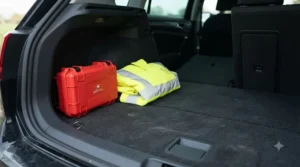
- A high-vis jacket and torch. Visibility matters more than most drivers think, especially in winter.
- Gloves and a small mat. Roadside kneeling is nobody’s idea of fun.
- A power bank for your phone. You’ll need to call for help.
- A locking wheel nut key, if your wheels have locking nuts, plus a jack and brace if you have a spare. A kit doesn’t replace those.
- Warning triangle (not on motorways). Never try to place one on a motorway carriageway; call for help instead.
Pair the kit with breakdown cover. The RAC advertises roadside cover from around £5 a month, which is a modest price against the cost of a long wait. A compact tyre repair kit and breakdown cover together form a sensible layered plan: one gets you moving, the other rescues you when the kit can’t.
Compact Tyre Repair Kit Options for Small Boots and Smaller Wheels
Boot space is precious, especially in superminis, hybrids with battery-packed floors and sports cars with space-saver compartments. Here a compact tyre repair kit solves a genuine problem.
The smallest options are plug sets such as the Tyre Doctor Tyre Repair Kit, which Parkers describes as a space-saving basic kit, and aerosol cans like Holts Tyreweld. Both need practice or luck, however. For a more complete but still compact tyre repair kit, the AirMan ResQ Pilot pairs a compressor with a 300ml bottle sized for wheels up to 17 inches, according to Parkers. The standard AirMan ResQ and the Continental ContiMobilityKit are also reasonably small, with the Continental bottle weighing around 585g.
The rule of thumb is simple: the smaller the kit, the more work you do. If you value ease over boot space, choose a compressor set; if space is tight, pick a plug kit and rehearse the repair once at home. And don’t forget to match sealant volume to your wheel size, because a bottle sized for small wheels may not stretch to a large SUV tyre.
Features That Actually Matter (And Mistakes to Avoid)
Not every feature on a box deserves your attention. Here’s what does, and what doesn’t.
Features that matter: a realistic puncture size (up to about 6mm for most sealants), a compressor that can run long enough to reach pressure, a washable, TPMS-safe formulation, and a decent shelf life. Features that don’t: headline claims such as “up to 60 repairs”, which are unverified marketing, or an impressive PSI rating on a compressor you’ll only use at car-tyre pressures.
Independent testing shows why labels deserve scepticism. Auto Express found CarPlan Flat Mate couldn’t seal a 4mm hole despite a 5mm claim on the can, and Slime Assist failed despite a 6mm claim. Those results are one test, not the final word, but they show that “up to 6mm” is a best case.
Common mistakes:
- Buying a kit and never reading the instructions.
- Forgetting the sealant’s use-by date.
- Trying to repair sidewall damage or a damaged rim.
- Treating a kit as a permanent fix.
- Ignoring a worn tyre. The legal minimum tread is 1.6mm across the central three-quarters, and many experts recommend replacing at around 3mm. A kit can’t rescue a bald tyre.
Long-Term Cost & Maintenance
The sticker price tells only part of the story. A sealant kit is a consumable: after use, the bottle (and sometimes the tubing) must be replaced. A kit that’s never used still ages, so check the use-by date every six months and diarise the expiry.
| Kit | Typical price range | What you’ll pay again | Shelf-life note | Best For |
|---|---|---|---|---|
| Holts Tyreweld | £7–£12 | A new can after each use | Check the can | Low-cost backup |
| Ring Flat Tyre Sealant | £10–£15 | A new bottle after use | Check the bottle | Owners of a compatible compressor |
| AirMan ResQ | £35–£45 | Replacement sealant | Sealant has a use-by date | Most cars without a spare |
| Continental ContiMobilityKit | £50–£65 | New bottle and tubing | Up to five years (maker figure) | Long storage, rarely opened boots |
Think in cost per year. A £40 kit stored for five years costs about £8 a year, and if it saves you one long recovery wait, it has paid for itself in time alone. That’s why a good roadside emergency tyre kit sits comfortably alongside breakdown preparedness spending: it’s cheap insurance against the most common roadside failure.

FAQ
❓ How long does a roadside emergency tyre kit repair last?
❓ Will temporary sealant damage my TPMS sensors?
❓ Is a compact tyre repair kit better than a spare wheel?
❓ How big a hole can a tyre repair kit for emergencies fix?
❓ Do I need to tell the tyre fitter I used sealant?
Conclusion
A tyre repair kit for emergencies won’t make you a roadside hero, but it can turn a ruined evening into a mild inconvenience. For most drivers without a spare, the sensible choice is a compressor-and-sealant set: the AirMan ResQ as the all-rounder, the Continental ContiMobilityKit for long shelf life and motorway miles, or the Streetwize Emergency Tyre Puncture Repair Kit if budget rules (with a home trial run). If you already own a good compressor, the Ring Flat Tyre Sealant earned the best independent result of the bunch.
For cheap backups, Holts Tyreweld and the Tyre Doctor Tyre Repair Kit have their place, and the Laser Tools Emergency Tyre Repair Kit is a good choice for bigger holes and calmer locations. Whatever you buy, remember the fine print: kits are temporary, sidewall damage is off-limits, and run-flat limitations mean owners of those tyres should check their handbook first. Combine your kit with breakdown cover and a few cheap extras, and you’ll have genuine breakdown preparedness rather than wishful thinking.
Recommended for You
- Tyre Repair Kit For Punctures: 7 Best Picks For UK Drivers (2026)
- Digital Vs Analogue Tyre Pressure Gauge: 7 Proven Picks (2026)
- Tyre Pressure Monitor For Caravans: 7 Essential Picks (2026)
Disclaimer: This article contains affiliate links. As an Amazon Associate, I earn from qualifying purchases. If you purchase products through these links, we may earn a small commission at no additional cost to you.
✨ Found this helpful? Share it with your friends! 💬🤗
