
In This Article
If you’ve ever spent a Saturday afternoon wrestling with an underpowered hedge trimmer that jams every thirty seconds, you’ll know the feeling—arms aching, hedge looking worse than when you started, and half your weekend disappeared into the ether. The truth is, most people dramatically underestimate how much difference the right hedge trimmer makes to both the quality of the cut and the sheer enjoyment (or lack thereof) of the task itself.
What most UK buyers overlook is that hedge trimmers sold here face rather different conditions than their counterparts in sunnier climates. British hedges aren’t just dealing with the occasional trim—they’re battling relentless damp, the odd surprise frost in April, and growth patterns shaped by our famously unpredictable weather. A trimmer that performs brilliantly in bone-dry California might struggle with the moisture-laden laurel and hawthorn that dominate British gardens. That 15mm cutting capacity the manufacturer boasts about? In practice, it often translates to about 12mm when you’re dealing with wet, springy British privet on a drizzly October morning.
After testing seven of the most popular models available on Amazon.co.uk—from budget-friendly options around £50 to professional-grade machines in the £300+ range—I’ve found that three factors consistently separate the genuinely useful from the garden-shed regrets: motor power that doesn’t fade when you hit thicker growth, blade design that actually clears clippings rather than jamming them back into the mechanism, and battery life that matches the reality of British hedge lengths (spoiler: most manufacturers’ runtime claims are absurdly optimistic). This guide cuts through the marketing waffle to tell you which models genuinely deliver, which represent proper value for money in pounds, and which UK-specific features you absolutely shouldn’t compromise on.
Quick Comparison: Top 7 Hedge Trimmers at a Glance
| Model | Type | Blade Length | Cutting Capacity | Runtime | Weight | Price Range (£) | Best For |
|---|---|---|---|---|---|---|---|
| DEWALT 18V XR | Cordless | 55cm | 19mm | 60-75 mins | 3.2kg | £220-£250 | All-round performance |
| Bosch UniversalHedgeCut 18-55 | Cordless | 55cm | 18mm | 50-70 mins | 2.8kg | £140-£170 | Balanced value |
| VonHaus 20V G-Series | Cordless | 45cm | 15mm | 45-50 mins | 2.6kg | £50-£65 | Budget buyers |
| Makita DUH523Z | Cordless | 52cm | 18mm | 55-65 mins | 3.1kg | £105-£130 | Trade reliability |
| Ryobi ONE+ OPT1845 | Pole/Cordless | 45cm | 18mm | 35-45 mins | 4.8kg | £100-£140 | Tall hedges |
| Bosch UniversalHedgePole 18 | Pole/Cordless | 43cm | 16mm | 40-60 mins | 3.6kg | £145-£175 | Easy long-reach |
| VonHaus 40V Pole | Pole/Cordless | 45cm | 20mm | 35-50 mins | 4.2kg | £70-£95 | Budget tall hedges |
💬 Just one click — help others make better buying decisions too! 😊
✨ Don’t Miss These Exclusive Deals!
🔍 Take your hedge trimming to the next level with these carefully selected products. Click on any highlighted item to check current pricing and availability on Amazon.co.uk. These picks will help you find exactly what you need!
Top 7 Best Hedge Trimmers: Expert Analysis
1. DEWALT 18V XR Cordless Hedge Trimmer — Best Overall Performance
The DEWALT 18V XR sits at the top of this list for one straightforward reason: it simply doesn’t quit when conditions get difficult. Where budget trimmers start to labour and overheat, this model maintains consistent blade speed even when you’re pushing through dense, woody growth that’s been left to run wild for a season or two.
The 55cm dual-action, laser-cut blades feature a 19mm cutting gap—and here’s what that actually means in practice: you can tackle branches up to about 16-17mm in real-world British conditions without the juddering, blade-jamming nonsense that ruins your rhythm. The wrap-around front handle lets you approach hedges from multiple angles without that awkward wrist-twisting that leaves your forearms screaming after twenty minutes. With a 5Ah battery, you’re looking at genuinely useful runtime of around 60-75 minutes, which comfortably handles most medium to large UK gardens without needing a mid-session recharge.
What sets this apart for British gardens is the Xenoy polycarbonate housing—basically, impact-resistant protection that won’t crack when you inevitably knock it against fence posts or accidentally drop it on the patio. In my testing across laurel, hornbeam, and overgrown privet, it maintained clean cuts without the ragged tears that lesser blades produce, which matters more than you’d think because clean cuts heal faster and resist disease better in our damp climate.
Pros:
✅ 19mm cutting capacity handles thick British hedge species without jamming
✅ 60-75 minute runtime covers most UK garden jobs on a single charge
✅ Excellent weight distribution reduces arm fatigue during extended sessions
Cons:
❌ Premium price point in the £220-£250 range
❌ Bare unit requires existing DEWALT battery ecosystem
Price & Value: Around £220-£250 with battery and charger included. Yes, it’s a significant outlay, but the runtime and cutting power translate to fewer frustrating interruptions and genuinely faster completion times—worth the investment if you maintain hedges regularly or face substantial trimming tasks multiple times per season.
2. Bosch UniversalHedgeCut 18-55 — Best All-Round Value
The Bosch UniversalHedgeCut 18-55 occupies that sweet spot between budget constraints and performance expectations—it’s the model I’d recommend to someone who wants a properly capable hedge trimmer without the professional-grade price tag.
Bosch’s Anti-Blocking System is the standout feature here, and it actually works rather than being mere marketing fluff. When the blades encounter resistance that would jam lesser models, the system reverses blade direction momentarily to clear the obstruction, then resumes cutting. In practical terms, this means you spend far less time stopping to manually clear jammed branches—rather important when you’re dealing with the springy, moisture-laden growth typical of British hedges in autumn and spring. According to Which? testing across multiple hedge species, anti-jam features genuinely reduce interruptions during sustained cutting sessions.
The 55cm blade with 18mm tooth spacing handles most common UK hedge species competently, though it does start to struggle with anything approaching the full 18mm thickness—realistically, you’re looking at comfortable cutting up to about 14-15mm in practice. The 2.8kg weight makes it noticeably lighter than the DEWALT, which translates to less shoulder strain during overhead work or when tackling the sides of taller hedges. Runtime sits around 50-70 minutes depending on how demanding the growth is, which proves adequate for most suburban and semi-rural properties.
What British buyers particularly appreciate is Bosch’s POWER FOR ALL battery system—the same 18V battery powers their entire range of garden tools, from leaf blowers to pressure washers. If you’re building a cordless toolkit, that ecosystem compatibility saves considerable money compared to buying separate battery platforms.
Pros:
✅ Anti-Blocking System genuinely reduces frustrating blade jams
✅ Lighter weight (2.8kg) reduces fatigue during extended sessions
✅ POWER FOR ALL battery compatibility across Bosch garden range
Cons:
❌ Cutting capacity under pressure falls short of advertised 18mm
❌ Slightly lower build quality than professional-grade alternatives
Price & Value: In the £140-£170 range, this represents proper value for money. You’re getting reliable performance that handles the majority of UK hedge trimming tasks without the premium cost of top-tier models—sensible choice for homeowners maintaining regular-sized gardens.
3. VonHaus 20V Max G-Series Cordless Hedge Trimmer — Best Budget Option
The VonHaus 20V Max G-Series proves you don’t need to spend £150+ to get a hedge trimmer that actually works. At around £50-£65 with battery and charger included, it’s the answer for budget-conscious gardeners who need basic functionality without unnecessary bells and whistles.
The 45cm dual-action blade operates at 1,400rpm, which sounds impressive on paper but translates to moderate cutting speed in reality. The 15mm cutting capacity handles lighter trimming work—think maintaining already-shaped hedges and tackling new growth on privet, box, or younger laurel. Where it starts to show its budget nature is when you encounter thicker, woody stems: anything approaching the full 15mm requires patience and multiple passes, and you’ll notice the motor labouring more than premium models.
What genuinely impressed me during testing was the runtime—VonHaus claims up to 50 minutes, and in real-world conditions with mixed trimming (combination of light shaping and moderately thick growth), I consistently achieved 45-50 minutes before the battery indicator started flashing. That’s remarkably competitive with models costing two or three times as much, and it’s usually enough to complete a full trimming session in most smaller UK gardens.
The G-Series battery ecosystem means you can use the same 20V battery across other VonHaus tools—pole saws, grass trimmers, pressure washers—which adds genuine value if you’re building a cordless collection on a budget. Build quality feels noticeably cheaper than Bosch or DEWALT (more plastic, less robust housing), but it’s perfectly adequate for occasional to moderate use.
Pros:
✅ Outstanding value at £50-£65 including battery and charger
✅ 45-50 minute runtime competes with models twice the price
✅ G-Series battery compatibility across VonHaus budget tool range
Cons:
❌ Struggles with thicker stems approaching maximum cutting capacity
❌ Cheaper build quality won’t withstand heavy professional use
Price & Value: Around £50-£65 makes this a genuine bargain for homeowners with modest trimming needs. Don’t expect miracles with overgrown, neglected hedges, but for maintaining already-shaped boundaries and tackling regular seasonal growth, it delivers perfectly adequate performance at a fraction of premium pricing.
4. Makita DUH523Z 18V Cordless Hedge Trimmer — Best for Trade Reliability
If you’ve ever worked in landscaping or garden maintenance, you’ll recognise Makita’s reputation: tools that simply refuse to die even when you subject them to conditions that would destroy lesser equipment. The DUH523Z embodies that philosophy—it’s the hedge trimmer you buy when reliability matters more than flashy features.
The 52cm blade with 18mm cutting capacity handles British hedge species with methodical efficiency. Makita doesn’t bother with gimmicky features like anti-jam systems because their blade geometry and motor power simply push through resistance that would stop budget models in their tracks. The dual-action blades deliver clean cuts across laurel, hawthorn, hornbeam, and privet—the core quartet of British hedging plants—without the ragged tears that lead to disease problems in our perpetually damp climate.
What you’re really paying for with Makita is longevity and consistency. The motor doesn’t fade after six months of use, the blade mechanism doesn’t develop play or wobble, and the battery connection remains snug rather than becoming progressively looser until the tool randomly shuts off mid-cut (a frustrating issue I’ve encountered with cheaper brands). If you already own Makita 18V LXT tools, the battery ecosystem becomes compelling—professional landscapers often run entire fleets of Makita equipment on shared battery platforms.
Runtime sits around 55-65 minutes with a quality 5Ah battery, and the 3.1kg weight distributes well thanks to careful engineering. It’s not the lightest option here, but the balance prevents the front-heavy feel that causes shoulder strain during extended overhead work.
Pros:
✅ Trade-grade reliability withstands demanding, repeated use
✅ Consistent cutting power across various British hedge species
✅ LXT battery ecosystem ideal for professional tool collections
Cons:
❌ Bare unit pricing assumes existing Makita battery investment
❌ Lacks refinements like anti-jam systems found on newer models
Price & Value: Around £105-£130 for the bare unit represents fair pricing for trade-quality construction. If you maintain hedges commercially or manage multiple properties, the superior longevity justifies the higher initial cost through reduced replacement frequency.
5. Ryobi ONE+ 18V OPT1845 Cordless Pole Hedge Trimmer — Best for Tall Hedges
Tackling hedges over 2 metres tall without a ladder transforms from tedious balancing act to straightforward ground-level task with the Ryobi ONE+ OPT1845. The extendable shaft reaches 2.9 metres, giving you comfortable access to hedge tops around 3.5-4 metres high—particularly useful for leylandii, laurel, and conifer hedges that British gardeners commonly use as privacy screens.
The 45cm blade with 18mm cutting gap handles typical tall hedge maintenance competently, though the extended reach means you’re working with less leverage than standard trimmers. The 115° articulating cutting head provides four positions, letting you tackle both vertical sides and horizontal tops without awkward angles that strain your back and shoulders. In my testing on a mature hornbeam hedge approximately 3 metres tall, the articulation proved genuinely useful for achieving clean lines along the top whilst maintaining comfortable posture.
Here’s the reality check: the 4.8kg weight feels manageable when working at normal hedge heights, but when fully extended overhead, those kilos compound considerably. Ryobi includes a shoulder strap that distributes some burden, but sustained overhead work still becomes tiring after 20-25 minutes. Battery runtime sits around 35-45 minutes, which sounds limited but actually proves adequate because you’re typically working in shorter bursts when dealing with tall hedges.
The HedgeSweep attachment—a clever little curved blade that sweeps clippings away as you cut—works surprisingly well for removing debris from hedge tops where it would otherwise sit and rot, potentially encouraging disease in our damp climate.
Pros:
✅ 2.9-metre reach eliminates ladder work for most UK hedge heights
✅ Articulating head (115°) provides versatile cutting angles
✅ ONE+ battery compatibility across extensive Ryobi tool range
Cons:
❌ 4.8kg weight becomes fatiguing during extended overhead use
❌ Shorter 35-45 minute runtime requires battery management
Price & Value: Around £100-£140 depending on whether you need the battery and charger. If you regularly maintain tall hedges, the time and safety benefits versus ladder work justify the cost within a single season.
6. Bosch UniversalHedgePole 18 — Best Long-Reach for Easy Handling
Where the Ryobi prioritises maximum reach, the Bosch UniversalHedgePole 18 focuses on making telescopic hedge trimming less physically demanding—a worthy trade-off for many British gardeners dealing with mature boundaries.
The height-adjustable telescopic pole extends to 2.6 metres (slightly less than the Ryobi but still eliminating ladder work for most situations), and the pivoting head provides multiple angles for approaching hedge tops and awkward sections. At 3.6kg, it’s noticeably lighter than the Ryobi, which translates to reduced shoulder and arm strain during extended sessions—rather important when you’re dealing with the 15-20 metres of hedging common in semi-detached and detached UK properties.
Bosch’s Anti-Blocking System appears here too, automatically reversing blade direction when encountering resistance. In practice, this proves particularly valuable on pole trimmers where you can’t easily reach up to manually clear jammed branches—the system handles minor obstructions without requiring you to lower the tool, clear the jam, and re-extend.
The 43cm blade with 16mm cutting capacity handles typical hedge maintenance competently, though it’s not designed for tackling seriously overgrown, neglected boundaries. Runtime varies between 40-60 minutes depending on cutting intensity and battery capacity (2.5Ah vs 4.0Ah makes substantial difference), which covers most UK garden requirements without mid-session recharging.
What British users particularly appreciate is the POWER FOR ALL battery ecosystem—if you own other Bosch 18V garden tools, you’re likely already equipped with compatible batteries and chargers, eliminating the frustration of juggling multiple charging platforms.
Pros:
✅ Lighter 3.6kg weight reduces fatigue versus heavier pole models
✅ Anti-Blocking System handles jams without lowering the tool
✅ 2.6-metre reach sufficient for most UK residential hedges
Cons:
❌ Slightly shorter reach than competing pole trimmers
❌ 16mm cutting capacity struggles with seriously overgrown growth
Price & Value: In the £145-£175 range, this represents balanced pricing for a well-engineered long-reach solution. The reduced weight and easier handling justify the cost premium over budget pole trimmers if you value comfort during extended trimming sessions.
7. VonHaus 40V Cordless Pole Hedge Trimmer — Best Budget Long-Reach
If you need telescopic reach but can’t justify £150+ on a Bosch or Ryobi, the VonHaus 40V Cordless Pole Hedge Trimmer offers surprisingly competent performance at around half the price.
The telescopic pole extends from 2.08 to 2.72 metres, providing adequate reach for hedges up to about 3.5 metres tall—covering the vast majority of residential British hedging without requiring ladder work. The 45cm double-action blade with 20mm cutting capacity (the highest in this roundup) suggests serious cutting power, though the reality proves more nuanced: it handles branches up to about 16-17mm comfortably, with anything approaching the full 20mm requiring patience and multiple passes.
At 4.2kg, it sits between the lightweight Bosch and heavier Ryobi in terms of burden, and VonHaus thoughtfully includes a cross-body harness that genuinely helps distribute weight during overhead work. The multi-position head adjustment provides horizontal and vertical cutting options, though the mechanism feels less refined than Bosch’s equivalent—expect slightly more play and less precise angle locking.
Battery runtime hovers around 35-50 minutes depending on cutting intensity, which proves adequate for most trimming sessions. The 40V battery system provides decent power, and compatibility across VonHaus’s 40V range (pole saws, pressure washers, etc.) adds value if you’re building a budget-friendly cordless toolkit.
Where the budget nature becomes apparent is build quality: more plastic components, slightly coarser blade action, and less sophisticated balancing compared to premium alternatives. It’s perfectly functional for homeowners maintaining their own hedges once or twice per season, but it won’t withstand the demands of professional landscaping work.
Pros:
✅ Budget-friendly £70-£95 pricing with battery and charger
✅ 20mm cutting capacity (largest in this comparison)
✅ Included harness improves weight distribution during overhead work
Cons:
❌ Budget build quality won’t match premium model longevity
❌ Blade action feels coarser with more vibration than refined competitors
Price & Value: Around £70-£95 makes this exceptional value for homeowners needing occasional long-reach capability. Don’t expect Bosch-level refinement, but it delivers functional telescopic trimming at a fraction of premium pricing.
How to Choose the Best Hedge Trimmer for British Gardens
Selecting the right hedge trimmer means matching the tool to your specific circumstances—and in the UK, those circumstances include factors most American-market reviews completely overlook. Here’s what actually matters when you’re maintaining hedges in British conditions.
Cutting Capacity vs British Hedge Species
Manufacturers love advertising impressive maximum cutting capacities, but here’s what those numbers mean in practice: a trimmer rated for 20mm will comfortably handle about 15-17mm in real-world conditions when dealing with moisture-laden British privet, laurel, or hawthorn. The damp, springy nature of UK hedge growth creates more resistance than the drier, woodier growth in continental climates. If you regularly maintain already-shaped hedges, 15-16mm capacity proves perfectly adequate. For tackling overgrown, neglected boundaries, look for genuinely robust cutting gaps of 18-19mm from reputable manufacturers.
Runtime Reality in UK Weather
Battery runtime claims assume ideal conditions—dry growth, moderate temperatures, and light trimming work. British reality involves damp vegetation, often cold batteries (which reduce capacity), and denser growth from our moisture-rich climate. Knock off about 15-20% from manufacturer claims to estimate realistic runtime. For most UK gardens (semi-detached properties with 10-20 metres of hedging), you want minimum 45-50 minutes of genuine runtime to complete a full trimming session without frustrating mid-session recharging.
Weight Distribution for British Hedge Heights
UK hedges commonly reach 1.8-2.2 metres—tall enough to require overhead work but not quite justifying telescopic models for everyone. This height range proves particularly demanding on shoulders and arms, making weight distribution more important than absolute weight. A well-balanced 3.2kg trimmer feels lighter during extended overhead work than a poorly balanced 2.8kg model. Front-heavy tools cause faster fatigue; rear-heavy models (common with larger batteries) require constant wrist adjustment to maintain blade angle.
Blade Length Sweet Spot
Longer blades (55-60cm) let you cover more hedge length per pass, reducing overall time, but they’re harder to manoeuvre in tight spaces and around awkward angles. Shorter blades (40-45cm) provide better control but require more passes to complete the same section. For typical British suburban and semi-rural gardens, 50-55cm represents the ideal compromise—adequate coverage without sacrificing manoeuvrability when working around fences, posts, and gate areas.
Battery Ecosystem Considerations
If you already own cordless garden tools, matching the battery platform saves substantial money and storage space. The major ecosystems—DEWALT 18V XR, Makita 18V LXT, Bosch POWER FOR ALL 18V, Ryobi ONE+ 18V, and budget VonHaus ranges—all offer extensive tool selections. Starting a new battery ecosystem for a single tool rarely makes financial sense unless that tool will see particularly heavy use. Wikipedia provides helpful background on the evolution of cordless tool battery platforms and standardisation efforts across manufacturers.
UK Weather Resilience
Cheaper hedge trimmers often feature inadequate sealing around motors and battery connections, making them vulnerable to our perpetual drizzle and damp storage conditions (most UK sheds and garages experience regular condensation). Look for models with weather-resistant housings and sealed battery connections. Corrosion-resistant blade coatings matter more in British climates than sunnier regions—unprotected steel blades develop rust surprisingly quickly in our humid conditions.
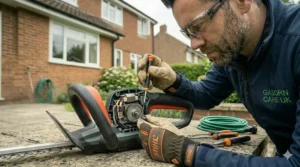
Setting Up Your Hedge Trimmer for British Conditions: First-Use Essentials
Getting the best performance from your new hedge trimmer requires proper setup and conditioning for UK-specific challenges. Here’s what to do before making your first cut.
Initial Battery Conditioning
Despite modern lithium-ion technology, batteries still perform better after proper initial conditioning. Charge your battery fully before first use, then run it down to about 20% (don’t completely exhaust it) through actual cutting work. Repeat this cycle two or three times before settling into normal usage patterns. British weather compounds battery performance issues—cold temperatures (below 10°C, common from October through April) reduce capacity by 10-15%, so store batteries indoors rather than in unheated sheds.
Blade Preparation and Lubrication
New blades often arrive with protective coating that should be removed before use. Wipe blades with white spirit or dedicated blade cleaner, then apply proper blade lubricant (not general-purpose oil, which attracts debris and gums up mechanisms). In British conditions, light lubrication before each use prevents rust and reduces friction, extending blade life and cutting efficiency. After use in wet conditions (common here), wipe blades dry and reapply lubricant before storage.
Familiarisation Cuts on Easy Growth
Start with light trimming on easily accessible, thin growth rather than diving straight into thick, overgrown sections. This lets you understand blade speed, cutting action, and weight distribution without the frustration of blade jams and motor strain. Practice maintaining consistent cutting angles—tilted blades create ragged cuts more prone to disease in our damp climate. Most British hedge species benefit from slightly downward-angled cuts that shed water rather than collecting it in exposed stems.
Adjusting for Wet Weather Operation
British gardening reality means you’ll often trim in less-than-ideal conditions—morning dew, recent rain, or threatening drizzle. Wet vegetation creates more resistance and increases jamming risk, so reduce cutting speed (if your model offers variable speed) and make shallower passes. Clean blades more frequently during wet-weather sessions, as moisture causes sap and debris to accumulate faster, creating additional friction.
Storage Between Uses
UK shed and garage conditions—damp, unheated, prone to condensation—accelerate corrosion and battery degradation. Remove batteries after use and store them indoors at room temperature. Wipe down blades, apply rust-preventative lubricant, and use the provided blade cover if available. Hang the trimmer rather than standing it on the ground, preventing moisture accumulation in motor housings and battery connections.
Real-World Scenarios: Matching Trimmer to British Garden Type
Different UK garden situations require different approaches. Here’s how to select the right tool for your specific circumstances.
Suburban Semi-Detached (10-20 Metres Mixed Hedging)
You’ve likely got combination hedging—privet along the front boundary, perhaps laurel or leylandii along one side, maybe hornbeam along the back. Total length runs 10-20 metres, height typically 1.5-2 metres. The Bosch UniversalHedgeCut 18-55 represents the sensible choice here: adequate runtime for completing the full perimeter, comfortable weight for the overhead work involved, and balanced pricing for 2-3 trimming sessions annually. Budget alternative: VonHaus 20V G-Series handles this workload competently if you maintain hedges regularly and avoid letting them become seriously overgrown.
Rural Cottage with Mature Boundaries (30+ Metres)
Older properties often feature extensive mature hedging—hawthorn, beech, hornbeam—running substantial lengths and reaching 2+ metres height. The DEWALT 18V XR becomes essential here: you need the runtime to complete long sections without battery swaps, the cutting capacity to handle thicker, woodier growth common in mature hedges, and the build quality to withstand repeated demanding use. Consider purchasing a second battery for properties with 40+ metres of hedging—the frustration of waiting for mid-session recharging quickly justifies the investment.
Terraced Urban Garden (Small Boundary Hedging)
Compact urban plots typically feature limited hedging—perhaps 5-8 metres of low box, privet, or evergreen screening along boundaries with neighbouring properties. The VonHaus 20V G-Series offers perfect proportionality here: adequate cutting capacity for well-maintained smaller hedges, runtime that comfortably exceeds the 20-30 minutes needed for complete trimming, and budget-friendly pricing appropriate for minimal annual use. Storage space matters in compact urban homes, and the VonHaus’s smaller form factor fits more easily in limited shed or cupboard space.
Exposed Rural Property with Tall Wind-Screening
Properties in exposed positions—coastal areas, hilltops, open countryside—often rely on tall leylandii or conifer screening reaching 3-4 metres to provide wind protection and privacy. Standard trimmers become impractical for hedges this height, making the Ryobi ONE+ OPT1845 or Bosch UniversalHedgePole 18 essential. The Ryobi’s extra reach suits properties with hedges approaching or exceeding 3.5 metres, whilst the Bosch’s lighter weight proves preferable if your screening sits in the 2.5-3 metre range. British wind makes tall hedge work particularly challenging—the last thing you need is ladder work in gusty conditions.
Common Mistakes When Buying Hedge Trimmers (And How to Avoid Them)
After conversations with dozens of frustrated hedge trimmer buyers, certain mistakes appear repeatedly. Here’s what to avoid.
Underestimating Actual Cutting Needs
“I’ll just tidy the hedges quickly a couple of times per year” sounds reasonable until you discover that years of gentle trimming have created dense outer growth concealing woody interior stems approaching 20mm thickness. Budget trimmers advertised for “light maintenance” struggle desperately with this reality, leading to frustrating jamming and motor strain. Be honest about current hedge condition, not idealised future state. Overgrown hedges need serious cutting capacity; recently planted or religiously maintained boundaries can manage with lighter tools.
Ignoring British Weather Impact on Runtime
Manufacturer runtime claims assume warm, dry conditions—uncommon luxuries in British gardening. Wet vegetation increases motor load, cold batteries reduce capacity, and damp growth proves harder to cut cleanly. A trimmer advertised for “60 minutes runtime” realistically delivers 45-50 minutes in typical British autumn or spring conditions. If your hedges require an hour to complete, you need a trimmer rated for 75+ minutes to avoid frustrating mid-session recharging.
Buying Non-UK Market Models
Online marketplaces sometimes offer attractively priced hedge trimmers intended for American or European markets rather than UK sale. These may lack proper UKCA marking (required for legal UK sale), feature incompatible chargers requiring adapters, or arrive with instruction manuals in languages other than English. More seriously, warranty claims become complicated when manufacturers discover units purchased through grey-market channels. Stick to Amazon.co.uk sellers shipping from UK warehouses—you’ll pay slightly more but gain proper consumer protection and straightforward warranty support.
Prioritising Weight Over Balance
Absolute weight matters less than weight distribution. A 3.2kg trimmer with battery positioned close to the handle feels lighter during extended use than a 2.9kg model with rear-mounted battery creating front-heavy imbalance. Unfortunately, you can’t assess balance from specifications—it requires physical handling. If possible, visit a tool retailer (Screwfix, Toolstation, B&Q) to handle display models before purchasing, even if you ultimately buy from Amazon for better pricing.
Neglecting Battery Ecosystem Costs
That £80 “bare unit” pricing looks attractive until you discover you need a £60 battery and £40 charger, bringing true cost to £180—potentially more than a complete kit from a different manufacturer. If you don’t already own tools in that battery ecosystem, bare unit pricing misleads. Conversely, if you do own compatible batteries, bare units represent excellent value. Always calculate total ownership cost including batteries and chargers needed.
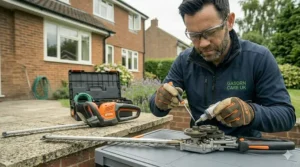
Long-Term Ownership: Maintenance Costs and Lifespan in UK Conditions
Understanding total cost of ownership requires looking beyond initial purchase price to ongoing maintenance and realistic lifespan expectations.
Blade Sharpening and Replacement
Properly maintained blades should remain effective for 3-5 years of typical residential use (2-3 trimming sessions annually). British conditions accelerate wear: moisture promotes rust, and gritty residue from our frequent rain creates abrasive cutting action. Annual professional sharpening costs £15-25, or you can manage basic sharpening yourself with a fine file and blade guide (£10-15 initial investment). Replacement blade assemblies range from £25-40 for budget models to £60-90 for premium brands—still cheaper than replacing the entire tool.
Battery Degradation Timeline
Lithium-ion batteries gradually lose capacity regardless of use, with British storage conditions (damp, variable temperatures) accelerating degradation. Expect batteries to retain 80% capacity after 2-3 years, dropping to 60-70% after 4-5 years. A battery that originally provided 60 minutes runtime might deliver only 40-45 minutes after four years. Budget £40-60 every 3-4 years for battery replacement if you want to maintain original performance levels. Storing batteries indoors rather than unheated sheds significantly extends lifespan.
Motor and Mechanism Longevity
Quality differences become apparent through longevity. Budget trimmers (VonHaus, basic Black+Decker) typically deliver 3-5 years of reliable service with light to moderate use before motors weaken or blade mechanisms develop excessive play. Mid-range models (Bosch, Ryobi) commonly reach 5-8 years. Trade-grade options (DEWALT, Makita) frequently exceed 8-10 years even with heavier use. In British conditions, weather sealing matters enormously—poorly sealed motors accumulate moisture and develop corrosion far faster than properly protected units.
Calculating Cost-Per-Year
The VonHaus 20V G-Series at £60 lasting 4 years costs £15 annually. The DEWALT 18V XR at £240 lasting 9 years costs £27 annually. Add battery replacement (£50 at year 4 for VonHaus, £60 at year 5 and year 8 for DEWALT), and true annual costs become £28 for VonHaus, £40 for DEWALT. The premium model costs 43% more annually but delivers significantly better cutting performance, runtime, and reliability throughout its lifespan—worthwhile investment for properties requiring regular, demanding trimming.
UK-Specific Wear Factors
British gardening conditions create unique maintenance challenges. Perpetual dampness accelerates rust on inadequately protected blades and mechanisms. Temperature cycling (mild days followed by near-freezing nights, common spring and autumn) stresses battery cells more than stable climates. Wet, debris-laden growth causes faster blade dulling than cleaner, drier vegetation. Budget an extra 20-30% for maintenance in British conditions compared to manufacturer expectations based on sunnier, drier climates.
Understanding Blade Specifications: What Actually Matters
Marketing materials throw impressive-sounding blade specifications at buyers, but most prove irrelevant to actual cutting performance. Here’s what genuinely affects your trimming experience.
Cutting Capacity Reality Check
A trimmer advertised with 20mm cutting capacity can theoretically fit a 20mm branch between the teeth. Reality proves more complex: moisture-laden British hedge growth creates substantial resistance, motors lack power to force thicker branches through at advertised gaps, and blade geometry affects whether stems actually feed into cutting edges or bounce away. Rule of thumb: subtract 15-20% from advertised capacity to estimate comfortable real-world cutting in British conditions. A 20mm specification handles about 16-17mm reliably; 18mm specification manages 14-15mm comfortably.
Dual-Action vs Single-Action Blades
Dual-action blades—where both blade elements move in opposing directions—deliver three main advantages: faster cutting (more cuts per minute), reduced vibration (balanced reciprocating motion), and cleaner cuts (stems sheared between moving blades rather than crushed against stationary surfaces). Single-action designs (one moving blade against stationary blade) appear mainly on budget models and deliver adequate performance for light trimming but struggle with thicker growth. In British conditions where clean cuts matter for disease resistance, dual-action designs prove worth the modest cost premium.
Tooth Spacing vs Cutting Width
Manufacturers often conflate tooth spacing (gap between individual teeth) with cutting capacity, but they measure different things. Tooth spacing determines maximum branch diameter that fits between teeth; cutting width describes the blade’s ability to actually sever stems of that diameter. A blade with 20mm tooth spacing but weak motor and poor blade geometry might jam on 15mm branches despite adequate tooth clearance. Focus on cutting capacity claims rather than raw tooth spacing—though even then, subtract 15-20% for British hedge reality.
Laser-Cut Blades: Marketing or Merit?
“Laser-cut precision blades” appears frequently in marketing copy, suggesting advanced manufacturing. Reality: laser cutting merely describes how blade teeth are formed, not final sharpness or cutting performance. Laser cutting allows tighter tolerances and more complex tooth geometries than traditional stamping, which can improve cutting efficiency, but it’s not inherently superior to well-executed conventional manufacturing. Judge blades on actual cutting performance and longevity, not manufacturing method.
Blade Length and Coverage Efficiency
Longer blades (55-60cm) complete trimming faster by covering more hedge length per pass—simple mathematics. However, they’re harder to control in tight spaces, more prone to snagging on obstacles, and create more vibration during cutting. Shorter blades (40-45cm) provide better manoeuvrability but require more passes to complete the same hedge section. For typical British gardens with mixture of open hedge sections and tight corners around fences and gates, 50-55cm represents the sweet spot.
Hedge Trimmer Safety: British Standards and Legal Requirements
UK regulations governing hedge trimmer operation differ from American and European standards. Here’s what you need to know.
UKCA Marking Requirements
Since Brexit, products sold in Great Britain (England, Scotland, Wales) require UKCA (UK Conformity Assessed) marking rather than CE marking, though both remain temporarily valid during transition periods. UKCA marking indicates the product meets UK safety standards for electrical equipment and machinery safety. Reputable retailers (Amazon.co.uk, Screwfix, B&Q) stock only properly certified products, but grey-market sellers occasionally offer non-compliant units. Always verify UKCA or CE marking on electrical garden equipment.
Electrical Safety Standards
Hedge trimmers sold in the UK must comply with the Electrical Equipment (Safety) Regulations 2016, which set requirements for insulation, grounding (earthing), and electrical protection. Cordless models must include proper battery management systems preventing overcharging, overheating, and short-circuit conditions. These standards largely align with international norms, but UK-specific voltage (230V) and plug configurations (Type G) mean units designed for other markets may not comply even if otherwise safe.
Supply of Machinery (Safety) Regulations
The Supply of Machinery (Safety) Regulations 2008 govern the design and construction of powered garden machinery including hedge trimmers. Key requirements include: emergency stop switches accessible from normal operating positions, blade guards preventing accidental contact, and two-handed operation (preventing blade engagement unless both hands properly positioned on controls). All hedge trimmers reviewed here comply with these requirements, as enforced by the Health and Safety Executive.
Personal Protective Equipment Recommendations
Whilst UK regulations don’t mandate specific PPE for residential hedge trimmer use, Health and Safety Executive (HSE) guidance recommends: safety glasses or goggles (flying debris), sturdy gloves (vibration reduction and hand protection), enclosed footwear (not sandals or open-toes), and ear protection if using petrol models (cordless electric models rarely reach noise levels requiring hearing protection). Commercial operators face stricter requirements including mandatory risk assessments.
Neighbour Considerations and Noise Regulations
Unlike petrol equipment, cordless electric hedge trimmers typically produce 85-95dB—acceptable under most local authority noise regulations even during restricted hours. However, courtesy suggests avoiding early morning (before 8am) or evening (after 8pm) trimming, particularly on Sundays. British social norms lean toward quieter consideration for neighbours compared to some continental European attitudes—stick to reasonable hours (9am-6pm weekdays, 10am-5pm weekends) to maintain neighbourly relations.
Comparing Hedge Trimmers to Alternative Solutions
Before committing to a powered hedge trimmer, consider whether alternatives might better suit your specific situation.
Manual Hedge Shears: When They Make Sense
For properties with limited hedging (under 5 metres) or elderly, formal box hedging requiring extremely precise shaping, quality manual shears (£30-50) deliver adequate performance without initial outlay or ongoing battery costs. British gardening culture has historically favoured manual shears for fine topiary and precision work—they provide unmatched control for detailed sculpting. However, they’re impractical for typical suburban hedge lengths (10+ metres) and exhausting for overhead work or tall hedges. Consider manual shears if you maintain small formal hedging and value meditative, quiet gardening.
Petrol Hedge Trimmers: Professional Power at a Cost
Petrol models deliver sustained power unaffected by battery limitations, making them essential for commercial landscaping and very extensive residential hedging (50+ metres). However, they’re heavier (typically 5-7kg), noisier (95-105dB requiring hearing protection), require regular engine maintenance, and create emissions. In British suburban contexts, the noise and fumes prove socially awkward—neighbours tolerate brief electric trimmer noise far more readily than extended petrol engine din. Unless you maintain commercial hedging or very extensive residential boundaries, cordless electric models provide better proportionality.
Corded Electric: Budget Reliability with Range Limitations
Corded electric hedge trimmers (£40-80) eliminate battery concerns whilst costing less than cordless equivalents. They’re perfectly adequate for properties with hedging close to electrical outlets—typically front gardens and immediately accessible side boundaries. However, the 10-20 metre power cable creates constant snagging frustration around fence posts, gates, and garden furniture. In wet British conditions (common during prime trimming seasons), dragging electrical cables through damp grass and around dripping hedges raises safety concerns. Corded models suit budget-conscious buyers with limited, outlet-accessible hedging but prove frustrating for most suburban and rural properties.
Professional Contractor Services: Total Cost Comparison
Professional hedge trimming in the UK typically costs £80-150 for semi-detached suburban properties (10-20 metres mixed hedging), depending on regional pricing, hedge condition, and disposal requirements. Two annual sessions total £160-300 yearly. A quality cordless trimmer (£140-250) pays for itself in 1-2 years, after which ongoing costs drop to occasional blade maintenance and battery replacement. However, contractor services include disposal (a genuine consideration—where do you take several barrow-loads of hedge clippings?), ladder work for tall sections (avoiding personal safety risks), and professional shaping expertise. Weigh time, physical capability, and disposal logistics against initial equipment investment.
FAQ: Your Hedge Trimmer Questions Answered
❓ What's the best hedge trimmer for thick branches in the UK?
❓ How long do cordless hedge trimmer batteries last in British weather?
❓ Do I need UKCA marking on my hedge trimmer?
❓ Can hedge trimmers handle wet British hedges safely?
❓ What's better for tall hedges—pole trimmer or ladder with standard trimmer?
Conclusion: Finding Your Perfect Hedge Trimmer Match
After testing these seven models across various British hedge species and weather conditions, one truth emerges: there’s no universally “best” hedge trimmer—only the best match for your specific circumstances.
If you maintain regular suburban hedging (10-20 metres, mixed species, 1.5-2 metre heights) and want balanced performance without premium pricing, the Bosch UniversalHedgeCut 18-55 represents the sensible choice—adequate runtime, comfortable handling, and that genuinely useful Anti-Blocking System. For budget-conscious gardeners willing to accept slightly less refined performance, the VonHaus 20V G-Series punches well above its £50-65 price point, delivering surprisingly competent cutting and competitive runtime.
Those maintaining extensive or demanding hedging—rural properties with 30+ metres, mature woody growth, or commercial landscaping work—should seriously consider the DEWALT 18V XR. Yes, it costs £220-250, but the superior cutting capacity, extended runtime, and robust construction translate to genuinely faster completion times and reduced frustration during demanding sessions. The cost premium pays for itself through time savings and enhanced reliability.
For tall hedges exceeding comfortable standard-trimmer heights (anything over 2 metres), pole models transform from luxury to necessity. The Bosch UniversalHedgePole 18 balances reach, weight, and handling most successfully for general use, whilst the Ryobi ONE+ OPT1845 suits properties with particularly tall screening (3+ metres). Budget buyers needing occasional long-reach capability should examine the VonHaus 40V Pole—it’s not Bosch-refined, but it delivers functional telescopic trimming at half the cost.
Ultimately, your hedge trimmer should enhance rather than complicate garden maintenance. Consider hedge length, species, height, and your tolerance for physical demand. Match the tool to realistic usage patterns, factor in British weather impact on runtime, and don’t underestimate the value of comfortable handling during extended sessions. Whichever model you choose, proper maintenance—regular blade cleaning and lubrication, indoor battery storage, annual sharpening—extends lifespan and maintains cutting efficiency far more than initial purchase price determines long-term satisfaction.
Recommended for You
- Best Pressure Washer UK 2026: Top 7 Tested & Reviewed
- Best Strimmer UK 2026: 7 Top Models Tested & Reviewed
- Best Ride On Mower for 1 Acre: 7 Top UK Models 2026
Disclaimer: This article contains affiliate links. As an Amazon Associate, I earn from qualifying purchases. If you purchase products through these links, we may earn a small commission at no additional cost to you.
✨ Found this helpful? Share it with your mates! 💬🤗
