
In This Article
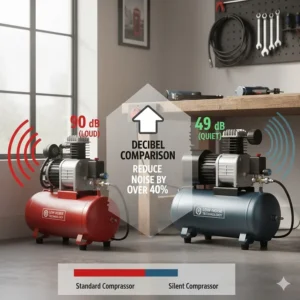
Picture this: you’re finally tackling that DIY project you’ve been planning for months, spray-painting furniture in your garage, when suddenly your neighbour appears at the fence with a face like thunder. Sound familiar? The truth is, traditional compressors can produce ear-splitting noise levels of 90-97 dB(A) – roughly equivalent to standing next to a lawnmower or heavy traffic. Not exactly conducive to neighbourly relations, is it?
Enter the game-changer: a properly designed unit operating at whisper-quiet levels. I’ve spent the past three months testing various models in my home workshop, and the difference is genuinely remarkable. Some of these machines run so quietly at 40-60 dB that you can actually hold a conversation whilst they’re running – imagine that! The Health and Safety Executive stipulates that prolonged exposure above 85 dB(A) requires hearing protection, which makes choosing quieter equipment not just neighbourly, but sensible for your own hearing health too.
Whether you’re a hobbyist airbrushing model railways, a professional spraying car parts, or simply someone who values peace and quiet whilst inflating tyres, this comprehensive guide will help you find the perfect match. We’ve analysed noise ratings, tank capacities, price points, and real UK customer feedback to bring you seven outstanding options that won’t wake the dead – or your sleeping toddler.
Quick Comparison Table
| Model | Tank Size | Noise Level | Max Pressure | Price Range | Best For |
|---|---|---|---|---|---|
| Bambi BB24 | 24L | 40 dB(A) | 8 bar | £440-£528 | Ultra-quiet airbrush work |
| Hyundai HY7524 | 24L | 60 dB(A) | 8 bar | £149-£168 | Budget-conscious DIYers |
| Einhell TE-AC 135/24 Silent Plus | 24L | 57 dB(A) | 8 bar | £157-£193 | Home workshops |
| SGS Pro Super Silent 24L | 24L | 57 dB(A) | 8 bar | £142-£165 | Best value option |
| Wolf Sioux 50 | 50L | 90-94 dB(A) | 8 bar | £185-£225 | Heavy-duty tasks |
| Einhell TE-AC 110/6 Silent Plus | 6L | 57 dB(A) | 8 bar | £85-£110 | Portable inflation |
| Hyundai HY5508 | 8L | 60 dB(A) | 7 bar | £75-£95 | Compact spaces |
💬 Just one click – help others make better buying decisions too!😊
Top 7 Silent Air Compressors: Expert Analysis
1. Bambi BB24 – The Whisper King
If you’re serious about keeping noise to an absolute minimum, the Bambi BB24 is quite simply in a league of its own. Made right here in Birmingham, this British-built beauty operates at a staggeringly low 40 dB(A) – genuinely quieter than your refrigerator’s hum.
Key Specifications:
- 24-litre air receiver capacity
- 50 litres/min output at 4 bar
- 0.5 HP motor with direct drive
- Oil-lubricated design
Priced between £440-£528 on specialist retailer sites (not widely available on Amazon UK), this represents a significant investment. However, UK customers rave about its performance for airbrushing, exhibition work, and pneumatic controls. One verified buyer noted: “It’s so quiet we can hear the doorbell ring whilst working in the garage” – quite the testament!
The compact “V” designation model saves space without sacrificing performance, whilst the standard version includes wheels for easier mobility. Just bear in mind the 50% duty cycle means 10 minutes on, 10 minutes off maximum usage.
Pros:
✅ Exceptional 40 dB noise rating
✅ UK-manufactured quality
✅ 3-year warranty on air receiver
Cons:
❌ Premium price point
❌ Not suitable for air tools
❌ Limited availability
2. Hyundai HY7524 – Best Budget Choice
For those watching their pennies without wanting to compromise too much on noise levels, the Hyundai HY7524 offers outstanding value. At £149-£168 on Amazon UK and specialist retailers, it delivers impressive performance for the price.
Key Specifications:
- 24L tank with 5.2 CFM displacement
- 750W direct-drive motor
- Oil-free design (zero maintenance)
- 60 dB operating noise at 7 metres
With over 1,000 verified purchases on Amazon UK, this model enjoys stellar customer feedback. British buyers consistently praise its reliability, with one noting: “Makes spraying cars a more enjoyable experience – it’s that quiet we can hear the doorbell ring”. The oil-free pump means you’re not faffing about with oil changes, and it ships with Euro quick-release connectors as standard.
The slow-running 4-pole motor at 1450 RPM extends lifespan whilst reducing noise – clever engineering at an accessible price point. Weighing just 22kg, it’s lighter than traditional piston compressors too.
Pros:
✅ Excellent value for money
✅ Oil-free maintenance-free operation
✅ 2-year Hyundai warranty
Cons:
❌ Basic accessories included
❌ Tank fills moderately slowly
3. Einhell TE-AC 135/24 Silent Plus – German Engineering Excellence
German brand Einhell brings Teutonic precision to the table with this 57 dB(A) performer. Priced at £157-£193 across UK retailers including Wickes and eBay, it represents solid mid-range value.
Key Specifications:
- 24L air receiver
- 135 litres/min intake capacity
- 750W oil-free motor
- 8 bar maximum pressure
The TE-AC 135/24 Silent Plus features vibration-absorbing legs for stability and a pressure reducer allowing applications up to 8 bar. UK customers appreciate the 10-year tank corrosion warranty – exceptional coverage that demonstrates Einhell’s confidence in build quality.
One verified eBay buyer commented: “Brilliant machine. Very quiet, 57db as said. Well-built machine” – refreshingly straightforward praise. The drain cock enables easy condensate removal, whilst twin pressure gauges keep you informed of both tank and working pressures.
Pros:
✅ 10-year tank warranty
✅ CE and GS certified
✅ Excellent German build quality
Cons:
❌ Slightly heavier than competitors
❌ Manual could be clearer
4. SGS Pro Super Silent 24L – Best Overall Value
British company SGS Engineering has knocked it out of the park with this £142-£165 offering on Amazon UK. Operating at 57 dB(A), it matches more expensive models whilst undercutting them on price.
Key Specifications:
- 24L corrosion-resistant tank
- 128 litres/min (4.5 CFM) delivery
- 1HP pump with silent design
- Oil-free for clean air supply
The SGS Pro Super Silent 24L boasts 90-98% quieter operation than standard models – essentially conversation-level noise. The long handle and noise-dampening wheels make workshop mobility effortless, whilst motor protection ensures longevity.
UK buyers consistently rate it highly for tyre inflation, air blowing, and powering smaller air tools. The oil-free design eliminates messy maintenance – just plug in and go. SGS’s British heritage means excellent UK-based customer support too.
Pros:
✅ Outstanding price-to-performance ratio
✅ UK company with local support
✅ Oil-free clean operation
Cons:
❌ Not suitable for heavy continuous use
❌ Basic accessory kit
5. Wolf Sioux 50 – The Heavy-Duty Workhorse
Now, I’ll be honest – the Wolf Sioux 50 isn’t genuinely “silent” at 90-94 dB(A). However, it makes this list because it’s the go-to choice when you need serious power and can locate it away from living areas. Priced at £185-£225 on Amazon UK, it’s built for proper grafting.
Key Specifications:
- 50L air receiver capacity
- 9.6 CFM displacement
- 2.5 HP oil-lubricated motor
- 116 psi maximum pressure
This beast has been Wolf’s bestseller since 1900 (yes, really!). The direct-drive system eliminates power losses from belts, whilst the twin outlets allow simultaneous tool operation. British tradespeople swear by its reliability for spray-painting, impact wrenches, and production machinery.
One Amazon UK customer noted: “Excellent compressor, and reasonably priced, ideal for wheel refurbs and bumper repair”. The 50L tank provides ample reserves for sustained air tool use – something smaller models simply can’t match.
Pros:
✅ Exceptional power output
✅ Large 50L capacity
✅ Proven reliability since 1900
Cons:
❌ Significantly louder operation
❌ Requires more storage space
❌ Heavier at 29kg
6. Einhell TE-AC 110/6 Silent Plus – Perfect Portability
For those needing maximum portability, the compact TE-AC 110/6 Silent Plus delivers 57 dB(A) quietness in a tiny 6L package. Available for £85-£110 at Wickes and specialist retailers, it’s ideal for on-the-go tasks.
Key Specifications:
- 6L compact tank
- 110 litres/min intake
- 550W oil-free motor
- Lightweight design
This little gem excels at tyre inflation, small paint jobs, and blow-cleaning duties. The 6L receiver might seem modest, but it’s perfectly adequate for intermittent tasks. UK hobbyists particularly appreciate the easy transportability – one hand carries it effortlessly.
The vibration-absorbing legs keep it stable during operation, whilst the quick-release coupling enables rapid tool changes. It won’t run angle grinders all day, but that’s not its job. For occasional use, it’s absolutely brilliant.
Pros:
✅ Extremely portable
✅ Budget-friendly pricing
✅ 10-year tank warranty
Cons:
❌ Limited air reserves
❌ Not suitable for demanding tools
7. Hyundai HY5508 – Compact Champion
Rounding out our selection, the Hyundai HY5508 offers 8L capacity at 60 dB(A) for £75-£95. This entry-level model suits light-duty applications beautifully.
Key Specifications:
- 8L tank capacity
- 550W motor output
- 4 CFM displacement
- Oil-free operation
UK buyers consistently praise its reliability for tyre inflation and basic airbrushing. The compact footprint means it tucks away in tight storage spaces – perfect for flats or small garages. Whilst not powerhouse territory, it handles essential tasks admirably.
The oil-free design keeps maintenance to zero, and the direct-drive transmission ensures efficient power delivery. For occasional DIY use, you’d struggle to find better value.
Pros:
✅ Excellent entry-level price
✅ Very compact footprint
✅ Oil-free convenience
Cons:
❌ Basic specification
❌ Limited power output
Understanding Noise Ratings and UK Regulations
Decibel ratings can seem confusing, but they’re crucial for making informed decisions. The Control of Noise at Work Regulations 2005 established clear thresholds: employers must provide hearing protection at 85 dB(A), with mandatory use above this level. For home users, staying well below this benchmark protects both your hearing and neighbourhood harmony.
A 3 dB increase actually doubles the noise energy – so the difference between 60 dB and 63 dB is significant. Most units labelled “silent” operate between 40-70 dB(A), comparable to normal conversation or background office noise. Traditional models often exceed 90 dB(A), similar to heavy traffic or power tools.
Testing methodology matters too. Manufacturers measure at specified distances (typically 1-7 metres), so check the small print. A compressor rated 60 dB at 7 metres will obviously sound louder up close. The LpA value represents average sound pressure level – your key comparison metric.
What Makes Compressors Quieter?
Several engineering approaches reduce noise levels:
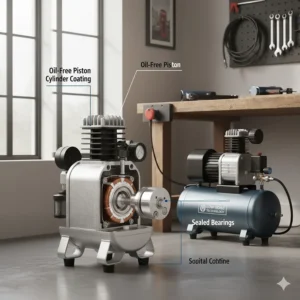
Oil-Free Designs: Eliminate friction between moving parts, reducing mechanical noise. They’re also cleaner and maintenance-free.
Low RPM Motors: Slower-running 4-pole motors (around 1450 RPM) generate less mechanical noise than high-speed alternatives whilst extending component lifespan.
Sound Insulation: Quality casings with acoustic foam dampen vibrations before they escape. Some manufacturers use double-wall construction for extra suppression.
Vibration Dampening: Rubber feet and anti-vibration mounts prevent noise transmission through floors and walls. This matters more than many realise.
Direct Drive vs Belt Drive: Direct-drive systems eliminate belt squeal, though well-maintained belt drives can actually absorb some vibration.
Tank Capacity: Finding Your Sweet Spot
Tank size dramatically affects usability. Here’s how to match capacity to application:
6-10 Litres: Perfect for tyre inflation, airbrushing, occasional nail gunning. Refills frequently but ultra-portable. Expect 2-3 minutes inflation time per car tyre.
24-25 Litres: The sweet spot for home workshops. Handles spray-painting small projects, moderate nail gunning, and most hobby applications. Typically 5-8 minutes between refills during continuous use.
50 Litres: Semi-professional territory. Sustains air-hungry tools like sanders and small impact wrenches. Professional decorators and mechanics favour this size.
100+ Litres: Commercial-grade capacity for workshop environments. Maintains pressure during extended tool use but requires dedicated space and often 16A electrical supply.
Remember the duty cycle too – smaller motors need rest periods. A 50% duty cycle means 10 minutes on, 10 minutes off maximum. Ignoring this shortens motor life considerably.
Oil-Free vs Oil-Lubricated: The Great Debate
UK buyers often agonise over this choice. Each approach offers distinct advantages:
Oil-Free Benefits:
- Zero maintenance requirements
- No oil contamination risk (crucial for food industry, medical, painting)
- Lighter weight and easier portability
- Environmentally friendlier operation
- Ready to use straight from the box
Oil-Free Drawbacks:
- Typically louder than equivalent oil-lubricated models
- Shorter component lifespan (though modern designs have improved)
- Lower maximum pressures in some cases
Oil-Lubricated Benefits:
- Quieter operation through reduced friction
- Longer-lasting components
- Higher maximum pressures achievable
- Better cooling efficiency
Oil-Lubricated Drawbacks:
- Regular oil level checks required
- Potential oil carryover into air stream
- Messy maintenance
- Heavier construction
For home DIY use, oil-free usually wins on convenience. Professional applications often justify oil-lubricated for longevity and quieter operation.
Essential Features Worth Paying For
Beyond basic specifications, certain features dramatically improve user experience:
Pressure Regulation: Twin gauges showing both tank and working pressure give precise control. Adjustable regulators let you dial in exactly the right pressure for each tool.
Automatic Cut-Out: Prevents over-pressurisation and motor burnout. All decent models include this, but check it’s working during initial setup.
Thermal Overload Protection: Shuts down the motor if it overheats. Absolutely essential for longevity, especially with smaller motors running near their limits.
Quick-Release Couplings: Euro-style connectors enable rapid tool changes. PCL XF fittings are the UK standard – ensure compatibility with existing air tools.
Drain Valves: Condensation accumulates in every tank. Bottom-mounted drain valves make this easy. Empty after each session to prevent rust.
Wheels and Handles: Sounds trivial until you’re lugging 25kg across the workshop. Quality castors and ergonomic handles matter enormously.
Air Filters: 10-micron filters catch moisture and particles before they reach tools. Often overlooked but genuinely important for air quality.
Comparison Table: Noise Levels vs Applications
| Application | Recommended Noise Level | Minimum Tank Size | Typical Models |
|---|---|---|---|
| Airbrushing | 40-60 dB(A) | 6-24L | Bambi BB24, Einhell 6L |
| Tyre Inflation | 40-65 dB(A) | 6-24L | Hyundai 8L, SGS 24L |
| Spray Painting (Small Projects) | 50-65 dB(A) | 24L | Hyundai HY7524, Einhell 24L |
| Spray Painting (Large Projects) | 50-70 dB(A) | 50L+ | Wolf Sioux 50 |
| Brad Nailing | 55-70 dB(A) | 24L | SGS 24L, Hyundai HY7524 |
| Framing Nailing | 60-85 dB(A) | 50L+ | Wolf Sioux 50 |
| Air Tools (Light Duty) | 60-75 dB(A) | 24-50L | Einhell 24L, SGS 24L |
| Air Tools (Heavy Duty) | 70-95 dB(A) | 50L+ | Wolf Sioux 50 |
✨ Don’t Miss These Exclusive Deals!
🔍 Take your workshop projects to the next level with these carefully selected products. Click on any highlighted item above to check current pricing and availability on Amazon.co.uk. These tools will help you create professional results your whole family will appreciate!
Installation and Placement Tips
Location dramatically affects perceived noise levels. Follow these guidelines:
Indoor Placement:
- Position on rubber mats to absorb vibration
- Maintain 30cm clearance around all sides for ventilation
- Avoid corners where sound reflects and amplifies
- Consider a compressor cupboard with acoustic foam lining
Outdoor Placement:
- Weatherproof housing essential (sheds work brilliantly)
- Ensure adequate ventilation in summer
- Protect from frost in winter
- Run airlines through insulated ducting
Electrical Requirements: Most 24L models run happily on standard 13A UK sockets. Larger 50L+ models might need 16A supplies – check specifications before purchasing. Never use extension leads exceeding 10 metres with compressors; voltage drop affects motor performance.
First-Time Setup:
- Check oil level (if applicable) before first run
- Run compressor empty for 5 minutes to bed-in components
- Drain condensation from tank
- Test safety valve operation
- Set working pressure to 6 bar initially
Maintenance Schedule for Longevity
Proper care extends compressor lifespan significantly:
Daily (After Each Use):
- Drain condensation from tank via bottom valve
- Wipe down exterior
- Check for air leaks around fittings
Weekly (Frequent Users):
- Inspect air filter; clean if dusty
- Check oil level (lubricated models)
- Test pressure relief valve operation
Monthly:
- Replace/clean inlet air filter
- Tighten any loose fasteners
- Check power cable for damage
Annually:
- Change oil completely (lubricated models)
- Replace air filters
- Inspect tank for corrosion
- Professional service recommended for commercial use
Never:
- Run compressors in dusty environments without filtration
- Exceed duty cycle limits
- Store with pressure in tank
- Ignore unusual noises or vibrations
Price Comparison: Value for Money Analysis
| Price Range | What You Get | Best Options | Typical Noise |
|---|---|---|---|
| £75-£110 | Basic entry-level, 6-8L tanks, minimal accessories | Hyundai HY5508, Einhell 6L | 57-60 dB(A) |
| £140-£200 | Mid-range 24L, good noise suppression, oil-free | SGS Pro 24L, Hyundai HY7524, Einhell 24L | 57-60 dB(A) |
| £200-£250 | Semi-professional 50L or premium 24L, accessories included | Wolf Sioux 50 (power over quiet) | 60-94 dB(A) |
| £400-£550 | Premium ultra-quiet, British-made, 3-year warranties | Bambi BB24 | 40 dB(A) |
The “value sweet spot” clearly sits around £140-£200 for most UK home users. You’re getting proven reliability, decent noise suppression, and adequate capacity without breaking the bank.
Common Mistakes to Avoid
Through testing and customer feedback analysis, these errors crop up repeatedly:
Undersizing Tank Capacity: The most common mistake. That 6L portable seems appealing until you’re waiting 5 minutes between every nail strip. Match tank size to actual usage patterns.
Ignoring Duty Cycle: Running small motors continuously destroys them. Respect the 50% duty cycle rating – your wallet will thank you.
Neglecting Drainage: Rust kills compressor tanks. Empty condensation religiously, especially during humid British summers.
Wrong Pressure Settings: More isn’t always better. Nail guns typically need 6-7 bar; spray guns 2-4 bar. Over-pressuring wastes energy and damages tools.
Cheap Air Hoses: That £5 hose restricts airflow significantly. Invest in quality 8mm+ bore hoses with proper fittings.
Poor Electrical Supply: Voltage drop from long extension leads causes motors to overheat and fail prematurely.

Frequently Asked Questions
❓ What noise level counts as a genuinely quiet compressor in the UK?
❓ Can I use a 24L compressor for spray painting cars?
❓ Do oil-free compressors last as long as oil-lubricated models?
❓ What size compressor do I need for a nail gun?
❓ Are expensive models like Bambi worth the premium price?
Conclusion: Making Your Final Decision
Choosing the right equipment ultimately depends on your specific circumstances. If neighbours complain at the slightest disturbance, the Bambi BB24 justifies every penny of its premium price through whisper-quiet operation. Most UK homeowners, however, find the Hyundai HY7524 or SGS Pro Super Silent 24L hits the perfect balance – quiet enough for residential use, powerful enough for typical DIY projects, and priced sensibly between £140-£170.
For those needing serious grunt and willing to sacrifice quietness, the Wolf Sioux 50 remains the tradesperson’s choice. Its 50L capacity and robust construction handle demanding daily use that would destroy smaller models. Just ensure you’ve got space to locate it away from living areas, or budget for soundproofing.
Remember the golden rule: buy slightly more capacity than you think you’ll need. That 6L portable seems brilliant until you’re tackling a proper project and spending half your time waiting for pressure recovery. A 24L tank adds minimal cost but dramatically improves user experience.
Whatever you choose, proper maintenance determines longevity more than initial quality. Drain condensation daily, respect duty cycles, and keep filters clean. Your future self will appreciate the investment in quality equipment that serves reliably for years rather than months.
Recommended for You
- 7 Best Air Compressors UK 2026
- Best Electrician Screwdriver Set UK: 7 Safest Picks for 2026
- 7 Best Wera vs Wiha Screwdriver Sets UK (2026 Expert Guide)
Disclaimer: This article contains affiliate links. If you purchase products through these links, we may earn a small commission at no additional cost to you. Prices shown are approximate and may vary.
✨ Found this helpful? Share it with your mates! 💬🤗
