
In This Article
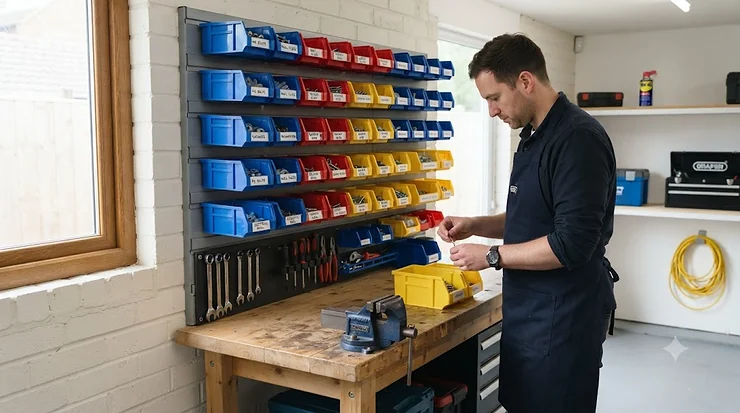
There’s a specific kind of frustration that builds up over months in a workshop or garage: the screw drawer that’s actually three different sizes of screw mixed together, the margarine tub of random washers, the moment you need one specific bolt and end up tipping out four containers to find it. Most people don’t decide to sort this out in one go — it happens gradually, usually after the third time in a week spent hunting for a 6mm nut that’s somewhere in the chaos. Wall mounted parts bins solve this specific, unglamorous problem: getting small hardware up off the bench and floor, onto the wall, sorted, labelled, and visible at a glance.
What are wall mounted parts bins? They’re small, open-fronted plastic or metal containers that clip, hang, or slot onto a wall-fixed panel or rail system, used to sort and store screws, bolts, washers, and other small hardware in a way that’s organised, space-saving, and quick to access compared with loose drawers or boxes.
That space-saving element matters more than it sounds like it should. A garage or workshop only has so much bench and floor area, and every bin sitting on a worktop is bench space you don’t have for actually working. This guide pulls together genuine UK product research, honest aggregated review sentiment — including the less flattering feedback, not just the glowing five-star quotes — and practical guidance on fitting these systems safely to a real wall, since a parts bin system that pulls out of plasterboard under load is worse than no system at all. We’ll walk through seven real wall mounted parts bin systems available in the UK, how louvre panels compare with pegboard bin systems, and how to actually plan a setup that holds up over years of garage use rather than months.
Quick Comparison: Wall Mounted Parts Bins at a Glance
If you’re short on time, here’s the condensed version before the detail below.
| Product | Best For | Approx. Price | Key Feature |
|---|---|---|---|
| BiGDUG Louvre Panel Kit (36 Red Bins) | Serious, semi-industrial workshop use | £45-£65 range | Powder-coated steel panel, impact-resistant bins |
| Faithfull Wall Mounted Storage Bins | Tradespeople, durable everyday use | £25-£40 range | Steel back panel, manufacturer guarantee |
| VonHaus 30pc Wall Mounted Storage Bin Organiser | General garage and shed organisation | Around £20 | 36kg capacity, two adjustable back panels |
| VonHaus 44 Piece Pegboard Hook & Bin Set | Combined tool and hardware storage | £20-£25 range | Pegboard plus bins and tool hooks in one system |
| Stalwart 30 Bin Wall Mounted Parts Rack | Budget hardware sorting | £15-£20 range | Interlocking track, stackable bins |
| BiGDUG Plastic Parts Bins (Pack of 10) | Vertical, stackable parts storage | £25-£40 range | Chemical-resistant, label holder, louvre-compatible |
| BiGDUG Wall Mountable Bin Rail | Adding bin capacity to an existing wall | Under £10 | Simple track for hanging individual parts bins |
The honest pattern in that table: there’s a real split between budget plastic-and-track systems built for light garage and shed use, and genuinely industrial-grade louvre panel kits built for workshops and small trade businesses where bins get loaded, unloaded, and knocked about daily. Picking the wrong category for your actual use case is the single most common mistake covered later in this guide.
💬 Just one click — help others make better buying decisions too! 😊
✨ Don’t Miss These Exclusive Deals!
🔍 Take the chaos out of your workshop wall. Click through on any product below to check current pricing and availability — getting hardware properly sorted today means no more tipping out three bins to find one bolt.
Top 7 Wall Mounted Parts Bins: Expert Analysis
We’ve focused this list on genuine products available through Amazon UK, covering established trade and DIY brands like BiGDUG, Faithfull, VonHaus and Stalwart, supported by honest aggregated review sentiment rather than cherry-picked five-star quotes.
1. BiGDUG Louvre Panel Kit (36 Red Bins)
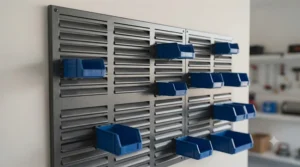
The standout feature here is the build quality difference between this and consumer-grade plastic pegboard kits: a louvre panel finished in grease-resistant, powder-coated steel, paired with bins manufactured from premium-grade, impact-resistant thermoplastic rather than the thinner injection-moulded plastic typical of budget sets. This is genuinely commercial-grade kit, built by a company that primarily supplies warehouses and workshops rather than a generic import brand repackaged for DIY shelves.
What most buyers overlook about louvre panel systems specifically is how the panel design itself does most of the structural work — rather than relying on a plastic track that can sag or warp under load, as several budget alternatives are honestly reported to do, the steel louvre panel provides a rigid mounting surface that bins hang from via reinforced rear lips. Based on the spec comparison with plastic-track competitors, this is the more durable choice for anyone loading bins with genuinely heavy hardware — nuts, bolts, fixings — rather than lightweight craft components.
Pros: genuinely commercial-grade steel panel construction; impact-resistant thermoplastic bins built for repeated daily use; grease-resistant powder coating suits real workshop conditions. Cons: a noticeably bigger investment than plastic pegboard kits; the steel panel is heavier and needs more robust wall fixings to install correctly.
Typically priced in the £45-£65 range at the time of research, it sits at the premium end — justified, based on the specification, by genuinely industrial-grade materials rather than branding alone.
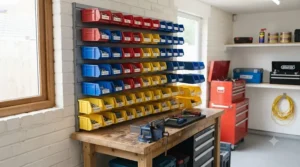
2. Faithfull Wall Mounted Storage Bins with Metal Back Panel
Faithfull is a long-established UK trade tool brand, and this product reflects that positioning: a steel wall panel paired with a set of heat-resistant, shock-proof polymer bins in assorted sizes, designed specifically with electricians, plumbers, and other trades in mind who need hardware sorted and accessible on a van wall, workshop, or site cabin rather than just a hobby garage. The bins are described as resistant to oils, solvents and mild acids, which matters considerably more in a working trade environment than a typical hobbyist’s shed.
Based on the spec comparison with plastic-only systems, the steel panel here is the meaningful upgrade — it resists the sagging and flexing that several budget plastic-backed competitors are honestly reported to suffer under sustained load. What most buyers overlook about trade-brand products like this is the manufacturer backing behind them: Faithfull’s listings reference a five-year guarantee on this range, a genuinely useful signal of expected product lifespan compared with unbranded imports offering no meaningful warranty support.
Pros: steel panel resists sagging better than plastic-backed alternatives; polymer bins resist oils and solvents, suiting genuine workshop and trade use; backed by a five-year manufacturer guarantee. Cons: pricier than basic plastic pegboard kits; the assorted bin sizing is fixed rather than fully customisable.
Priced in the £25-£40 range at the time of research, it represents solid mid-to-upper value for anyone using the system professionally rather than for occasional home DIY.
3. VonHaus 30pc Wall Mounted Storage Bin Organiser
This is one of the more heavily reviewed products in this category on Amazon UK, with a genuinely large sample of customer feedback to draw on. It includes two adjustable back panels, twelve large bins, eighteen small bins, labels, and the screws and wall plugs needed for installation, rated to a 36kg overall weight capacity — a useful, concrete figure that’s worth checking against your intended hardware load before buying.
Reviewers consistently report that it’s straightforward to assemble and genuinely sturdy in everyday garage use, with several specifically describing it as well-made and good value alongside other VonHaus garage storage products. Based on the spec comparison with the more expensive industrial louvre kits above, the trade-off here is fairly clear: this isn’t built to the same commercial-grade standard, but for general household garage and shed hardware sorting, the honest reviewer consensus suggests it comfortably does the job it’s designed for.
Pros: strong, large sample of genuinely positive review sentiment on sturdiness and ease of assembly; two adjustable panels allow flexible layout across a wall; clear, stated 36kg weight capacity for planning purposes. Cons: not built to the same commercial-grade standard as louvre panel systems; fixed bin sizes offer less flexibility than a fully modular louvre setup.
At around £20 at the time of research, it’s a genuinely well-reviewed, accessible entry point into proper wall-mounted hardware organisation.
4. VonHaus 44 Piece Wall Mounted Pegboard Hook, Storage Bins and Panel Set
This product specifically represents the pegboard bin system category — combining four large bins, twelve medium bins, twelve small bins, and fourteen tool storage accessories such as hooks across two back panels, rather than focusing purely on small-parts bins. It’s a genuinely useful hybrid for anyone wanting to organise both loose hardware and hand tools like screwdrivers and pliers on the same section of wall.
What most buyers overlook about combined pegboard-and-bin systems is the layout flexibility this design offers: because hooks and bins both attach to the same panel, the configuration can be rearranged entirely as storage needs change, rather than being locked into a fixed bin layout. Based on the spec comparison with bin-only systems like the VonHaus 30pc option above, this is the better choice specifically when hand tools, not just small hardware, are part of the storage problem being solved.
Pros: genuinely combines tool hooks and hardware bins in one coherent system; two panels can be mounted together or separately depending on available wall space; flexible, rearrangeable layout. Cons: the smaller bin sizes are better suited to fasteners than larger components; with both hooks and bins on offer, the system covers more ground but each individual bin allocation is slightly smaller than dedicated bin-only sets.
Priced in the £20-£25 range at the time of research, it’s a sensible mid-range pick for anyone organising a genuinely mixed collection of tools and small parts.
5. Stalwart 30 Bin Wall Mounted Parts Rack
This is one of the most widely available entry-level options in this category, built around an interlocking plastic track system with stackable bins designed for nuts, bolts, and other small parts. It’s worth being genuinely upfront about this one: aggregated review sentiment is notably mixed, which is useful, honest information rather than something to gloss over in a buying guide.
Several reviewers describe it as good value and functional for everyday hardware storage, with the backing plate’s interlocking design praised as clever and the trays as thick enough to avoid feeling flimsy. However, other genuine reviews report bins not gripping the holding rail well, trays falling off with light contact, and the system running smaller than the listed dimensions suggest once wall thickness is accounted for. Based on the spec comparison with the steel-backed options above, the honest takeaway is that this product performs reasonably for light-duty use and a tight budget, but isn’t the right choice if you’re planning to load it with genuinely heavy hardware or need it to survive years of daily knocks in an active trade workshop.
Pros: genuinely low entry price point; interlocking track allows long horizontal runs; works well for lightweight items like screws, washers, and small electrical parts according to multiple reviewers. Cons: honest review consensus flags inconsistent build quality, with some reporting trays detaching or cracking under normal use; dimensions run smaller in practice than the listing suggests.
Typically priced in the £15-£20 range at the time of research, it’s a reasonable budget starting point provided expectations are set around light-duty use rather than heavy-duty workshop service.
6. BiGDUG Plastic Parts Bins (Pack of 10)
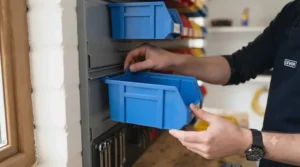
These bins represent the vertical parts storage side of this category particularly well — designed to be fully stackable to create storage columns on a worktop or shelf, while also including a reinforced rear lip that allows the same bins to be wall-mounted on a compatible louvre panel. That dual stacking-or-wall-mounting flexibility is a genuinely useful feature most single-purpose bin sets don’t offer.
What most buyers overlook about this kind of bin is the material specification: manufactured from polypropylene that’s impermeable and resistant to most acids, alkalis, solvents and oils, which is a meaningfully different proposition from generic craft-storage plastic bins when stored hardware includes anything oily or chemically contaminated, as is common in automotive and engineering workshops. Based on the spec comparison with the assorted-bin kits above, the open-front, integral label holder design also makes ongoing organisation noticeably easier — each bin clearly states its contents rather than relying on memory or guesswork.
Pros: genuinely chemical and solvent resistant, suiting automotive and engineering use specifically; stackable or wall-mountable depending on need; integral label holders aid ongoing organisation. Cons: requires a compatible louvre panel for wall mounting, sold separately; pack pricing makes it a bigger upfront commitment than mixed bin-and-panel kits.
Priced in the £25-£40 range at the time of research for a pack of ten, this is a strong choice specifically for anyone building a genuinely modular, expandable vertical parts storage system over time.
7. BiGDUG Wall Mountable Bin Rail for Plastic Parts Bins
The final product on this list isn’t a full bin kit at all, but the simple track accessory that lets individual parts bins hang directly from a wall without needing a full louvre panel system — a 600mm rail designed specifically to take compatible plastic parts bins. For anyone with an existing shelf, a small section of available wall, or who simply wants to add a couple of extra bins without committing to a full panel kit, this is a genuinely practical, low-cost option.
Based on the spec comparison with full panel kits, the trade-off is straightforward: a single rail offers far less capacity and layout flexibility than a louvre panel, but it’s also a fraction of the cost and installation effort, making it a sensible way to extend an existing bin collection or test the wall-mounted approach before committing to a larger system. What most buyers overlook is that this kind of simple rail is often the most practical wall-mount organiser for genuinely small spaces — above a workbench corner, inside a cupboard door, or along a narrow strip of otherwise unused wall.
Pros: genuinely inexpensive way to add wall-mounted bin capacity; simple, low-effort installation compared with a full panel kit; compatible with standard BiGDUG-style parts bins for easy expansion later. Cons: limited to a single row of bins per rail; not a complete storage solution on its own for anyone starting from scratch.
Typically under £10 at the time of research, this is the smallest spend on the list and a sensible way to extend or trial a wall-mounted bin system incrementally.
Practical Usage Guide: Installing and Setting Up Wall Mounted Parts Bins
Buying the right bin system only solves half the problem — fitting it correctly to an actual wall, and setting it up sensibly from day one, matters just as much for long-term reliability. Before drilling anything, it’s worth locating the wall studs or solid masonry behind plasterboard, since a heavily loaded panel relying solely on plasterboard-only fixings is a common cause of systems pulling away from the wall after a few months of use. A detailed technical guide on load ratings for wall fixings is a genuinely useful reference for matching the right fixing type to the actual weight a loaded panel will carry, rather than guessing.
In the first month of use, the most common mistake is overloading a handful of bins near the centre of a panel rather than distributing hardware weight evenly across the full mounting area, which puts uneven stress on individual fixing points. Maintenance is minimal but worth doing: periodically check that wall fixings haven’t worked loose, particularly on panels mounted to plasterboard rather than solid masonry or timber studs, and relabel bins as contents change so the system keeps earning its keep rather than slowly reverting to mixed, unsorted hardware.
Real-World Scenarios: Matching the System to the Space
It helps to think through actual workshop situations rather than abstract categories. Consider three common scenarios.
First, a hobbyist with a small home garage, mostly storing screws, wall plugs, and odds and ends from various DIY projects. Here, the VonHaus 30pc Wall Mounted Storage Bin Organiser earns its keep — genuinely well-reviewed, affordable, and more than sufficient capacity for typical household hardware without the cost or installation complexity of a commercial louvre system.
Second, a tradesperson working from a van or small workshop, needing durable, chemical-resistant storage that survives daily loading and unloading. Here, the Faithfull Wall Mounted Storage Bins or the BiGDUG Plastic Parts Bins make more sense — the steel panel and chemical-resistant polypropylene respectively are built for genuinely heavier, more frequent use than a hobbyist setup typically demands.
Third, someone slowly expanding their workshop storage over time rather than committing to one large system upfront. Here, starting with a BiGDUG Wall Mountable Bin Rail and adding individual bins as needed, then expanding to a full louvre panel later if the collection grows, avoids overcommitting to a system size before knowing what’s actually needed.
Problem → Solution: Common Wall Mounted Parts Bin Issues
A handful of issues come up repeatedly across reviews and forums, each with a fairly specific fix.
Problem: bins keep falling off the rail or track with light contact. Solution: this is most commonly reported on budget plastic-track systems under load — switching to a steel-backed louvre panel, or simply not overloading individual bins beyond their stated capacity, generally resolves it.
Problem: the wall panel has started sagging or pulling away from the wall. Solution: this usually points to inadequate wall fixings for the load involved — locating studs or using properly rated cavity anchors for plasterboard, rather than basic wall plugs, is the recommended fix.
Problem: it’s hard to remember what’s in which bin without opening several. Solution: using the integral label holders included on better-designed bins, or simply adding written labels to budget bins that lack them, solves this directly and keeps the whole system genuinely useful rather than just tidy-looking.
Problem: hardware stored in bins is rusting or contaminated with oil residue. Solution: switching to chemical and oil-resistant polypropylene bins, rather than basic craft-storage plastic, is specifically designed to address this in workshop and automotive environments.
Problem: the system looked spacious in the listing but fills up faster than expected. Solution: this is where modular, expandable systems built around a rail or louvre panel genuinely outperform fixed all-in-one kits, since extra bins or panel sections can simply be added later.
How to Choose Wall Mounted Parts Bins
Working through a short list of practical questions, in order, makes this decision considerably easier than starting with price or bin count alone.
- Be honest about how heavy your hardware actually is. Light fasteners and craft components suit budget plastic systems fine; genuinely heavy bolts, fittings, or automotive parts need steel-backed or commercial-grade bins.
- Check the wall you’re fixing to before buying. Solid masonry or timber studs support far more weight than plasterboard alone, which should influence both the system you choose and the fixings you use.
- Think about how often the system will be loaded and unloaded. Daily trade use wears budget plastic track systems faster than occasional hobbyist use, based on the honest review patterns seen across this category.
- Decide between a fixed kit and a modular, expandable system. A rail-and-bin approach scales more easily over time than committing to one fixed-size panel kit upfront.
- Check for chemical or oil resistance if relevant. Workshop and automotive environments benefit meaningfully from polypropylene bins rated for solvents and oils, not just generic plastic.
- Look at genuine review sentiment on durability, not just the star rating. As seen above, average ratings can mask a meaningful split between reviewers who load bins lightly versus those who push the system harder.
- Plan your layout before drilling. Grouping similar hardware together and leaving room to expand saves a second installation later as your collection grows.
Wall Storage Bins for Workshop vs Free-Standing Storage
| Factor | Wall Storage Bins for Workshop | Free-Standing Storage (drawers/totes) |
|---|---|---|
| Floor space used | None — frees up bench and floor area | Significant, particularly for larger collections |
| Visibility of contents | High, with open-front bins visible at a glance | Lower, often requires opening multiple drawers |
| Installation effort | Requires wall fixing and a level surface | None — simply placed on a bench or shelf |
| Load limits | Defined by wall fixing strength and panel rating | Defined by floor or shelf load capacity, generally higher |
| Expandability | Easy to add bins or panels over time | Limited by available floor or shelf space |
The pattern in that table is fairly clear: wall storage bins for workshop use earn their keep specifically by freeing up the floor and bench space that free-standing alternatives consume, at the cost of needing a proper wall fixing and a defined load limit. For genuinely small workshops and garages where floor space is the scarcest resource, that trade-off consistently favours wall-mounted systems; for larger spaces with floor area to spare, free-standing drawer units can offer higher overall capacity without worrying about wall load at all.
Hardware Parts Bins Garage: Setting Up an Organised System
Garage hardware storage tends to accumulate organically rather than by design — a few screws here, leftover fixings from a flat-pack project there — which is exactly why a dedicated hardware parts bins garage setup pays off over time. The most effective approach groups bins by category from the outset: fasteners by type and size in one section, electrical components in another, plumbing fittings elsewhere, rather than filling bins in whatever order items happen to arrive.
What most people overlook when setting up garage hardware storage is planning for growth from day one. Based on the spec comparison between fixed bin kits and modular rail systems covered earlier, starting with slightly more capacity than currently needed, or choosing an expandable rail-based system, avoids the common situation of running out of bin space within the first year and needing to either consolidate categories awkwardly or start a second, disconnected storage area.
Vertical Parts Storage: Maximising Wall Space
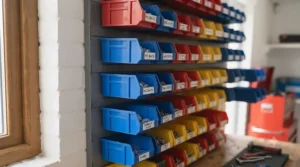
Vertical parts storage — stacking bins or panels upward rather than spreading them across a single horizontal strip of wall — makes a meaningful difference in genuinely small garages and workshops where wall width is limited but height above a workbench often isn’t. Bins like the BiGDUG Plastic Parts Bins, specifically designed to stack vertically as well as wall-mount, suit this approach particularly well, since the same bins can be reconfigured between stacked and wall-mounted arrangements as storage needs change.
Here’s what most flat, single-row bin layouts don’t account for: the most frequently used hardware should sit at a comfortable reaching height, while less-used or bulkier items can go higher or lower without slowing down daily work. Based on the spec comparison with single-height rail systems, a properly planned vertical layout effectively multiplies the storage capacity of a given section of wall without needing to claim additional wall width — a genuinely practical solution for narrow workshop spaces, alcoves, or the often-wasted area beside a garage door.
Pegboard Bin System: How It Compares to Louvre Panels
| Factor | Pegboard Bin System | Louvre Panel System |
|---|---|---|
| Material | Typically plastic or MDF backing board | Steel or heavy-duty polypropylene panel |
| Load capacity | Moderate, suits hooks and lighter bins well | Higher, designed for heavier commercial-grade bins |
| Flexibility | High — hooks, bins and accessories mix freely | High for bins specifically, less suited to hand tools |
| Typical use case | Mixed tool and hardware storage in home garages | Dedicated parts storage in workshops and trade settings |
| Cost | Generally lower | Generally higher, reflecting commercial-grade build |
A pegboard bin system and a louvre panel system solve a genuinely similar problem from two different angles. Based on the spec comparison above, pegboard systems make more sense when hand tools and hardware need to share the same wall space, since hooks and bins can be freely rearranged on the same backing board, while louvre panels are the stronger choice when the priority is purely small-parts storage at higher load capacity, typically in workshops handling heavier or more frequently accessed hardware.
Wall-Mount Organiser: Installation and Load Safety
Getting the installation right matters more for a wall-mount organiser than almost any other factor in this guide, since even the best-reviewed bin system will fail if it’s fixed into a wall that can’t support the intended load. As a general guide, properly installed single plasterboard can support meaningfully less weight per fixing point than a timber stud or solid masonry wall, which is why locating studs — or using cavity anchors specifically rated for the load involved — is consistently recommended over basic wall plugs for anything beyond very light hardware storage.
For workshops operating at a more commercial or trade scale, it’s also worth being aware of the wider context: the Health and Safety Executive’s HSG76 guidance on warehousing and storage sets out the broader principles UK businesses are expected to follow around safe storage systems, including ensuring equipment is installed and used within its rated capacity. While a domestic garage setup isn’t subject to the same formal inspection regime as a commercial warehouse, the same underlying logic applies directly: know the rated load of your system, don’t exceed it, and check fixings periodically rather than assuming a wall-mounted system installed correctly once will stay that way indefinitely.
Features That Actually Matter (and Those That Don’t)
Marketing copy for wall mounted parts bins tends to emphasise piece count — “44 piece set,” “30 bins” — as the headline selling point, but raw bin count rarely predicts how useful a system actually is in practice. Features that genuinely matter include the strength and material of the wall panel itself, the load rating of individual bins, integral label holders that keep organisation sustainable over time, and chemical resistance for anyone storing hardware that’s likely to pick up oil or grease.
Conversely, features that sound appealing but matter less in practice include excessive colour variety across bins, which looks attractive in product photography but offers little practical benefit once a system is labelled properly, and very high piece counts achieved primarily by including many tiny bins better suited to beads or jewellery findings than typical garage hardware. If a listing leads with bin count rather than panel material or weight capacity, that’s often a fair signal about where the manufacturer’s priorities sit.
Long-Term Cost and Maintenance
A £16 budget plastic rack that needs replacing within a year or two due to cracked trays and a sagging track works out more expensive over a typical five-year garage-storage lifespan than a £45 steel louvre panel kit built to handle daily loading without degrading. As with most workshop equipment, the cheapest option upfront isn’t necessarily the cheapest over the system’s realistic working life.
| Price Tier | Typical Products | Realistic Lifespan | Best Suited To |
|---|---|---|---|
| Budget (under £20) | Stalwart-style plastic track kits | 1-3 years under moderate use | Light hobbyist use, occasional projects |
| Mid-range (£20-£40) | VonHaus pegboard/bin sets, Faithfull steel panels | 3-7 years under regular use | Regular home DIY, light trade use |
| Premium (£40+) | BiGDUG louvre panel kits | 7+ years under daily use | Workshops, trade and commercial settings |
Maintenance itself is minimal: a periodic check of wall fixings, particularly after any house move or significant temperature and humidity changes that can affect plasterboard fixings, and occasional cleaning of bins exposed to oil or dust keeps most systems performing as intended for years. The genuinely hidden cost worth weighing is the time lost to a poorly organised workshop — hardware that’s hard to find or improperly stored tends to get duplicated unnecessarily, which adds up considerably faster than the price difference between a budget and mid-range bin system.
Common Mistakes When Buying Wall Mounted Parts Bins
The most frequent mistake is buying based purely on bin count or price without checking genuine review sentiment on build quality — as the honest reviewer feedback throughout this guide shows, not every “30 bin” system performs equally once loaded with real hardware. A close second is underestimating wall fixing requirements, mounting a heavily loaded panel directly into plasterboard with basic wall plugs rather than locating studs or using properly rated cavity anchors. Skipping a labelling system from day one is another common oversight, since even a well-built bin system gradually becomes disorganised again without it. Finally, plenty of buyers commit to a single fixed-size kit without considering whether a modular, expandable rail-based system would better suit a hardware collection that’s likely to keep growing. For anyone setting up a more formal trade or small business workshop, it’s also worth noting that storage and racking generally falls under the same broad duty of care as other workplace equipment — the HSE’s overview of the Provision and Use of Work Equipment Regulations sets out the general principle that equipment used at work should be suitable for its purpose and properly maintained, which applies just as sensibly to a loaded parts bin wall as it does to any other piece of workshop kit.
Frequently Asked Questions
❓ What's the best wall mounted parts bins system for a home garage?
❓ Can wall mounted parts bins be fixed to plasterboard safely?
❓ What's the difference between a pegboard bin system and a louvre panel system?
❓ How do I stop hardware bins from getting disorganised again over time?
❓ Are chemical-resistant parts bins necessary for a home workshop?
Conclusion
There’s no single best wall mounted parts bins system, and that’s largely because workshops and garages genuinely vary in how heavily they’re used — a hobbyist sorting the occasional box of screws has very different needs from a tradesperson loading and unloading hardware daily. What stays consistent across every product in this guide is the underlying principle: proper wall fixing matched to actual load, bins sized and labelled for genuine usability rather than maximum piece count, and a system chosen with realistic growth in mind rather than just what fits the current pile of loose hardware. Whether that means a simple budget rack for a small garage, a pegboard system combining tools and bins, or a genuinely commercial-grade louvre panel for a working trade space, choosing deliberately based on real use rather than the biggest piece count on the box makes a measurable difference to how long the system actually stays useful.
✨ Don’t Miss These Exclusive Deals!
🔍 Take your workshop organisation to the next level with these carefully researched products. Click on any item above to check current pricing and availability — getting hardware properly sorted today means less time hunting and more time actually working.
Recommended for You
- Best Small Parts Storage Bins UK 2026: 7 Expert Picks for Tidy Workshops
- Best Stackable Boxes for Small Garage UK 2026: 7 Expert Picks
- Best Stackable Storage Containers UK 2026: 7 Top Picks Reviewed
Disclaimer: This article contains affiliate links. As an Amazon Associate, I earn from qualifying purchases. If you purchase products through these links, we may earn a small commission at no additional cost to you.
✨ Found this helpful? Share it with your friends! 💬🤗
