

In This Article
Engine oil for high mileage cars is a lubricant formulated for engines that have typically covered 75,000 miles or more. It combines a conventional or synthetic base oil with seal conditioners, extra detergents and robust anti-wear additives, aiming to soften hardened seals, cut oil consumption and keep sludge and wear in check as components age.

That’s the textbook version. The real-life version goes like this: your car has rolled past 90,000 miles, the dipstick keeps dropping, and a faint damp patch has appeared on the driveway like a slow, passive-aggressive hint. Choosing the right engine oil for high mileage cars is less about miracle claims and more about matching chemistry to ageing parts.
First, a little decoder-ring work. The numbers on every bottle, such as 10W-40, come from the SAE J300 viscosity standard. The first figure describes cold-weather flow, and the second describes thickness at operating temperature. Pair those numbers with the ACEA and manufacturer approvals printed on the label, and you can shortlist sensibly.
I’ve compared seven real products available to UK buyers, from a classic-engine mineral oil to a bottled additive. The sources are manufacturer data sheets, retailer specifications and independent guides. I haven’t tested any of them myself. Where I couldn’t verify a meaningful pool of owner reviews, I say so. Expect honest trade-offs, a few warnings about diesel particulate filters (DPFs), and prices in ranges only, because they move constantly.
Quick Comparison: Engine Oil for High Mileage Cars at a Glance
| Product | Type | Approx. price | Best For |
|---|---|---|---|
| Valvoline MaxLife 10W-40 | Semi-synthetic oil | £30-£40 / 5L | All-round seal care in older petrol cars |
| Valvoline MaxLife 5W-40 | Full synthetic oil | £35-£50 / 5L (where stocked) | Easier cold starts in ageing engines |
| Liqui Moly Super Leichtlauf 10W-40 | Synthetic-technology oil | Mid-£30s to low-£40s / 5L | European petrol and non-DPF diesel past 100,000 km |
| Castrol GTX Ultraclean 10W-40 A3/B4 | Part-synthetic oil | £25-£40 / 4L | Budget sludge control |
| Liqui Moly Top Tec 4100 5W-40 | Synthetic C3 oil | Mid-£40s to around £50 / 5L | Modern DPF diesels that need approvals |
| Millers Classic Pistoneeze 20W-50 | Mineral oil | High-£30s / 5L | Pre-1980 classics that burn oil |
| Liqui Moly Motor Oil Saver | Additive, 300ml | Under £10 | Adding seal care to any approved oil |
Looking at the table, Valvoline MaxLife 10W-40 is the safest first stop for an older petrol car that weeps or burns a little oil. Liqui Moly Top Tec 4100 5W-40 is the grown-up choice when your handbook demands modern approvals. Liqui Moly Motor Oil Saver is the odd one out because it’s an additive rather than an oil, but it’s also the cheapest way to add seal care. Prices were gathered at the time of research and may vary, so check current price before buying.
💬 Just one click — help others make better buying decisions too!😊
Top 7 Engine Oil for High Mileage Cars: Expert Analysis
Each pick below is judged on its specifications, what those specs mean in practice, and what verified reviews actually say. Always check your handbook before buying.
1. Valvoline MaxLife 10W-40 — best all-round seal care
Valvoline markets MaxLife as the world’s first high mileage oil, and seal care is the whole point of the formula. This semi-synthetic 10W-40 carries ACEA A3/B3 and A3/B4, API SN/CF, Mercedes-Benz 229.3, PSA B71 2300 and Renault RN0700/0710 approvals. In practice, that suits older petrol and non-DPF diesel engines where a 10W-40 is permitted. The thicker hot film gives tired bearings and piston rings a little extra cushion, and the detergents target sludge left by years of short trips.
Based on the spec comparison, this is the most purpose-built high mileage motor oil here. What most buyers overlook is that A3/B4 oils aren’t low-SAPS, so this is a poor match for any diesel with a particulate filter.
Verified review sentiment is small but positive. A Dutch DIY retailer’s page showed 17 reviews averaging 4.5 out of 5 at the time of research. Owners mentioned easy pouring and cars running well, with one low-scoring outlier. I couldn’t verify a large UK review pool.
Pros:
- ✅ Dedicated seal conditioners aimed at leaks
- ✅ Broad approvals list for older cars
- ✅ Widely recognised high mileage brand
Cons:
- ❌ Full-SAPS formula, unsuitable for DPF cars
- ❌ Limited high street stock in the UK
Expect around £30-£40 for 5L, which is strong value if your handbook allows 10W-40. Check current price.

2. Valvoline MaxLife 5W-40 — full synthetic cold-start comfort
This is the full synthetic sibling, and the “5W” is the selling point. Valvoline’s product sheet lists ACEA A3/B3 and A3/B4, API SN/CF, Mercedes-Benz 229.3, Renault RN0700/0710, and suitability where VW 502 00/505 00 applies. It’s positioned for modern engines with higher mileage.
One independent UK guide notes that 5W and 10W grades behave almost identically once warm, but the 5W flows slightly faster on a frosty morning. That matters for turbocharger bearings and variable valve timing actuators. So this suits a 2005-2015 turbo petrol with 100,000-plus miles, provided the handbook allows 5W-40.
A Belgian retailer’s page showed 13 reviews at the time of research, with most scoring five stars and a few lukewarm or critical ones. UK stock appears patchier than the 10W-40, so confirm availability before you commit.
Pros:
- ✅ Faster cold-start flow than 10W-40
- ✅ Full synthetic base for stability
- ✅ Same seal-care philosophy as its sibling
Cons:
- ❌ Not suited to diesels with particulate filters
- ❌ Dearer and harder to find in the UK
Indicatively £35-£50 for 5L where stocked. Worth it for cold-start protection, but check current price.
3. Liqui Moly Super Leichtlauf 10W-40 — German workhorse for 100,000 km-plus engines
Liqui Moly describes this as particularly suited to vehicles with high mileage. It says the oil keeps shaft seals and valve stem seals flexible and holds oil consumption low. Approvals include ACEA A3/B4, MB 229.3 and VW 501 01/505 00. Liqui Moly also recommends it for Fiat 9.55535-D2/G2, PSA B71 2300 and Renault RN 0700/0710. It’s tested for turbochargers and catalytic converters.
Those approvals are the practical reason to choose it over a generic 10W-40. Older Volkswagen Group, Peugeot-Citroën and Renault cars often specify exactly these standards. The claim of reduced oil consumption is a manufacturer statement, so treat it as an intention rather than a guarantee.
I couldn’t verify a meaningful pool of owner reviews in the sources I checked, so I won’t pretend there’s a consensus. The brand’s reputation among European workshops is the main supporting evidence.
Pros:
- ✅ Strong approvals list for older European cars
- ✅ Explicitly pitched at 100,000 km-plus engines
- ✅ Easy to find from UK online retailers
Cons:
- ❌ Full-SAPS A3/B4, not for DPF-equipped diesels
- ❌ Costs more than mainstream 10W-40 rivals
Typically mid-£30s to low-£40s for 5L. Good value for the right engine, so check current price.
4. Castrol GTX Ultraclean 10W-40 A3/B4 — budget sludge fighter
The standout here is cleanliness. Castrol’s data sheet claims its GTX range is 35% cleaner than industry standards in a sludge test, which is a company claim worth treating as marketing. The spec sheet shows ACEA A3/B3 and A3/B4, API SN, MB 229.1, VW 501 01/505 00, and Fiat and Renault approvals.
One independent guide notes it’s the UK counterpart to the US-market GTX High Mileage line but isn’t branded as high mileage here. I found no dedicated seal-conditioner claim, so don’t expect leak-stopping magic.
So who is it for? Based on the specs, it suits a mechanically sound older car with a short-trip history, where sludge is the main worry. If the car weeps oil, pair it with an additive.
A handful of owner comments on a UK parts retailer mention lower top-ups compared with cheap supermarket oil. That’s anecdotal rather than a trend.
Pros:
- ✅ Strong detergent package against sludge
- ✅ Keeps cost per litre competitive
- ✅ Easy to buy on the high street
Cons:
- ❌ No dedicated seal conditioner claim
- ❌ Thinner evidence for oil-burning engines
Roughly £25-£40 for 4L depending on retailer. Solid budget value, but check current price.
5. Liqui Moly Top Tec 4100 5W-40 — approvals for modern engines
This isn’t a dedicated high mileage motor oil, and that’s exactly why it matters. It’s an ACEA C3 synthetic with BMW Longlife-04, MB 229.31/229.51, VW 505 00/505 01 and Porsche A40 approvals. Liqui Moly also recommends it for Ford WSS-M2C 917-A and GM dexos2. It’s suitable for diesel particulate filter engines, and Liqui Moly says long intervals of up to 30,000 km are possible, depending on the manufacturer’s specification.
For a tired engine, I’d treat that long-drain figure as a ceiling, not a target. Shorter intervals are the cheap insurance of older engines.
Here’s the analysis: if your car demands a C-class oil, you can’t simply swap in a full-SAPS high mileage product. This oil keeps you compliant. Add Liqui Moly Motor Oil Saver if the seals are weeping.
Retailer pages carry user comments praising value even on higher mileage cars, but I couldn’t verify a sizeable UK review pool.
Pros:
- ✅ Wide modern approvals, DPF-compatible
- ✅ Synthetic base suits turbo engines
- ✅ Keeps warranty-style compliance intact
Cons:
- ❌ No built-in seal conditioning
- ❌ Priciest oil in this round-up
Expect mid-£40s to around £50 for 5L. Fair value if approvals matter, so check current price.
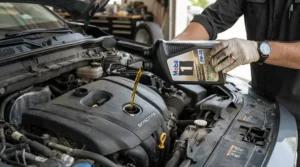
6. Millers Classic Pistoneeze 20W-50 — built for pre-1980 classics
This mineral 20W-50 is a moderate-detergent oil formulated with ZDDP, with API SJ performance. Millers lists it for primarily pre-1980 petrol and diesel engines and says it suits higher mileage applications where oil consumption is a problem. Its viscosity at 100°C is 18.5 cSt with a viscosity index of 133, which means a thick, stable film when hot.
That thick film is the draw. ZDDP protects flat-tappet camshafts, and the heavy grade helps loose, worn clearances hold pressure. But this isn’t an everyday oil for modern cars. API SJ and a 20W cold grade are wrong for catalysts, variable valve timing and particulate filters.
I found no verified reviews on the retailer pages I checked, so I can’t offer a sentiment summary. Its standing rests on Millers’ classic-car reputation.
Pros:
- ✅ ZDDP protection for flat-tappet camshafts
- ✅ Thick film for worn clearances
- ✅ Formulated for oil-consuming old engines
Cons:
- ❌ API SJ is outdated for modern engines
- ❌ Slow cold-start flow in winter
Around the high-£30s for 5L. Excellent value for the right classic, so check current price.
7. Liqui Moly Motor Oil Saver — bottled seal care for any approved oil
The standout is flexibility. One 300ml can treats up to 5L of oil, and Liqui Moly says it regenerates rubber and plastic seals and reduces oil consumption through piston rings and valve guides. It states compatibility with petrol and diesel engines, with or without a DPF. The sealing effect first appears after roughly 600-800 km, and re-dosing is suggested every 30,000 km. It isn’t suitable for motorbikes with wet clutches.
Liqui Moly’s reasoning is that seals lose plasticisers over time, contract and turn brittle, and the additive makes them swell again. That’s plausible chemistry. But no additive repairs a cracked seal or worn rings, so manage expectations.
Its great trick is letting you keep a manufacturer-approved oil while still getting seal care. I couldn’t verify a sizeable review pool, so judge it by the manufacturer data and your own dipstick.
Pros:
- ✅ Works with approved oils in DPF cars
- ✅ Cheap compared with an engine rebuild
- ✅ One can treats a full sump
Cons:
- ❌ Can’t fix cracked or damaged seals
- ❌ Results are claims, not guarantees
Under £10 per can. Cheap insurance, but check current price.
| Product | Viscosity | Key specs | Approx. price | Best For |
|---|---|---|---|---|
| Valvoline MaxLife 10W-40 | 10W-40 | ACEA A3/B4, MB 229.3 | £30-£40 / 5L | Seal care in older petrol cars |
| Valvoline MaxLife 5W-40 | 5W-40 | ACEA A3/B4, VW 502 00/505 00 | £35-£50 / 5L | Cold-start flow |
| Liqui Moly Super Leichtlauf 10W-40 | 10W-40 | ACEA A3/B4, VW 501 01/505 00 | Mid-£30s to low-£40s / 5L | Older European cars |
| Castrol GTX Ultraclean 10W-40 A3/B4 | 10W-40 | ACEA A3/B4, MB 229.1 | £25-£40 / 4L | Budget sludge control |
| Liqui Moly Top Tec 4100 5W-40 | 5W-40 | ACEA C3, BMW LL-04 | Mid-£40s to around £50 / 5L | DPF-era engines |
| Millers Classic Pistoneeze 20W-50 | 20W-50 | API SJ, ZDDP | High-£30s / 5L | Pre-1980 classics |
| Liqui Moly Motor Oil Saver | Additive | Seal regeneration | Under £10 | Adding seal care |
Notice the split. Five of the seven are full-SAPS or classic-grade oils for engines without particulate filters, while only Liqui Moly Top Tec 4100 5W-40 and the additive suit modern emissions hardware. For a typical 120,000-mile hatchback, Valvoline MaxLife 10W-40 edges Castrol GTX Ultraclean 10W-40 A3/B4 because it explicitly targets seal care, though the Castrol wins on price. For classics, nothing else here competes with Millers Classic Pistoneeze 20W-50.
✨ Ready to Pick the Right Bottle?
🔍 Click on any highlighted product name to check current pricing and availability. Match the viscosity and approvals to your handbook, and your engine will thank you with fewer top-ups and a quieter life!
Practical Usage Guide: Switching to High Mileage Motor Oil
Changing to high mileage motor oil is easy. Doing it well takes a little method.
- Read the handbook first. Note the viscosity, ACEA or API class and any manufacturer approval.
- Warm the engine briefly, then drain. Warm oil drains more completely and carries more contaminants out.
- Fit a new filter. An old filter holds dirty oil and undermines the point of the change.
- Fill, then check properly. Park on level ground, wait a few minutes, wipe the dipstick and re-dip, following the RAC’s oil-check guidance.
- Log the mileage and level. A simple note helps you measure oil consumption honestly later.
Be patient. Liqui Moly says its additive takes effect after about 600-800 km. One independent guide quotes noticeably reduced leaks within 500-1,000 miles for Valvoline’s formula, with the full benefit after about two changes.
During the first 30 days, check the level weekly and watch the driveway. Common mistakes are overfilling, skipping the filter and judging success after one cold, rainy morning. If nothing improves after roughly 2,000 miles, suspect a damaged seal rather than the oil.

Real-World Scenarios: Three Drivers, Three Oils
These are illustrative profiles, not personal testimonials.
The budget commuter. A 2009 petrol hatchback with 118,000 miles, a light cam-cover weep and half a litre of top-up every 2,000 miles. Budget: about £40. Provided the handbook allows 10W-40, Valvoline MaxLife 10W-40 is the logical fit. The seal conditioners address the weep, and the price is manageable.
The family diesel. A 2013 diesel estate with a DPF and 135,000 miles of school runs. Budget: about £60. Full-SAPS oils are the wrong tool here. Liqui Moly Top Tec 4100 5W-40, where its approvals match the handbook, plus Liqui Moly Motor Oil Saver keeps the DPF-safe oil and adds seal care.
The weekend classic. A 1970s saloon with 90,000 miles, 800 miles a year and a thirst for oil. Budget: about £40. Millers Classic Pistoneeze 20W-50 brings ZDDP and a thick film. Change it annually regardless of mileage, because oil degrades with time as well as use.
The lesson? The right engine oil for high mileage cars depends on the engine’s age, its emissions equipment and what the handbook demands.
Problem → Solution Guide
Oil spots on the driveway. Identify the source first. For a minor weep, try Valvoline MaxLife 10W-40 or add Liqui Moly Motor Oil Saver, then reassess after about 1,000 miles.
Blue smoke on start-up. This often points to hardened valve stem seals. A seal-conditioning product may help, but persistent smoke under hard acceleration suggests worn rings, which no bottle fixes.
Ticking or rattling when cold. Check the oil level first. A move from 10W-40 to 5W-40 may help cold flow, though a noisy timing chain is a mechanical issue.
Topping up between services. Measure consumption over a set mileage before changing anything. That tells you whether you have a nuisance or a fault.
DPF worries. Stick with a C-class approved oil such as Liqui Moly Top Tec 4100 5W-40 and use only additives rated for DPF cars.
How to Choose Engine Oil for High Mileage Cars
Here’s a short, practical route to a sensible choice:
- Start with the handbook. Your manufacturer’s viscosity and approvals outrank any marketing.
- Rule out the DPF trap. Particulate-filter cars generally need low-SAPS C-class oils, not full-SAPS A3/B4 formulas.
- Match the symptom. Weeps and smoke point to seal conditioners, sludge to detergents, and low idle pressure to viscosity.
- Pick viscosity with winter in mind. A 10W-40 and a 5W-40 behave alike when warm, but the 5W flows faster at cold start.
- Compare base oils. Semi-synthetic, synthetic and mineral oils differ in stability and cost.
- Weigh additive against dedicated oil. An approved oil plus Liqui Moly Motor Oil Saver can beat a dedicated oil when approvals are strict.
- Shorten the interval. Older engines tolerate neglect poorly, so check the dipstick regularly.
High Mileage Motor Oil vs Standard Oil: What Actually Changes?
Standard oil is formulated for engines in good mechanical condition. High mileage motor oil adds conditioners for ageing seals, extra detergents and robust anti-wear additives. One UK guide adds that many such formulas sit at the upper end of their viscosity grade and carry slightly higher ZDDP, which can help worn engines.
The catch is approvals. Most dedicated high mileage products are built for the North American market and don’t carry modern European approvals. So the choice isn’t always “better versus worse”.
| Option | Seal care | Approval risk | Cost | Best For |
|---|---|---|---|---|
| Dedicated oil: Valvoline MaxLife 10W-40 | Built in | Higher in modern European cars | Moderate | Older non-DPF petrol cars |
| Approved standard oil: Liqui Moly Top Tec 4100 5W-40 | Minimal | Low | Higher | DPF-era cars |
| Approved oil plus Liqui Moly Motor Oil Saver | Added separately | Low | Moderate | Weeping modern engines |
| Classic mineral: Millers Classic Pistoneeze 20W-50 | Moderate | Wrong for modern cars | Moderate | Pre-1980 classics |
Look at the trade-off. The dedicated oil gives the strongest seal care for the least fuss, but only where approvals don’t bite. For modern cars, the “approved oil plus additive” route is the grown-up compromise.
Seal Conditioners: What They Can and Can’t Fix
Rubber seals harden and shrink with age. Liqui Moly explains that they lose plasticisers through years of heat cycling, becoming brittle and leaking. Seal conditioners work by swelling the rubber slightly, restoring flexibility so minor weeps can stop.
That mechanism is real, but it has limits. Seal conditioners help with seeping gaskets, tired valve stem seals and hardened shaft seals. They can’t repair a torn seal, a cracked gasket or a warped surface.
Timing matters. Expect to wait several hundred miles. If a leak persists after about 2,000 miles, treat it as mechanical. Another warning: concentration is a balance, since some conditioners can conflict with low-SAPS formulations in modern engines. That’s why Liqui Moly Motor Oil Saver, which states DPF compatibility, exists as a separate bottle.
Oil Consumption: How Much Is Too Much?
Some oil consumption is normal in older engines. The question is how much. One UK guide suggests that around 0.5-1L per 2,000-3,000 miles, with no other symptoms, is manageable. More than 1L per 1,000 miles points to repair territory. Manufacturers differ, so treat that as a rule of thumb and check your handbook.
Here’s a simple test. Fill to the dipstick’s top mark, note the mileage, drive about 1,000 miles, then re-check on level ground. Measuring beats guessing.
Money matters too. At £7-£10 per litre, an engine burning 1L every 1,000 miles consumes roughly £70-£100 of oil per 10,000 miles. That’s before you count the risk of running low.
A thicker grade, such as moving from a 5W-30 to a 10W-40, may trim oil consumption in a worn engine. But it can backfire in modern turbo engines with variable valve timing. Where approvals allow, products like Valvoline MaxLife 10W-40 or Millers Classic Pistoneeze 20W-50 target exactly this problem.
Engine Wear Protection: Detergents, ZDDP and Viscosity
Engine wear protection comes from three levers. Detergents keep deposits from forming. Anti-wear additives such as ZDDP form a protective film on metal surfaces. Viscosity maintains a film between moving parts.
In an older engine, clearances have grown. A slightly thicker film can maintain pressure, and extra ZDDP helps worn cams and tappets. That’s why Millers Classic Pistoneeze 20W-50 is built around ZDDP for flat-tappet engines.
Be wary of marketing percentages. Claims like “20% better wear protection” or “35% cleaner than industry standards” are company statements against specific test benchmarks, and they don’t translate directly to your car. Treat them as directional.
What actually delivers engine wear protection is boring: the correct approved oil, a fresh filter and short intervals. Castrol GTX Ultraclean 10W-40 A3/B4 and Liqui Moly Super Leichtlauf 10W-40 both follow that formula.
Oil for Older Engines: Petrol, Diesel and Classics
The best oil for older engines depends on age and hardware. A useful rule from one UK guide: pre-2000 non-turbo engines often suit 10W-40 or 20W-50, which can reduce consumption. Post-2000 turbo petrols and diesels should stay inside the manufacturer’s specification, typically a 5W-30 or 5W-40 C2/C3 oil.
For older petrols without special approvals, Valvoline MaxLife 10W-40 or Liqui Moly Super Leichtlauf 10W-40 make sense. For older diesels without a particulate filter, the same A3/B4 grades usually fit, provided the handbook agrees.
For classics, the gap widens. Millers Classic Pistoneeze 20W-50 is designed around pre-1980 engines, with period viscosity and ZDDP. It’s a poor choice for anything with a catalyst.
The takeaway? Age alone doesn’t make an engine a candidate for oil for older engines. Mileage, emissions equipment and the handbook decide.
Engine Oil for Worn Engines: Realistic Expectations
Engine oil for worn engines can reduce symptoms, not reverse damage. A good oil may quieten the engine, trim consumption and slow further wear. It can’t restore compression or replace bearings.
Know the red flags. One UK guide lists consumption above 1L per 1,000 miles, blue or grey smoke under hard acceleration, low or erratic oil pressure, cylinder knock, mist from the oil filler, and metal particles in drained oil. If you see these, the oil is no longer the answer.
Don’t expect the MOT to catch the problem early. Government guidance on MOT parts says the test isn’t a service and doesn’t cover the engine’s condition. So an engine can pass while quietly deteriorating.
The economics also matter. The same UK guide suggests that if a rebuild or short-block replacement (roughly £800-£2,500 or more) costs over about 30-40% of the car’s value, replacement is usually more rational. Until then, the right oil and a disciplined dipstick routine buy time cheaply.
Common Mistakes When Buying Engine Oil for High Mileage Cars
- Treating oil as a repair. It manages symptoms. Cracked seals and worn rings need a spanner.
- Ignoring approvals. Running an unapproved oil can complicate any remaining warranty and, in DPF cars, risks ash loading.
- Going thicker blindly. Heavier oil can slow turbo and variable timing response.
- Stretching intervals. Long-drain claims, such as the 30,000 km figure for Liqui Moly Top Tec 4100 5W-40, are ceilings for healthy engines.
- Forgetting the filter. Fresh oil through a clogged filter wastes the point of the change.
- Not checking the dipstick. Consumption you never measure is consumption you can’t manage.
If there’s a single theme, it’s discipline over products. The best engine oil for high mileage cars still loses to a missed top-up.
Long-Term Cost & Maintenance
Let’s talk about total cost of ownership. A dedicated oil costs a few pounds more per fill than a standard equivalent. The pay-off is fewer top-ups, fewer leaks and, hopefully, more years from the engine.
| Product | Typical pack | Approx. cost per litre | Best For |
|---|---|---|---|
| Valvoline MaxLife 10W-40 | 5L | £6-£8 | Everyday older petrol cars |
| Valvoline MaxLife 5W-40 | 5L | £7-£10 | Cold-start protection |
| Liqui Moly Super Leichtlauf 10W-40 | 5L | £7-£8.50 | Older European cars |
| Castrol GTX Ultraclean 10W-40 A3/B4 | 4L | £6-£10 | Budget buyers |
| Liqui Moly Top Tec 4100 5W-40 | 5L | £9-£10 | DPF-era engines |
| Millers Classic Pistoneeze 20W-50 | 5L | £7-£8 | Classics |
| Liqui Moly Motor Oil Saver | 300ml | Around £1.50-£2 per litre treated | Low-cost seal care |
The numbers show a narrow spread. Between the cheapest and dearest oil, the difference is only a few pounds per fill, so approvals and fit matter far more than price. Liqui Moly Motor Oil Saver is the cheapest lever of all, but only worth buying if you actually have a seal problem. Maintenance remains simple: check monthly, change on schedule and keep receipts for the logbook.
Safety, MOT and DPF Guide
Three practical rules keep you legal and your engine safe.
MOT smoke rules. Government MOT guidance says dense blue or clearly visible black exhaust smoke is a fail. An oil-burning engine can therefore become an MOT problem, not just an expense. Fix the cause early.
DPF compatibility. Particulate filters need low-SAPS oils. The A3/B4 formulas in Valvoline MaxLife 10W-40, Liqui Moly Super Leichtlauf 10W-40 and Castrol GTX Ultraclean 10W-40 A3/B4 are generally unsuitable for them. Liqui Moly Top Tec 4100 5W-40 and Liqui Moly Motor Oil Saver both state DPF compatibility.
Approvals and disposal. Use oil that meets your manufacturer’s specification, particularly under warranty. Never pour used oil down a drain. Take it to a household waste recycling centre, and check your local council for details.

FAQ
❓ Is engine oil for high mileage cars worth it under 75,000 miles?
❓ Can I mix high mileage motor oil with my current oil?
❓ How often should I change engine oil for high mileage cars?
❓ Does engine oil for high mileage cars affect my warranty?
❓ Where can I buy high mileage motor oil in the UK?
Conclusion
Choosing engine oil for high mileage cars comes down to three questions. What does your handbook demand? Does your car have a particulate filter? And what symptom are you actually trying to solve?
For an older petrol car that weeps or burns a little oil, Valvoline MaxLife 10W-40 is the most purpose-built answer here, with Valvoline MaxLife 5W-40 as the cold-start alternative. Liqui Moly Super Leichtlauf 10W-40 suits older European cars past 100,000 km, while Castrol GTX Ultraclean 10W-40 A3/B4 is the budget sludge fighter. If your car needs modern approvals, Liqui Moly Top Tec 4100 5W-40 keeps you compliant, and Liqui Moly Motor Oil Saver can add seal care on top. For pre-1980 classics, Millers Classic Pistoneeze 20W-50 is the specialist.
Remember the limits, too. No bottle fixes worn rings or cracked seals. Measure your consumption, change on schedule and stay inside your manufacturer’s specification.
Recommended for You
- Value Engine Oil Under £20: 7 Smart Budget Picks (2026)
- Engine Oil For Cars: 7 Best Picks & Costly Mistakes (2026)
- Ceramic Coating Vs Wax Comparison: 7 Best Picks For UK Cars (2026)
Disclaimer: This article contains affiliate links. As an Amazon Associate, I earn from qualifying purchases. If you purchase products through these links, we may earn a small commission at no additional cost to you.
✨ Found this helpful? Share it with your friends! 💬🤗
