
In This Article
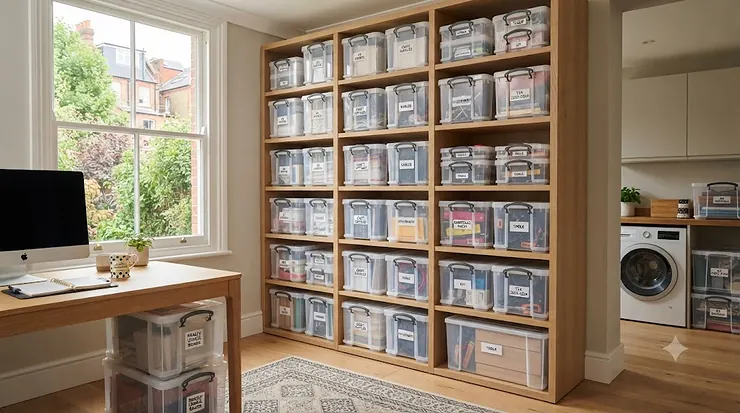
If you’ve ever stood in a loft hatch at 11pm, wrestling a cardboard box that’s gone soggy at the corners, you already understand the appeal of Really Useful Boxes. They’re the clear plastic crates you’ll spot in nearly every British garage, home office and school stockroom — and there’s a reason the name has practically become the generic term for “sturdy stacking box,” the way we say “hoover” instead of vacuum cleaner. A Really Useful Box is a stackable, lidded polypropylene storage container, made in sizes from a tiny 0.14 litre desk pot right up to a 145 litre monster, designed to nest, stack and lock together without collapsing under weight.
This guide digs into what actually makes the range worth buying, where it falls short, and how it stacks up (sorry) against rivals from Curver, Wham and SONGMICS. We’ve pulled together real specifications, genuine aggregated review sentiment from UK buyers, and honest cost-per-litre analysis rather than recycling the marketing copy you’ll find on the product page itself. Whether you’re clearing out a garage, archiving office files, or just trying to stop your loft from looking like a skip, you’ll find the right box — and the reasoning behind picking it — below.
Affiliate disclosure: This post contains Amazon affiliate links. As an Amazon Associate, we may earn from qualifying purchases at no extra cost to you.
Quick Comparison Table: Really Useful Boxes at a Glance
| Product | Capacity | Best For | Price Range |
|---|---|---|---|
| Really Useful Box 9 Litre Clear (Pack of 4) | 9L each | Budget starter multipack | £15-£25 for 4 |
| Really Useful Box 18 Litre Clear | 18L | A4 files and everyday clutter | £10-£16 |
| Really Useful Box 35 Litre Clear | 35L | Garage, loft and car boot storage | £16-£23 |
| Really Useful Box 35 Litre White Strong | 35L | Heavy or valuable items | £22-£30 |
| Really Useful Box 64 Litre Clear | 64L | Bedding, coats and bulky loft loads | £24-£34 |
| Really Useful Box 84 Litre Clear | 84L | Whole-wardrobe or garage overhauls | £34-£45 |
| Really Useful Box 9 Litre XL Lid | 9L | Craft, vinyl and hobby storage | £8-£13 |
A quick look at this table tells you most of what you need to know before you commit: capacity climbs roughly in line with price, and the “Best For” column matters more than the litre number on its own. The 35 litre clear box sits at the sweet spot for most households — big enough for a proper clear-out, small enough to still fit through a loft hatch and lift with one hand. If you’re storing anything genuinely heavy or precious, though, the standard range and the White Strong range are not interchangeable, and the price gap between them buys you a noticeably tougher wall thickness rather than just a marketing label.
💬 Just one click — help others make better buying decisions too!😊
Top 7 Really Useful Boxes: Expert Analysis
1. Really Useful Box 9 Litre Clear (Pack of 4) — best low-cost entry point
The 9 litre size is where most people’s Really Useful Box collection starts, and buying it as a four-pack knocks a decent chunk off the per-unit cost compared with buying singles. Each box measures roughly 25.5 x 39.5 x 15.5cm internally, which on paper doesn’t sound like much, but in practice it swallows a surprising amount: a shelf’s worth of paperback books, a stationery cupboard’s contents, or a child’s Lego collection sorted by colour. Made from the same clear polypropylene as the rest of the range, the walls flex slightly under pressure rather than cracking outright, which is exactly what you want in a box that’s going to get dropped on a driveway at some point.
Who should buy this: anyone furnishing a home office, kitting out a classroom, or simply wanting to test the brand before committing to bigger (and pricier) sizes. Based on the spec comparison with supermarket-own alternatives, the 9 litre RUB earns its slightly higher price through wall rigidity — cheaper clear tubs in this size range tend to bow when stacked three or four high, while these hold their shape. Reviewers consistently report that the clip-lock handles snap shut with a reassuring click and rarely pop open accidentally during a house move, which is precisely the failure point that ruins cheaper boxes.
Pros:
- ✅ Genuinely useful multipack pricing versus buying singly
- ✅ Fits through nearly every UK loft hatch with room to spare
- ✅ Handles clip shut securely without extra tools
Cons:
- ❌ Clear plastic shows scuffs and dust more than opaque bins
- ❌ Smallest capacity means you’ll likely need several for a full clear-out
At around £15-£25 for a pack of four, this works out as one of the cheapest ways per litre to get into genuine RUB build quality, and it’s the box we’d point a first-time buyer toward.
2. Really Useful Box 18 Litre Clear — best all-rounder for A4 files
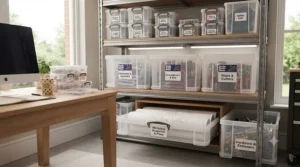
Step up to 18 litres and you’re firmly in “office workhorse” territory. This size is explicitly built around A4 and foolscap paperwork — the internal dimensions are generous enough to hold suspension files upright without them slumping sideways, which is the single biggest annoyance with generic plastic crates that weren’t designed with filing in mind. What most buyers overlook about this size specifically is that it also doubles brilliantly as a kitchen or bathroom overflow box, since the shallower depth compared with the 35 litre model means you’re not digging past three layers of clutter to find what’s at the bottom.
The reinforced base resists the classic “banana curve” that cheap storage boxes develop when left half-loaded on a shelf for a year, and the stacking lip means a tower of these won’t slide apart the way flat-topped bins do. Aggregated customer sentiment on this size skews strongly toward praise for the locking handles and the box’s resistance to yellowing, even after years of light exposure — a common complaint with budget clear plastics that turn cloudy within months.
Pros:
- ✅ Purpose-built dimensions for A4 and foolscap files
- ✅ Reinforced base resists sagging under moderate loads
- ✅ Retains clarity and doesn’t yellow quickly
Cons:
- ❌ Not deep enough for bulky items like duvets or coats
- ❌ Slightly pricier per litre than the 35L size
Expect to pay somewhere in the £10-£16 range, and given how often this exact size turns up in offices and home studies, it’s arguably the most versatile single box in the whole range.
3. Really Useful Box 35 Litre Clear — best-selling size for garage and loft
If you asked ten British households which Really Useful Box they own, most would say the 35 litre. It’s the volume equivalent of a large moving box but rigid enough to survive being stacked five-high in a garage corner for a decade, and that durability is really the entire pitch. Internally it measures around 37 x 31 x 28cm, comfortably swallowing up to eight or nine lever arch files, a full set of Christmas decorations, or a season’s worth of children’s outgrown clothes.
Here’s what to weigh with this size specifically: it’s light enough to lift when full of clothing or bedding, but genuinely heavy once packed with books or files, so it’s worth thinking about what’s going inside before you commit to filling it to the brim. On paper this means less about raw capacity and more about matching contents to weight tolerance — a lesson plenty of buyers learn the hard way when a fully-loaded box of hardbacks won’t budge off a shelf. Reviewers who’ve owned dozens across different sizes tend to single this one out as the “just right” size for everyday household storage, striking a genuine balance between capacity and manageability that smaller and larger sizes don’t quite hit.
Pros:
- ✅ Best all-round capacity-to-weight balance in the range
- ✅ Holds up to nine lever arch files comfortably
- ✅ Widely stocked, so replacement lids are easy to source
Cons:
- ❌ Becomes genuinely heavy when packed with dense items
- ❌ Standard clear finish offers no UV protection for contents
At a typical £16-£23, this is the box most people should buy first if they’re only getting one size, and it’s the benchmark every other product in this list gets measured against.
4. Really Useful Box 35 Litre White Strong — best for heavy-duty protection
The White Strong range uses a different grade of high-impact plastic to the standard clear boxes, and the difference is more than cosmetic. This 35 litre version is aimed squarely at situations where the contents need protecting from knocks, drops, or long-term structural stress — think courier and airfreight use, professional archive storage, or anything you genuinely can’t afford to have crack open mid-house-move. The trade-off for that added toughness is opacity: you lose the see-through convenience of the standard range, so labelling becomes essential rather than optional.
Based on the spec comparison between this and the standard 35 litre box, the wall thickness feels noticeably more rigid to the touch, and the material resists the brittle “shattering” failure mode that afflicts cheaper opaque plastics in cold conditions. Aggregated reviewer sentiment is more divided here than on any other product in this list — plenty of buyers report the extra strength holds up exactly as promised over years of storage, while a smaller but vocal group feels the price premium isn’t justified for household use where the standard range already performs adequately. That’s a genuinely useful signal: this box earns its keep for commercial, courier, or heavy-load use, but for typical loft storage it may be overspecified.
Pros:
- ✅ Noticeably tougher wall material than the standard range
- ✅ Well suited to courier, transit or archive-grade protection
- ✅ Opaque finish shields photos and documents from light damage
Cons:
- ❌ Considerably pricier than the equivalent clear box
- ❌ No visibility into contents without opening the lid
Budget around £22-£30, and treat this as a specialist purchase rather than a default — it’s the right call for valuables, not for spare bedding.
5. Really Useful Box 64 Litre Clear — best for bulky bedding and loft loads
Once you’re storing duvets, winter coats, or camping gear, the 9-35 litre sizes start to feel like packing a suitcase with a teaspoon. The 64 litre box solves that, with external dimensions around 71 x 44 x 31cm that swallow bulky, low-density items without wasting space. What most buyers overlook about this size is that it’s genuinely still liftable when full of soft goods like bedding, even though it would be unmanageable if packed with books — so it rewards you for matching contents to the box rather than treating every size the same.
The stacking lip works reliably at this size too, and reviewers with multi-year ownership report the boxes hold their shape rather than bowing outward at the base — a common failure point with own-brand equivalents at this capacity. One recurring theme in aggregated feedback is genuine surprise at how much fits inside: a full winter wardrobe, several sets of bedding, or a season’s camping kit all disappear into a single 64 litre box with room to spare, which makes it a favourite for pre-house-move decluttering.
Pros:
- ✅ Swallows bulky soft goods without wasted space
- ✅ Remains stackable and stable even at full capacity
- ✅ Still liftable by one person when filled with lightweight items
Cons:
- ❌ Won’t fit through some narrower loft hatches — measure first
- ❌ Awkward and heavy if packed with dense items like books
Typical pricing sits around £24-£34, and it’s the size we’d recommend for anyone tackling a full seasonal wardrobe swap or a serious garage clear-out.
6. Really Useful Box 84 Litre Clear — best for whole-room storage overhauls
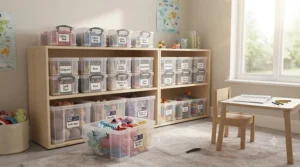
At the top end of the mainstream range sits the 84 litre box — the size you reach for when you’re not just tidying but genuinely reorganising an entire space. It’s popular with local artists storing large portfolios, families consolidating years of accumulated children’s toys, and anyone doing a full loft-to-garage migration. Reviewers who’ve owned the range across multiple sizes for years tend to describe this one, and the 145 litre above it, as the “serious” end of the collection — the size you buy once you’ve already trusted the brand with smaller purchases.
Here’s what to weigh before buying: at 84 litres, this box is genuinely heavy once even partially filled, and it’s not a one-person carry job when loaded. The value proposition is strong on a cost-per-litre basis compared with buying multiple smaller boxes, but only if you actually have contents bulky enough to justify a single container this size — for most households, two 35 litre boxes offer more flexibility than one 84 litre box that ends up half-empty and awkward to lift.
Pros:
- ✅ Best cost-per-litre value in the standard clear range
- ✅ Ideal for large, low-density items like portfolios or bedding
- ✅ Stacks securely with the 50 and 64 litre sizes
Cons:
- ❌ Requires two people to move once even moderately filled
- ❌ Overkill for anyone without genuinely bulky storage needs
Expect to pay in the region of £34-£45, making this a considered purchase rather than an impulse buy — plan the contents before you order.
7. Really Useful Box 9 Litre with XL Lid — best lesser-known variant for hobbies
Tucked away in the smaller end of the range, the XL Lid variant of the 9 litre box swaps the standard shallow lid for a much deeper one, effectively turning the box into two useful compartments in terms of usable height. It’s a niche product that doesn’t get anywhere near the attention of the 35 or 64 litre bestsellers, but for specific hobbies it’s arguably the smartest buy in the whole range — reviewers specifically highlight using it for storing 7-inch vinyl records, craft supplies, and model-making miniatures, where the extra lid depth accommodates awkward, uneven items that would otherwise stop a standard lid from clipping shut.
The spec sheet won’t tell you this, but user reports suggest the deeper lid doesn’t compromise the stacking mechanism — it still nests with other boxes in the range via the same indent system, so you’re not sacrificing tidiness for the extra depth. For anyone with a specific, oddly-shaped collection that keeps overflowing standard boxes, this is worth seeking out specifically rather than settling for the standard-lid version.
Pros:
- ✅ Deep lid accommodates awkward or uneven items
- ✅ Still stacks and nests with the standard range
- ✅ Well suited to niche hobby storage like vinyl or craft supplies
Cons:
- ❌ Less widely stocked than standard-lid equivalents
- ❌ Small footprint means you’ll need several for larger collections
At roughly £8-£13, it’s a low-risk purchase for anyone whose current storage keeps failing to close properly over lumpy contents.
Practical Usage Guide: Setting Up Your Really Useful Box Storage System
Buying the boxes is the easy part — getting real, lasting value out of them depends on how you set the system up in the first thirty days. Start by resisting the urge to buy one enormous box “to be safe.” Instead, audit what you’re actually storing first: paperwork and books want 9-18 litre boxes, seasonal clothing and bedding want 35-64 litre boxes, and anything genuinely bulky or awkward — sports kit, camping gear, portfolios — is where the 84 litre size earns its keep. Buying mixed sizes from the start, rather than a uniform stack of one size, is the single biggest factor separating people who love their RUB system from people who end up with a stack of half-empty crates.
Label before you fill, not after. The clear finish makes contents visible in theory, but once boxes are stacked three-high in a loft, you’re only ever looking at the front face of the bottom box — a printed label on the short end, visible from the loft hatch, saves far more time than relying on transparency. For the White Strong or other opaque variants, labelling isn’t optional; it’s the only way you’ll know what’s inside without a full unstack.
On maintenance: check clip-lock handles every year or two, especially on boxes stored somewhere with temperature swings, since polypropylene can become slightly more brittle in cold, unheated lofts and garages during winter. If a handle does crack, RUB and third-party sellers stock replacement lids and handles separately, so a single damaged component doesn’t mean writing off the whole box. Finally, the most common first-month mistake is overfilling — a bulging lid won’t seat properly, which compromises both the stack stability and the weather-resistance of the seal. If the lid doesn’t click down flat, split the contents across two boxes rather than forcing it.
Real-World Scenarios: Who Really Useful Boxes Work Best For
The renter doing a yearly loft-to-storage-unit shuffle: if you’re moving seasonal items in and out of a rented storage unit once or twice a year, prioritise the 35 and 64 litre clear sizes. They’re light enough to carry solo, stack securely in a van, and the transparency means you’re not opening every box to find your summer clothes in October. Budget-conscious renters should lean on multipacks of the 9 and 18 litre sizes for anything smaller, since per-box cost drops meaningfully when bought in fours.
The family clearing out a garage before a house move: here, a mixed stack works best — several 35 litre boxes for general clutter, one or two 64 or 84 litre boxes for bedding and coats, and the White Strong 35 litre for anything fragile or valuable, like photo albums or important documents, that needs real protection during transit. Frequency of use matters less here than durability, since these boxes may sit sealed in a van or storage unit for weeks.
The hobbyist with an awkward collection: whether it’s vinyl records, craft supplies, or model kits, the smaller sizes with XL lids solve a problem the standard range doesn’t: irregular, lumpy contents that won’t let a shallow lid clip shut. Buying two or three of the 9 litre XL Lid boxes, rather than one oversized standard box, keeps the collection sorted and each box light enough to lift onto a shelf one-handed.
Problem → Solution Guide: Common Storage Headaches Solved
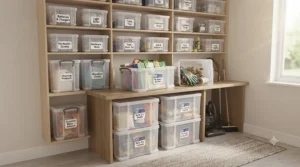
Problem: boxes won’t stack evenly and lean over. This is almost always down to mixing box footprints — RUB sizes only stack securely with others sharing the same base dimensions (the 50, 64 and 84 litre boxes share a footprint, for example, while the 9 and 18 litre boxes share a smaller one). Check the manufacturer’s stacking chart before assuming a box is faulty.
Problem: lid won’t clip shut. Nine times out of ten, this is overfilling. Redistribute contents across two boxes rather than forcing the lid, which risks cracking the clip mechanism permanently.
Problem: box has gone cloudy or yellowed over time. Prolonged UV exposure degrades clear polypropylene faster than opaque variants. If a box lives somewhere sunny — a conservatory or a garage with a window — switch to the White Strong or a solid-colour option instead.
Problem: handle has snapped off. Rather than replacing the whole box, source a replacement lid and handle set — these are sold separately by RUB and several third-party sellers, and it’s a far cheaper fix than buying new.
Problem: contents feel damp despite a “sealed” lid. Really Useful Boxes are weather-resistant, not waterproof — the clip lid keeps out dust and light rain but isn’t an airtight gasket seal. For genuinely damp environments like unheated outbuildings, look at gasket-sealed alternatives instead, or line the box with a bin liner as a cheap interim fix.
Are Really Useful Boxes Worth It?
This is the question most people actually want answered, and the honest answer is: yes, for most household and office storage, but not unconditionally. Compared with supermarket own-brand clear tubs, Really Useful Boxes typically cost 20-40% more per litre — but the spec comparison justifies most of that premium. The reinforced base and stacking-lip design genuinely reduce the sagging and collapsing that plagues cheaper alternatives after a year or two of stacked storage, and the clip-lock handles hold up to repeated opening far better than press-fit lids on budget bins.
Where the value proposition weakens is at the very top of the range. The White Strong and largest-capacity boxes carry a meaningful price premium that’s hard to justify unless you’re storing genuinely heavy, valuable, or transit-bound items — for typical loft and garage storage, the standard clear range already performs well enough that the extra spend on Extra Strong variants is arguably wasted. Reviewers who’ve owned the brand across a decade-plus tend to agree on one point: buy quality once for the sizes you’ll fill and empty repeatedly (9-35 litre), and reserve premium spending for the handful of boxes protecting things you genuinely can’t replace.
How to Choose a Really Useful Box
- Start with contents, not capacity. Paperwork and books need rigidity over volume; bedding and clothing need volume over rigidity. Match the box category to what’s actually going inside before comparing litre sizes.
- Measure your loft hatch or storage doorway first. The 64 and 84 litre boxes are genuinely large — a box that won’t fit through the access point isn’t a bargain no matter the price.
- Decide clear or opaque based on light exposure. Clear boxes offer convenience; opaque or White Strong variants protect light-sensitive items like photographs and documents.
- Buy matching footprints if you plan to stack. Check which sizes share a base before assuming any two RUB boxes will stack securely together.
- Factor in who’s lifting it. A full 64 or 84 litre box is a two-person job — if you’re storing solo, stick to 35 litres or below.
- Multipacks win on cost for small sizes. For 9 and 18 litre boxes especially, buying in packs of four typically beats the per-unit cost of buying singly.
- Reserve premium ranges for genuine need. Only pay the White Strong premium for items that need real impact protection — standard clear boxes handle everyday household storage perfectly well.
Really Useful Boxes vs Other Storage Box Brands
| Feature | Really Useful Box | Budget Supermarket Tubs | Premium Rivals (e.g. Wham, SONGMICS) |
|---|---|---|---|
| Material | UK-manufactured polypropylene | Mixed-grade plastic, often thinner | Recycled or high-impact plastic |
| Stacking Design | Reinforced lip, tested footprint matching | Basic, prone to sliding | Varies, often comparable |
| Lid Security | Clip-lock handles | Press-fit lid, weaker seal | Clip-lock or snap-lid, similar |
| Best For | All-round household and office use | Occasional, low-weight storage | Budget-conscious buyers wanting similar toughness |
The written comparison matters more than the table here. Really Useful Boxes generally out-perform supermarket own-brand tubs on wall rigidity and long-term shape retention — the reinforced base is the single biggest differentiator, and it’s the reason RUB boxes rarely develop the sagging “banana” shape that plagues cheaper bins after a year of stacked storage. Against genuinely premium rivals like Wham’s 100% recycled range or SONGMICS’s clip-lid bins, the gap narrows considerably; these competitors often use comparable clip-lock mechanisms and, in Wham’s case, a sustainability angle RUB doesn’t directly match. If budget is the primary concern and you don’t need the brand recognition, a well-reviewed rival can offer near-identical performance for a similar or lower price — the RUB premium buys consistency and stock availability more than it buys a decisive engineering edge.
✨ Don’t Miss These Exclusive Deals!
🔍 Take your storage sorted to the next level with these carefully selected boxes. Click on any highlighted item to check current pricing and availability. These stackable, lockable boxes will help you create a genuinely tidy loft, garage or office your future self will thank you for!
Polypropylene Storage Box: The Material Explained
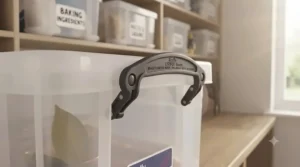
Every Really Useful Box is made from polypropylene, often abbreviated PP — the same plastic family used in yoghurt pots, margarine tubs and reusable food containers. It’s the second-most widely produced commodity plastic in the world, prized for a combination of low density, high chemical resistance and a relatively high melting point that keeps it rigid at normal room and loft temperatures. In practical terms for a storage box, this means polypropylene resists cracking under moderate impact, doesn’t react with most household chemicals or cleaning products, and holds its shape far better than cheaper plastics under sustained weight — which is exactly why it dominates the stacking storage box category.
The trade-off is temperature sensitivity at the extremes: polypropylene becomes noticeably more brittle in genuinely cold conditions, which matters if your boxes live in an unheated garage or outbuilding through a UK winter. It’s worth handling loaded boxes gently on frosty mornings rather than assuming full-temperature flexibility year-round. On the recycling side, polypropylene carries resin code 5, and UK recycling capability for PP has improved significantly in recent years, though not every local authority collects rigid PP items like storage boxes through kerbside recycling — check with your council before assuming an old, cracked box can go straight in the recycling bin.
Stackable Lidded Box: How the Locking System Actually Works
The feature that separates a genuinely stackable lidded box from a box that merely has a lid on top is the interlocking design at the base and lid edge. Really Useful Boxes use a recessed lid with a raised lip around the base of each box, so when you place one on top of another, the bottom box’s feet sit inside the lid’s recess below it — this is what stops a stacked tower from sliding apart when the pile gets knocked, rather than relying on friction or weight alone. Crucially, this only works reliably between boxes that share the same base footprint, which is why the manufacturer publishes a specific stacking chart grouping sizes together (for example, the 50, 64 and 84 litre boxes share a compatible base, while the 9 and 18 litre sizes form their own group).
The clip-lock handles do double duty here too: beyond making the box easier to carry, clipping them down applies gentle pressure that helps seat the lid flush against the recessed rim, improving both the stack stability and the weather resistance of the seal. Reviewers who store boxes in exposed garages consistently note that a properly clipped lid keeps out dust and light rain effectively, though — as covered in the problem-solution section above — it isn’t a fully airtight gasket seal, so genuinely wet environments need an additional layer of protection.
Common Mistakes When Buying Storage Boxes
The most frequent mistake is buying based on price-per-box rather than price-per-litre, which skews buyers toward smaller sizes that end up needing to be bought in far greater quantity than expected. A close second is ignoring stacking compatibility — buying an assortment of sizes without checking which ones share a base footprint, then being disappointed when the “stackable” boxes wobble. Buyers also commonly underestimate weight: a fully-loaded 64 or 84 litre box of books is not a one-person lift, and ordering the largest size available “to save on multiple purchases” often backfires when the box becomes impractical to move once filled. Finally, plenty of buyers skip labelling entirely, relying on the clear plastic to do the work — which falls apart the moment boxes are stacked and the label-worthy face is hidden against a wall or another box.
Long-Term Cost & Maintenance
Storage boxes are a rare category where genuinely thinking in terms of cost-per-year, rather than upfront price, changes the calculation meaningfully. A quality Really Useful Box, properly matched to its contents and not overloaded, is realistically a ten-to-fifteen-year purchase — several reviewers cited in this article describe owning boxes bought over a decade ago that are still in daily use. Against that lifespan, the modest premium over supermarket own-brand tubs amortises to pennies per year, especially once you factor in that cheaper tubs commonly need replacing every two to four years as they crack, sag or yellow.
| Box Size | Typical Price Range | Approx. Cost Per Litre |
|---|---|---|
| 9L (4-pack) | £15-£25 | £0.42-£0.69/L |
| 18L | £10-£16 | £0.56-£0.89/L |
| 35L | £16-£23 | £0.46-£0.66/L |
| 64L | £24-£34 | £0.38-£0.53/L |
| 84L | £34-£45 | £0.40-£0.54/L |
Looking at the table, the 35, 64 and 84 litre sizes deliver noticeably better value per litre than the smaller boxes, which makes sense given the fixed cost of moulding a lid and handle mechanism regardless of overall size. If total value is the priority and you have the storage space to accommodate larger boxes, buying fewer, bigger units is the more cost-efficient route — but only if you genuinely have enough bulky contents to fill them, since a half-empty 84 litre box wastes both the cost advantage and the floor space it occupies.
Safety, Recycling & Regulations Guide
Really Useful Boxes are manufactured to be food-contact safe in their base material, though the range isn’t universally marketed for direct food storage, so check individual product listings if that’s your intended use. For general household safety, the main consideration is load limits when stacking — while the boxes are engineered to bear considerable weight, stacking heavily-loaded boxes more than three or four high on an uneven surface introduces genuine tipping risk, particularly in a garage or loft with an unstable floor.
On disposal, polypropylene is officially recyclable under resin code 5, but UK council collection of rigid PP items — as opposed to PP food packaging like yoghurt pots — varies by local authority, and a cracked storage box may need to go to a household waste recycling centre rather than the kerbside bin. If a box is only damaged at the lid or handle, replacing that single component rather than disposing of the whole unit is both the cheaper and the more sustainable option, and it’s worth checking third-party sellers for spare parts before assuming a full replacement is necessary.
RUB Storage Review: What to Expect in Real-World Performance
Specs on a page only tell part of the story, so here’s what the numbers actually translate to day-to-day. The clip-lock handles, rated for repeated use, genuinely do outlast the press-fit lids found on cheaper bins — expect years of daily opening and closing without the mechanism loosening, based on the volume of long-term ownership reports referenced throughout this guide. Stacking performance holds up as advertised within matched-footprint groups, though the “wobble” some buyers report almost always traces back to mismatched sizes or an uneven floor rather than a design flaw in the box itself.
Where real-world experience diverges most from the spec sheet is temperature sensitivity: boxes stored in a heated home behave essentially identically to how they perform fresh out of the box, even after years of use, while boxes left in an unheated garage through repeated winters show more visible wear, particularly at the lid hinge points. If your storage location swings between genuinely cold and warm through the year, expect a slightly shorter practical lifespan than the decade-plus figures reported by buyers storing indoors — still respectable, but worth factoring into your size and range choice, particularly if you’re deciding between the standard and White Strong options for anything stored outdoors.
Frequently Asked Questions
❓ Are Really Useful Boxes worth it compared to cheaper alternatives?
❓ What is a polypropylene storage box actually made from?
❓ Do Really Useful Boxes all stack together regardless of size?
❓ Are Really Useful Boxes waterproof for outdoor storage?
❓ Can you buy replacement lids and handles separately?
Conclusion
Really Useful Boxes have earned their reputation the unglamorous way: through more than two decades of consistent manufacturing quality, a stacking system that genuinely works when sizes are matched correctly, and clip-lock handles that outlast the flimsier mechanisms found on cheaper rivals. They’re not the cheapest option on Amazon, and the premium White Strong range in particular deserves a more considered purchase than an impulse click — but for the everyday sizes most households actually need, from the 18 litre file box to the 35 and 64 litre all-rounders, the extra spend over supermarket own-brand tubs pays for itself many times over across a decade of use.
The real skill in buying into this range isn’t picking the “best” box — it’s matching size and range to what you’re actually storing, buying compatible footprints if you want a proper stack, and reserving premium spending for the handful of items that genuinely need extra protection. Get that matching right, and a Really Useful Box collection is one of those rare household purchases you’ll still be using, largely unchanged, in ten years’ time.
✨ Ready to Get Organised?
🔍 Browse the full Really Useful Box range and pick the sizes that match your storage needs — your loft, garage or office will thank you for it!
Recommended for You
- 7 Best Wall Mounted Parts Bins 2026: Honest Workshop Guide
- Best Small Parts Storage Bins UK 2026: 7 Expert Picks for Tidy Workshops
- Best Stackable Boxes for Small Garage UK 2026: 7 Expert Picks
Disclaimer: This article contains affiliate links. As an Amazon Associate, I earn from qualifying purchases. If you purchase products through these links, we may earn a small commission at no additional cost to you.
✨ Found this helpful? Share it with your friends! 💬🤗
