
In This Article
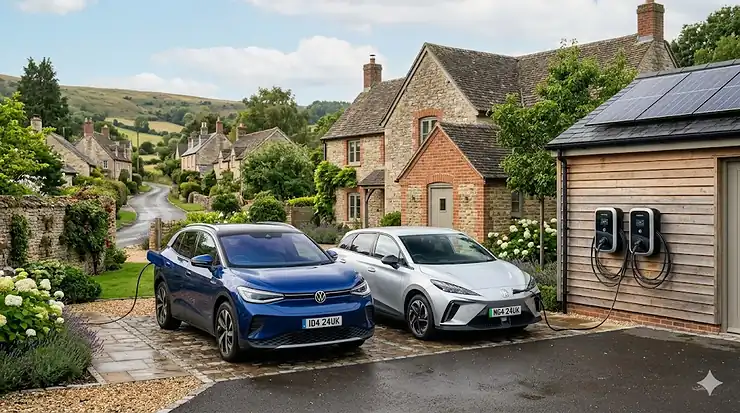
Picture this: You’ve just pulled into your driveway after a long day, your partner arrives moments later in their electric vehicle, and you both need a full charge by morning. Sound familiar? You’re not alone. With over 1.5 million electric vehicles now on UK roads and multi-car households on the rise, the demand for efficient EV charger for dual parking solutions has never been more critical.
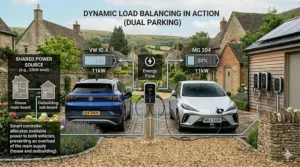
The traditional “one car, one charger” approach simply doesn’t cut it anymore for households juggling two EVs, especially when installation costs can exceed £1,000 per unit. But here’s the good news: dual-port EV chargers allow simultaneous charging of two vehicles by splitting available power, typically providing around 3.5kW to each vehicle from a standard 7kW system. This means you can future-proof your home without breaking the bank or overloading your electrical system.
Whether you’re managing a two-car family, preparing for a second EV, or simply want flexibility for guests and future vehicle changes, this comprehensive guide unpacks everything you need to know about EV charger for dual parking in 2026.
Quick Comparison Table: Top EV Chargers for Dual Parking
| Product | Type | Power Output | Key Feature | Price (GBP) | Rating |
|---|---|---|---|---|---|
| evec EDC01 | Dual Socket | 7.4kW (split) | Type 2 + Universal socket | £599-£799 | 4.5/5 |
| myenergi Zappi | Untethered | 7kW-22kW | Solar integration | £599-£779 | 4.6/5 |
| Ohme Home Pro | Tethered | 7.4kW | Smart tariff integration | £999-£1,126 | 4.7/5 |
| Easee One | Tethered/Untethered | 7.4kW | 3 chargers on 1 fuse | £918-£999 | 4.8/5 |
| Pod Point Solo 3S | Tethered/Untethered | 7.4kW | 5-year warranty | £999 installed | 4.4/5 |
| Project EV 22kW Dual | Floor Standing | 22kW per socket | Commercial grade | £1,500-£2,200 | 4.2/5 |
| NeoCharge Smart Splitter | Smart Adapter | 40A (split) | Sequential charging | £350-£450 | 4.1/5 |
💬 Just one click – help others make better buying decisions too! 😊
✨ Don’t Miss These Exclusive Deals!
🔍 Take your dual EV charging to the next level with these carefully selected products. Click on any highlighted item to check current pricing and availability on Amazon.co.uk. These tools will help you create authentic charging solutions your household will love!
Top 7 EV Charger for Dual Parking: Expert Analysis
1. evec EDC01 Dual EV Charger – Best True Dual Socket Solution
The evec EDC01 stands out as the most affordable dual charger in the UK, offering genuine dual-parking capability without compromise. This innovative unit features both a Type 2 tethered cable and a universal socket, providing unparalleled flexibility.
Key Specifications:
- Power: 7.4kW total output (split between vehicles when both charging)
- Connectivity: Wi-Fi enabled with mobile app control
- Safety: CE and UKCA-approved with built-in PEN protection
- Warranty: 3-year manufacturer’s warranty
Customer Feedback: UK buyers consistently praise the EDC01’s intelligent power distribution. One verified purchaser noted: “When just one car is plugged in, it gets the full 7.4kW. When both cars charge overnight, they each get around 3.7kW, which is perfect for our daily commute needs.”
✅ Pros:
- Most cost-effective dual charging solution in the UK
- Automatic power distribution between vehicles
- Compatible with all EV types (Type 1 & Type 2)
❌ Cons:
- Slower charging when both vehicles connected simultaneously
- Requires professional installation
Price Range: £599-£799 (unit only, installation extra)
2. myenergi Zappi – Best for Solar Panel Owners
For households with solar panels or renewable energy aspirations, the myenergi Zappi reigns supreme. This UK-manufactured charger offers three distinct charging modes: Fast (full grid power), Eco (blend of solar and grid), and Eco+ (100% surplus solar only).
Key Specifications:
- Power: 7kW or 22kW options available
- Solar integration: Industry-leading Eco+ mode
- Connectivity: Built-in WiFi with myenergi app
- Design: Available in black/grey or white/grey
According to recent UK market data, the Myenergi Zappi reaches £1,100–£1,500 with solar integration, but the investment pays dividends through free solar charging.
Customer Feedback: “The Zappi has transformed our energy bills,” reports a Surrey-based owner. “On sunny days, we charge both cars completely free using excess solar generation. The app makes it incredibly easy to monitor and schedule.”
✅ Pros:
- Exceptional solar diversion capabilities
- UK-manufactured quality
- Works with multiple energy tariffs
- No earth rod required
❌ Cons:
- Higher upfront cost compared to basic chargers
- 3-year warranty (some competitors offer 5 years)
Price Range: £599-£779 (unit only) | £1,100-£1,500 (installed with solar integration)
3. Ohme Home Pro – Best Smart Tariff Integration
The Ohme Home Pro excels at intelligent charging automation. From £999 including standard installation and a 3 year warranty, this charger connects directly to your electricity tariff and automatically schedules charging during off-peak hours.
Key Specifications:
- Power: 7.4kW output
- Display: Colour LCD screen
- Connectivity: Built-in 3G/4G SIM (no WiFi required)
- Cable: 5m or 8m tethered options
The Ohme’s killer feature is its seamless integration with popular UK tariffs like Octopus Intelligent Go and OVO Charge Anytime. Some customers report being paid to charge during negative pricing periods!
Customer Feedback: “The Ohme charger syncs perfectly with Octopus Intelligent,” shares a London-based user. “Two nights ago, I was actually paid by Octopus to charge the car during a wind energy surplus. The app makes everything effortless.”
✅ Pros:
- Automatic tariff integration saves hundreds annually
- Solar Boost mode for panel owners
- Intuitive LCD screen and app
- No WiFi dependency
❌ Cons:
- Tethered only (no untethered option)
- Cable holder could be more robust
Price Range: £999-£1,126 (fully installed)
4. Easee One – Most Flexible Installation
The Norwegian-designed Easee One offers remarkable versatility: it works as both tethered and untethered from the same unit, and uniquely allows up to three chargers on a single 32A fuse.
Key Specifications:
- Power: 7.4kW (upgradeable to 22kW via software)
- Dimensions: Compact 253mm × 193mm × 106mm
- Connectivity: Lifetime 4G eSIM + WiFi + Bluetooth
- Colours: Five options (black, white, anthracite, red, blue)
Unit-only prices range from £405 to £630 across four major UK retailers, with installation typically adding £400–£600.
Customer Feedback: “The Easee’s three-on-one-fuse capability is brilliant,” explains a Manchester installer. “For families planning future EV purchases, this is the most cost-effective way to prepare without rewiring.”
✅ Pros:
- Tethered/untethered flexibility via app-controlled cable lock
- Can power three chargers from one circuit
- Incredibly compact and stylish
- Built-in PEN protection saves installation costs
❌ Cons:
- No native solar diversion (requires separate Equalizer accessory £125)
- Doesn’t support Octopus Intelligent Go directly
Price Range: £918-£999 (installed) | £405-£630 (unit only)
5. Pod Point Solo 3S – Longest Warranty Protection
Pod Point brings 15 years of UK EV charging experience to the Solo 3S, backed by an industry-leading 5-year warranty. Priced from £999 (installed), with a 5 years warranty, this charger combines reliability with comprehensive support.
Key Specifications:
- Power: 7.4kW Type 2
- Weight: 3.5kg (untethered) | 6kg (tethered)
- Protection: IP54 weather rating, IK10 impact rating
- Solar: Integrated solar mode
The Solo 3S offers two purchase paths: outright at £999 or via Pod Drive subscription at £40/monthly with cashback rewards.
Customer Feedback: “Pod Point’s installation service was flawless,” reports a Bristol homeowner. “The Which? endorsement gave me confidence, and the 5-year warranty is unbeatable. The solar integration works perfectly on cloudy days too.”
✅ Pros:
- Industry-leading 5-year warranty
- Which?-endorsed installation service
- Excellent solar integration
- Pod Drive subscription option available
❌ Cons:
- Bulkier design than some competitors
- Subscription model may not suit everyone
Price Range: £999 (installed outright) | £40/month (Pod Drive subscription)
6. Project EV 22kW Pro Dual Floor Charger – Commercial-Grade Solution
For businesses or households with three-phase power supply, the Project EV 22kW dual charger delivers professional-grade performance. This three phase, 63A fixed-to-the-floor standing charger is very easy-to-use and cost effective.
Key Specifications:
- Power: 22kW maximum per socket (three-phase)
- Current: 32A per socket
- Installation: Floor-standing (no wall mounting)
- Control: RFID access, app connectivity
Customer Feedback: Business owners appreciate the monetisation potential: “We installed this between two commercial parking bays. The ability to connect to the UK charging network and charge customers per kWh has created a genuine revenue stream.”
✅ Pros:
- Professional commercial capability
- Two independent 22kW sockets
- Solar compatibility
- RFID security features
❌ Cons:
- Requires three-phase electricity supply
- Higher installation complexity and cost
- Overkill for most residential applications
Price Range: £1,500-£2,200 (unit only, professional installation required)
7. NeoCharge Smart Splitter – Budget-Friendly Sequential Solution
The NeoCharge Smart Splitter takes a different approach: rather than splitting power simultaneously, it intelligently switches between two existing chargers based on vehicle need and scheduled times.
Key Specifications:
- Compatibility: Works with two separate 7kW chargers
- Connection: NEMA 14-50 plug standard
- Control: Mobile app with scheduling
- Safety: UL Listed, automatic switching
This solution works brilliantly for households that already own one charger and want to add capacity without expensive electrical upgrades.
Customer Feedback: “The NeoCharge splitter solved our problem perfectly,” shares a Scottish homeowner. “We charge Car A from 11pm-3am, then Car B automatically switches on from 3am-7am. Both fully charged by morning, no fuss.”
✅ Pros:
- Most affordable way to add dual charging capability
- Works with existing chargers
- Automatic sequential scheduling
- No electrical panel upgrades needed
❌ Cons:
- Sequential only (not simultaneous charging)
- Requires compatible NEMA connectors
- Less common in UK market (more North American focused)
Price Range: £350-£450
Understanding EV Charger for Dual Parking: What You Need to Know
What Is Dual EV Charging?
An EV charger for dual parking refers to any charging system that enables two electric vehicles to charge from a shared electrical connection. This can be achieved through:
✅ Dual-port chargers – Single units with two independent charging points (like the evec EDC01)
✅ Load-balanced systems – Multiple chargers that communicate to share available power
✅ Untethered charge points – Universal sockets allowing different vehicles to use the same infrastructure
✅ Sequential charging systems – Smart splitters that charge vehicles one after another
According to the UK government’s Electric Vehicles (Smart Charge Points) Regulations from June 2022, all new home and workplace EV chargers must include smart functionality, which makes load balancing and scheduled charging much more accessible.
How Does Power Splitting Work?
When both vehicles charge simultaneously on a 7kW dual system:
- Each vehicle receives approximately 3.5kW
- Charging adds roughly 15-20 miles of range per hour to each car
- For most daily commutes (20-30 miles), this provides sufficient overnight charging
The average UK car travels approximately 20-30 miles daily, which requires only about 6-9 kWh of electricity. A 3.5kW charge rate delivers this in just 2-3 hours.
Single-Phase vs Three-Phase: Do You Need an Upgrade?
Most UK homes have single-phase supply (230V, up to 100A), which supports:
- One 7kW charger at full power
- Two 7kW chargers at 3.5kW each (with load balancing)
- Dedicated dual chargers up to 7.4kW total
Three-phase supply (400V) is rare in residential properties but enables:
- Multiple 7kW chargers running simultaneously at full power
- 22kW charging capability per vehicle
- Commercial-grade charging infrastructure
Before investing in a three-phase upgrade (£2,000-£5,000), consider whether sequential overnight charging meets your needs. For more details on electrical requirements, consult the UK government’s Building Regulations Approved Document S.
Key Features to Consider in Multi-Vehicle Charging
Load Balancing Technology
Modern smart chargers automatically distribute available power between vehicles and household appliances. When two EVs are connected to a dual charger or two separate smart chargers, the system monitors the total electrical load and divides it appropriately to prevent circuit overloads.
How it works:
- Charger detects total available circuit capacity
- Monitors current household electricity usage
- Allocates remaining power between connected vehicles
- Adjusts in real-time as appliances turn on/off
Untethered vs Tethered: The Flexibility Factor
Untethered chargers (socket only):
- Compatible with all EV cable types (Type 1, Type 2)
- Neater appearance when not in use
- More expensive cables required separately (£100-£200)
- Better for households with varying EV types
Tethered chargers (built-in cable):
- Instant plug-and-play convenience
- Cable included in purchase price
- Restricted to one connector type (usually Type 2)
- Requires cable management solutions
For dual parking scenarios, untethered systems offer maximum flexibility, allowing each household member to use their own cable and potentially charge different vehicle types.
Smart Tariff Integration: The Money-Saving Secret
The cleverest EV owners are slashing charging costs by 60-80% through smart tariff integration. Here’s how:
Compatible UK tariffs:
- Octopus Intelligent Go: 7p/kWh off-peak (00:30-05:30)
- Octopus Agile: Variable pricing, sometimes negative (you get paid!)
- OVO Charge Anytime: 7p/kWh off-peak
- British Gas Electric Drivers: 8.5p/kWh off-peak
Chargers like the Ohme Home Pro automatically schedule charging during these ultra-cheap windows. For a typical dual-EV household driving 20,000 miles annually, this saves £800-£1,200 compared to standard tariffs.
Installation Requirements for Dual Parking Chargers
Electrical Assessment Checklist
Before installing any EV charger for dual parking, verify:
✅ Consumer Unit Capacity – Spare circuit breaker slot available
✅ RCD Protection – Type A RCD minimum (Type B RCD for DC fault protection)
✅ Main Fuse Size – 60A minimum for single 7kW, 80-100A recommended for dual
✅ Cable Route – Under 25 metres from consumer unit to parking area
✅ Parking Type – Must be off-street and within property boundary
Residential buildings with more than 10 parking spaces must have at least one EV chargepoint per dwelling with associated parking, along with cable routes in all spaces without chargepoints, according to updated Building Regulations.
PEN Fault Protection Explained
All UK EV chargers must include protection against Protective Earth and Neutral (PEN) conductor faults. Modern chargers like the Zappi, Easee One, and Ohme have this built-in, eliminating the need for expensive earth rod installation (saving £50-£150).
Without built-in PEN protection, installers must:
- Install a separate earth rod (£100-£200)
- Run additional earth cable
- Conduct TT earthing system tests
Installation Costs Breakdown (2026 Prices)
| Item | Cost Range (GBP) |
|---|---|
| Standard single charger install | £400-£600 |
| Dual charger installation | £600-£900 |
| Consumer unit upgrade (if needed) | £200-£400 |
| Additional cable runs (per metre) | £15-£25 |
| Earth rod installation | £100-£200 |
| Three-phase conversion | £2,000-£5,000 |
Money-saving tip: As of May 2025, planning permission is no longer required for most EV charger installations across the UK, saving up to £1,100 on average.
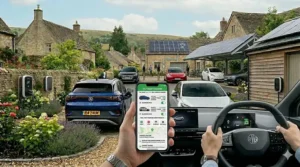
Dual Parking vs Two Separate Chargers: Cost Comparison
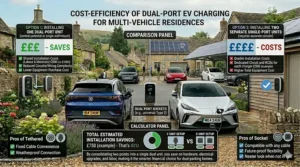
Initial Investment Analysis
Dual Charger System (e.g., evec EDC01):
- Charger unit: £599-£799
- Installation: £600-£800
- Total: £1,199-£1,599
Two Separate 7kW Chargers:
- Two charger units: £800-£1,200 (£400-£600 each)
- Dual installation: £800-£1,200
- Possible consumer unit upgrade: £200-£400
- Total: £1,800-£2,800
Savings with dual system: £600-£1,200
Long-Term Running Costs
Both systems consume similar electricity when charging equivalent amounts. The difference comes from:
Smart tariff savings (annual, dual-EV household):
- Standard tariff (24p/kWh): £3,360
- Smart off-peak tariff (7p/kWh): £980
- Annual saving: £2,380
Solar integration (with 4kW panels):
- Free daytime charging potential: 3,000-4,000 kWh/year
- Annual saving: £720-£960 (at 24p/kWh grid rates)
Space and Aesthetic Considerations
Dual chargers win for:
- Limited wall space (one unit vs two)
- Cleaner visual appearance
- Centralised cable management
- Shared parking bays or narrow driveways
Separate chargers win for:
- Garages with vehicles parked far apart
- Different charging requirements per vehicle
- Independent control and scheduling
Legal and Regulatory Compliance
UK Building Regulations Part S
Requirement S1 applies to new residential buildings where associated parking spaces are not within a covered car park and the average connection cost is less than £3,600 per charge point.
Key requirements:
- Chargepoints must have minimum 7kW output
- Smart functionality mandatory (schedule, remote control)
- Open protocol communication (OCPP 1.6 minimum)
- Randomised delay function to prevent grid spikes
Post-Installation Certification
Every EV charger installation requires:
✅ Electrical Installation Certificate (EIC or MEIWC)
✅ Building Control notification (if structural work involved)
✅ DNO notification (Distribution Network Operator) for loads >3.68kW
✅ Proof of compliance with Smart Charge Point Regulations
OZEV-approved installers handle these certifications automatically. Always verify your installer’s credentials at OZEV approved installer list.
Safety Standards and Certifications
Look for these marks on any dual parking charger:
- UKCA marking – UK Conformity Assessed (post-Brexit standard)
- CE marking – European Conformity (still accepted)
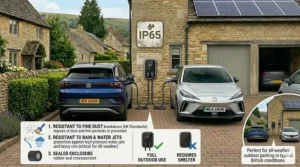
- IP54 rating – Weather protection (dust and water resistant)
- IK08-IK10 – Impact resistance rating
Charge Point Sharing Solutions
Commercial Applications
For businesses, car parks, or landlords managing multiple tenancies, charge point sharing offers revenue opportunities:
Monetisation platforms:
- Co Charger – Peer-to-peer home charger sharing network
- Monta – Commercial charge point management
- Zap-Map – Public network integration
Commercial dual chargers like the Project EV 22kW support:
- Per-kWh pricing and billing
- RFID access control
- Payment card integration
- Usage analytics and reporting
A mobile dual charger operator can generate serious income from per-kWh fees and session charges, particularly at events or underserved areas.
Residential Charge Sharing
Even home installations can participate in the shared economy:
- Register your charger on Co Charger platform
- Set your availability hours and pricing
- Earn £200-£500 annually from neighbours without home charging
- Help accelerate EV adoption in your community
Legal considerations:
- Check buildings insurance covers commercial use
- Verify with mortgage provider (if applicable)
- Ensure charger has user authentication (RFID/app)
- Keep records for tax purposes (income may be taxable)
Universal EV Cables: Making Untethered Systems Work
Why Untethered Makes Sense for Dual Parking
For households with two different EVs, untethered chargers offer unbeatable flexibility:
- Type 1 vehicles (older Nissan Leaf, some PHEVs): Use Type 1 to Type 2 cable
- Type 2 vehicles (all modern EVs): Use Type 2 to Type 2 cable
- Future-proofing: Swap cables as you change vehicles
Choosing Quality Charging Cables
Not all EV cables are created equal. Essential features:
✅ Current rating: 32A minimum (matches 7kW chargers)
✅ Cable length: 5-7 metres for dual parking flexibility
✅ Weather protection: IP65 rated connectors
✅ Certification: CE/UKCA marked
✅ Warranty: 3-year minimum
Recommended cable brands (UK):
- Top Charger Type 2 Cable: £99.99 (7m, UKCA certified, 3-year warranty)
- EzGoGo Type 2 Cable: £85-£120 (various lengths, 22kW capable)
- Voldt Type 2 Cable: £110-£150 (premium quality, carry case included)
Cable Storage and Management
Prevent cable damage and theft with proper storage:
Wall-mounted holders: £15-£30
- Keep cables off ground
- Prevent trip hazards
- Organised appearance
Lockable cases: £40-£80
- Boot storage for portable charging
- Weather protection
- Theft deterrent
Household Multi-Car Charging Strategies
Sequential Charging Schedules
For many UK households, charging vehicles one after another optimises electricity use:
Example schedule (dual-EV family):
- 22:00-01:00: Vehicle 1 charges (3 hours @ 7kW = 21 kWh)
- 01:00-04:00: Vehicle 2 charges (3 hours @ 7kW = 21 kWh)
- 04:00-05:30: Smart tariff top-up if needed
This approach:
- Uses cheaper off-peak rates fully
- Prevents load on main fuse
- Requires no electrical upgrades
- Managed automatically by smart chargers
Boost Mode vs Scheduled Charging
Modern chargers offer flexibility for unexpected needs:
Scheduled charging (typical use):
- Set departure time in app
- Charger calculates required kWh
- Charges during cheapest tariff periods
- Vehicle ready by departure time
Boost mode (emergency top-ups):
- Override schedule for immediate charging
- Delivers maximum available power
- Useful for unplanned journeys
- Activates via app or charger button
Solar Integration for Multi-Vehicle Homes
Households with solar panels can dramatically reduce grid reliance:
Typical 4kW solar system (South-facing roof):
- Generates 3,500-4,000 kWh annually
- Peak generation 10:00-16:00 (2-4kW)
- Summer surplus 8-12 kWh daily
Charging strategy:
- Workday – One vehicle charges via solar (home-based worker)
- Weekend – Both vehicles trickle-charge from solar surplus
- Night-time – Top-up from grid during off-peak (7p/kWh)
The Zappi’s Eco+ mode maximises free solar charging automatically, while the Ohme can prioritise solar when available through Solar Boost mode.
Troubleshooting Common Dual Charging Issues
Problem: Charger Not Delivering Full Power
Symptoms:
- Both vehicles charging slower than expected
- Single vehicle not reaching 7kW
Possible causes:
- Load balancing active – Check if household appliances using significant power
- Cable rating too low – Ensure cables are 32A minimum
- Vehicle limiting charge – Some EVs cap charging below maximum
Solutions:
- Schedule charging during low household usage periods
- Upgrade to higher-rated cables if needed
- Check vehicle charging settings and battery temperature
Problem: Charger Keeps Tripping RCD
Symptoms:
- Consumer unit RCD trips when charging starts
- Intermittent power loss during charging
Possible causes:
- Earth leakage – Moisture in connections or damaged cable
- Wrong RCD type – Type AC instead of Type A/B
- Overload condition – Total load exceeds circuit capacity
Solutions:
- Have qualified electrician test for earth faults
- Upgrade to Type B RCD if currently Type A
- Reduce charging current in charger settings
- Consider consumer unit upgrade
Problem: App Won’t Connect to Charger
Symptoms:
- Unable to control charger remotely
- Smart scheduling not working
Solutions:
- WiFi models: Check router signal strength, consider WiFi extender
- 4G/LTE models: Verify mobile signal coverage (Easee One, Ohme)
- Bluetooth: Ensure within 10-metre range for initial pairing
- Factory reset charger if persistent issues (consult manual)
Future-Proofing Your Dual Parking Setup
Preparing for V2G (Vehicle-to-Grid)
The next revolution in EV charging is bidirectional power flow. Select chargers already support or plan to enable:
V2G capabilities:
- Discharge vehicle battery to power home during peak tariff periods
- Sell electricity back to grid (earning potential)
- Backup power during outages
V2G-ready chargers (2026):
- Wallbox Quasar 2 (bidirectional capable)
- Indra Smart Pro V2G variant
- Easee One (software update planned)
For dual parking, V2G means using one EV as a home battery while the other charges – ultimate flexibility.
Scalability for Additional Vehicles
As EV adoption grows, you might add a third vehicle:
Expandable systems:
- Easee One: Install up to three chargers on single 32A fuse
- Project EV modular: Add capacity units as needed
- Smart splitters: Chain multiple units with coordination
Planning tip: When installing first charger, run cable rated for future upgrades (10mm² instead of 6mm²), saving hundreds in rewiring costs later.
Software Updates and Future Features
Modern chargers receive over-the-air updates:
Recent updates have added:
- New tariff integrations (Octopus Agile, etc.)
- Enhanced load balancing algorithms
- Improved solar diversion logic
- Security patches and bug fixes
Choose manufacturers with strong UK presence and active development:
- myenergi (UK-based, frequent updates)
- Ohme (UK-focused, excellent support)
- Easee (Nordic, robust update schedule)
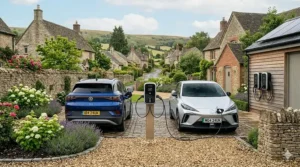
FAQ: Your Dual Parking Charging Questions Answered
❓ Can I charge two EVs simultaneously from one home charging system in the UK?
❓ What's the difference between untethered and tethered EV chargers for dual parking?
❓ Do I need planning permission to install an EV charger for dual parking?
❓ How much does it cost to install a dual EV charger in the UK in 2026?
❓ Will dual EV charging overload my home's electrical system?
Conclusion: Making the Right Choice for Your Household
Choosing an EV charger for dual parking isn’t just about buying hardware—it’s about investing in your household’s electric future. Whether you opt for the budget-friendly evec EDC01 dual socket system, the solar-savvy myenergi Zappi, the tariff-intelligent Ohme Home Pro, or the versatile Easee One, you’re taking a significant step towards sustainable, convenient multi-vehicle charging.
Key takeaways:
✅ Dual chargers save £600-£1,200 compared to installing two separate units
✅ Smart tariff integration can reduce charging costs by 60-80% annually
✅ Untethered systems offer maximum flexibility for mixed-EV households
✅ Load balancing technology prevents electrical overloads automatically
✅ Planning permission no longer required for most UK installations (2025)
For most UK households with two EVs, we recommend starting with an untethered smart charger like the Ohme Home Pro or Easee One. These provide excellent flexibility, future-proofing, and smart features that pay for themselves through tariff savings within 12-18 months.
Households with solar panels should seriously consider the myenergi Zappi—its exceptional Eco+ mode delivers genuinely free charging on sunny days, whilst maintaining excellent grid-charging capabilities for overnight top-ups.
Remember: the “best” EV charger for dual parking is the one that matches your specific electrical setup, parking arrangement, daily driving patterns, and long-term EV plans. Always consult with an OZEV-approved installer for a professional assessment before making your final decision.
Recommended for
- 7 Best Smart EV Chargers UK 2026: Save £600/Year Guide
- 7 Best Home EV Chargers UK 2026
- 7 Best Combination Ladders UK 2026
Disclaimer: This article contains affiliate links. If you purchase products through these links, we may earn a small commission at no additional cost to you. Prices shown are approximate and may vary.
✨ Found this helpful? Share it with your mates! 💬🤗
