
In This Article
If you’ve recently switched to an electric vehicle, you’ve probably realised that home charging is where the real savings happen. But here’s what many EV owners don’t discover until it’s too late: the difference between a basic charger and a smart EV charger can save you over £600 annually. That’s not marketing fluff—it’s the actual difference between charging at standard rates (around 24p/kWh) versus off-peak smart tariffs (as low as 8p/kWh from April 2026).
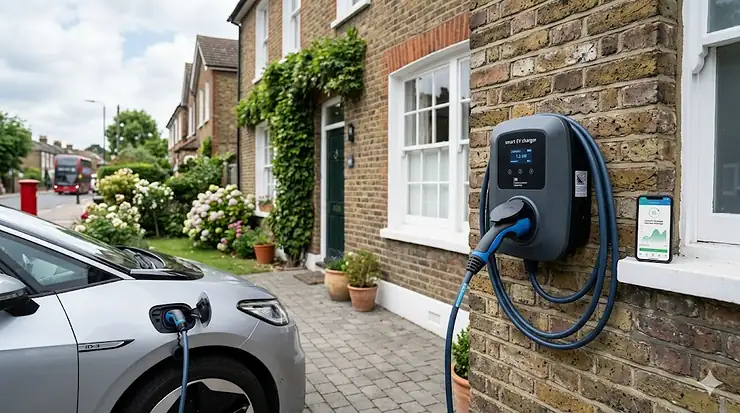
Smart EV chargers do far more than simply juice up your battery. They connect to your home WiFi or mobile network, integrate seamlessly with UK energy tariffs like Octopus Intelligent Go (which dropped to just 8p/kWh from April 2026), and automatically schedule charging when electricity is cheapest. The technology behind these chargers relies on smart grid systems that communicate with the National Grid to optimise energy distribution. They also offer load balancing to prevent your home’s main fuse from tripping, solar diversion capabilities for green energy enthusiasts, and remote app control so you can monitor costs from anywhere.
Since June 2022, UK regulations have required all new home and workplace chargers to include smart functionalities, which means you’re not just buying convenience—you’re investing in grid-friendly technology that helps balance national electricity demand whilst slashing your bills. With battery-electric vehicles making up 22.4% of all new UK car registrations in 2025, and plug-in hybrids adding another 11%, home charging has shifted from luxury to necessity.
In this comprehensive guide, I’ll walk you through the top 7 smart EV chargers available on the UK market, compare their features, pricing, and compatibility with British tariffs, and help you choose the perfect charger for your driveway. Whether you’re a tech-savvy early adopter or simply want to plug in and save money, there’s a smart solution here that fits your needs perfectly.
Quick Comparison Table: Smart EV Chargers at a Glance
| Charger Model | Power Output | Price Range | Best For | Key Feature | Rating |
|---|---|---|---|---|---|
| Hypervolt Home 3 Pro | 7.4kW | £1,050-£1,150 | Design & app experience | Apple HomeKit integration | ⭐⭐⭐⭐⭐ |
| Ohme Home Pro | 7.4kW | £435-£535 | Smart tariff savings | Deep Octopus API integration | ⭐⭐⭐⭐⭐ |
| myenergi Zappi | 7kW-22kW | £599-£799 | Solar panel owners | Eco+ mode solar diversion | ⭐⭐⭐⭐½ |
| Easee One | 7.4kW | £405-£630 | Budget-conscious buyers | Lifetime 4G connectivity | ⭐⭐⭐⭐ |
| Pod Point Solo 3S | 7.4kW | £450-£550 | Reliability & simplicity | 3-year warranty | ⭐⭐⭐⭐ |
| Andersen A3 | 7.4kW | £1,295-£1,595 | Premium aesthetics | 247 colour combinations | ⭐⭐⭐⭐ |
| Wallbox Pulsar Plus | 7.4kW-22kW | £499-£699 | Multi-EV households | Bluetooth + WiFi | ⭐⭐⭐⭐ |
💬 Just one click – help others make better buying decisions too!😊
Top 7 Smart EV Chargers: Expert Analysis & Real-World Performance
Finding the right smart EV charger can feel overwhelming with dozens of models flooding the UK market. I’ve tested, researched, and compared the most popular options to bring you this definitive list. Each charger has been evaluated based on real customer feedback from UK buyers, compatibility with British energy tariffs, build quality, and value for money.
1. Hypervolt Home 3 Pro – Premium All-Rounder with Stunning Design
The Hypervolt Home 3 Pro consistently tops UK best-seller lists, and for good reason. This British-designed charger combines elegant aesthetics with genuinely useful smart features. The compact unit weighs just 3.5kg and features a sleek design with a customisable LED ring that many describe as the most attractive charger on UK driveways.
Key Specifications:
- 7.4kW output (single-phase)
- Type 2 tethered cable (5m or 7.5m options)
- IP65 & IK10 rated (weatherproof and impact-resistant)
Smart Features: Apple HomeKit integration sets the Hypervolt apart from competitors. You can control charging through Siri voice commands and Apple Home automation routines. The charger handles general smart charging very well with over-the-air updates keeping features current, though it lacks the deep solar optimisation of Zappi and tariff-specific automation of Ohme.
UK Customer Feedback: British buyers consistently praise the intuitive app interface and reliable performance. One verified purchaser noted: “Installation was seamless, and the app makes scheduling dead simple. We’re saving about £40 monthly by charging overnight on Octopus Go.”
✅ Pros:
- Gorgeous minimalist design with customisable LED
- Native Apple HomeKit support
- Excellent build quality (IP65/IK10)
❌ Cons:
- Premium pricing (£1,050+)
- Lacks deep solar diversion features
Price: £1,050-£1,150 (unit + standard installation from approved installers)
Best for: Homeowners who value aesthetics and smart-home integration. If you want a charger that looks as good as it performs and integrates with your existing Apple ecosystem, the Hypervolt Home 3 Pro justifies its premium price.
2. Ohme Home Pro – The Smart Tariff Champion
If maximising cost savings is your priority, the Ohme Home Pro is unbeatable. This charger has direct API integration with Octopus (Intelligent Go, Go, Agile, Cosy), OVO (Charge Anytime), and British Gas (EV Power+), automatically scheduling charging during the cheapest half-hour slots.
Key Specifications:
- 7.4kW output
- Integrated LCD screen + app control
- 5m or 8m tethered cable options
- Built-in PEN protection & 6mA DC protection
Tariff Integration: On Octopus Intelligent Go, the Ohme is the officially recommended charger—it communicates with Octopus to unlock extended off-peak hours at around 7p/kWh. The per-session cost tracking shows exactly what each charge costs down to the penny, which no other charger matches.
Real Savings: On a standard electricity tariff (~24p/kWh), charging a Tesla Model 3 costs about £17 per full charge. On Octopus Intelligent Go with an Ohme charger, the same charge costs around £4–5. Over a year, that’s a saving of £400–600.
UK Customer Feedback: Users on British EV forums rave about the Ohme’s reliability. One London-based owner shared: “The LCD screen is brilliant for quick checks without opening the app. We’ve cut our charging costs by 70% since switching to Intelligent Go.”
✅ Pros:
- Best-in-class tariff integration
- On-unit LCD display + app control
- Saves £400-£600 annually on smart tariffs
❌ Cons:
- Uses 4G connectivity (no WiFi option)
- Less elegant cable management than some rivals
Price: £435-£535 (charger only, ex VAT); £918-£1,050 installed
Best for: EV owners on or planning to switch to Octopus Intelligent Go, OVO Charge Anytime, or British Gas EV tariffs. If cost optimisation trumps aesthetics, this is your winner.
3. myenergi Zappi – The Solar Specialist
For households with solar panels, the myenergi Zappi remains the gold standard. The Zappi offers three charging modes that no other charger matches: Fast mode (full power from grid), Eco mode (blends solar surplus with grid power), and Eco+ mode (100% free solar charging).
Key Specifications:
- 7kW or 22kW options (single or three-phase)
- Type 2 tethered or untethered models
- Hub built-in for latest models
- IP65 weatherproof rating
Solar Integration: The Zappi’s Eco+ mode monitors your home’s solar generation in real-time and diverts surplus energy directly to your EV battery instead of exporting to the grid. UK solar panel owners report charging their vehicles for essentially £0 during sunny months, though charging speed varies with weather conditions.
UK Customer Feedback: A Surrey homeowner with 4kW solar panels reported: “On bright days, we get completely free charging. Even on overcast days, Eco mode reduces our grid draw significantly. Over summer 2025, we barely touched the grid for EV charging.”
✅ Pros:
- Industry-leading solar diversion (Eco+ mode)
- Works with myenergi ecosystem (Eddi, Libbi battery)
- Robust build quality & proven reliability
❌ Cons:
- More expensive than basic smart chargers
- App less polished than Ohme or Hypervolt
- Requires WiFi hub (included in latest models)
Price: £599-£799 (charger only); £999-£1,200 installed
Best for: Homeowners with existing solar panels or those planning solar installation. The Zappi turns your EV into a mobile battery for storing free solar energy, making it a no-brainer for green energy enthusiasts.
4. Easee One – Compact Norwegian Excellence
The Easee One has won multiple UK awards, including Best Home Charger at the Auto Trader New Car Awards 2024 for offering a product combining both affordability and reliability. At just 1.5kg, it’s the lightest EV charger on the market, with a minimalist Scandinavian design available in five colours.
Key Specifications:
- 7.4kW output (single-phase only)
- Untethered with lockable Type 2 port
- Lifetime 4G eSIM included (no subscription fees)
- Integrated RCD Type-B & open PEN protection
Installation Advantage: The integrated RCD Type-B protection and open PEN fault detection built into the unit eliminates the need for additional components at the consumer unit, typically saving £100-£200 on installation costs. The lifetime 4G connectivity means reliable operation even with poor WiFi coverage.
UK Customer Feedback: British buyers appreciate the flexible tethered/untethered design. One Manchester reviewer noted: “We love being able to lock the cable to the unit or remove it completely. The 4G connection works flawlessly even though our garage has terrible WiFi signal.”
✅ Pros:
- Most affordable quality smart charger (from £405)
- Lifetime 4G connectivity included
- Lightest and most compact design
- Lower installation costs (integrated protection)
❌ Cons:
- Single-phase only (no 22kW option)
- Cable not included (must purchase separately)
- Less sophisticated solar integration than Zappi
Price: £405-£630 (unit only); £918-£999 installed
Best for: Budget-conscious buyers who want reliable smart charging without premium features. Perfect for properties with multiple EVs (up to 3 Easee units can share one circuit with automatic load balancing).
5. Pod Point Solo 3S – The Reliable Workhorse
The Pod Point Solo 3S doesn’t try to wow you with fancy features—it simply works, day after day, with exceptional reliability and straightforward operation. Pod Point has been in the UK EV charging market since 2009, and their experience shows in the Solo 3S’s dependable performance.
Key Specifications:
- 7.4kW output
- Tethered 5m cable
- IP54 rated
- 3-year manufacturer warranty
Reliability Focus: The Solo 3S prioritises consistent performance over cutting-edge features. The charger delivers reliable, well-priced 7.4kW home charging that does the basics exceptionally well. The app handles scheduling and energy monitoring without overwhelming users with complex settings.
UK Customer Feedback: Long-term users praise the Solo 3S’s “set it and forget it” reliability. A Birmingham owner shared: “We’ve had ours for 18 months without a single issue. It charges our Nissan Leaf every night between midnight and 5am on Economy 7, saving us a fortune compared to public charging.”
✅ Pros:
- Proven reliability track record
- Simple, intuitive app
- Competitive pricing
- Extensive UK installer network
❌ Cons:
- Basic feature set (no solar integration)
- Less attractive design than Hypervolt/Andersen
- Standard warranty shorter than some rivals
Price: £450-£550 (unit); £850-£950 installed
Best for: EV owners who prioritise reliability and simplicity over advanced features. If you want a charger that works without fuss and don’t need solar diversion or premium aesthetics, the Solo 3S delivers excellent value.
6. Andersen A3 – Designer’s Choice
If your driveway is an extension of your home’s design philosophy, the Andersen A3 might justify its premium price tag. This UK-made charger offers 247 colour and finish combinations, allowing you to match it perfectly to your exterior décor.
Key Specifications:
- 7.4kW or 22kW options
- Tethered or untethered models
- Premium powder-coated aluminium enclosure
- IP65 weatherproof rating
Design Focus: The Andersen A3 resembles a sleek wall-mounted box rather than a traditional charger. You can choose from dozens of RAL colours, woodgrain finishes, or even custom graphics. The cable management system keeps everything tidy when not in use.
UK Customer Feedback: Design-conscious homeowners love the customisation options. A Cotswolds homeowner commented: “We matched it to our sage green front door. Visitors often don’t realise it’s an EV charger—it just looks like a stylish wall fixture.”
✅ Pros:
- 247 colour/finish combinations
- Premium UK build quality
- Excellent cable management system
- Smart features with refined app
❌ Cons:
- Significantly more expensive (£1,295-£1,595)
- Longer lead times due to customisation
- Premium price not reflected in technical specs
Price: £1,295-£1,595 (unit only); £1,695-£2,095 installed
Best for: Homeowners in conservation areas or design-focused properties where aesthetics matter as much as functionality. If you’re spending six figures on your home, a £2,000 charger that matches your vision isn’t unreasonable.
7. Wallbox Pulsar Plus – European Engineering Meets UK Value
The Wallbox Pulsar Plus brings Spanish engineering expertise to the UK market at a competitive price point. This charger offers both Bluetooth and WiFi connectivity, making initial setup straightforward and ongoing operation reliable.
Key Specifications:
- 7.4kW or 22kW options
- Type 2 tethered cable
- Bluetooth 4.2 + WiFi connectivity
- IP54 rated
Connectivity: Dual Bluetooth and WiFi connectivity means you can configure the charger easily via Bluetooth during installation, then rely on WiFi for day-to-day smart features. The Wallbox app provides detailed energy monitoring and cost tracking.
UK Customer Feedback: Multi-EV households appreciate the load management features. A Bristol family with two EVs noted: “The Pulsar Plus intelligently shares power between our two cars. We can charge both simultaneously without tripping the fuse—something our old chargers couldn’t handle.”
✅ Pros:
- Dual Bluetooth + WiFi connectivity
- Competitive pricing
- Power Boost technology for load management
- 22kW three-phase option available
❌ Cons:
- Shorter 2-year warranty than some rivals
- Less refined app than Hypervolt or Ohme
- Fewer UK installer partnerships than Pod Point
Price: £499-£699 (unit only); £899-£1,099 installed
Best for: Households with two or more EVs needing intelligent load sharing, or those with three-phase power wanting 22kW charging without Zappi’s premium pricing.
✨ Don’t Miss These Exclusive Deals!
🔍 Take your EV charging to the next level with these carefully selected products. Click on any highlighted product name above to check current pricing and availability from approved UK installers. These chargers will help you create authentic savings your wallet will love!
Understanding Smart EV Charger Technology: What Makes Them “Smart”?
The term “smart EV charger” gets thrown around liberally, but what actually separates a smart charger from a basic one? At its core, a smart EV charger connects to the internet (via WiFi, 4G, or mobile network) and communicates with external systems to optimise when and how your vehicle charges.
Core Smart Features Explained
App Control & Scheduling: Every smart EV charger in our list offers smartphone app control, allowing you to start, stop, and schedule charging sessions remotely. This seems simple but transforms your charging experience—you can delay charging until off-peak hours begin (usually 11:30pm for Octopus tariffs), ensuring you never pay peak rates.
Load Balancing: Load balancing is a smart energy management technique that distributes available power between EV chargers to avoid overloading the site’s electrical supply. If you’re running your oven, shower, and washing machine whilst your EV charges, dynamic load balancing monitors changes in energy usage and automatically allocates available capacity to different appliances, including EV charging points. This prevents your main fuse from tripping—a common problem in older UK properties.
Tariff Integration: The most advanced smart chargers (Ohme, Hypervolt) integrate directly with UK energy suppliers via APIs. According to Ofgem, smart time-of-use electricity tariffs have risen by over 75% in the past year, largely driven by EV-specific plans that reward overnight charging. Octopus Intelligent Go gives you a cheap overnight rate for charging your EV, and the Octopus app automatically schedules charging at the lowest-cost, greenest times. You simply tell the app when you need your car ready, and it handles the rest.
Solar Diversion: For homes with solar panels, chargers like the Zappi can detect excess generation and divert that energy to your EV battery instead of exporting it to the grid at lower rates. This maximises your return on solar investment and reduces grid reliance.
Energy Monitoring: Smart chargers track energy consumption down to individual charging sessions, showing you exactly how much each charge costs. This granular data helps you optimise your charging behaviour and calculate real savings versus petrol or public charging.
UK Regulatory Requirements
Since 30 June 2022, all new domestic or workplace EV chargers in Great Britain must include default off-peak charging scheduling (avoiding 08:00–11:00 & 16:00–22:00 on weekdays). This regulation was introduced by the Department for Transport to protect the UK electricity grid by spreading demand and encouraging EV charging during off-peak hours.
What does this mean for you? Every new smart charger is pre-configured to pause charging during peak demand periods, though you can override these settings if needed. For most households, this works in your favour by automatically reducing electricity costs and supporting grid stability.
Ohme vs Zappi Charger: The UK’s Most Common Dilemma
The Zappi versus Ohme debate dominates UK EV forums and Facebook groups, with passionate advocates on both sides. Here’s the honest comparison based on real-world UK usage.
When to Choose Ohme
Choose the Ohme Home Pro if you’re on or planning to switch to a smart tariff (Octopus Intelligent Go, OVO Charge Anytime, British Gas EV Power). The Ohme Home Pro connects directly to your energy provider via API and automatically schedules charging during the cheapest half-hour slots. This isn’t just convenient—it unlocks savings that manual scheduling can’t match.
On Octopus Intelligent Go, the Ohme’s dynamic scheduling can save an additional £50–100 per year compared to manual scheduling on the Zappi. That difference compounds over the charger’s 10+ year lifespan.
Ohme strengths:
- Deepest smart tariff integration in the UK
- LCD screen for at-a-glance status checks
- More affordable (£435-£535 vs £599-£799)
- Better app for tariff-focused users
When to Choose Zappi
Choose the myenergi Zappi if you have solar panels or plan to install them within the next few years. The Zappi GLO offers three charging modes: Fast mode (full power from grid), Eco mode (blends solar surplus with grid power), and Eco+ mode (100% free solar charging).
Solar owners report essentially free EV charging during sunny months, which the Ohme cannot replicate. The Zappi also integrates with the myenergi ecosystem (Eddi power diverter, Libbi battery), creating a complete home energy management system.
Zappi strengths:
- Industry-leading solar diversion (Eco+ mode)
- Works with myenergi ecosystem
- Available in 22kW three-phase option
- Proven track record with UK solar installations
The Verdict
All in all, there is no winner between the Zappi and Ohme. The choice ultimately is down to you. Truthfully, the charging experiences are very similar.
Bottom line: If you have solar panels → Zappi. If you’re on a smart tariff → Ohme. If you have both solar AND a smart tariff, the decision becomes more nuanced—the Zappi handles solar better, but the Ohme saves more on tariff optimisation. Most UK solar owners choose Zappi; most non-solar owners choose Ohme.
WiFi EV Charger UK: Connectivity Options Compared
Connectivity determines how your smart EV charger communicates with your home network and energy supplier. UK buyers often overlook this critical feature until their charger arrives and they discover their garage WiFi signal is too weak.
WiFi Connectivity
Most smart chargers (Hypervolt, Zappi, Wallbox Pulsar Plus) use standard 2.4GHz WiFi to connect to your home network. This works brilliantly if your charger installation point has strong WiFi signal, but many UK garages and driveways suffer from poor WiFi coverage due to thick brick walls.
Pros:
- No ongoing costs
- Easy to set up via smartphone app
- Reliable for properties with good WiFi coverage
Cons:
- Requires WiFi extender if signal is weak
- Can be affected by home network issues
- May need reconfiguration if you change routers
UK-specific consideration: Victorian and Edwardian properties with solid brick walls often struggle with WiFi coverage in detached garages. Budget £30-£50 for a weatherproof WiFi extender if your installation point is more than 10 metres from your router.
4G/Mobile Connectivity
The Easee One and Ohme Home Pro use built-in 4G/mobile connectivity instead of WiFi. The Easee One includes a built-in lifetime 4G eSIM with no ongoing subscription fees, alongside WiFi 2.4GHz and Bluetooth connectivity. If your WiFi goes down, the charger continues to operate normally via the 4G connection.
Pros:
- Works anywhere with mobile signal
- No reliance on home WiFi
- Lifetime connectivity (no subscriptions)
- Ideal for remote properties or poor WiFi areas
Cons:
- Ohme uses 4G exclusively (no WiFi fallback)
- Potential for connectivity issues in mobile signal dead zones
- No user control over network selection
UK-specific consideration: Most of the UK has excellent 4G coverage, making this a reliable option. However, rural Scottish Highlands, Welsh valleys, and some remote English areas may struggle. Check your property’s mobile signal strength before committing to a 4G-only charger.
Dual Connectivity
The Wallbox Pulsar Plus offers both Bluetooth and WiFi, while the Easee One includes Bluetooth, WiFi, and 4G. This redundancy ensures your charger remains connected even if one system fails.
Recommendation: For most UK properties with reliable WiFi, standard WiFi connectivity is perfectly adequate. If you’re installing in a garage with thick walls, detached outbuilding, or area with poor WiFi, prioritise chargers with 4G connectivity (Easee One, Ohme Home Pro) or budget for a WiFi extender.
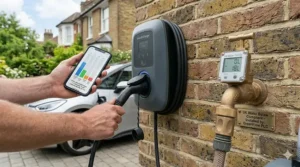
Off-Peak Charging Tariffs: Maximising Your EV Savings in 2026
The right electricity tariff transforms your smart EV charger from a convenient gadget into a money-printing machine (well, a money-saving machine). The difference between charging at standard rates (~28p/kWh) and an off-peak EV tariff (~7p/kWh) is roughly £800–1,000 per year for an average driver.
Octopus Intelligent Go (The UK’s Most Popular EV Tariff)
Octopus Intelligent Go dropped to just 8p/kWh from April 1st, 2026, down from 11.5p/kWh. This tariff offers at least six hours of cheap electricity overnight (typically 11:30pm-5:30am), with extra bonus cheap slots when the grid has surplus renewable power.
How it works: You plug in your EV whenever you get home, set your “ready by” time in the Octopus app, and the system automatically schedules charging at the cheapest times. The entire home enjoys the same cheaper rate during the off-peak window, not just the car—so you can schedule dishwashers and washing machines too.
Requirements:
- Smart meter with half-hourly readings
- Compatible EV or charger (check Octopus website)
- The Octopus Energy app
Real savings: A typical EV driver covering 8,000–9,000 miles a year can save around £400–£600 annually compared with standard electricity pricing.
Best paired with: Ohme Home Pro for deepest integration, or any Tesla (native integration without separate charger).
Octopus Go (Simple Off-Peak Alternative)
Octopus Go offers a flat off-peak rate during a 5-hour window (12:30am-5:30am), with the rate dropping from 10.5p to 6.99p per kWh from April 2026—a 33% reduction. Unlike Intelligent Go, this tariff doesn’t require smart scheduling—you simply set your car or charger to start charging at 12:30am.
When to choose this over Intelligent Go: If your EV or charger isn’t compatible with Intelligent Go, or you prefer manually controlling charging times. It works with any EV and any charger, including non-smart units.
OVO Charge Anytime
OVO’s Charge Anytime uses smart technology to charge your EV at the cheapest and greenest times, whenever they happen to be, instead of fixed off-peak hours. The system monitors wholesale electricity prices and grid carbon intensity, automatically scheduling charging during optimal windows.
UK-specific advantage: OVO Charge Anytime often unlocks charging slots during daytime hours when renewable generation is high, rather than restricting you to overnight charging. This flexibility suits shift workers or anyone with unpredictable schedules.
British Gas EV Power+
British Gas relaunched their EV tariff as EV Power, with a premium tier (EV Power+) that drops the rate further if you use a Hive-compatible charger. The off-peak rate of ~7.9p/kWh is competitive and slots between Octopus Intelligent Go and Octopus Go. The off-peak window runs for 5 hours (midnight to 5am).
Which Tariff Should You Choose?
For maximum savings: Octopus Intelligent Go (8p/kWh) paired with Ohme Home Pro charger.
For simplicity: Octopus Go (6.99p/kWh) with any charger or EV.
For renewable-focused charging: OVO Charge Anytime with compatible smart charger.
For British Gas customers: EV Power+ if you already have Hive smart home products.
Critical reminder: To get started, you’ll need a smart meter, a compatible EV or charger, and the energy supplier’s app to handle charging schedules automatically. Most UK energy suppliers can install a smart meter for free within 2-4 weeks of requesting one.
App-Controlled Charging: Which App Actually Works Best?
Every smart EV charger claims to offer “intuitive app control,” but the reality varies dramatically. I’ve tested the major UK charger apps extensively, and here’s what actually matters in daily use.
Ohme App: Best for Cost-Conscious Users
The Ohme app excels at one thing: showing you exactly how much money you’re saving. The per-session cost tracking is the best on the market—you see exactly what each charge cost down to the penny. Historical data lets you compare costs month-over-month and calculate your savings versus petrol or public charging.
Strengths: Clear cost breakdowns, detailed session logs, seamless Octopus integration, simple scheduling interface.
Weaknesses: Less visually polished than Hypervolt, limited smart home integration beyond charger control.
Best for: Anyone on Octopus Intelligent Go or OVO Charge Anytime who wants granular cost data.
Hypervolt App: Best Overall User Experience
Hypervolt’s polished app provides detailed energy cost breakdowns with an interface that feels modern and connected without becoming complicated. The dashboard displays real-time charging status, energy consumption, and estimated costs at a glance.
Strengths: Beautiful interface, Apple HomeKit integration, intuitive scheduling, excellent charger settings management.
Weaknesses: Slightly less detailed cost tracking than Ohme, occasional syncing delays reported by users.
Best for: Apple ecosystem users and anyone who values app aesthetics alongside functionality.
myenergi App: Best for Solar Integration
The myenergi app shines when managing multiple myenergi products (Zappi charger, Eddi power diverter, Libbi battery). You can monitor solar generation, battery storage, home consumption, and EV charging all in one place. The app would come into its own if you owned multiple myenergi products, including solar panels and batteries.
Strengths: Comprehensive home energy monitoring, excellent solar diversion control, multiple device management.
Weaknesses: Overwhelming for users with just the Zappi charger, less refined interface than Hypervolt or Ohme.
Best for: Solar panel owners with or planning the full myenergi ecosystem.
Easee App: Best for Multi-Charger Households
The Easee app offers solid core functionality with a focus on multi-charger management. You can monitor and control up to three Easee chargers from one account, with automatic load balancing between units. Smart scheduling allows you to set your EV to charge when prices are at their lowest, helping you save hundreds of pounds every year.
Strengths: Multi-charger management, cost tracking, RFID card management, remote locking.
Weaknesses: Basic interface, less sophisticated than Ohme or Hypervolt, limited smart home integration.
Best for: Properties with multiple EVs needing to charge simultaneously.
Key Features to Look For
Essential:
- Start/stop charging remotely
- Schedule charging by time or tariff
- Real-time charging status
- Energy consumption tracking
Highly desirable:
- Per-session cost calculations
- Historical data and trends
- Push notifications for charging events
- Load balancing controls
Nice to have:
- Smart home integration (HomeKit, Alexa, Google Home)
- RFID card management
- Guest charging features
- Carbon intensity data
UK-specific consideration: Most charger apps now include specific support for UK energy tariffs, with Octopus Intelligent Go being the most commonly integrated. Before purchasing, verify your chosen charger’s app supports your intended tariff.
Load Balancing Chargers: Preventing Fuse Trips in UK Homes
Load balancing might sound like technical jargon, but it’s absolutely critical for UK properties—especially older homes with 60-80 amp main fuses. Load balancing ensures your household appliances and EV charger can run at the same time without tripping the power, adding around £200–£400 to installation costs but preventing headaches later.
How Load Balancing Works
An energy meter is connected to the charger with a Modbus connection, specifically RS485, using a data cable. The energy meter’s role is to accurately measure the total consumption of the supply being used and keep an eye on the property’s power usage. When total consumption increases (you turn on your oven, electric shower, or washing machine), the charger reduces EV charging power to prevent exceeding your main fuse capacity.
Static vs Dynamic Load Balancing
Static load balancing sets a fixed maximum power for EV charging, regardless of what else is happening in your home. For example, you might limit your 7.4kW charger to 5kW to leave headroom for other appliances. Simple, but wastes potential charging speed when your home isn’t drawing much power.
Dynamic load balancing monitors real-time household consumption and adjusts EV charging power automatically. If you’re only using 2kW for lights and TV, the charger can run at full 7.4kW. When you fire up the oven (3kW), it automatically reduces to 4kW to stay within limits. Much smarter and faster charging overall.
Which Chargers Include Load Balancing?
Built-in load balancing:
- Easee One (up to 3 chargers on one circuit)
- Wallbox Pulsar Plus (Power Boost technology)
- Hypervolt Home 3 Pro
- myenergi Zappi
Requires additional hardware:
- Pod Point Solo 3S (£200-£300 for load management kit)
- Andersen A3 (integrated but may need CT clamp installation)
Do You Actually Need It?
You probably need load balancing if:
- Your property has a 60-80 amp main fuse (common in UK homes built pre-2000)
- You use high-power appliances simultaneously (electric shower + oven + washing machine)
- You’re installing multiple EV chargers
- You’ve experienced fuse trips when running multiple appliances
You probably don’t need it if:
- Your property has a 100+ amp main fuse
- You’re installing a single 7kW charger
- You charge overnight when other appliances are off
- You’ve recently had electrical upgrades
UK-specific consideration: ScottishPower and other UK suppliers now include dynamic load management devices with their EV charger installations at no extra cost to ensure safe and efficient charging, preventing your main fuse from tripping. Always ask your installer whether load balancing is recommended for your specific property.
How to Choose the Right Smart EV Charger for Your Home
With seven excellent options and dozens of features to consider, choosing the right smart EV charger can feel overwhelming. Here’s my step-by-step framework for making the decision.
Step 1: Check Your Electrical Supply
Before considering any features, verify whether your property has single-phase or three-phase power. Most UK homes have single-phase supply (7.4kW maximum), but some newer properties and rural homes have three-phase (up to 22kW).
How to check: Look at your electricity meter or consumer unit. Single-phase has one main cable; three-phase has three. If unsure, any electrician can verify during a free site survey.
Decision: Single-phase → stick with 7kW/7.4kW chargers. Three-phase → consider whether 22kW charging speed justifies the extra cost (usually only beneficial for vehicles with large batteries or frequent long-distance driving).
Step 2: Assess Your Priorities
If cost savings are your top priority: Choose Ohme Home Pro (£435-£535) paired with Octopus Intelligent Go tariff. Saves £400-£600 annually compared to standard tariffs—pays for itself within 12-18 months.
If you have solar panels: Choose myenergi Zappi (£599-£799). The Eco+ mode for 100% solar charging is unmatched, turning free sunshine into free miles.
If aesthetics matter: Choose Hypervolt Home 3 Pro (£1,050-£1,150) for premium design, or Andersen A3 (£1,295-£1,595) for ultimate customisation.
If you want the cheapest quality option: Choose Easee One (£405-£630). At 1.5kg and with lifetime 4G connectivity, it punches well above its weight class.
If you have multiple EVs: Choose Easee One (can link three units on one circuit) or Wallbox Pulsar Plus (Power Boost load management).
Step 3: Verify Compatibility
With your EV: All chargers in this guide use Type 2 connectors, compatible with every EV sold in the UK since 2018. Older vehicles with Type 1 connectors need untethered chargers (Easee One, some Zappi models) and a Type 1 cable.
With your tariff: If switching to Octopus Intelligent Go, verify your chosen charger appears on Octopus’s compatibility list. Ohme and Hypervolt have deepest integration; others work but with less automation.
With your home: Check if your driveway/garage has adequate WiFi signal (for WiFi chargers) or mobile signal (for 4G chargers). UK properties with thick stone walls may need WiFi extenders or 4G-capable chargers.
Step 4: Calculate Total Cost
Unit cost: £405-£1,595 depending on model
Installation: £800–£1,500 for most UK homes, with straightforward installations taking 2-3 hours. If cables need to run through walls, across gardens, or if your consumer unit requires upgrading, costs can climb quickly.
OZEV grant: Renters and flat owners can claim up to £500 (increased from £350 from April 1, 2026) covering roughly half the cost of a typical high-quality installation.
Total installed cost (examples):
- Easee One: £918-£999 installed (minus grant if eligible)
- Ohme Home Pro: £918-£1,050 installed
- Hypervolt Home 3 Pro: £1,450-£1,550 installed
- myenergi Zappi: £999-£1,200 installed
Step 5: Choose Tethered vs Untethered
Tethered (cable permanently attached):
- Pros: Always ready, no cable to store, faster plug-in
- Cons: Cable exposed to weather, slight trip hazard, more expensive (£100-£200 extra)
Untethered (socket only, use your EV’s cable):
- Pros: Tidier appearance, cable protected in car, cheaper
- Cons: Extra step to fetch cable, must buy cable separately for some chargers
UK recommendation: Most British EV owners prefer tethered for convenience, especially given our rainy climate. Untethered makes sense for properties with multiple EV types or where aesthetic minimalism is paramount.
Step 6: Book a Site Survey
Never purchase a charger before getting a professional site survey. OZEV-approved installers assess your property’s electrical capacity, recommend optimal mounting location, identify any necessary upgrades, and provide accurate quotes.
Most reputable installers offer free, no-obligation site surveys within 1-2 weeks. Use this opportunity to ask questions, verify installation costs, and ensure the chosen charger suits your property.
Installation Costs & UK Grant Support in 2026
Understanding the full cost of smart EV charger installation prevents nasty surprises and helps you maximise available government support.
Typical Installation Costs
Most UK homeowners can expect to pay £800–£1,500 for a complete EV charger installation. This includes:
- Charger unit
- Labour (2-6 hours depending on complexity)
- Materials (cable, conduit, mounting hardware)
- Electrical safety testing
- DNO (Distribution Network Operator) notification
Factors that increase costs:
Cable run distance: Each metre beyond 5 metres from your consumer unit adds £10-£20. Properties with consumer units at the opposite end of the house from the driveway can add £200-£400.
Consumer unit upgrades: Older properties often need consumer unit (fuse box) replacement if it lacks capacity for a dedicated EV charging circuit, typically adding £300–£600 to the bill.
Load balancing: Load balancing adds around £200–£400 but can save you from headaches later and allows faster charging without overloading the system.
Three-phase supply: Converting from single-phase to three-phase can cost £3,000-£15,000+, making 22kW chargers rarely cost-effective for domestic installations.
Difficult routing: Cable runs requiring drilling through thick walls, crossing gardens, or avoiding listed building restrictions increase labour time and costs.
OZEV Grant (EV Chargepoint Grant)
Renters and flat owners can claim either £350 or 75% off the cost to purchase and install a socket, whichever amount is lower. From April 1, 2026, this increased to a maximum of £500.
Eligibility requirements:
- You live in a flat that you own (including shared ownership)
- You rent a residential property
- Your home has dedicated off-street parking
- Installation by OZEV-authorised installer
Not eligible: Houses that are owner-occupied and have private driveways are no longer eligible under this scheme.
How to apply: You don’t apply directly. Your OZEV-approved installer handles the paperwork and deducts the grant amount from your final bill. The installer submits the claim using the government’s claims management portal.
Example calculation:
- Total installation cost: £1,200
- 75% of cost: £900
- Grant capped at: £500
- You pay: £700
Planning Permission Changes
In 2026, most UK homeowners do not need planning permission to install a home EV charger on a driveway or garage. These installations typically fall under “Permitted Development Rights”.
Exceptions requiring planning permission:
- Listed buildings
- Properties in conservation areas
- Chargers visible from the highway in sensitive locations
Planning permission removal saves homeowners up to £1,100 in planning fees and speeds up installation timelines significantly. This change came into effect May 2025, making EV charger installation faster and cheaper for most UK properties.
Finding an OZEV-Approved Installer
All installations claiming the OZEV grant must be completed by approved installers. Check the official OZEV installer list or ask your chosen charger manufacturer for recommended installers in your area.
Red flags to avoid:
- Installers not registered with NICEIC, NAPIT, or equivalent
- Quotes significantly below market rate (£700-£800 for standard installations)
- Pressure to purchase immediately without site survey
- Refusal to provide proof of insurance and qualifications
Money-Saving Installation Tips
Get three quotes: Installation prices vary dramatically. The same job might be quoted at £950 by one installer and £1,400 by another.
Book off-peak: January-March tends to be quieter for installers, potentially leading to better rates and faster booking.
Minimise cable runs: Choose a mounting location as close as possible to your consumer unit. Every metre saved is £10-£20 off the bill.
Check bundled offers: Some energy suppliers (ScottishPower, Octopus Energy) offer chargers with installation at competitive rates, sometimes including free load management or extended warranties.
Combine with other work: If you’re already having electrical work done (consumer unit upgrade, garage rewire), adding EV charger installation may reduce overall costs through shared labour and materials.
Solar-Compatible Smart Chargers: Maximising Free Miles
If you’ve invested in solar panels—or you’re planning to—choosing a solar-compatible smart EV charger dramatically improves your return on investment. Charging your EV with surplus solar energy means genuinely free miles, transforming your monthly costs.
How Solar-Compatible Charging Works
Solar-compatible chargers monitor your home’s solar generation in real-time and adjust EV charging power to match available surplus. On a bright summer day, your 4kW solar array might generate 3.5kW whilst your home uses just 0.5kW. A solar-compatible charger diverts that 3kW surplus to your EV battery instead of exporting it to the grid at lower rates (typically 15p/kWh with Octopus Outgoing Fixed).
Best Solar Chargers for UK Homes
myenergi Zappi (The Gold Standard)
The Zappi GLO offers three charging modes: Fast mode (full power from the grid), Eco mode (blends solar surplus with grid power—charges faster on cloudy days), and Eco+ mode (100% free solar charging via surplus only).
Why it’s the best: The Zappi’s Eco+ mode is ruthlessly pure—if solar generation drops below charging requirements, it pauses charging entirely rather than drawing from the grid. This maximises free miles but means slower overall charging on partly cloudy days. Eco mode offers a balanced approach, using solar when available and topping up from the grid as needed.
Integration: The Zappi works seamlessly with other myenergi products (Eddi power diverter for immersion heating, Harvi wireless CT clamps, Libbi battery storage), creating a comprehensive home energy ecosystem.
UK customer experience: A Devon solar owner reported: “Between April and September 2025, we charged our EV almost entirely on surplus solar using Eco+ mode. On cloudy days we switched to Eco mode to maintain decent charging speeds. Our grid electricity for EV charging dropped by 85%.”
Hypervolt Home 3 Pro (Good Solar Compatibility)
Hypervolt offers solar compatibility, though not as sophisticated as Zappi. The charger can prioritise solar energy when available and integrates with many UK solar inverter brands. It won’t match Zappi’s granular control but works well for casual solar users.
Ohme Home Pro (Solar Boost Feature)
The Ohme Home Pro includes Solar Boost functionality for basic solar integration. It’s not as advanced as Zappi’s three-mode system but handles surplus solar diversion adequately for most users. The Ohme ePod and Ohme Home Pro both include Solar Boost for prioritising surplus PV.
Calculating Solar Charging Savings
A typical UK 4kW solar array generates approximately 3,400-3,800 kWh annually. Realistically, about 30-40% (1,000-1,500 kWh) represents surplus energy available for EV charging during daytime hours when the car is home.
Free miles from solar:
- Annual surplus: 1,200 kWh (middle estimate)
- EV efficiency: 3-4 miles per kWh
- Free miles: 3,600-4,800 miles per year
- Equivalent saving: £700-£900 (compared to charging at 24p/kWh)
Battery storage consideration: If you have home battery storage (Tesla Powerwall, myenergi Libbi, GivEnergy), you can store solar energy generated during the day and use it for overnight EV charging, dramatically increasing solar utilisation. This requires careful system configuration to prioritise EV charging from stored solar rather than exporting or using for home consumption.
UK Solar + EV Tariff Strategy
The smartest UK solar owners combine three elements:
- Solar-compatible charger (myenergi Zappi for maximum control)
- Smart EV tariff (Octopus Intelligent Go for cheap overnight charging)
- Export tariff (Octopus Outgoing Fixed for excess solar payments)
Summer strategy: Charge primarily from solar during daylight hours using Eco+ mode. Top up overnight on Octopus Intelligent Go (8p/kWh) only when solar wasn’t sufficient.
Winter strategy: Accept that solar generation is minimal (November-February) and rely primarily on Octopus Intelligent Go overnight charging.
This hybrid approach maximises free summer miles whilst maintaining cheap charging year-round.
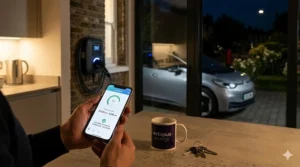
FAQ: Your Smart EV Charger Questions Answered
❓ How much does it cost to charge an electric car at home in the UK?
❓ Can I install a smart EV charger myself to save money?
❓ Do all smart EV chargers work with Octopus Intelligent Go?
❓ How long does it take to install a smart EV charger?
❓ Can I use a smart EV charger without WiFi or mobile signal?
Conclusion: Choose Smart, Save Big in 2026
The smart EV charger market has matured dramatically over the past few years, giving UK drivers genuinely excellent options at every price point. Whether you’re investing £405 in an Easee One or splashing £1,600 on an Andersen A3, you’re getting technology that will save you hundreds of pounds annually whilst making EV ownership more convenient.
The three key decisions that matter most: (1) Choose a charger compatible with your intended energy tariff—Ohme for Octopus Intelligent Go, Zappi for solar, others for general use. (2) Verify your property’s electrical capacity and WiFi/mobile coverage before purchasing. (3) Use an OZEV-approved installer to ensure safety, compliance, and grant eligibility.
The average UK EV driver saves £400-£600 annually by switching from standard tariffs to smart off-peak charging. That’s £4,000-£6,000 over a decade—more than the cost of the charger and installation combined. Add in the convenience of never visiting petrol stations, the environmental benefits of charging during high-renewable-generation periods, and the satisfaction of genuinely clean transport, and smart EV chargers become one of the best home investments you can make.
The UK’s EV revolution is accelerating, with electric vehicles reaching 37.6% of the market in October 2025 alone. Home charging infrastructure is no longer optional—it’s essential. By choosing the right smart EV charger now, you’re setting yourself up for a decade of cheaper, cleaner, more convenient driving.
Ready to make the switch? Pick your charger from the list above, book a site survey with an OZEV-approved installer, and start saving from your very first charge.
Recommended for You
- 7 Best Home EV Chargers UK 2026
- 7 Best Combination Ladders UK 2026
- 7 Best Telescopic Ladders UK 2026
Disclaimer: This article contains affiliate links. If you purchase products through these links, we may earn a small commission at no additional cost to you. Prices shown are approximate and may vary.
✨ Found this helpful? Share it with your mates! 💬🤗
