
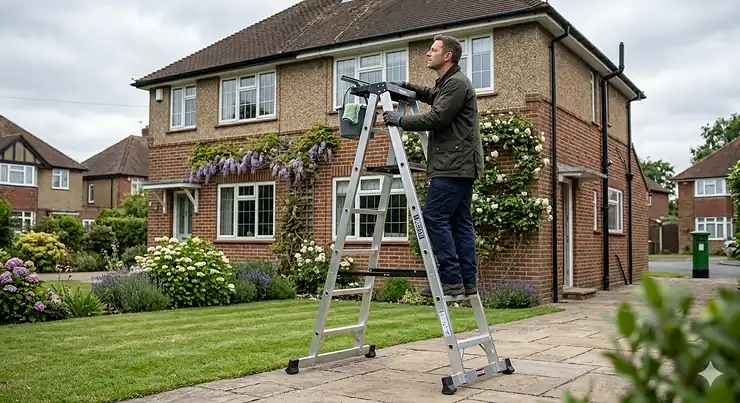
In This Article
Picture this: you’re halfway through painting your hallway when you realise you need a different ladder configuration for the awkward stairwell section. Frustrating, isn’t it? That’s precisely why combination ladders have become the go-to solution for savvy homeowners and professional tradespeople across the UK in 2026.
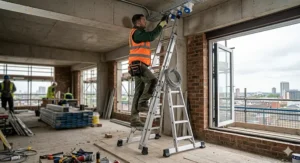
A combination ladder – also known as a multi-position ladder or versatile ladder system – is essentially three or more ladder types rolled into one clever piece of kit. These ingenious tools can transform from a stepladder to an extension ladder, stairwell ladder, and even a working platform, all without requiring a garage full of different equipment.
What makes the best combination ladder stand out in today’s market? It’s the perfect marriage of safety, versatility, and build quality. With the Health and Safety Executive (HSE) reporting that falls from height remain one of the most common workplace fatalities in the UK, choosing a properly certified ladder isn’t just smart – it’s essential. The revised EN131 standard, which came into force in 2019, has significantly improved ladder safety by requiring wider bases, stronger construction, and rigorous testing protocols.
Whether you’re a weekend DIY enthusiast tackling home improvements or a professional decorator working across multiple sites, investing in a quality combination ladder can genuinely transform how you work. This comprehensive guide examines seven of the finest combination ladders available on Amazon.co.uk in 2026, helping you make an informed decision that prioritises both safety and value for money.
Quick Comparison Table
| Product | Configurations | Max Height | Load Capacity | Price Range | Rating |
|---|---|---|---|---|---|
| Werner 5-in-1 Platform Ladder | 5 positions | 4.6m | 150kg | £180-£220 | ⭐⭐⭐⭐⭐ |
| StepIt 14-in-1 Multi-Purpose | 14 positions | 4.7m | 150kg | £150-£180 | ⭐⭐⭐⭐½ |
| TB Davies STILO 3-Section | 3 positions | 4.26m | 150kg | £200-£240 | ⭐⭐⭐⭐⭐ |
| Multi-Purpose 6-in-1 Aluminium | 6 positions | 4.7m | 150kg | £129-£159 | ⭐⭐⭐⭐ |
| Workplace Depot Multi-Purpose | 4 positions | 4.81m | 150kg | £145-£175 | ⭐⭐⭐⭐ |
| Sterk 3-Way Combination | 3 positions | 2.65m | 150kg | £115-£145 | ⭐⭐⭐⭐ |
| Excel 12-Tread Steel Platform | 4 positions | 3.8m | 150kg | £160-£190 | ⭐⭐⭐⭐½ |
💬 Just one click – help others make better buying decisions too!😊
✨ Don’t Miss These Exclusive Deals!
🔍 Take your DIY projects to the next level with these carefully selected products. Click on any highlighted item to check current pricing and availability on Amazon.co.uk. These tools will help you create professional results your family will love!
Top 7 Best Combination Ladders: Expert Analysis
1. Werner 5-in-1 Combination Ladder with Platform
The Werner 5-in-1 Combination Ladder stands as a benchmark in versatile access equipment, and for good reason. This aluminium marvel combines a stepladder, extension ladder, stairwell ladder, level work platform, and stairwell platform all in one robust package.
Key Specifications:
- Extended height: 4.6 metres (15.1 feet)
- Working platform: 94cm x 30cm
- Weight: Approximately 16kg
- EN131 Professional certified
Price: £180-£220
Customer Feedback: UK buyers consistently praise the Werner 5-in-1’s stability on uneven surfaces, particularly staircases. However, several reviewers noted that initial assembly can be tricky without consulting Werner UK’s support resources, as the instruction diagrams lack close-up detail of the strut installation points.
✅ Pros:
- Exceptional stability with wide base stabilisers
- Large, comfortable working platform
- Five genuinely useful configurations
- Rock-solid construction inspires confidence
❌ Cons:
- Assembly instructions could be clearer
- Slightly heavier than some competitors at 16kg
2. StepIt 14-in-1 Multi-Purpose Combination Ladder 4×4
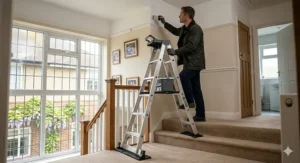
Don’t let the “14-in-1” claim put you off – the StepIt Multi-Purpose Combination Ladder genuinely delivers remarkable versatility. This 4×4 configuration ladder extends to an impressive 4.7 metres and includes two removable work platforms plus an adjustable tool tray.
Key Specifications:
- Maximum extension: 4.7 metres (15.5 feet)
- A-frame height: 3 metres
- Platform height: 94cm
- Click-lock hinge system
- Includes two slip-resistant aluminium platforms
Price: £150-£180
Customer Feedback: Tradespeople working on UK building sites appreciate the StepIt ladder’s compact folded dimensions (approximately 1.2 metres) which make van storage straightforward. The click-lock mechanism receives particular praise for its intuitive operation.
✅ Pros:
- Outstanding value for money
- Truly compact when folded
- Included platforms add genuine functionality
- UK-based customer support
❌ Cons:
- Tool tray position requires adjustment for some configurations
3. TB Davies STILO 3-Section Combination Ladder
For those who prefer quality over quantity of features, the TB Davies STILO 3-Section Combination Ladder represents professional-grade engineering at its finest. This British-designed ladder focuses on doing three things exceptionally well: staircase access, extension ladder work, and A-frame positioning.
Key Specifications:
- Closed height: 2.0 metres
- Extended length: 4.26 metres (13.97 feet)
- Professional aluminium construction
- Telescopic adjustment system
Price: £200-£240
Customer Feedback: Professional decorators and electricians working in period properties with challenging staircases consider the TB Davies STILO an investment rather than an expense. The telescopic design allows precise height adjustment.
✅ Pros:
- Superior build quality
- Excellent for period properties with awkward access
- Smooth telescopic action
- Highly stable on stairs
❌ Cons:
- Premium pricing
- Fewer configurations than some rivals
4. Multi-Purpose 6-in-1 Aluminium Combination Ladder
The Multi-Purpose 6-in-1 Aluminium Combination Ladder represents the sweet spot between affordability and functionality. With a 4×4 step configuration and 15.4-foot maximum extension, this ladder tackles most domestic and light trade applications with confidence.
Key Specifications:
- Extended height: 4.7 metres (15.4 feet)
- Load capacity: 150kg (330.6 lbs)
- Anti-slip feet
- Locking hinges with safety mechanism
Price: £129-£159
Customer Feedback: UK homeowners particularly value this ladder for seasonal tasks like gutter cleaning and exterior painting. The lightweight aluminium construction (typically around 14kg) makes it manageable for solo use.
✅ Pros:
- Excellent entry-level price point
- Lightweight yet sturdy
- Good for homeowners with varied tasks
- Portable design
❌ Cons:
- Not suitable for heavy commercial use
- Platform not included (available separately)
5. Workplace Depot Multi-Purpose Combination Ladder
The Workplace Depot Multi-Purpose Combination Ladder brings commercial-grade features to the mid-market price bracket. This four-in-one ladder functions as an extension ladder, stair ladder, scaffold ladder, and workstation.
Key Specifications:
- Maximum extension: 4.81 metres (15.8 feet)
- Load capacity: 150kg
- Reinforced stability beams
- Chemical-resistant treads
- Folded dimensions: 1.295m (H) x 600mm (W) x 270mm (D)
Price: £145-£175
Customer Feedback: Maintenance professionals working in industrial environments appreciate the Workplace Depot ladder’s chemical-resistant treads and reinforced construction. The compact folded size fits neatly in commercial vehicle storage.
✅ Pros:
- Industrial-grade durability
- Compact storage footprint
- Chemical-resistant construction
- Good value for professional use
❌ Cons:
- Heavier than domestic alternatives
- Overkill for occasional home use
6. Sterk 3-Way Combination Step Ladder
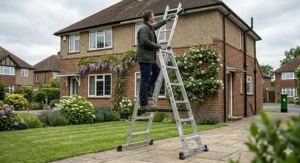
Perfect for smaller homes and flats, the Sterk 3-Way Combination Step Ladder offers essential functionality without the bulk. This 5+6 rung configuration provides three core positions: stepladder, stairwell ladder, and extension ladder.
Key Specifications:
- Closed height: 1.75 metres
- Extended length: 2.65 metres
- Stepladder height: 1.58 metres
- Weight: Just 5.95kg
- Stabiliser bar width: 81cm
- EN131 and GS certified
Price: £115-£145
Customer Feedback: Flat dwellers and those with limited storage space consistently highlight the Sterk ladder’s lightweight design and compact folded dimensions (175cm x 39.5cm x 12.5cm) as major advantages.
✅ Pros:
- Exceptionally lightweight at under 6kg
- Ideal for compact storage
- Perfect for flats and smaller properties
- Competitive pricing
❌ Cons:
- Limited height capability
- Not suitable for commercial applications
7. Excel 12-Tread Steel Multi-Purpose Platform Ladder
Combining steel frame strength with aluminium rung comfort, the Excel 12-Tread Steel Multi-Purpose Combination Ladder targets users who prioritise maximum stability and platform work capability.
Key Specifications:
- 12 treads for superior height access
- Steel frame with aluminium rungs
- Slip-resistant work platform included
- Maximum load: 150kg
- EN131 certified
Price: £160-£190
Customer Feedback: Building contractors appreciate the Excel ladder’s hybrid construction – the steel frame provides reassuring rigidity whilst aluminium rungs keep weight manageable. The included platform receives particular praise for its generous dimensions.
✅ Pros:
- Steel frame offers exceptional rigidity
- Large, secure work platform
- Comfortable aluminium rungs
- Excellent for platform work
❌ Cons:
- Heavier than all-aluminium alternatives
- Steel frame requires careful storage to prevent corrosion
Understanding Combination Ladder Configurations
When manufacturers claim their ladder offers “5-in-1” or “14-in-1” functionality, what exactly do these numbers mean? Let’s demystify the most common configurations you’ll encounter when shopping for the best combination ladder.
Standard Configurations Explained
Stepladder (A-Frame) Position 🪜
The classic freestanding configuration where the ladder forms an inverted V shape. Perfect for indoor work like changing light bulbs, painting ceilings, or accessing loft hatches. The self-supporting design means you don’t need a wall or other surface to lean against.
Extension Ladder Position 📏
The ladder extends to its full length and leans against a wall or building. Ideal for exterior work such as gutter cleaning, window washing, or accessing roofs. The Ladder Association recommends a 75-degree angle (the 1-in-4 rule: one unit out for every four units up) for optimal safety.
Stairwell Position 🏠
This clever configuration allows you to work safely on staircases where floor heights differ. One side of the ladder rests on a lower step whilst the other sits on a higher surface, creating a level working platform. Absolutely invaluable for decorating stairwells or installing stair lighting.
Scaffold Platform 🛠️
Some combination ladders can be configured with both sides at equal height to create a stable working platform between two supports. Professional painters and decorators frequently use this setup with additional planks to create a mini scaffold system.
Advanced Configurations
Modern versatile ladder systems often include additional positions such as:
- Twin stepladders (both sides form independent A-frames)
- Adjustable-height platforms for uneven ground
- Extended base positions for increased stability
- Convertible trestle configurations
The key is understanding which configurations you’ll genuinely use. A 14-in-1 ladder might sound impressive, but if you only need three or four positions regularly, you might be paying for complexity you don’t require.

Essential Safety Features to Look For
Safety isn’t negotiable when it comes to working at height. According to the Health and Safety Executive, falls from ladders account for a significant proportion of workplace injuries each year. Here’s what separates a safe combination ladder from a liability waiting to happen.
EN131 Certification – Your Safety Baseline
Every combination ladder you consider should carry EN131 certification. This European standard, which replaced the older BS 2037 and BS 1129 classifications in 2019, ensures ladders meet rigorous requirements for stability, slip resistance, durability, and strength.
The certification comes in two flavours:
EN131 Professional – Designed for trade and commercial applications, these ladders undergo 50,000 repetition cycles during durability testing. If you’re using your ladder regularly or earning income from your work, this is the certification you need.
EN131 Non-Professional – Intended for home DIY use, these ladders pass 10,000 repetition cycles. Both classifications support the same 150kg maximum load, but professional-grade ladders offer superior longevity under frequent use.
Stabiliser Bars and Base Width
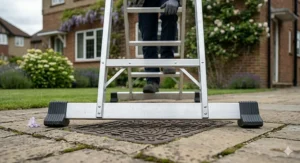
One significant improvement introduced by EN131 standards is the requirement for stabiliser bars on ladders exceeding 3 metres in length. These wide-stance footings dramatically improve stability, particularly on smooth surfaces like tiled floors or paved patios.
Look for base widths of at least 80cm – some premium models like the Werner 5-in-1 feature stabilisers approaching 90cm for exceptional steadiness.
Anti-Slip Features
Quality combination ladders incorporate anti-slip technology at multiple points:
- Rubber feet with deep tread patterns grip various surfaces
- Serrated or ribbed rungs prevent foot slippage when climbing
- Platform surfaces with raised patterns or perforations
- Hinge locks that prevent accidental folding during use
Load Capacity Reality Check
Every ladder certified to EN131 standards supports a maximum load of 150kg. However, this total includes:
- Your body weight
- Clothing and safety equipment
- Tools you’re carrying
- Materials (paint, tiles, etc.)
A professional tradesperson carrying a heavy toolbelt, wearing safety gear, and transporting materials can easily approach this limit. Always leave a safety margin rather than working at maximum capacity.
How to Choose the Best Combination Ladder for Your Needs
Selecting the perfect combination ladder isn’t about finding the one with the most features or the lowest price – it’s about matching capabilities to your specific requirements. Here’s how to make a smart decision.
Assess Your Maximum Working Height
Start by identifying the highest point you need to reach regularly. Remember, you shouldn’t work from the top three rungs of any ladder for safety reasons. If your tallest task involves accessing a loft hatch 2.5 metres high, you’ll need a ladder with a working height of at least 3 metres.
For exterior work, measure from ground level to your highest access point (typically eaves or an upstairs window sill). Add at least 1 metre to this measurement to ensure safe overlap when using the ladder in extension position.
Frequency of Use Matters
Occasional DIY Users (a few times per year)
A compact 3-in-1 combination ladder like the Sterk model offers sufficient versatility without breaking the bank. EN131 Non-Professional certification is acceptable for light, infrequent use.
Regular Homeowners (monthly projects)
Mid-range options like the Multi-Purpose 6-in-1 provide better value through enhanced durability. Consider EN131 Professional certification even for domestic use if you’re tackling substantial renovation projects.
Professional Tradespeople (daily use)
Premium models from Werner, TB Davies, or similar manufacturers justify their cost through superior build quality and longevity. EN131 Professional certification is mandatory, and features like included platforms and tool trays become genuine productivity enhancers.
Storage Space Considerations
Combination ladders fold surprisingly compact, but dimensions vary significantly. Measure your available storage space before purchasing:
- Garage ceiling hooks: Check vertical clearance (typical folded heights range from 1.2m to 2.0m)
- Van storage: Note both folded length and width
- Shed or garage floor storage: Consider whether the ladder will fit alongside other equipment
The Workplace Depot model’s folded dimensions (1.295m x 600mm x 270mm) exemplify thoughtful design for commercial vehicle storage.
Weight and Portability
Aluminium combination ladders typically weigh between 6kg (compact 3-way models) and 18kg (large platform systems). Consider how you’ll transport the ladder:
- Can you comfortably carry it up stairs?
- Will you need to load it into a vehicle alone?
- Does your work involve frequent repositioning?
Professional decorator? A few extra kilograms in exchange for stability might be worthwhile. Weekend DIYer? Lightweight portability could be more valuable than heavy-duty construction.
Combination Ladders vs. Traditional Ladder Systems
You might wonder whether a combination ladder genuinely offers better value than purchasing separate stepladders and extension ladders. Let’s examine the mathematics and practicalities.
Cost Comparison
| Option | Items Required | Typical UK Cost 2026 | Storage Space |
|---|---|---|---|
| Quality Combination Ladder | 1 ladder | £150-£220 | 1.3m x 0.6m |
| Traditional Separate Ladders | 5-tread stepladder + 3m extension ladder + stairwell solution | £90 + £80 + £70 = £240 | 2.5m x 1.2m combined |
| Premium Separate System | Professional stepladder + extension + platform | £130 + £120 + £95 = £345 | 3.0m x 1.5m combined |
The financial case for combination ladders becomes compelling quickly, particularly when you factor in storage space savings.
Versatility Benefits
Traditional ladders excel at specific tasks but create gaps in capability:
What separate ladders can’t do:
- Work efficiently on staircases with different floor levels
- Quickly transform between configurations mid-project
- Provide stable platform work without additional equipment
- Fit in compact storage spaces
What combination ladders handle brilliantly:
- Adapt to unusual access challenges (dormer windows, split-level gardens)
- Eliminate the “which ladder do I need?” decision before starting work
- Reduce vehicle trips for mobile professionals
- Simplify insurance and maintenance tracking (one serial number, one inspection schedule)
When Separate Ladders Make Sense
Combination ladders aren’t always the answer. Consider traditional separate ladders if:
- You exclusively work at consistent heights (always painting single-storey exteriors, for example)
- Multiple people need simultaneous access to different heights
- Your work demands maximum lightweight portability (roof work requiring frequent ladder repositioning)
- You have abundant storage space and prefer specialised tools
Maintenance and Safety Inspection Guidelines
According to the Work at Height Regulations 2005, which remain fully in force across the UK in 2026, ladder users must conduct regular inspections to ensure equipment remains safe for use. Here’s your practical maintenance roadmap.
Pre-Use Inspection Checklist (Every Use)
Before ascending any combination ladder, conduct this 60-second visual inspection:
✅ Stiles (vertical side rails) – Check for cracks, dents, or corrosion
✅ Rungs or treads – Ensure they’re firmly attached, not bent, and free from grease
✅ Feet – Verify rubber pads are present, not worn smooth, and firmly attached
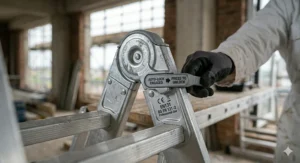
✅ Locking mechanisms – Test hinges lock securely in each configuration
✅ Tie rods – Confirm connecting hardware is tight and undamaged
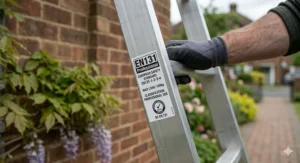
✅ Labels and markings – Check EN131 certification labels remain legible
If you discover any defects, remove the ladder from service immediately. Operating damaged access equipment isn’t just dangerous – it violates UK health and safety legislation.
Detailed Inspections (Every 3-6 Months)
For ladders used professionally or frequently, the Ladder Association recommends formal inspections every three to six months. These deeper examinations should include:
Structural integrity testing:
- Gentle lateral pressure to identify loose joints
- Rung load testing (carefully apply bodyweight to centre of each rung)
- Hinge mechanism operation through full range of motion
Component condition assessment:
- Measure remaining tread depth on rubber feet (replace when worn below 3mm)
- Check for aluminium oxidation (white powder indicating corrosion)
- Inspect platform attachment points for wear or deformation
Documentation:
Maintain a simple log recording:
- Inspection date
- Inspector name
- Any defects identified
- Remedial actions taken
- Next inspection due date
For professional use, this documentation demonstrates compliance if HSE inspectors visit your workplace.
Cleaning and Storage Best Practices
Cleaning:
After use in dirty environments, clean your combination ladder with warm water and mild detergent. Avoid pressure washers which can force water into hollow sections and promote internal corrosion. For oil or grease, use white spirit sparingly, then rinse thoroughly.
Storage:
- Store indoors or under cover whenever possible
- Hang horizontally on wall brackets (not vertically leaning against walls which can warp stiles)
- Keep away from damp areas where corrosion accelerates
- Ensure storage area temperature remains above freezing (ice can damage rubber components)
- Never store items on top of ladders which can bend rungs
Winter considerations:
UK winters demand special attention. Aluminium contracts in cold temperatures, making joints slightly less secure. Always allow ladders to warm to room temperature before use if stored in unheated sheds or garages.
Real-World Applications: When to Use Each Configuration
Understanding theory is valuable, but let’s explore practical scenarios where different combination ladder configurations shine.
The Home Decorator’s Day
Morning: Painting the stairwell
Sarah needs to reach the ceiling above her staircase, where traditional stepladders can’t provide stable access. She configures her StepIt 14-in-1 in stairwell mode, with one leg resting on the landing and the other on the third step down. The adjustable platform attachment creates a stable workspace at precisely the right height.
Afternoon: Exterior window frames
Switching to extension ladder configuration takes under 30 seconds. Sarah extends the ladder to reach second-floor window frames, ensuring a 75-degree angle using the 1-in-4 rule. The stabiliser bars prevent lateral movement on her paved patio.
Evening: Kitchen ceiling light replacement
Back to A-frame stepladder configuration. The ladder’s compact footprint fits comfortably in her kitchen, and she can work from the platform attachment without overreaching.
One ladder. Three different tasks. Zero equipment changes.
The Professional Electrician’s Challenge
Commercial site with uneven ground
James is installing external security lighting on a building where landscaping has created an uneven perimeter. His Workplace Depot combination ladder’s adjustable leg extensions allow him to level the ladder on slopes up to 16 degrees. The reinforced construction supports his weight plus a heavy toolbelt and equipment.
Interior corridor work
The same ladder transforms into a compact stepladder configuration for ceiling-mounted emergency lighting in narrow corridors. The 600mm folded width means he can manoeuvre through doorways without tilting the ladder sideways.
The Weekend Garden Enthusiast
Pruning mature trees
Michael uses his Werner 5-in-1 in extension ladder configuration to access tree branches at 4 metres height. The wide base stabilisers provide confidence when reaching slightly off-centre (though he’s careful never to overreach beyond his belt buckle position).
Cleaning conservatory roof
A-frame stepladder mode provides stable access to the conservatory roof panels. The platform attachment holds his bucket and squeegee within easy reach, eliminating dangerous stretching or balancing acts.
Gutter maintenance on split-level garden
Here’s where combination ladders truly excel. Michael’s garden slopes significantly, making traditional extension ladder positioning hazardous. Using the stairwell configuration with adjustable legs, he creates a safe, level working position despite the challenging terrain.
Understanding UK Ladder Regulations and Compliance
Navigating UK ladder regulations needn’t be complex, but understanding your legal obligations protects both safety and liability. Here’s what you need to know in 2026.
The Work at Height Regulations 2005
Despite being nearly two decades old, these regulations remain the cornerstone of UK ladder safety legislation. They establish three fundamental principles:
Principle 1: Avoid work at height where possible
Can the task be completed from ground level using extension poles or similar tools? If yes, you’re legally obligated to use that safer method.
Principle 2: Prevent falls where you can’t avoid height
When working at height is necessary, select equipment providing the highest level of fall protection justified by the task’s risk and duration.
Principle 3: Mitigate consequences if falls remain possible
Where residual fall risk exists, minimise potential fall distance and consequences.
When Ladders Are Legally Appropriate
The HSE’s guidance is refreshingly clear: ladders can be used for work at height when a risk assessment shows that using alternative equipment with higher fall protection isn’t justified because:
- The task involves low risk (stable working position, no heavy loads, minimal tool use)
- The duration is short (typically under 30 minutes of continuous work)
- Site features can’t be altered to accommodate other access equipment
Important clarification: “Short duration” doesn’t mean you can work all day on a ladder by breaking tasks into 29-minute intervals. The regulation refers to continuous working periods at height.
Employer Responsibilities
If you employ others – even a single apprentice or occasional contractor – you have specific legal duties:
✓ Conduct risk assessments before any work at height
✓ Provide suitable, properly maintained access equipment
✓ Ensure workers are competent (trained, experienced, or supervised)
✓ Implement inspection regimes appropriate to equipment usage intensity
✓ Maintain records of inspections and training
Negligence can result in HSE enforcement action, including improvement or prohibition notices, and in severe cases, prosecution. The average fine for serious Work at Height Regulations breaches exceeded £50,000 in 2025.
Competence Requirements
UK law doesn’t mandate formal certification for ladder use, but you must be “competent” – possessing appropriate knowledge, training, and practical experience. For employers, this typically means:
For employees:
- Formal working at height training
- Ladder-specific instruction covering your equipment types
- Supervised practice before independent work
- Refresher training every 3-5 years
For the self-employed: Demonstrable knowledge of safe ladder practices, even without formal certificates. Consider the Ladder Association’s LadderCard scheme which provides recognised proof of competence.
Frequently Asked Questions
❓ How often should I replace my combination ladder?
❓ Can I use a combination ladder on stairs if it's not EN131 certified?
❓ What's the maximum weight I can safely carry up a combination ladder?
❓ Do combination ladders work with ladder stabilisers and stand-offs?
❓ Are aluminium or fibreglass combination ladders better for UK weather?
Conclusion: Making Your Investment Count
Choosing the best combination ladder for your needs ultimately comes down to matching quality, features, and price to your specific requirements. Whether you’re a homeowner tackling weekend projects or a professional tradesperson working across multiple sites daily, the right combination ladder transforms from a simple access tool into a genuine productivity enhancer.
The seven models we’ve examined each offer distinct advantages. The Werner 5-in-1 leads for all-round professional capability and included platform features. The StepIt 14-in-1 delivers exceptional value for money with genuinely useful versatility. The TB Davies STILO targets professionals demanding premium build quality and superior stairwell performance. For budget-conscious homeowners, the Multi-Purpose 6-in-1 provides excellent essential functionality without unnecessary complexity.
Remember that EN131 certification isn’t merely a marketing badge – it represents genuine safety improvements backed by rigorous testing. The revised standards introduced in 2019 have made today’s combination ladders significantly safer than their predecessors through wider bases, stronger construction, and enhanced stability features.
As you make your decision, prioritise these factors:
Safety first: Never compromise on EN131 Professional certification for regular or commercial use
Honest assessment: Choose configurations you’ll genuinely use rather than chasing impressive feature counts
Quality over bargains: A £200 ladder lasting 15 years costs less per year than a £80 ladder needing replacement every three years
Maintenance commitment: Even the finest combination ladder requires regular inspection and appropriate storage
The UK’s working at height regulations exist because falls remain one of the most common causes of serious workplace injuries. Your ladder choice directly impacts not just project efficiency, but personal safety. Invest wisely, maintain diligently, and use responsibly.
Ready to take the next step? Click through to Amazon.co.uk to check current availability and pricing on these expertly reviewed combination ladders. Your perfect access solution awaits.
Recommended for You
- 7 Best Telescopic Ladders UK 2026
- Werner vs Youngman Ladder: 7 Best Picks Tested (2026 UK Guide)
- 7 Best Step Ladder Options for UK Homes 2026
Disclaimer: This article contains affiliate links. If you purchase products through these links, we may earn a small commission at no additional cost to you. Prices shown are approximate and may vary. All products featured meet current UK EN131 safety standards. Always conduct your own research and risk assessment before purchasing access equipment.
✨ Found this helpful? Share it with your mates! 💬🤗
