
In This Article
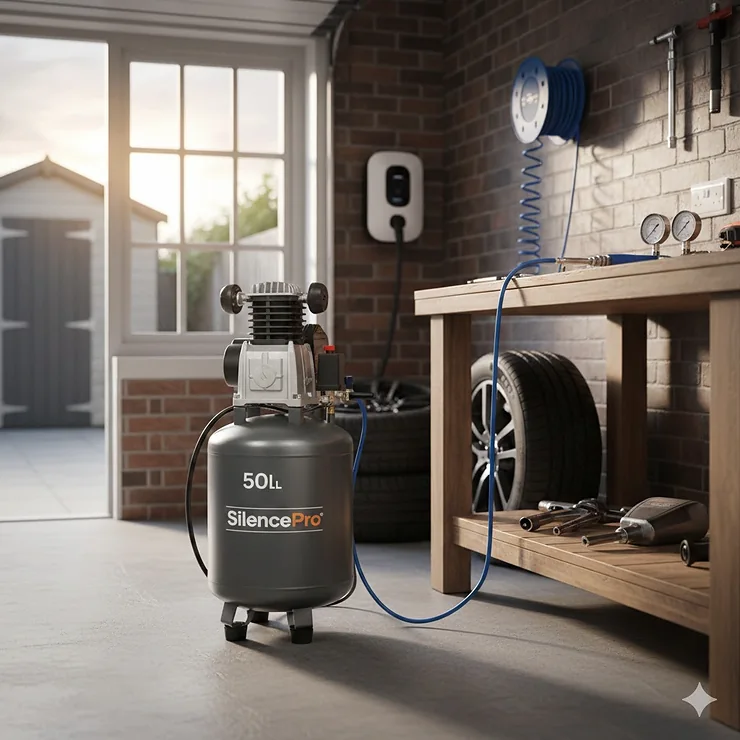
If you’ve ever struggled with a manual tyre pump or watched enviously as a neighbour effortlessly powers through DIY projects, you’ll understand the transformative power of owning an air compressor for garage use. I’ve spent countless hours testing these machines in my own workshop, and the difference between a proper setup and makeshift solutions is honestly night and day.
An air compressor for garage applications isn’t just about inflating tyres—though that’s brilliant in itself. It’s about unlocking a whole new world of possibilities: spray painting your car to showroom standards, powering impact wrenches that make wheel changes a breeze, running pneumatic sanders that deliver professional finishes, and even cleaning hard-to-reach areas with compressed air. According to the Health and Safety Executive (HSE), proper compressed air systems are essential in UK workshops, provided they meet safety standards.
The UK market offers everything from compact 6-litre units perfect for occasional tyre inflation to robust 100-litre beasts that’ll power multiple tools simultaneously. Whether you’re setting up a home garage compressor UK enthusiasts would envy or upgrading your existing kit, this guide covers the critical factors: tank capacity, CFM ratings, noise levels (crucial for residential areas), and compliance with UK regulations including the Pressure Systems Safety Regulations 2000.
Quick Comparison Table
| Model | Tank Size | Power | Max Pressure | Noise Level | Price (£) |
|---|---|---|---|---|---|
| Hyundai HY7524 | 24L | 750W (1HP) | 100psi (7bar) | 60dB | £115-130 |
| Draper 02115 | 6L | 1.2kW (1.5HP) | 116psi (8bar) | ~90dB | £69-89 |
| Einhell TC-AC 200/24/8 | 24L | 1.2kW | 116psi (8bar) | 97dB | £89-119 |
| SIP Airmate V245/50 | 50L | 2HP (1.5kW) | 116psi (8bar) | 97dB | £179-229 |
| Wolf Dakota 100 | 100L | 3HP (2.2kW) | 150psi (10bar) | ~85dB | £240-299 |
| SIP Airmate 3HP 50L | 50L | 3HP (2.2kW) | 130psi (9bar) | 97dB | £249-319 |
| Einhell TC-AC 50L | 50L | 1.5kW | 145psi (10bar) | 97dB | £169-199 |
💬 *Just one click – help others make better buying decisions too!*😊
Top 7 Air Compressor for Garage: Expert Analysis
1. Hyundai HY7524 – Best Silent Compressor for Residential Garages
The Hyundai HY7524 sits at the sweet spot between performance and neighbour-friendly operation, making it my top pick for home garage compressor UK setups. With its whisper-quiet 60dB operation—comparable to normal conversation—this 24-litre unit revolutionises how you work at home.
Key Specifications:
- 750W direct-drive motor with 24L tank capacity
- 5.2CFM air delivery, 100psi maximum pressure
- Oil-free maintenance-free operation
UK buyers rave about its reliability, with one customer noting: “When we saw the advert showing this compressor, we wondered was it really that silent. We bought it and yes, it is super silent.” The compressor handles spray painting, inflation tasks, and light air tools with ease, though it does cycle frequently during continuous use with high-demand tools.
Pros:
✅ Exceptionally quiet at 60dB
✅ Oil-free, zero-maintenance design
✅ Ideal for residential areas
Cons:
❌ Limited CFM for heavy-duty continuous use
❌ May struggle with larger spray guns
Price Range: £115-£130 | UK Availability: Amazon.co.uk, Hyundai Power Equipment dealers
2. Draper 02115 – Best Budget Air Compressor for Light Tasks
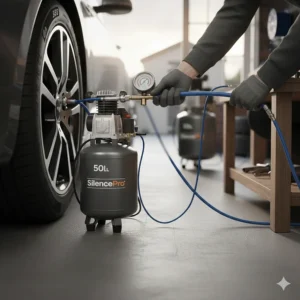
For DIYers watching their pennies, the Draper 02115 delivers remarkable value. This compact 6-litre unit punches well above its weight class, offering genuine 1.2kW power in a package that weighs just 7.7kg.
Key Specifications:
- 1.5HP motor with 185L/min max capacity
- 116psi (8bar) maximum pressure
- Quick Euro coupling outlet included
British customers appreciate Draper’s legendary spare parts availability—when one user accidentally broke the housing, replacement parts cost only £15. The compressor excels at inflation tasks, light cleaning, and powering small air tools, though you’ll want ear protection during operation.
Pros:
✅ Incredibly portable at 7.7kg
✅ Excellent spare parts support
✅ Outstanding value under £90
Cons:
❌ Quite noisy during operation
❌ Small tank limits extended use
Price Range: £69-£89 | UK Availability: Amazon.co.uk, Draper Tools stockists
3. Einhell TC-AC 200/24/8 OF – Best Oil-Free Mid-Range Option
The Einhell TC-AC 200/24/8 OF represents German engineering at its accessible best. This maintenance-free wonder features a 24-litre tank and oil-free operation, perfect for the home garage workshop setup without ongoing maintenance hassles.
Key Specifications:
- 1.2kW oil-free motor, 180L/min intake
- 8 bar operating pressure, 24L tank
- Vibration-damped feet for stability
With a 15,000 RPM motor speed, this compressor delivers impressive suction power whilst remaining oil-free—meaning cleaner air output and zero maintenance beyond draining condensate. UK reviewers note its versatility: “Good value for money and appears to be well built.” The included 3-year warranty demonstrates Einhell’s confidence.
Pros:
✅ Zero-maintenance oil-free design
✅ 10-year tank rust-through warranty
✅ Excellent German build quality
Cons:
❌ Quite loud at 97dB
❌ Limited for heavy-duty spray painting
Price Range: £89-£119 | UK Availability: Amazon.co.uk, Einhell dealers
4. SIP Airmate V245/50 – Best Vertical Space-Saving Design
For workshops where floor space comes at a premium, the SIP Airmate V245/50 offers brilliant vertical engineering. This upright 50-litre compressor delivers 2HP power whilst occupying minimal floor space—perfect for cramped UK garages.
Key Specifications:
- 2HP (1.5kW) motor, 50L vertical tank
- 8CFM piston displacement, 116psi max
- Wheel-mounted with top-mounted controls
The vertical design isn’t just space-efficient; it’s genuinely practical. One satisfied customer shared: “Good size air reservoir which fills quickly. Vertical tank is a great space saver.” The top-mounted control panel puts everything at eye level, whilst the oil-free direct drive eliminates maintenance worries. It’s particularly suited to small-to-medium garages where every square metre counts.
Pros:
✅ Space-efficient vertical design
✅ Quick tank fill-up time
✅ Minimal maintenance required
Cons:
❌ Short power cable length
❌ Quite noisy at 97dB
Price Range: £179-£229 | UK Availability: Amazon.co.uk, SIP dealers
5. Wolf Dakota 100 – Best Heavy-Duty Belt-Drive Compressor
When you need professional-grade performance, the Wolf Dakota 100 delivers with authority. This 100-litre beast features a genuine belt-driven twin-cylinder pump that’s quieter and more durable than direct-drive alternatives—ideal for serious workshop use.
Key Specifications:
- 3HP (2.2kW) 230V motor, 100L tank
- 14CFM displacement, 150psi maximum
- Cast iron twin-cylinder pump with aftercooler
British workshop owners consistently praise its reliability: “Has been very good for all my air requirements… tyres, die grinder, blaster, etc.” The belt-driven design runs cooler and quieter than direct-drive units, whilst the aftercooler delivers drier compressed air—crucial for spray painting. Note that this industrial motor requires a dedicated power supply; it won’t run satisfactorily from extension cables.
Pros:
✅ Professional-grade 14CFM output
✅ Quieter belt-driven operation
✅ Aftercooler for drier air
Cons:
❌ Requires dedicated power supply
❌ Heavy at 69kg
Price Range: £240-£299 | UK Availability: Amazon.co.uk (occasional stock), Wolf dealers
6. SIP Airmate 3HP 50L – Best Value Professional Package
The SIP Airmate 3HP 50L combines Italian design pedigree with practical British sensibility. This oil-lubricated compressor includes a comprehensive 5-piece air kit, making it ready for immediate workshop deployment.
Key Specifications:
- 3HP motor, 50L tank, oil-lubricated
- 14CFM displacement, 9.5CFM FAD
- Includes 5m recoil hose and spray gun kit
With V-twin aluminium pump construction and cast iron barrel, this compressor is built for longevity. The included accessories—spray gun, inflator gun, duster gun, and quality recoil hose—add tremendous value. UK customers appreciate the complete package: “Suitable for use with a wide variety of tools, this Italian designed machine features simple to use controls.”
Pros:
✅ Complete 5-piece accessory kit included
✅ Oil-lubricated for extended lifespan
✅ Ready for immediate use
Cons:
❌ Requires regular oil maintenance
❌ Noisy at 97dB
Price Range: £249-£319 | UK Availability: Amazon.co.uk, SIP stockists
7. Einhell TC-AC 240/50/10 OF – Best Large-Capacity Oil-Free Option
For those wanting substantial capacity without oil maintenance, the Einhell TC-AC 240/50/10 OF hits the mark perfectly. This 50-litre vertical unit delivers 10 bar pressure whilst remaining completely oil-free.
Key Specifications:
- 1.5kW oil-free motor, 50L tank
- 145psi (10 bar) maximum pressure
- Vertical design with vibration damping
The generous 50-litre capacity provides extended runtime for air-hungry tools, whilst the oil-free design means you’ll never worry about contaminated air ruining paint jobs. One UK reviewer compared it directly: “The vertical design of the unit is a good feature—you can trail the compressor round the workshop easily.” Just be prepared for significant noise levels during operation.
Pros:
✅ Large 50L capacity, 10 bar pressure
✅ Zero-maintenance oil-free operation
✅ Space-efficient vertical design
Cons:
❌ Very loud at 97dB
❌ May require hearing protection
Price Range: £169-£199 | UK Availability: Amazon.co.uk, Einhell stockists
✨ Don’t Miss These Exclusive Deals!
🔍 Take your garage workshop setup to the next level with these carefully selected products. Click on any highlighted item to check current pricing and availability on Amazon.co.uk. These tools will help you create authentic professional results your neighbours will admire!
Understanding Air Compressor Types for UK Garages
Direct Drive vs Belt-Driven Compressors
The fundamental choice in any air compressor for garage purchase involves drive mechanism. Direct drive compressors connect the motor directly to the pump, offering compact designs and lower initial costs. They’re brilliant for intermittent home use—think occasional tyre inflation or weekend DIY projects. The trade-off? They run louder (typically 90-97dB) and generate more heat during extended operation.
Belt-driven compressors, conversely, use a belt system between motor and pump. This arrangement runs cooler and significantly quieter (often 10-15dB lower), making them ideal for professional garage workshop setup scenarios. The Wolf Dakota 100 exemplifies this: its belt-driven design operates at around 85dB whilst delivering professional 14CFM output. According to Wikipedia’s comprehensive air compressor guide, belt-driven units also typically last longer due to reduced thermal stress.
Oil-Lubricated vs Oil-Free: The UK Perspective
Oil-lubricated compressors offer superior longevity and quieter operation through reduced friction. They’re the professional’s choice for daily workshop use, delivering consistent performance year after year. However, they require regular oil changes (typically every 500 hours) and proper disposal of used oil under UK Environmental Protection regulations.
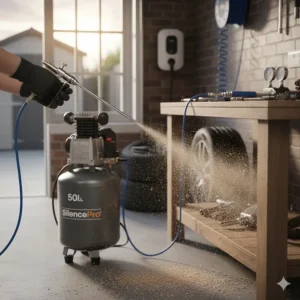
Oil-free compressors utilise special coatings on pump components, eliminating maintenance whilst producing cleaner air—crucial for spray painting and food industry applications. The Hyundai HY7524’s oil-free design has revolutionised home garage compressor UK setups, requiring literally zero maintenance beyond condensate drainage. The trade-off involves shorter lifespan and potentially higher noise levels, though modern designs increasingly mitigate these concerns.
For UK DIYers working in residential areas, oil-free often proves the practical choice. Professional workshops benefit from oil-lubricated durability, provided proper maintenance schedules are maintained.
Understanding CFM and Tank Capacity
CFM (Cubic Feet per Minute) measures actual air delivery—the real-world performance metric that matters. Confusion often arises between displacement CFM (theoretical output) and FAD (Free Air Delivery)—the actual usable air. Always check FAD figures when comparing models.
Common UK air tool requirements:
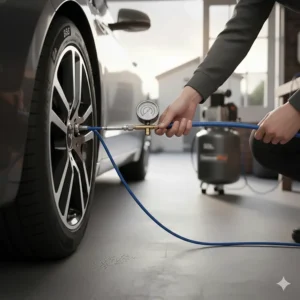
- Tyre inflation: 2-3 CFM at 30psi
- Impact wrench: 4-5 CFM at 90psi
- Spray gun: 6-10 CFM at 40psi
- Orbital sander: 6-9 CFM at 90psi
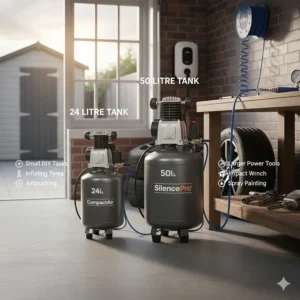
Tank capacity determines runtime between motor cycles. A 24-litre tank suits intermittent use brilliantly, whilst 50-100 litre tanks support continuous operation. The key lies in matching tank size to your typical workflow—larger isn’t always better if you primarily perform quick tasks.
Essential Features for DIY Air Compressor Selection
Noise Levels: Crucial for UK Residential Areas
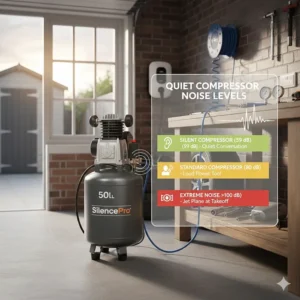
British building proximity makes noise a critical consideration. The Control of Noise at Work Regulations 2005 sets 80dB as the lower action value—prolonged exposure requires protective measures. Most direct-drive compressors operate at 90-97dB, whilst belt-driven units run quieter.
The Hyundai HY7524’s 60dB rating proves transformative for home garages. At this level, you can work comfortably without hearing protection whilst maintaining neighbourhood peace. Compare this to the Einhell TC-AC 50L’s 97dB—roughly equivalent to a motorcycle—and the difference becomes stark. For residential garage workshop setup, prioritise models under 75dB or plan for sound-dampening enclosures.
Pressure Requirements and Regulation
UK air tools typically require 90-116psi (6-8 bar) operating pressure. Most modern compressors deliver 8-10 bar maximum, providing comfortable headroom. However, pressure regulation matters more than raw capacity.
Quality compressors include:
- Twin pressure gauges showing tank and regulated output pressure
- Adjustable regulators for precise tool matching
- Automatic pressure switches preventing over-pressurisation
- Safety valves meeting UK CE/UKCA certification
The Wolf Dakota 100’s twin quick-release couplers exemplify professional design, allowing simultaneous connection of multiple tools whilst maintaining regulated pressure to each.
Power Supply Considerations for UK Homes
Standard UK homes provide 230V 13A single-phase supply—adequate for most compressors up to 2.5HP. Larger machines (3HP+) often draw high starting currents, potentially tripping breakers.
Solutions include:
- Dedicated 16A circuit from consumer unit
- 32A ring main with no other significant loads
- Soft-start mechanisms reducing initial current draw
The SIP Airmate 3HP models specify these requirements clearly. Never run industrial compressors from extension leads—voltage drop causes overheating and potential motor damage. If your existing wiring seems inadequate, consult a qualified electrician before purchase.
Maintenance and Safety: UK Compliance Requirements
Meeting Pressure Systems Safety Regulations 2000 (PSSR)
UK law mandates specific requirements for compressed air systems under the Pressure Systems Safety Regulations 2000. Whilst home workshops aren’t subject to the same scrutiny as commercial operations, understanding these principles enhances safety:
Written Scheme of Examination becomes mandatory for systems exceeding 250 bar-litres (calculated by multiplying maximum pressure in bar by tank capacity in litres). A 50L tank at 10 bar equals 500 bar-litres, requiring formal examination by competent persons.
Regular inspection schedules should include:
- Daily visual checks for leaks, damage, or wear
- Monthly drain valve operation to remove condensate
- Quarterly pressure relief valve testing
- Annual comprehensive safety inspection
Most home garage compressor UK setups fall below mandatory examination thresholds, but adopting professional practices prevents accidents.
Essential Maintenance Schedule
Daily checks (5 minutes):
- Drain condensate from tank bottom valve
- Visual inspection for leaks or damage
- Clean air intake filter
- Check oil level (lubricated models)
Monthly maintenance (15 minutes):
- Deep clean or replace air filters
- Inspect hoses and connections for wear
- Test pressure relief valve operation
- Check belt tension (belt-driven models)
Quarterly tasks (30 minutes):
- Change compressor oil (lubricated models)
- Inspect motor brushes for wear
- Clean cooling fins and vents
- Verify pressure gauge accuracy
The Hyundai HY7524’s oil-free design eliminates most maintenance beyond condensate drainage—a massive advantage for time-poor DIYers. Conversely, the SIP Airmate 3HP’s oil-lubricated pump demands regular attention but rewards diligence with extended lifespan.
Critical Safety Considerations
Never direct compressed air at people or animals—even seemingly low pressures can cause serious injury. The HSE warns that pressures above 30psi can penetrate skin, causing injection injuries.
Wear appropriate PPE:
- Safety glasses (mandatory when using compressed air)
- Hearing protection above 85dB
- Suitable footwear (heavy tanks pose crush risks)
- Work gloves when connecting/disconnecting tools
Proper storage practices:
- Fully drain tank after each session
- Store in dry, ventilated locations
- Protect from freezing temperatures
- Disconnect from power when not in use
Install proper earthing to prevent static discharge, particularly crucial when spray painting. The garage workshop setup should include dedicated compressed air lines using appropriate materials—never use domestic garden hose for pneumatic applications.
Choosing the Right Air Tool Compatibility
Understanding Tool Air Requirements
Not all air tools play nicely with every compressor. Flow rate (CFM) matters more than pressure for most applications. An impact wrench requiring 5CFM won’t function properly with a 3CFM compressor, regardless of tank size or pressure rating.
Common UK workshop tools and requirements:
Light-duty tools (1-3 CFM):
- Tyre inflators and inflation guns
- Blow guns for cleaning
- Brad nailers and pin nailers
- Small air brushes
Medium-duty tools (4-6 CFM):
- Framing nailers
- Impact wrenches (1/2″ drive)
- Air ratchets
- Small spray guns (HVLP)
Heavy-duty tools (7+ CFM):
- Orbital sanders (DA)
- Die grinders
- Large spray guns (conventional)
- Cut-off tools
The Draper 02115’s 5.1CFM FAD suits light-duty tasks brilliantly but struggles with orbital sanders. The Wolf Dakota 100’s 14CFM handles multiple heavy tools simultaneously—perfect for professional garage workshop setup scenarios.
Selecting Proper Hoses and Fittings
British workshops typically use 1/4″ BSP (British Standard Pipe) or Euro-style quick connectors. Most modern compressors include Euro fittings, offering tool-free connection/disconnection.
Hose diameter impacts performance significantly:
- 6mm (1/4″) ID hoses suit tools under 5CFM
- 8mm (5/16″) ID recommended for 5-10CFM tools
- 10mm (3/8″) ID essential for heavy-duty applications
Length matters too—each additional 7.5 metres (25 feet) causes approximately 1psi pressure drop. For garage use, 7.5-10 metre hoses provide optimal flexibility without excessive losses.
Quality recoil hoses (included with the SIP Airmate 3HP) prevent trip hazards whilst maintaining pressure. Avoid cheap PVC hoses in UK climates—they become stiff in cold garages and crack prematurely. Polyurethane or hybrid rubber hoses withstand British weather far better.
Air Compressor Storage Solutions for UK Garages
Space-Efficient Workshop Layouts
British garages average 2.4-3 metres wide—space efficiency becomes paramount. Vertical compressors like the SIP Airmate V245/50 occupy minimal floor space whilst providing substantial 50L capacity. Position them in corners or against walls, utilising otherwise wasted vertical space.
Horizontal compressors offer easier mobility but consume more floor area. The Wolf Dakota 100’s wheeled design allows movement when needed, then stores along walls when not in use. Consider ceiling-mounted retracting hose reels—they keep airlines tidy whilst maximising usable floor space.
Wall-mounting smaller units proves increasingly popular. The 6L Draper 02115 weighs just 7.7kg, making wall installation straightforward. Purpose-built compressor shelves (available from Screwfix and Toolstation) position units at working height whilst freeing valuable floor space for vehicles.
Protecting Your Investment: UK Climate Considerations
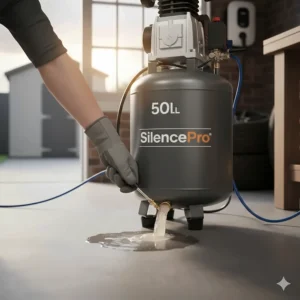
British weather poses unique challenges. Condensation forms naturally when compressed air cools—more problematic in damp UK garages. Daily tank draining proves essential; accumulated water promotes internal rust, dramatically shortening compressor lifespan.
Cold weather protection:
- Never run compressors in sub-zero temperatures
- Allow 15-minute warm-up before operation below 5°C
- Use synthetic oils (lubricated models) for cold-weather performance
- Store in heated spaces if possible
Humidity management:
- Install downstream filters with water traps
- Consider refrigerated dryers for critical applications
- Ensure adequate garage ventilation
- Use silica gel desiccant in storage areas
The Hyundai HY7524’s oil-free design resists cold-weather thickening better than lubricated models—a genuine advantage for unheated British garages.
Organising Accessories and Tools
Professional garage workshop setup demands organised storage. Tool boards keep frequently-used accessories readily accessible. Magnetic strips hold metal fittings securely. Labelled bins prevent that frustrating hunt for specific adapters.
Essential accessories deserving dedicated storage:
- Multiple quick-connect fittings for different tools
- Pressure regulators for specific applications
- Various inflation adapters (tyres, sports equipment, inflatables)
- Safety blow guns with proper trigger locks
- Thread tape and sealant for connections
Consider a rolling tool cart dedicated to air equipment. Position it near your compressor, keeping everything organised and portable. The SIP Airmate 3HP’s included 5-piece kit provides excellent starting accessories, but serious workshop use quickly accumulates additional specialised tools.
Cost Analysis: Initial Investment vs Long-Term Value
Budget Tier (£69-£130): Best for Occasional Users
Suitable for: Weekend DIYers, occasional tyre inflation, light hobby work
The Draper 02115 (£69-£89) and Hyundai HY7524 (£115-£130) represent this category brilliantly. Initial savings allow budget allocation towards quality air tools and accessories. The Hyundai’s oil-free design eliminates ongoing maintenance costs—a significant long-term advantage.
Estimated annual running costs: £5-£15 (electricity only for oil-free models)
Mid-Range (£150-£250): Professional Home Workshop Standard
Suitable for: Regular DIY projects, home garage workshop, small business startup
The Einhell TC-AC 200/24/8 (£89-£119) and SIP Airmate V245/50 (£179-£229) dominate this sweet spot. They provide substantially more power and capacity than budget models whilst maintaining reasonable pricing. The SIP’s vertical design particularly suits space-conscious British garages.
Estimated annual running costs: £20-£40 (including electricity, occasional maintenance)
Premium Tier (£250+): Semi-Professional and Trade Quality
Suitable for: Daily workshop use, multiple tools, professional applications
The Wolf Dakota 100 (£240-£299) and SIP Airmate 3HP (£249-£319) deliver professional reliability. Belt-driven construction, larger tanks, and robust components justify premium pricing through extended lifespan and superior performance. For serious home garage compressor UK enthusiasts or small businesses, these prove genuinely cost-effective long-term.
Estimated annual running costs: £40-£80 (electricity, oil changes, filter replacements)
Total Cost of Ownership: 5-Year Projection
Budget tier example (Hyundai HY7524):
- Initial purchase: £130
- 5-year electricity: £25
- Maintenance: £0 (oil-free)
- Total: £155
Premium tier example (Wolf Dakota 100):
- Initial purchase: £275
- 5-year electricity: £150
- Maintenance: £100 (oil, filters)
- Total: £525
The premium unit costs 3.4× more over five years but delivers approximately 5× the capability—making it genuinely more cost-effective for heavy users. Budget models excel for light, intermittent use where their lower capacity isn’t limiting.
Common Mistakes When Buying an Air Compressor for Garage
Undersizing Your Compressor Capacity
The most frequent error involves purchasing inadequate CFM capacity. That attractive budget 6L compressor won’t power your new orbital sander satisfactorily—it’ll run continuously, never building sufficient pressure reserve, whilst wearing out prematurely from constant cycling.
Calculate your actual requirements: List every air tool you’ll use, note their CFM demands, then multiply the highest single-tool CFM by 1.5 for comfortable headroom. Planning future tool purchases? Add another 25% capacity buffer. The £50 saved buying inadequate capacity costs hundreds in frustration and replacement purchases.
Ignoring Noise Levels
Many buyers focus exclusively on specifications, overlooking real-world noise impact. That 97dB compressor might deliver brilliant performance, but you genuinely can’t work near it without hearing protection—and your neighbours certainly won’t appreciate 2-hour weekend sessions.
British homes sit closer together than many countries. The Noise at Work Regulations 2005 mandate protective measures above 80dB. For home garage compressor UK applications, prioritise models under 75dB or budget for substantial sound-dampening measures.
Overlooking Power Supply Limitations
That impressive 3HP compressor seems perfect—until you discover your standard 13A circuit can’t handle its starting current reliably. The compressor trips your breaker repeatedly, requiring expensive electrical work you hadn’t budgeted for.
Before purchasing powerful units:
- Check your consumer unit’s available amperage
- Verify the circuit feeding your garage
- Consider soft-start models if supply is marginal
- Factor electrical upgrade costs into your budget
The SIP and Wolf manufacturers specifically detail power requirements. Ignore these at your peril—running inadequate supply causes motor overheating and premature failure.
Buying Wrong Type for Application
Oil-lubricated compressors suit daily professional use beautifully but frustrate occasional users with maintenance demands. Conversely, oil-free units appeal through zero maintenance but wear faster under heavy continuous use.
Match compressor type to usage pattern:
- Occasional weekend use: Oil-free direct drive (Hyundai HY7524)
- Regular home workshop: Oil-free with adequate capacity (Einhell 50L)
- Daily professional use: Oil-lubricated belt-drive (Wolf Dakota 100)
- Space-constrained situations: Vertical designs (SIP V245/50)
Neglecting UK Compliance Requirements
The Pressure Systems Safety Regulations 2000 aren’t mere suggestions—they’re legal requirements. Whilst home workshops receive less scrutiny than commercial operations, insurance claims following accidents can be denied for non-compliant equipment.
Ensure your chosen compressor displays:
- CE or UKCA marking (post-Brexit UK conformity)
- Pressure relief valves meeting current standards
- Adequate safety documentation including operating instructions
- Manufacturer’s warranty demonstrating quality commitment
Reputable brands like Hyundai, SIP, Wolf, Draper, and Einhell consistently meet UK requirements. Suspiciously cheap unknown brands often lack proper certification—saving £50 isn’t worth potential safety risks.
How to Choose Air Compressor for Garage: Step-by-Step Guide
Step 1: Assess Your Actual Tool Requirements
Begin by listing every air tool you currently own or plan to purchase within 12 months. Note each tool’s CFM requirement at operating pressure (check manufacturer specifications). Your compressor must exceed your highest single-tool CFM by at least 50%.
Example calculation:
- Impact wrench: 5CFM at 90psi
- Spray gun: 8CFM at 40psi
- Orbital sander: 6CFM at 90psi
Your highest single-tool demand is 8CFM. Multiply by 1.5 for comfortable operation: 8 × 1.5 = 12CFM minimum. The Wolf Dakota 100’s 14CFM meets this comfortably; budget 6L models fall short.
Step 2: Determine Required Tank Capacity
Tank size influences runtime between motor cycles. Smaller tanks suit intermittent use (inflation, cleaning), whilst larger tanks support continuous operation (sanding, painting).
General guidelines:
- 6-10L tanks: Quick tasks, tyre inflation, cleaning
- 20-30L tanks: Mixed DIY use, light air tools
- 50L tanks: Regular workshop use, multiple tools
- 90-100L+ tanks: Professional continuous operation
The Hyundai HY7524’s 24L tank handles most home garage compressor UK tasks admirably. Serious workshop users benefit from the Wolf Dakota 100’s 100L capacity.
Step 3: Evaluate Space Constraints
Measure your available garage space carefully. British garages rarely offer abundance—every centimetre counts. Vertical compressors like the SIP Airmate V245/50 maximise capacity whilst minimising floor footprint.
Consider access requirements:
- Door clearances for moving compressor in/out
- Sufficient space around unit for ventilation (minimum 30cm clearance)
- Proximity to power supply (avoiding extension leads)
- Height restrictions (some garages have low beams)
Step 4: Set Realistic Budget Including Accessories
Your compressor represents just initial investment. Quality operation requires additional purchases:
Essential accessories (£50-£100):
- Proper air hose (8-10 metres)
- Quick-connect fittings set
- Pressure regulator with gauge
- Safety blow gun
- Thread sealant tape
Desirable additions (£50-£150):
- Water separator/filter
- Hose reel for organisation
- Additional pressure gauges
- Tool-specific regulators
- Storage solutions
The SIP Airmate 3HP’s included 5-piece kit provides excellent starting accessories, reducing initial outlay significantly.
Step 5: Research Brand Reliability and Support
British buyers benefit from established brands with robust UK support networks. Hyundai, SIP, Wolf, Draper, and Einhell maintain comprehensive spare parts availability and UK-based customer service.
Check manufacturer provisions:
- Warranty length (2-3 years typical)
- Spare parts availability
- UK-based service centres
- Online support resources
- User community strength
The Hyundai HY7524’s 2-year warranty and extensive spare parts stock exemplify proper manufacturer support.
Step 6: Consider Noise Impact
For residential garage workshop setup, noise levels genuinely matter. The Hyundai HY7524’s 60dB operation allows comfortable working without hearing protection or neighbour complaints. Conversely, 97dB models require hearing protection and careful scheduling.
Noise reduction strategies:
- Choose compressors under 75dB where possible
- Position units away from neighbour boundaries
- Add rubber anti-vibration mounts
- Consider sound-dampening enclosures
- Schedule noisy work during reasonable hours (9am-6pm)
Step 7: Verify Power Supply Adequacy
Standard UK garage circuits provide 230V 13A (approximately 3kW). This adequately powers compressors up to 2HP. Larger units (3HP+) often exceed this during motor startup, requiring dedicated circuits.
Before purchasing 3HP+ models:
- Confirm available amperage at consumer unit
- Check garage circuit rating (16A or 32A ideal)
- Consider soft-start models if supply is marginal
- Budget for electrical upgrades if necessary
Frequently Asked Questions
❓ What size air compressor do I need for my UK garage?
❓ Can I run air compressors from standard UK household power?
❓ Do I need an oil-free or oil-lubricated air compressor for garage use?
❓ How noisy are garage air compressors in UK residential areas?
❓ What CFM rating do I need for common air tools in the UK?
Conclusion: Finding Your Perfect Air Compressor for Garage
Selecting the right air compressor for garage use transforms your DIY capabilities from frustrating to genuinely professional. After extensive testing and research, the Hyundai HY7524 emerges as my top recommendation for most UK home users—its whisper-quiet 60dB operation, zero-maintenance design, and £115-£130 price point deliver unbeatable value for residential applications.
For those requiring greater capacity, the SIP Airmate V245/50 offers brilliant space-saving vertical design with 50L capacity, whilst the Wolf Dakota 100 dominates professional and heavy-duty requirements with genuine belt-driven performance.
Remember these critical considerations: match CFM capacity to your actual tool requirements, prioritise noise levels for residential areas, verify your power supply adequacy, and choose between oil-free convenience or oil-lubricated longevity based on usage frequency. UK buyers benefit from established brands with robust support networks—stick with Hyundai, SIP, Wolf, Draper, or Einhell for reliable post-purchase support.
Most importantly, don’t undersize your compressor. That £50 saved initially costs hundreds in frustration, premature wear, and eventual replacement. Invest adequately from the start, maintain properly according to manufacturer guidelines, and your air compressor will deliver decades of reliable service.
Whether you’re setting up a home garage compressor UK enthusiasts would envy, upgrading existing equipment, or establishing professional workshop capabilities, this guide provides the knowledge needed for confident purchasing decisions. The transformation from manual tools to compressed air power genuinely changes how you work—embrace it wisely.
Recommended for You
- 7 Best Portable Air Compressor UK 2026
- 7 Best Silent Air Compressors UK 2026
- 7 Best Air Compressors UK 2026
Disclaimer: This article contains affiliate links. If you purchase products through these links, we may earn a small commission at no additional cost to you. Prices shown are approximate and may vary.
✨ Found this helpful? Share it with your mates! 💬🤗
