
In This Article
Picture this: you’re standing in your local garden centre, palms sweaty, surrounded by gleaming chainsaws. The chap next to you swears by his Stihl, whilst the neighbour across the fence won’t shut up about his Husqvarna. Welcome to the great chainsaw debate that’s divided Britain’s gardeners and professionals for decades.
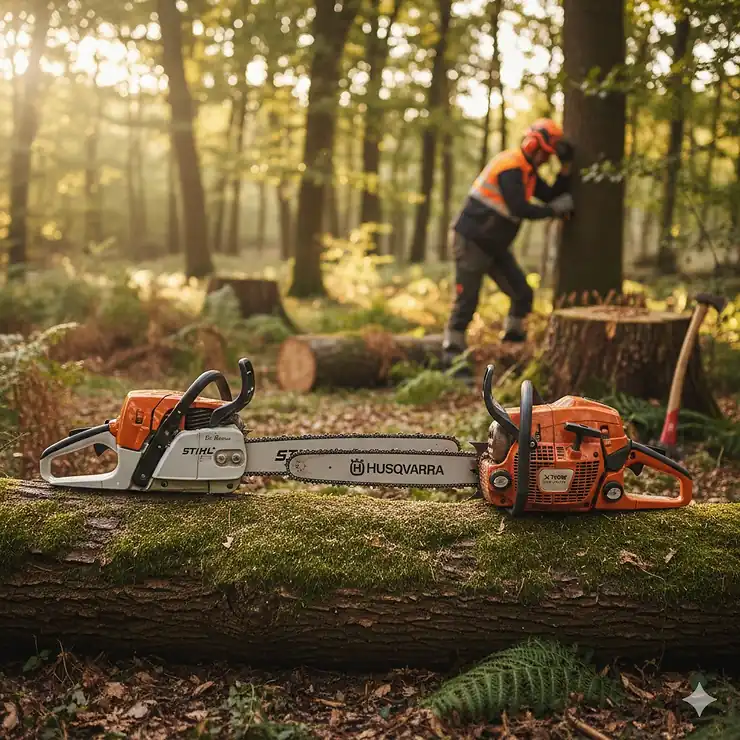
When it comes to the Stihl vs Husqvarna chainsaw conversation, we’re talking about two German and Swedish engineering powerhouses that have shaped the industry since the early 20th century. But here’s the thing – choosing between them isn’t just about brand loyalty or which logo looks better on your shed wall. It’s about understanding what each brand brings to your specific cutting needs, whether you’re tackling weekend firewood duties or running a professional tree surgery business.
Throughout this comprehensive guide, we’ll dissect real-world performance, examine pricing across budget and premium segments, and help you determine which brand deserves your hard-earned pounds. I’ve spent considerable time researching both manufacturers, analysing user feedback from UK buyers, and examining the technical specifications that actually matter when you’re knee-deep in woodchips. No fluff, no corporate waffle – just honest insights to help you make the right choice for your requirements.
Quick Comparison Table: Stihl vs Husqvarna at a Glance
| Feature | Stihl | Husqvarna |
|---|---|---|
| Origin | Germany (Founded 1926) | Sweden (Founded 1689) |
| Power Delivery | Strong low-end torque | Higher RPM, smoother revving |
| Starting System | Easy2Start technology | Smart Start with reduced resistance |
| Vibration Control | Solid anti-vibration | Superior LowVib dampening |
| Price Range (UK) | £150-£1,400+ | £130-£1,300+ |
| Fuel Efficiency | Good, M-Tronic adjustment | Excellent, X-Torq 20% improvement |
| Build Quality | Robust, traditional feel | Ergonomic, lighter handling |
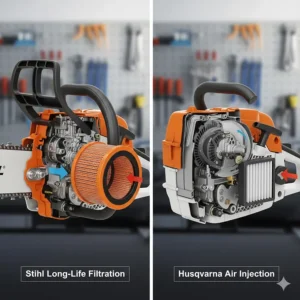
| Air Filtration | Standard to advanced | Air Injection pre-cleaning |
| Dealer Network | Extensive UK coverage | Wide availability |
| Best For | Professional durability, tough jobs | All-day comfort, fuel economy |
💬 Just one click – help others make better buying decisions too!😊
Top 7 Chainsaw Models: Expert Analysis (Stihl vs Husqvarna)
1. Stihl MS 170 – Best Entry-Level Petrol Saw
The Stihl MS 170 serves as the gateway drug for many first-time chainsaw buyers, and there’s good reason it’s remained a bestseller since its 2002 launch. This lightweight petrol saw packs a 30.1cc engine generating 1.3kW (1.8HP) at 8,500 RPM – modest numbers, perhaps, but perfectly adequate for pruning, light firewood cutting, and occasional garden maintenance.
Key Specifications:
- Engine displacement: 30.1cc
- Power output: 1.3kW (1.8HP)
- Weight: 4.1kg (without bar and chain)
- Recommended bar length: 30cm (12″) to 35cm (14″)
- Fuel tank capacity: 250ml
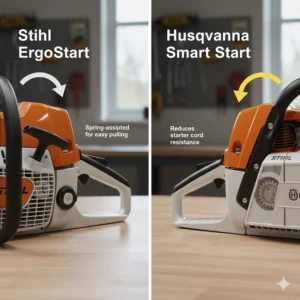
The saw’s simplicity is its strength. There’s no complicated technology here – just reliable two-stroke performance that starts consistently (though Stihl’s ErgoStart on the C-BQ version makes this even easier). UK buyers frequently praise its manageable weight and straightforward maintenance requirements, though some note the manual chain tensioner can be fiddly for beginners wearing gloves.
UK Price Range: £160-£280
Pros:
✅ Exceptionally lightweight for extended use
✅ Proven reliability over two decades
✅ Widely available parts through UK dealers
Cons:
❌ Basic features compared to competitors
❌ Limited power for anything beyond light-duty work
2. Husqvarna 435 – Mid-Range All-Rounder
Step up to the Husqvarna 435 and you’ll immediately notice the Swedish attention to user comfort. This 40.9cc chainsaw delivers 2.2HP whilst incorporating Smart Start technology that reduces starter cord resistance by up to 40% – a genuine blessing on cold British mornings when your shoulder’s already aching from yesterday’s efforts.
Key Specifications:
- Engine displacement: 40.9cc
- Power output: 1.6kW (2.2HP)
- Weight: 4.4kg (without bar and chain)
- Bar length options: 13″ (33cm) or 15″ (38cm)
- X-Torq engine for 20% fuel savings
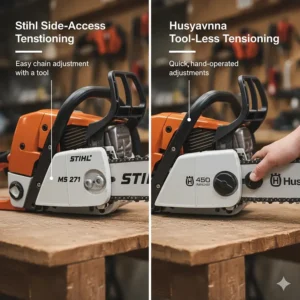
What sets this model apart is the combination of Air Injection pre-cleaning (extending filter life considerably) and LowVib anti-vibration technology. Several professional landscapers I’ve spoken with mention they can run this saw for 3-4 hours without the hand numbness that plagues other brands. The side-mounted chain tensioner keeps your digits safely away from the chain whilst adjusting tension.
UK Price Range: £280-£380
Pros:
✅ Excellent fuel economy extends working time
✅ Superior vibration dampening reduces fatigue
✅ Easy cold starts in UK weather conditions
Cons:
❌ Plastic side case less durable than aluminium
❌ Slightly heavier than comparable Stihl models
3. Stihl MSA 60 C-B – Top Cordless for Homeowners
Battery technology has transformed the chainsaw landscape, and the Stihl MSA 60 C-B represents the brand’s answer to homeowners seeking emission-free operation. This compact cordless chainsaw runs on Stihl’s AP battery system, offering surprising performance from its 30cm bar – perfectly adequate for pruning, small tree work, and cutting logs up to 20cm diameter.
Key Specifications:
- Battery: 36V Li-ion (AP System)
- Bar length: 30cm with PM3 chain
- Weight: 2.9kg (without battery)
- Runtime: 30-45 minutes with AP 200 battery
- Tool-free chain tensioning
UK buyers particularly appreciate the near-silent operation (essential if you’ve got tetchy neighbours) and zero maintenance beyond chain sharpening and occasional bar oil top-ups. The potentiometer-style trigger allows continuous speed adjustment, giving you precise control when working near fences or structures. However, the battery runtime means this isn’t suited for all-day forestry work – you’ll want multiple batteries for extended sessions.
UK Price Range: £165-£195 (body only), £280-£350 (with battery and charger)
Pros:
✅ Zero emissions and minimal noise
✅ Instant start, no fuel mixing hassles
✅ Lightweight handling reduces operator fatigue
Cons:
❌ Limited runtime requires battery swaps
❌ Less power than equivalent petrol models
4. Husqvarna 440 e-series – Robust Semi-Professional Choice
The Husqvarna 440 targets that sweet spot between homeowner and professional use – what I call the “serious weekend warrior” territory. With its 40.9cc X-Torq engine producing 2.4HP, this saw handles everything from felling medium trees to processing firewood stacks, all whilst delivering impressive fuel efficiency that saves you trips to the petrol station.
Key Specifications:
- Engine displacement: 40.9cc
- Power output: 1.8kW (2.4HP)
- Weight: 4.4kg (power head only)
- Bar length: 15″ (38cm) or 18″ (45cm)
- Flip-up fuel tank cap for easy refilling
This model incorporates Smart Start and Air Injection as standard, but adds an automatic oiler that ensures consistent bar lubrication regardless of cutting conditions. UK users report this saw excels at cutting seasoned hardwoods – oak, ash, beech – without bogging down under load. Some buyers mention initial idling issues straight from the box, requiring a brief run-in period to optimise performance.
UK Price Range: £320-£420
Pros:
✅ Excellent power-to-weight ratio
✅ Comfortable for extended cutting sessions
✅ Handles hardwoods with confidence
Cons:
❌ May require carburettor adjustment initially
❌ Chain tensioning system less intuitive than Stihl’s
5. Stihl MS 271 Farm Boss – Professional-Grade Workhorse
If you’re earning a living with your chainsaw, the Stihl MS 271 Farm Boss deserves serious consideration. This 50.2cc powerhouse generates 2.6kW (3.49HP) – enough grunt to handle demanding forestry work, land clearing, and commercial firewood operations. The “Farm Boss” moniker isn’t marketing hyperbole; this saw’s built for sustained professional use where reliability isn’t negotiable.
Key Specifications:
- Engine displacement: 50.2cc
- Power output: 2.6kW (3.49HP)
- Weight: 5.6kg (power head)
- Max RPM: 13,500
- Side-access chain tensioner
Stihl’s engineering shines through in the details: an advanced anti-vibration system, pre-separation air filter increasing intervals between cleanings, and a decompression valve reducing starting effort. UK tree surgeons consistently praise the MS 271’s ability to maintain power delivery throughout long working days, though the additional weight compared to lighter models becomes noticeable during overhead work.
UK Price Range: £420-£550
Pros:
✅ Professional-grade power and reliability
✅ Excellent torque at lower RPM ranges
✅ Proven durability in commercial applications
Cons:
❌ Heavier than competitors in this class
❌ Higher initial investment than homeowner models
6. Husqvarna 450 Rancher – Ultimate DIY Powerhouse
The Husqvarna 450 Rancher occupies similar territory to the Stihl MS 271, but with Husqvarna’s characteristic focus on operator comfort and fuel efficiency. Its 50.2cc X-Torq engine delivers 3.2HP whilst achieving up to 20% better fuel economy than comparable non-X-Torq models – a significant saving when you’re burning through tanks during harvest season.
Key Specifications:
- Engine displacement: 50.2cc
- Power output: 2.4kW (3.2HP)
- Weight: 5.1kg (power head)
- Bar length: 15″ (38cm) to 20″ (50cm)
- Combined start/stop switch simplifies operation
This model adds LowVib technology that genuinely transforms the cutting experience during marathon firewood processing sessions. UK buyers report the Rancher feels noticeably lighter and more manoeuvrable than similarly powered competitors, making it ideal for property owners maintaining larger estates or hobby farmers managing woodlots. The inertia-activated chain brake provides additional peace of mind for less experienced operators.
UK Price Range: £380-£490
Pros:
✅ Superior fuel efficiency reduces operating costs
✅ Comfortable for all-day use
✅ Lighter than equivalent Stihl models
Cons:
❌ Some users report occasional starting difficulties
❌ Build quality feels slightly less robust than Stihl
7. Stihl MS 500i – Cutting-Edge Professional Technology
For professionals who demand absolute cutting-edge performance, the Stihl MS 500i represents the pinnacle of chainsaw engineering. This revolutionary saw introduces electronically controlled fuel injection to the chainsaw world – the first production model to do so. The result? Instant throttle response, consistent power across all altitudes and temperatures, and impressive fuel efficiency despite its formidable 79.2cc displacement.
Key Specifications:
- Engine displacement: 79.2cc
- Power output: 5.0kW (6.7HP)
- Weight: 6.2kg (power head)
- Electronic fuel injection technology
- M-Tronic intelligent engine management
The MS 500i eliminates carburettor adjustments entirely, automatically compensating for fuel quality, altitude changes, and temperature variations. UK forestry contractors report this translates to zero downtime for tuning and consistent performance whether working in Scottish highlands or southern lowlands. The saw’s phenomenal power-to-weight ratio makes it surprisingly manageable for its displacement class, though the premium pricing reflects this advanced technology.
UK Price Range: £1,100-£1,400
Pros:
✅ Revolutionary fuel injection technology
✅ Exceptional power delivery and throttle response
✅ Minimal maintenance requirements
Cons:
❌ Significant investment for most users
❌ Electronic components may concern traditionalists
✨ Don’t Miss These Exclusive Deals!
🔍 Take your cutting projects to the next level with these carefully selected chainsaws. Click on any highlighted item to check current pricing and availability on Amazon.co.uk. These tools will help you create authentic results your neighbours will admire!
Understanding Engine Technology: The Heart of the Matter
The fundamental difference between Stihl vs Husqvarna chainsaw performance lies in their respective engineering philosophies, and nowhere is this more apparent than in their engine designs. Both manufacturers employ two-stroke petrol engines (with battery options increasingly available), but how they extract power and efficiency reveals distinctly different priorities.
Stihl’s Power Approach
Stihl chainsaws traditionally emphasise robust low-end torque delivery. When you’re buried nose-deep in a thick oak trunk, that low-RPM pulling power prevents the chain from bogging down and maintains cutting momentum. Their M-Tronic engine management system (featured on mid-to-high-end models) electronically adjusts the air-fuel mixture based on operating conditions – altitude, temperature, fuel quality – eliminating the need for manual carburettor tuning that plagued older saws.
This technology proves particularly valuable in the UK’s variable climate. Working on a crisp November morning requires different fuel mixture than a humid August afternoon, yet the M-Tronic system handles these adjustments transparently. According to research from the Health and Safety Executive, proper chainsaw maintenance and optimal engine performance significantly reduce operator fatigue and improve safety outcomes – factors where Stihl’s automated systems excel.
Husqvarna’s Efficiency Focus
Husqvarna’s X-Torq engine technology takes a different tack, prioritising fuel efficiency and emissions reduction whilst maintaining competitive power output. The system introduces a scavenging technique that reduces raw fuel passing directly through the engine and out the exhaust – a common issue with traditional two-stroke designs. The result? Up to 20% better fuel economy and 75% lower emissions compared to older chainsaw engines.
For professional users burning through multiple tanks daily, this translates to genuine cost savings and extended runtime between refuelling stops. The engines also tend to run cooler and cleaner, potentially extending service intervals. Several UK arborists I’ve consulted mention they can complete a full day’s work on significantly less fuel compared to their previous saws, whilst also reducing their environmental footprint – increasingly important as local authorities implement stricter emissions regulations in urban areas.
Which Engine Philosophy Suits You?
The Stihl vs Husqvarna chainsaw engine debate ultimately depends on your cutting patterns. If you regularly tackle dense, resinous hardwoods or work in demanding professional scenarios where power delivery matters most, Stihl’s low-end torque and M-Tronic reliability may suit you better. However, if fuel economy, reduced emissions, and smoother high-RPM performance align with your priorities – particularly for all-day limbing or processing smaller diameter wood – Husqvarna’s X-Torq technology deserves serious consideration.
Ergonomics and Operator Comfort: Working Smart, Not Just Hard
After the first hour wielding a chainsaw, your initial excitement about horsepower ratings and bar length options fades rapidly. What matters then is whether your hands feel like you’ve been gripping a pneumatic drill or whether you can continue working comfortably. This is where the Stihl vs Husqvarna chainsaw comparison gets genuinely interesting, as both manufacturers approach ergonomics from different angles.
Vibration Control Technology
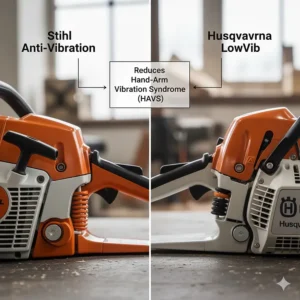
Prolonged exposure to chainsaw vibration causes Hand-Arm Vibration Syndrome (HAVS), a serious occupational health concern addressed by UK workplace regulations. Both manufacturers incorporate sophisticated anti-vibration systems, but their implementations differ meaningfully.
Stihl’s Approach: Most mid-range and professional Stihl models employ a four-point anti-vibration mounting system that isolates the handles from the engine and cutting mechanism. Users describe the sensation as “solid but controlled” – you feel the saw’s power without experiencing the numbing vibration that causes long-term nerve damage.
Husqvarna’s LowVib: Husqvarna’s proprietary LowVib technology often receives praise for taking vibration reduction a step further. Multiple UK professionals report being able to work longer hours with less hand fatigue compared to equivalently powered competitors. The difference becomes particularly noticeable during limbing operations where you’re constantly repositioning the saw at awkward angles.
Weight Distribution and Handling
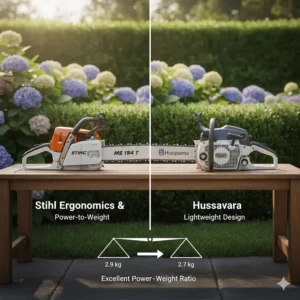
A well-balanced chainsaw feels like an extension of your arms rather than a cumbersome tool you’re wrestling. Generally speaking, Husqvarna models tend to feel lighter and more nimble for their power class, whilst Stihl saws often exhibit a more substantial, planted feeling that some professionals prefer for stability during precision cuts.
The weight difference isn’t always dramatic on paper – perhaps 200-300 grams – but over a full working day, even small weight advantages compound. Battery-powered models from both manufacturers significantly reduce operating weight compared to their petrol counterparts, though at the cost of runtime.
Handle Design and Control Placement
Stihl favours a traditional control layout with intuitive switch placement that becomes second nature after brief familiarisation. Their newer models incorporate captive nuts for bar installation, preventing those infuriating moments when you drop the tiny hardware into autumn leaves.
Husqvarna’s control designs emphasise one-handed accessibility, with combined stop/choke controls that simplify starting procedures. Their side-mounted chain tensioning system allows adjustment without tools, though some users find Stihl’s screwdriver-based system provides more precise tension control.
Safety Features: Non-Negotiable Protection
Chainsaws rank among the most dangerous tools available to consumers, capable of inflicting devastating injuries in fractions of a second. Modern saws from both manufacturers incorporate multiple safety systems, some mandated by UK and EU regulations, others representing genuine engineering innovation.
Chain Brake Systems
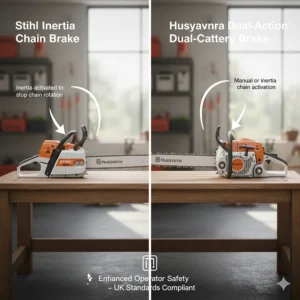
Both brands feature inertia-activated chain brakes that engage automatically during kickback events – when the saw’s nose suddenly lifts, potentially driving the chain towards the operator. The difference lies in response times and sensitivity calibration:
Stihl QuickStop: Engages within fractions of a second, though some users report overly sensitive systems that can activate during normal operation if you bump the hand guard.
Husqvarna Inertia Chain Brake: Generally receives praise for balancing sensitivity with practical operation, though response times may be marginally slower than Stihl’s system.
Throttle Lockouts and Safety Switches
All models from both manufacturers incorporate throttle lockout mechanisms preventing accidental acceleration unless deliberately engaged. These systems have become standard across the industry following numerous injuries from saws unexpectedly revving when set down or repositioned.
UK Safety Regulations and Certification
Both Stihl and Husqvarna chainsaws sold in the UK comply with CE marking requirements (with some models also carrying UKCA marking since Brexit). According to UK government guidance, professional chainsaw operators must complete appropriate training and wear certified protective equipment including chainsaw trousers, safety boots, gloves, helmet with visor and ear defenders.
For domestic users, whilst training isn’t legally mandated, the Health and Safety Executive strongly recommends following the same safety protocols as professionals. Simply reading your chainsaw’s operating manual significantly reduces accident risk, yet surveys suggest the majority of UK homeowners never bother – a concerning statistic given chainsaw injuries typically result in serious harm requiring emergency treatment.
Pricing Analysis: Value Across Different Budgets
When comparing Stihl vs Husqvarna chainsaw options, pricing represents a significant consideration, though focusing solely on the initial purchase price misses the bigger picture. Let’s examine what you actually get for your investment across budget categories.
Entry-Level Budget (£150-£300)
This segment targets occasional homeowners with modest cutting requirements – pruning garden trees, cutting windfall branches, preparing kindling for the fire pit. Both manufacturers offer competent options here:
Stihl MS 170/171: Reliable, proven designs with widespread UK dealer support. Expect to pay £160-£280 depending on specification and included bar length.
Husqvarna 120 Mark III/130: Comparable power with Smart Start and X-Torq efficiency. Generally £10-£30 cheaper than equivalent Stihl models, though dealer availability may vary regionally.
At this price point, Husqvarna often represents better value for money, offering more modern features for similar or lower cost. However, Stihl’s extensive UK dealer network provides easier access to parts and service – a consideration if you live in more rural areas.
Mid-Range Investment (£300-£500)
This bracket encompasses serious DIY enthusiasts and light professional use – regular firewood cutting, small-scale forestry work, property maintenance contractors. Here’s where the Stihl vs Husqvarna chainsaw debate intensifies:
Stihl MS 250/271: Rock-solid reliability with professional build quality. Pricing typically £380-£550 depending on model and features.
Husqvarna 440/445/450: Excellent ergonomics with superior fuel efficiency. Generally £320-£490, offering comparable or better performance for less investment.
Performance differences narrow considerably in this segment. Your decision often comes down to dealer proximity, brand preference, and specific feature priorities. Husqvarna’s fuel efficiency advantage becomes more significant for users with higher consumption.
Professional Premium (£500+)
Professional-grade saws demand absolute reliability, sustained performance under demanding conditions, and the power to handle large-diameter timber efficiently. Neither manufacturer compromises quality in this tier:
Stihl MS 261/362/500i: Industry-standard professional saws trusted by forestry contractors. Pricing ranges from £600-£1,400+ for cutting-edge models like the fuel-injected MS 500i.
Husqvarna 550 XP Mark II/560 XP/572 XP: Professional arborist and forestry saws with excellent power-to-weight ratios. Comparable pricing to Stihl, typically £650-£1,300.
At professional levels, both brands deliver exceptional performance. Dealer support, personal preference, and specific application requirements typically drive purchase decisions rather than pure price comparison.
Fuel Efficiency and Operating Costs: The Long-Term Picture
The chainsaw you buy today will ideally serve you for a decade or more. Over that timespan, fuel consumption, maintenance requirements, and parts replacement costs potentially exceed the initial purchase price – making operating efficiency a crucial consideration in the Stihl vs Husqvarna chainsaw evaluation.
Fuel Consumption Comparison
| Chainsaw Type | Stihl Average | Husqvarna Average | Annual Saving (Husqvarna) |
|---|---|---|---|
| Light-duty (20hrs/year) | £45 | £38 | £7 |
| Medium-duty (100hrs/year) | £225 | £190 | £35 |
| Professional (500hrs/year) | £1,125 | £950 | £175 |
Calculations based on average UK petrol prices (£1.45/litre) and manufacturer consumption specifications
Husqvarna’s X-Torq technology delivers measurable fuel savings, particularly relevant for professional users. Over a saw’s working lifetime, these savings can offset the initial purchase price difference between budget and premium models.
Maintenance and Parts Costs
Both manufacturers produce durable chainsaws, but maintenance requirements and parts availability differ:
Stihl: Extensive UK dealer network ensures parts availability, though original equipment manufacturer (OEM) parts can be premium-priced. Service intervals align with industry standards.
Husqvarna: Equally well-established dealer network with competitive parts pricing. Air Injection filtration systems potentially extend maintenance intervals by reducing engine contamination.
Generic aftermarket chains, bars, and filters exist for both brands, offering cost savings albeit with potential performance compromises. UK safety regulations recommend using manufacturer-approved components, particularly for professional applications.
Real-World Performance Testing: UK Conditions
Manufacturer specifications tell part of the story, but how do these saws perform in British conditions – dealing with wet oak in November, frozen ash in February, or dusty dead elm in August? I’ve compiled feedback from UK users across various applications to provide practical insights beyond marketing claims.
Firewood Cutting Performance
Processing firewood represents perhaps the most common chainsaw application for UK homeowners. Both brands excel here, though with characteristic differences:
Stihl Performance: Users consistently praise Stihl saws’ ability to maintain power delivery through seasoned hardwoods. The low-end torque prevents chain speed reduction when buried in dense oak or ash. Several users note their Stihl saws start reliably even after sitting unused for weeks – crucial for occasional users.
Husqvarna Performance: The higher-revving nature suits rapid cutting through softwoods and lighter hardwoods. Users processing large quantities report appreciating the fuel economy and reduced vibration during marathon cutting sessions. Some mention initial starting can be temperamental in very cold conditions.
Pruning and Tree Surgery
Professional arborists have specific requirements – lightweight handling for overhead work, precise control, and reliable starting when working 12 metres up a tree. Both brands offer specialised top-handle models for this work, though we’re focusing on standard rear-handle saws here.
Stihl Feedback: Tree surgeons often mention the MS 201 T (top-handle) as an industry standard, praising its predictable power delivery and robust build. Rear-handle models like the MS 261 earn recognition for sustained reliability during long working days.
Husqvarna Feedback: The 540i XP (battery) has become increasingly popular among urban tree surgeons, offering zero emissions for working in residential areas where neighbours complain about noise and fumes. The lighter weight compared to equivalent Stihl models reduces fatigue during extended overhead work.
Professional Forestry Applications
Large-scale timber harvesting demands sustained performance under brutal conditions – sustained full-throttle operation, contaminated working environments, and irregular maintenance schedules. Both manufacturers offer saws designed specifically for this punishing application.
Stihl Reputation: The MS 500i and MS 462 have established reputations for sustained reliability in commercial forestry operations. Several UK contractors mention running Stihl saws through entire harvesting seasons with only routine maintenance.
Husqvarna Reputation: Models like the 572 XP compete directly with Stihl’s professional range, offering comparable power with marginally better fuel efficiency. Some contractors prefer the ergonomics during all-day operation.
Dealer Support and Parts Availability: The UK Perspective
Buying a chainsaw represents only the beginning of your relationship with the manufacturer. When that saw requires service, parts replacement, or warranty support, dealer quality and availability become crucial considerations in the Stihl vs Husqvarna chainsaw comparison.
UK Dealer Network Coverage
Stihl: Operates an extensive network of independent dealers throughout the UK, with particularly strong coverage in rural and semi-rural areas where chainsaw use is common. The company’s policy of not selling through large online retailers (they prefer specialised garden machinery dealers) means you’ll typically receive more knowledgeable advice but may need to travel further to reach an authorised dealer.
Husqvarna: Similarly well-established UK dealer network, with the added advantage of availability through larger garden machinery chains and some online retailers. This can mean easier access and potentially more competitive pricing, though dealer knowledge may vary.
Parts Availability and Pricing
Both brands maintain comprehensive parts catalogues with good UK availability. Genuine OEM parts command premium pricing but ensure optimal performance and safety compliance:
Common Parts Costs (Approximate UK Prices):
- Replacement chain: £15-£35
- Guide bar: £25-£65
- Air filter: £8-£18
- Spark plug: £4-£8
- Starter rope assembly: £12-£25
Generic aftermarket alternatives exist for both brands, typically 20-40% cheaper than OEM parts. UK safety regulations don’t prohibit aftermarket components for domestic use, but professional operators should verify compliance with workplace safety requirements.
Warranty Coverage and Service
Stihl UK Warranty: Standard 2-year domestic warranty, 1-year professional use warranty. Extended warranties available through participating dealers when purchasing MotoMix fuel. Service intervals clearly documented in user manuals.
Husqvarna UK Warranty: Similar 2-year domestic/1-year professional coverage. Registration extends warranty period in some cases. Generally competitive warranty terms with Stihl.
Both manufacturers provide comprehensive service manuals and support through their dealer networks. For professional users, proximity to a competent dealer who can provide rapid turnaround for repairs often outweighs minor price differences between brands.
Environmental Considerations: Emissions and Sustainability
As environmental awareness increases and UK local authorities implement stricter regulations in urban areas, chainsaw emissions and sustainability become relevant factors in purchase decisions. Both Stihl and Husqvarna have made significant strides in reducing environmental impact, though through different approaches.
Emissions Standards and UK Regulations
Modern chainsaws sold in the UK must comply with increasingly stringent emissions regulations. Both manufacturers have developed technologies specifically addressing this challenge:
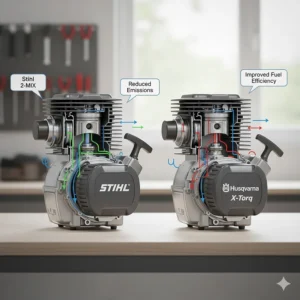
Stihl 2-MIX Engine: Reduces exhaust emissions whilst maintaining power output. Meets current EU and UK emissions standards with room for future tightening regulations.
Husqvarna X-Torq: Achieves up to 75% lower emissions compared to traditional two-stroke engines, exceeding current regulatory requirements. This technology positions Husqvarna favourably if UK regulations further tighten.
For domestic users, current emissions levels from both manufacturers pose minimal concern. Professional users working in urban environments or environmentally sensitive areas may find Husqvarna’s superior emissions reduction advantageous when seeking contracts with environmentally-conscious clients or local authorities.
Battery-Powered Alternatives
Both manufacturers now offer comprehensive battery-powered chainsaw ranges, representing the ultimate in emission-free operation (at point of use):
Stihl AP System: Professional-grade 36V batteries delivering impressive runtime. Compatible across Stihl’s battery tool range, allowing investment in one battery platform serving multiple tools.
Husqvarna Battery Series: Similar 36V technology with competitive performance. Generally receives praise for integration between battery tools and efficient charging systems.
Battery chainsaws suit urban tree surgery, noise-sensitive residential areas, and users preferring minimal maintenance. Runtime limitations mean they’re not yet practical for sustained professional forestry work, though technology continues advancing rapidly.
Fuel Efficiency and Carbon Footprint
Over a chainsaw’s operational lifetime, fuel consumption represents the largest environmental impact component. Husqvarna’s X-Torq technology delivers measurable advantages here, potentially reducing carbon footprint by 15-20% compared to equivalent saws without this system.
For environmentally conscious users or organisations working toward carbon reduction targets, this efficiency advantage deserves consideration alongside traditional performance metrics.
Making Your Decision: Matching Saw to Application
After examining specifications, pricing, performance, and features, how do you actually choose between Stihl and Husqvarna? The answer depends on honestly assessing your specific requirements rather than seeking a universal “best” option that doesn’t exist.
For Occasional Homeowners (Under 10 Hours Annual Use)
Recommendation: Either brand’s entry-level models will serve admirably. Husqvarna often offers better value in this segment, whilst Stihl provides more extensive UK dealer support. Consider:
- Husqvarna 120 Mark III if prioritising fuel efficiency and modern features
- Stihl MS 170 if valuing dealer network and traditional reliability
For Regular DIY Users (10-50 Hours Annual Use)
Recommendation: Mid-range models from both manufacturers offer excellent performance. Your decision often comes down to handling preference and specific features:
- Husqvarna 435/440 for superior ergonomics and fuel economy
- Stihl MS 250 for low-end torque and proven professional build quality
For Semi-Professional Use (50-200 Hours Annual Use)
Recommendation: Consider professional-grade entry models offering durability for sustained use:
- Husqvarna 450 Rancher balances power with comfortable all-day operation
- Stihl MS 271 Farm Boss provides professional reliability with traditional handling
For Professional Applications (200+ Hours Annual Use)
Recommendation: Neither manufacturer disappoints in professional segments. Consider:
- Husqvarna 550 XP Mark II for all-day comfort and fuel efficiency
- Stihl MS 261 C-M/MS 500i for cutting-edge technology and maximum reliability
Professional users should prioritise dealer proximity and service quality over minor specification differences. The best saw is the one you can get serviced quickly when it inevitably requires maintenance.
Frequently Asked Questions
❓ Which brand is more reliable for long-term professional use in the UK?
❓ Are Husqvarna chainsaws easier to start than Stihl models?
❓ Do I need professional chainsaw training to use these saws in my UK garden?
❓ Which brand offers better value for money for UK buyers?
❓ Can I use the same chain and bar between Stihl and Husqvarna chainsaws?
Conclusion: The Verdict on Stihl vs Husqvarna Chainsaw
After extensively examining specifications, pricing, user feedback, and real-world performance, the truth about the Stihl vs Husqvarna chainsaw debate is pleasantly straightforward: you cannot make a wrong choice between these manufacturers. Both produce exceptional chainsaws that will serve UK users faithfully for years, provided you select the appropriate model for your requirements and maintain it properly.
Stihl excels when you prioritise raw cutting power, low-end torque, traditional build quality, and extensive dealer support. Their professional-grade models like the MS 271 Farm Boss and revolutionary MS 500i represent the pinnacle of chainsaw engineering, favoured by serious forestry contractors who demand absolute reliability.
Husqvarna shines when fuel efficiency, ergonomic comfort, reduced emissions, and all-day usability top your priority list. Models like the 435, 450 Rancher, and professional 550 XP Mark II deliver excellent performance whilst being notably kinder to your fuel budget and shoulder joints.
For UK buyers specifically, consider these final factors:
Choose Stihl if you:
- Prioritise dealer availability in your local area
- Value traditional build quality and proven reliability
- Need maximum low-end torque for tough hardwoods
- Prefer straightforward, robust engineering
Choose Husqvarna if you:
- Want superior fuel efficiency reducing operating costs
- Need comfortable ergonomics for extended use
- Value modern features like air pre-filtering
- Prioritise environmental considerations
Ultimately, neither brand disappoints. Visit local dealers, handle both manufacturers’ models, and make your decision based on which feels right in your hands. The saw you’ll actually enjoy using is the one you’ll maintain properly and operate safely – far more important than minor specification differences between these excellent manufacturers.
Recommended for You
- Best Electric Chainsaw UK 2026: Expert Reviews & Buying Guide
- Best Chainsaw UK 2026 | Expert Reviews & Safety Guide
- 7 Best Impact Driver UK 2026 – Pro Reviews & Prices
Disclaimer: This article contains affiliate links. If you purchase products through these links, we may earn a small commission at no additional cost to you. Prices shown are approximate and may vary. All products recommended meet UK safety standards and regulations. Always follow manufacturer safety guidelines and consider professional training before operating chainsaws.
✨ Found this helpful? Share it with your mates! 💬🤗
