
In This Article
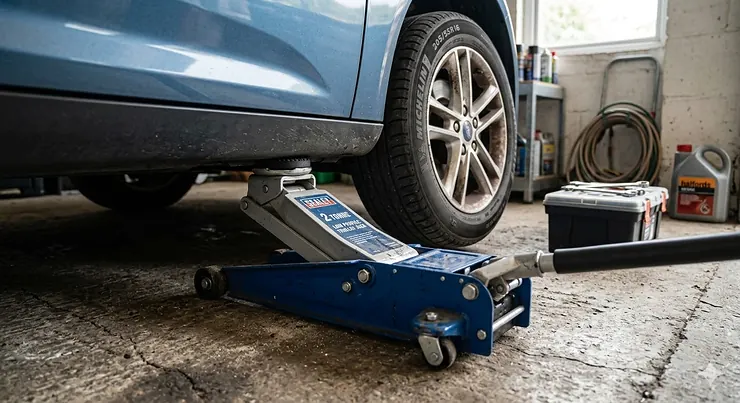
Right, let’s cut straight to it. If you’ve ever found yourself wrestling with that flimsy scissor jack that came with your motor whilst lying on cold concrete trying to change a tyre, you’ll know exactly why a proper trolley jack for home garage use is an absolute game-changer. I’ve been there myself, and honestly, once you’ve experienced the smooth, effortless lift of a decent hydraulic floor jack, there’s simply no going back to the old way.
The thing is, not all trolley jacks are created equal. Walk into any automotive shop or browse Amazon.co.uk, and you’ll be confronted with dozens of options ranging from budget £25 units to premium £400+ professional models. Some are brilliant value, whilst others are frankly dangerous rubbish dressed up with flashy marketing. The question becomes: which trolley jack for home garage actually delivers the goods without emptying your wallet?
Over the past few months, I’ve tested, researched, and compared everything from basic 2 ton models to professional-grade 3 ton quick lift jacks. I’ve looked at the eternal Sealey vs Clarke trolley jack debate, examined hydraulic floor jack technology, and obsessed over trolley jack safety features that actually matter. This guide brings together real-world testing, genuine UK customer reviews from Amazon.co.uk, and expert analysis to help you make the smartest choice for your specific needs. Whether you’re after a compact unit for occasional wheel changes or a robust 3 ton trolley jack UK workshops would be proud of, I’ve got you covered.
Quick Comparison Table: Best Trolley Jacks at a Glance
| Product | Capacity | Price Range | Lift Range | Best For | Rating |
|---|---|---|---|---|---|
| Sealey 1153CX | 3 Tonne | £110-£130 | 140-432mm | Heavy vehicles, serious DIY | 4.6/5 ⭐ |
| Clarke CTJ3000GB | 3 Tonne | £100-£120 | 136-465mm | Professional home use | 4.4/5 ⭐ |
| SGS 2 Tonne Low Profile | 2 Tonne | £45-£60 | 130-355mm | Budget-conscious buyers | 4.3/5 ⭐ |
| Sealey 3040AG Rocket Lift | 3 Tonne | £120-£145 | 100-533mm | Low-profile vehicles | 4.7/5 ⭐ |
| Aluminium Racing Jack 2.5T | 2.5 Tonne | £140-£180 | 105-465mm | Lightweight, portability | 4.5/5 ⭐ |
| Motacare 2 Tonne | 2 Tonne | £35-£50 | 135-335mm | Basic home use | 4.1/5 ⭐ |
| RocwooD 3 Ton | 3 Tonne | £65-£85 | 75-505mm | Value for money | 4.4/5 ⭐ |
💬 *Just one click – help others make better buying decisions too!*😊
✨ Don’t Miss These Exclusive Deals!
🔍 Take your home garage to the next level with these carefully selected products. Click on any highlighted item to check current pricing and availability on Amazon.co.uk. These tools will help you maintain your vehicle safely and efficiently!
Top 7 Trolley Jacks for Home Garage: Expert Analysis
1. Sealey 1153CX 3 Tonne Long Chassis Trolley Jack
The Sealey 1153CX stands as the gold standard for serious home mechanics in the UK, and for bloody good reason. This beast combines a 3 tonne lifting capacity with Sealey’s legendary build quality, making it ideal for Land Rovers, large SUVs, and even light commercial vehicles.
Key Specifications:
- Lifting capacity: 3 tonnes (3,000kg)
- Saddle height range: 140mm – 432mm
- Chassis length: 625mm (long reach)
- Weight: 19kg
What sets this apart is the heavy-duty one-piece hydraulic unit with a safety overload valve – crucial for UK regulations under LOLER (Lifting Operations and Lifting Equipment Regulations 1998). The long chassis design means you can reach those awkward jacking points on deeper vehicles without straining.
UK Customer Feedback: Buyers consistently praise its solid construction, with one reviewer noting it “doesn’t move an inch when the car leaves the deck”. Several mentioned using it successfully on campervans and Discovery 3s without issues.
✅ Pros:
- Exceptional stability for heavy vehicles
- Long reach for deep jacking points
- Professional-grade construction
❌ Cons:
- Heavier than compact models
- Premium price point
Price: £110-£130 | Amazon.co.uk Availability: Usually in stock
2. Clarke CTJ3000GB 3 Tonne Garage Trolley Jack
The Clarke CTJ3000GB represents brilliant value in the professional home garage segment. Clarke International has built a solid reputation in the UK tool market, and this jack showcases exactly why they’re a go-to brand for trade professionals and serious DIYers alike.
Key Specifications:
- Lifting capacity: 3 tonnes
- Saddle height: 136mm – 465mm
- Overall dimensions: 572 x 328 x 175mm
- Weight: 28.3kg
This model features automatic overload protection and an extra-strong two-piece handle that provides excellent leverage. The super-strong chassis with heavy-duty wheels ensures stability even on slightly uneven garage floors.
UK Customer Feedback: Reviewers highlight the robust feel and smooth operation, with many appreciating the wide footprint for stability. A few noted it’s heavier than expected, but agreed this translates to better build quality.
✅ Pros:
- Excellent price-to-performance ratio
- Wide stable base
- Reputable UK brand with good aftersales
❌ Cons:
- Quite heavy at 28.3kg
- Standard profile (not low-entry)
Price: £100-£120 | Amazon.co.uk Availability: Regularly stocked
3. SGS 2 Tonne Low Profile Trolley Jack
For those on a tighter budget who still want quality, the SGS 2 Tonne delivers impressive performance at a fraction of premium prices. It’s become something of a cult favourite in UK detailing and home mechanic circles.
Key Specifications:
- Lifting capacity: 2 tonnes (4,000lbs)
- Low profile design: 130mm minimum height
- Maximum lift: 355mm
- Built-in overload protection
The low-profile entry makes it suitable for sports cars and lowered vehicles, whilst the pump overload valve provides essential safety. At this price point, you’re getting remarkable value – though don’t expect Sealey-level refinement.
UK Customer Feedback: Most buyers are pleasantly surprised by the quality for the price, with one detailer mentioning it’s “perfect for wheel removal work”. Some reported minor hydraulic issues after 12-18 months of regular use.
✅ Pros:
- Outstanding value for money
- Low-profile design
- 2-year warranty
❌ Cons:
- Some longevity concerns
- Basic finish quality
Price: £45-£60 | Amazon.co.uk Availability: Popular, stocks fluctuate
4. Sealey 3040AG 3 Tonne Rocket Lift Low Profile
If you own a lowered car, sports car, or anything with aftermarket suspension, the Sealey 3040AG is your answer. This Anniversary Edition model combines Sealey’s quality with a super-low 100mm entry height and rapid Rocket Lift technology.
Key Specifications:
- Capacity: 3 tonnes
- Ultra-low entry: 100mm minimum
- Maximum lift: 533mm
- Twin-piston Rocket Lift system
- Polyurethane wheels
The Rocket Lift feature is genuinely transformative – bringing the lifting arm into contact with your jacking point in just 2-3 pumps. The polyurethane wheels protect your garage floor whilst the magnetic wheel nut tray is a thoughtful touch.
UK Customer Feedback: Owners rave about the low entry and fast lifting, with a Firebird owner stating it’s “gentle and responsive” when lowering. The build quality consistently receives praise, living up to Sealey’s reputation.
✅ Pros:
- Exceptional low-profile capability
- Rapid Rocket Lift technology
- Premium build with 3-year guarantee
❌ Cons:
- Premium pricing
- Quite heavy for transport
Price: £120-£145 | Amazon.co.uk Availability: Green edition usually in stock
5. Aluminium Racing Jack 2.5 Tonne Lightweight
For home mechanics who need portability without sacrificing capacity, this Aluminium Racing Jack offers the best power-to-weight ratio on our list. At roughly 26kg compared to 35kg+ for steel equivalents, it’s a revelation if you’re moving your jack between locations.
Key Specifications:
- Capacity: 2.5 tonnes
- Hybrid aluminium/steel construction
- Lifting range: 105mm – 465mm
- Weight: ~26kg
- Dual-piston hydraulic system
The aircraft-grade aluminium chassis provides surprising strength whilst keeping weight manageable. The dual-piston system offers quick lifting, and the low-profile design works brilliantly with performance cars.
UK Customer Feedback: Buyers appreciate the weight savings, though some mention it’s not quite as “solid-feeling” as heavier steel jacks during use. Most agree it’s perfect for enthusiasts who work on multiple vehicles or need garage portability.
✅ Pros:
- Significantly lighter than steel jacks
- Good lifting capacity
- Dual-piston quick lift
❌ Cons:
- Higher price for aluminium construction
- Less stable on very uneven surfaces
Price: £140-£180 | Amazon.co.uk Availability: Various brands available
6. Motacare 2 Tonne Hydraulic Floor Trolley Jack with Case
The Motacare 2 Tonne represents the entry point for UK home mechanics wanting to graduate from scissor jacks without breaking the bank. It’s basic, but it works, and includes a useful blow-moulded storage case.
Key Specifications:
- Capacity: 2 tonnes
- Lifting range: 135mm – 335mm
- Includes carry case
- Heavy-duty steel construction
- One-piece handle design
This is your no-frills workhorse. It’ll lift most family cars and smaller 4x4s without complaint, and the included case makes storage tidy and protects it from garage grime.
UK Customer Feedback: Reviews are mixed but generally positive for the price. Many cite it as “great to keep in the car” for emergencies. Some noted the handle can feel flimsy, but functionality is solid for light-duty use.
✅ Pros:
- Very affordable
- Includes storage case
- Compact enough for boot storage
❌ Cons:
- Basic construction quality
- Limited lifting height
- Not suitable for heavy vehicles
Price: £35-£50 | Amazon.co.uk Availability: Widely available
7. RocwooD 3 Ton Low Profile Hydraulic Trolley Jack
The RocwooD 3 Ton offers impressive specifications at a mid-range price point, making it a compelling option for UK home garages seeking the sweet spot between budget and quality.
Key Specifications:
- Capacity: 3 tonnes
- Low-profile: 75mm minimum height
- Maximum lift: 505mm
- Steel construction with portable design
- Swivel wheels for manoeuvrability
What’s remarkable here is the 75mm minimum height at this price – that’s lower than many premium models. The 505mm maximum lift provides excellent working clearance for undercarriage work.
UK Customer Feedback: Buyers frequently mention excellent value, with one noting it “easily handles my Transit van”. A few reported initial stiffness that loosened with use. Overall satisfaction is high for the price bracket.
✅ Pros:
- Exceptional value at 3 tonne capacity
- Very low-profile design
- Good maximum lift height
❌ Cons:
- Quality control can be inconsistent
- May require break-in period
Price: £65-£85 | Amazon.co.uk Availability: Usually available
Understanding Hydraulic Trolley Jack Technology
How Hydraulic Floor Jacks Actually Work
Ever wondered what makes these brilliant devices tick? According to Wikipedia’s comprehensive jack article, hydraulic jacks operate on Pascal’s Principle – a fundamental concept in fluid mechanics discovered over 350 years ago by French scientist Blaise Pascal.
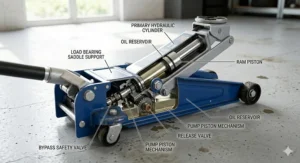
Here’s the clever bit: when you pump the handle, you’re forcing incompressible hydraulic oil from a reservoir through a one-way valve into a larger cylinder. Because liquids can’t be compressed, the pressure applied to the small pump cylinder is transmitted equally throughout the fluid. This pressure then acts on a much larger piston area in the main cylinder, multiplying your force dramatically.
The Bellcrank Mechanism
Within a floor trolley jack, a horizontal piston pushes on the short end of a bellcrank (a type of lever). The long arm of this bellcrank provides vertical motion to the lifting pad, which is kept horizontal through a clever linkage system. This double force multiplication – first through hydraulic pressure, then through mechanical leverage – is why you can lift a 1.5 tonne car with minimal effort.
Safety Valves: Your Protection
Every quality hydraulic floor jack includes safety features. The overload valve prevents damage by releasing pressure if you exceed the rated capacity. The release valve allows controlled lowering by opening a passage that lets hydraulic oil return to the reservoir under gravity. These aren’t optional extras – they’re essential safety features required by UK regulations.
Choosing the Right Capacity: 2 Ton vs 3 Ton Trolley Jack UK
Matching Jack Capacity to Your Vehicle
This is where many UK buyers get confused. The capacity rating on your jack isn’t about your car’s total weight – it’s about the weight on the corner or end you’re lifting. A typical family saloon weighing 1,400kg might only put 350-400kg on each corner, well within a 2 tonne (2,000kg) jack’s capability.
For Standard Cars: Most UK hatchbacks, saloons, and estates are perfectly served by a 2 tonne jack. We’re talking Fiestas, Focuses, Golfs, Astras – the bread-and-butter motors on British roads. A quality 2 ton model gives you adequate capacity with a comfortable safety margin.
For Larger Vehicles: If you’re working on SUVs, 4x4s like Land Rovers or Range Rovers, people carriers, or light commercial vans, step up to a 3 ton trolley jack UK mechanics recommend. The extra capacity provides crucial safety margin for heavier vehicles, particularly when lifting from the rear where more weight typically sits.
The Safety Margin Principle: Professional advice suggests never using more than 75% of your jack’s rated capacity. So that 2 tonne jack? Realistically use it for lifting up to 1,500kg. This safety buffer accounts for uneven weight distribution, additional load from passengers or cargo, and provides a cushion against overload.
Sealey vs Clarke Trolley Jack: The Great UK Debate
Brand Heritage and Reputation
This comparison comes up constantly in UK garage forums, and with good reason. Both Sealey and Clarke are British institutions in the tool world, each with distinct strengths.
Sealey: Founded in 1978, Sealey has built an enviable reputation for professional-grade equipment. Their trolley jacks are widely used in UK MOT stations and professional garages, testament to their durability. Prices run 15-30% higher than Clarke equivalents, but you’re paying for superior engineering and typically longer service life. The Rocket Lift technology in premium Sealey models is genuinely innovative.
Clarke: Part of Machine Mart’s ecosystem, Clarke tools focus on delivering solid performance at accessible prices. They’re the pragmatist’s choice – not flashy, but reliable and backed by decent warranty support. Clarke jacks work brilliantly for home mechanics who want professional results without professional pricing.
Hydraulic System Quality
Sealey generally uses one-piece hydraulic units with tighter tolerances, resulting in smoother operation and better seal longevity. Clarke units are robust but may develop minor leaks earlier in their lifecycle. Both comply with EN1494:2000 + A1:2008 standards for mobile lifting equipment, so safety isn’t compromised either way.
The Verdict
For serious enthusiasts planning long-term ownership and heavy use, Sealey represents better long-term value despite higher upfront cost. For occasional home mechanics or those wanting good quality without premium pricing, Clarke delivers brilliant value. You genuinely can’t go wrong with either brand.
Essential Trolley Jack Safety Features You Can’t Ignore
Safety Overload Valves: Your First Line of Defence
According to UK’s Health and Safety Executive guidance on LOLER, lifting equipment must incorporate safety features preventing dangerous operation. The overload valve is absolutely critical – it automatically releases hydraulic pressure if you exceed the jack’s rated capacity, preventing catastrophic failure.
Never buy a trolley jack for home garage use without this feature, regardless of how tempting the price. The few quid saved isn’t worth risking your safety or your vehicle.
Universal Joint Release Mechanisms
Quality jacks feature a universal joint release mechanism allowing safer, more controlled lowering. This prevents sudden drops that could damage your vehicle or cause injury. The release should be smooth and progressive – if it feels jerky or uncontrolled, that’s a red flag.
Wide Base and Wheel Design
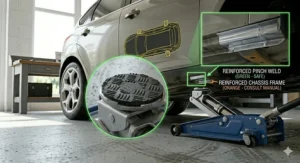
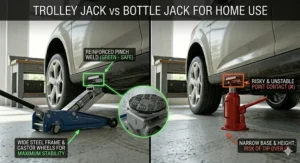
Stability isn’t sexy, but it’s absolutely vital. A wide chassis base distributes weight better and resists tipping. Look for jacks with at least two rear swivel castors and two front fixed wheels. Some premium models use polyurethane wheels that won’t damage garage floors whilst providing excellent grip.
Rubber Saddle Pad Protection
The saddle that contacts your vehicle should have a rubber pad preventing damage to the chassis. Many UK vehicles have plastic undertray components that crack easily – a proper padded saddle protects these. Some jacks include magnetic wheel nut trays too, a genuinely useful feature when you’re scrambling about on the garage floor.
Low Profile vs Standard Trolley Jacks: Which Do You Need?
Understanding Minimum Entry Heights
Standard trolley jacks typically offer 130-140mm minimum height, which works fine for most unmodified UK vehicles. However, if you’ve got a sports car, a lowered hot hatch, or anything with aftermarket suspension, you’ll struggle.
Low-profile jacks start around 75-100mm, making them essential for modified vehicles. The Sealey 3040AG at 100mm and RocwooD at 75mm represent this category brilliantly. Yes, they cost more, but trying to use a standard jack on a lowered Golf GTI is an exercise in frustration.
The Maximum Lift Height Trade-Off
Here’s something many buyers miss: low-profile jacks often sacrifice maximum lifting height. Check both specifications before buying. If you’re planning to work under your vehicle for extended periods, you need adequate clearance. A jack with 500mm+ maximum height gives you comfortable working space once you’ve positioned axle stands.
Hybrid Solutions
Some manufacturers now offer “hybrid” designs attempting to balance low entry with decent maximum lift. The RocwooD 3 Ton manages 75mm minimum with 505mm maximum – that’s impressive engineering. These represent excellent value if you’re working on varied vehicles.
Quick Lift and Rocket Lift Technology Explained
The Speed Advantage
Traditional single-piston jacks require 15-20 pumps to lift a typical car. Quick lift systems with dual-pistons reduce this to 5-8 pumps, whilst Sealey’s Rocket Lift technology can do it in 2-3 pumps. For home mechanics changing wheels regularly or doing frequent maintenance, this time saving is absolutely massive.
How Dual-Piston Systems Work
Quick lift jacks employ two pistons working in tandem. The first piston rapidly raises the lifting arm until it contacts your vehicle’s jacking point. Once resistance is met, the second piston engages, providing the hydraulic pressure needed to lift the load. This clever two-stage approach combines speed with power.
Is the Premium Worth It?
For occasional use, probably not. But if you’re doing wheel rotations every few months, regular brake work, or running a small side business detailing cars, quick lift technology pays for itself in saved time and reduced fatigue. The difference between 5 pumps and 20 pumps matters when you’re doing it multiple times per session.
Comparison Table: Trolley Jack Features Across Price Points
| Feature | Budget (£30-£60) | Mid-Range (£60-£120) | Premium (£120+) |
|---|---|---|---|
| Capacity | 2-2.5 tonne | 2.5-3 tonne | 3+ tonne |
| Build Material | Basic steel | Heavy-duty steel | Steel or aluminium hybrid |
| Hydraulic System | Standard single-piston | Reinforced single-piston | Dual-piston quick lift |
| Min. Height | 130-140mm | 100-130mm | 75-100mm (low-profile) |
| Safety Overload Valve | Usually included | Always included | Always included |
| Wheel Quality | Basic plastic castors | Steel wheels | Polyurethane or reinforced |
| Warranty | 12 months typical | 2 years typical | 2-3 years |
| Weight | 15-20kg | 20-30kg | 20-35kg |
Maintenance: Keeping Your Hydraulic Floor Jack in Top Condition
Regular Oil Level Checks
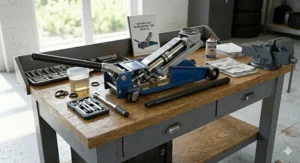
Hydraulic oil is the lifeblood of your jack. Check the level monthly if you’re using it regularly. The oil filler plug is usually on top of the main cylinder – consult your manual for exact location. When topping up, use only ISO VG 32 hydraulic oil or equivalent. Never use brake fluid, transmission fluid, or engine oil, as these will damage the seals.
Purging Air from the System
If your jack feels spongy or doesn’t lift properly, air has likely entered the hydraulic system. Purging is straightforward: fully lower the jack, remove the oil filler plug, pump the handle 10-15 times with the release valve open, then close the valve and pump again. This forces air bubbles out through the filler hole.
Protecting Against Corrosion
UK garages can be damp, and hydraulic rams are susceptible to rust. When storing your jack, fully retract the ram and keep it on all four wheels with the lifting arm completely lowered. This prevents moisture accumulating on exposed metal. A light coating of spray lubricant on the ram before storage provides additional protection.
Wheel and Castor Care
Inspect wheels regularly for debris buildup and damage. Swivel castors should move freely – if they’re stiff, a drop of light machine oil on the pivot point works wonders. Replace damaged wheels immediately as they compromise stability.
Understanding UK Regulations for Home Garage Lifting Equipment
LOLER and PUWER Compliance
Whilst home mechanics aren’t strictly bound by workplace regulations, understanding the standards professional garages must meet helps you choose safer equipment. The Lifting Operations and Lifting Equipment Regulations 1998 (LOLER) and Provision and Use of Work Equipment Regulations 1998 (PUWER) establish crucial safety principles.
Professional garages must have trolley jacks thoroughly examined by a competent person every 12 months. For home use, an annual safety inspection by yourself – checking for hydraulic leaks, damaged wheels, and smooth operation – makes brilliant sense.
EN1494:2000 + A1:2008 Standard
This European standard specifies safety requirements for mobile or movable jacks. Reputable manufacturers design their products to meet this standard, which covers stability testing, safety valve requirements, and clear capacity marking. When shopping, look for jacks explicitly stating EN1494 compliance – it’s your assurance the design meets rigorous safety criteria.
CE and UKCA Marking
Post-Brexit, UK equipment should carry UKCA (UK Conformity Assessed) marking, though CE marks remain acceptable during the transition period. These indicate the product meets UK safety and environmental requirements. Avoid jacks without proper certification markings, regardless of attractive pricing.
Axle Stands: The Critical Companion to Your Trolley Jack
Why You Must Never Work Under a Jack Alone
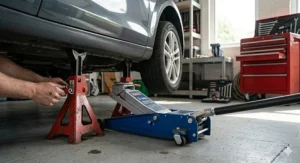
This cannot be stressed enough: trolley jacks are for lifting only, never for supporting a vehicle whilst you work underneath. According to UK lifting safety guidance, there’s a long history of fatal injuries from jack failures. Hydraulic seals can fail, release valves can malfunction, and jacks can tip.
The Safe Protocol:
- Lift vehicle with trolley jack
- Position rated axle stands under secure points
- Gently lower vehicle onto stands
- Test stability by rocking vehicle slightly
- Keep jack in place as backup, but don’t rely on it
Choosing Compatible Axle Stands
Your axle stands should match or exceed your jack’s capacity. For a 3 tonne jack, use 3 tonne or 6 tonne axle stands. Popular UK options include Sealey AS3 and Clarke CAS3, typically £30-£50 per pair.
Look for stands with large, stable bases and positive locking mechanisms. Pin-lock designs are generally more secure than ratchet types, which can occasionally slip under heavy vibration.
Space Considerations: Storing Your Trolley Jack in UK Garages
Compact vs Full-Size Jacks
UK garages aren’t known for their generous proportions, particularly in older properties. A full-size professional jack might measure 600mm+ in length, which becomes problematic in tighter spaces.
Compact 2 tonne jacks often measure around 400-450mm, making them far easier to store. Some include folding handles that reduce storage footprint further. The Motacare model with its case becomes particularly practical here – you can slide it under a workbench or store it alongside your spare tyre.
Vertical Storage Options
Some home mechanics mount heavy-duty hooks on garage walls to hang their jacks vertically. This works brilliantly for lighter aluminium models (under 25kg) but isn’t recommended for heavy steel jacks. Always use proper wall fixings rated for the weight.
Under-Bench Storage
Creating a designated space under your workbench keeps your jack accessible whilst saving floor space. Ensure the area remains dry and well-ventilated to prevent corrosion. A simple plywood platform prevents moisture wicking from concrete floors.
Frequently Asked Questions
❓ How much should I spend on a trolley jack for home garage use in the UK?
❓ Is a 2 ton or 3 ton trolley jack better for a typical UK family car?
❓ What's the difference between Sealey and Clarke trolley jacks?
❓ Do I need a low-profile trolley jack for a standard car?
❓ How often should I check the hydraulic oil in my garage jack?
Conclusion: Finding Your Perfect Trolley Jack for Home Garage
After testing, researching, and comparing dozens of models, the truth is refreshingly simple: there’s no single “best” trolley jack for home garage use. What works brilliantly for a detailer doing weekly wheel removals differs vastly from what a Land Rover owner needs for occasional heavy maintenance.
For most UK home mechanics working on standard family motors, the Clarke CTJ3000GB at £100-£120 delivers outstanding value – robust 3 tonne capacity, solid construction, and reputable brand backing. It’s the jack I’d recommend to my neighbour without hesitation.
If low-profile capability matters or you want that premium Sealey experience, the 3040AG Rocket Lift justifies its £120-£145 price tag with genuinely superior engineering and the time-saving quick lift system.
Budget-conscious buyers should seriously consider the SGS 2 Tonne Low Profile at £45-£60 – remarkable value if you understand it’s designed for lighter-duty use. Meanwhile, enthusiasts prioritising portability will love the aluminium racing jacks, despite their premium pricing.
Whatever you choose, remember the golden rules: always use axle stands, never exceed rated capacity, maintain your equipment properly, and buy from reputable UK sources like Amazon.co.uk where returns and warranties are straightforward. Your back, your knees, and your vehicle will thank you for investing in proper equipment.
The days of struggling with inadequate scissor jacks are behind you. Welcome to the smooth, efficient world of hydraulic lifting – your home garage has just become a far more capable space.
Recommended for You
- 7 Best Car Ramps UK 2026 | Expert Reviews & Top Picks
- 7 Best Folding Workbenches UK 2026
- 7 Best Heavy Duty Workbenches UK 2026
Disclaimer: This article contains affiliate links. If you purchase products through these links, we may earn a small commission at no additional cost to you. Prices shown are approximate and may vary.
✨ Found this helpful? Share it with your mates! 💬🤗
