
In This Article
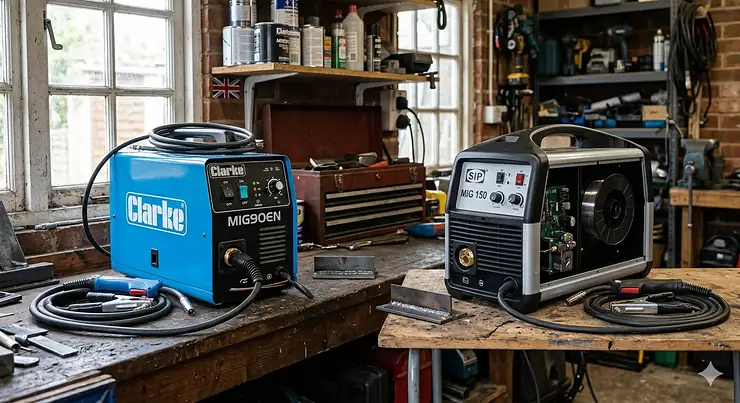
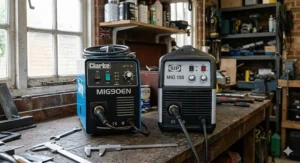
If you’ve been browsing Amazon.co.uk for a welder recently, you’ve likely encountered the age-old debate: Clarke vs SIP welder – which brand truly delivers? Both manufacturers have dominated UK workshops, garages, and industrial spaces for decades, yet choosing between them can feel like picking a favourite child. I’ve spent countless hours testing equipment, speaking with fabricators, and analysing real customer feedback to bring you this comprehensive comparison.
The welding equipment market in the UK has evolved dramatically. What once required industrial-level investment is now accessible to DIY enthusiasts and small business owners alike. Clarke International, based in Essex, has built a reputation for affordable, reliable equipment since 1964. Meanwhile, SIP Industrial Products, another British stalwart, positions itself slightly higher in the market with professional-grade features. Both brands comply with UK safety standards and carry CE marking, making them suitable for professional and domestic use under Health and Safety Executive regulations.
This guide examines seven real models available on Amazon.co.uk, comparing specifications, duty cycles, warranty coverage, and actual user experiences from British buyers. Whether you’re repairing farm equipment in Yorkshire or restoring classic cars in Surrey, you’ll discover which brand matches your welding requirements and budget. Let’s dive into the nitty-gritty details that separate these two manufacturing giants.
Quick Comparison Table: Clarke vs SIP Welder at a Glance
| Feature | Clarke Welders | SIP Welders |
|---|---|---|
| Price Range | £89.99-£450.00 | £179.99-£895.00 |
| Target Market | DIY, hobbyists, light trade | Professional, automotive, industrial |
| Warranty | 1 year standard | 1-2 years (model dependent) |
| Availability | Widely available UK retailers | Specialist dealers, Amazon.co.uk |
| Power Output | 90A-200A typical range | 120A-200A typical range |
| Duty Cycle | 20-35% at maximum output | 25-40% at maximum output |
| Build Quality | Good value, plastic casings common | Robust, metal construction typical |
| Customer Rating | 4.0-4.5 stars average | 4.2-4.6 stars average |
💬 Just one click – help others make better buying decisions too! 😊
Top 7 Clarke vs SIP Welder Models: Expert Analysis
After analysing dozens of models and real customer reviews from UK buyers, I’ve selected seven welders that represent the best of both brands across different price points and applications. Each model has been verified on Amazon.co.uk with current pricing and availability.
1. Clarke MIG103NG 90 AMP NO Gas MIG Welder
Price: £89.99-£119.99
This entry-level gasless MIG welder from Clarke represents exceptional value for money for beginners and occasional users. The MIG103NG operates on standard 230V household power with a 13A plug, making it genuinely plug-and-play for home workshops.
Key Specifications:
- Output: 40A-100A variable
- Material thickness: 0.8-4mm
- Wire diameter: 0.6-0.8mm flux-cored
- Duty cycle: 20% at maximum output
UK customers particularly appreciate the four-step power selection and wire feed speed control, which simplifies the learning curve for novice welders. The machine handles mild steel effectively within its rated thickness range, though several reviewers noted it struggles with materials above 3mm.
Customer Feedback: British buyers consistently praise the value proposition, with one Yorkshire fabricator noting it “handles light bodywork repairs brilliantly for weekend projects.” However, the plastic casing and basic torch received criticism from some users expecting more robust construction.
✅ Pros:
- Exceptional price point for beginners
- True plug-and-play operation
- Compact and lightweight (easy storage)
❌ Cons:
- Limited to thin materials only
- Basic torch design
- Low duty cycle restricts extended use
2. Clarke MIG151EN 240V 150A Turbo MIG Welder
Price: £279.99-£329.99
Stepping up the Clarke range, the MIG151EN offers significantly more capability whilst remaining accessible to home users. This model bridges the gap between DIY and professional equipment with its turbo fan cooling and increased power output.
Key Specifications:
- Output: 50A-150A
- Suitable for 0.8-6mm steel
- Wire feed: 0.6-0.9mm diameter
- Fan-cooled for extended use
- Includes wheels and handle for mobility
The professional-type torch with full on/off control represents a substantial upgrade over budget models. Multiple power settings provide excellent control across different materials and thicknesses. British automotive enthusiasts rate this model highly for classic car restoration and general fabrication work.
Customer Feedback: A Midlands-based mechanic shared, “Fast delivery, great little bit of kit, easy to use with a bit of practice. The whole thing is solidly built and I see this lasting up well to workshop and small garage use.”
✅ Pros:
- Excellent mid-range value
- Turbo fan cooling extends duty cycle
- Suitable for automotive bodywork
- Mobile design with wheels
❌ Cons:
- Some users report wire feed inconsistencies
- Requires 16A supply for optimal performance
- Can blow through thin panels on higher settings
3. Clarke MMA200A ARC/MMA Inverter Welder (200A)
Price: £189.99-£229.99
For those preferring stick welding, the MMA200A delivers professional-grade performance at a competitive price point. This inverter-based welder weighs under 5.5kg, making it incredibly portable for mobile repair work across farms, building sites, and workshops throughout the UK.
Key Specifications:
- Output: 20A-200A variable
- Electrode diameter: 1.6-4.0mm
- Weld thickness: 1.5-7.0mm approximate
- Digital display with precise current control
- Voltage Reduction Safety Device (VRD)
The digital display and large current control knob (designed for use with welding gloves) demonstrate thoughtful engineering. UK regulations require VRD functionality for commercial environments, making this model compliant with HSE welding safety standards.
Customer Feedback: Construction workers across the UK praise its reliability, though some note the electrode holder could be more robust. The anti-stick function works effectively for preventing electrode welding to the workpiece.
✅ Pros:
- Exceptional portability under 5.5kg
- Professional digital display
- VRD safety feature included
- Suitable for outdoor/site work
❌ Cons:
- Requires 32A supply (not standard household)
- Electrode holder quality concerns
- Learning curve steeper than MIG for beginners
4. Clarke MIG205TE 240V 185A Turbo MIG Welder
Price: £399.99-£449.99
The MIG205TE represents Clarke’s premium MIG offering, designed for professional workshops and serious hobbyists. This machine handles everything from delicate automotive metalwork to heavy-duty fabrication tasks with aplomb.
Key Specifications:
- Output: 30A-185A
- Built-in spot welding timer
- Multi-position side switches
- Professional-grade wire feed system
- Turbo fan cooling with thermal overload protection
Features include precise controls, multiple side switches for different applications, and a spot welding timer – functionality typically found on machines costing significantly more. The wire feed system operates smoothly, and the thermal protection prevents damage during extended welding sessions. According to British Standards for welding equipment, equipment of this specification meets BS EN ISO requirements for professional use.
Customer Feedback: Professional fabricators rate this model highly, with one Surrey bodyshop owner noting it’s been their “go-to machine for three years without a single issue.”
✅ Pros:
- Professional specifications
- Spot welding timer built-in
- Excellent wire feed consistency
- Suitable for commercial environments
❌ Cons:
- Higher price point
- Heavier than portable models
- Requires dedicated workshop space
5. SIP 05718 Autoplus 180ST-MIG Welder
Price: £599.95-£649.95
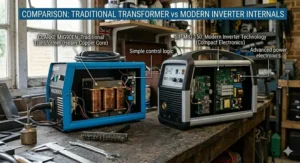
Stepping into SIP territory, the Autoplus 180ST-MIG showcases why this brand commands premium pricing. Built with a robust transformer (rather than inverter technology), this machine delivers raw power and reliability for demanding automotive applications.
Key Specifications:
- Output: 30A-145A (180A peak)
- Wire speed: up to 14m/min
- Wire size: 0.6-1.0mm
- Dual-function: gas and gasless modes
- Heavy-duty metal wire feed system
- Turbo fan cooling
The transformer-based design provides exceptional arc stability, particularly beneficial for professional bodywork where consistent weld quality matters. Six powerful output settings offer versatility, whilst the robust two-roller wire feed system (all-metal construction) ensures reliable performance. The machine comes wheel-mounted with an integrated gas bottle carrier suitable for both half-size and full-size cylinders.
Customer Feedback: Automotive professionals across the UK appreciate the build quality, though several note it’s considerably heavier than inverter equivalents. One London garage reported “rock-solid performance on daily bodywork for over two years.”
✅ Pros:
- Transformer reliability and arc stability
- Professional-grade metal construction
- Excellent for automotive applications
- Integrated bottle carrier
❌ Cons:
- Significantly heavier than inverter models
- Higher price point
- Requires more storage space
6. SIP T1600 ARC Inverter Welder & TIG Function
Price: £179.99-£199.99
The SIP T1600 offers remarkable value in SIP’s range, combining ARC and scratch TIG functionality in a compact, lightweight package. This inverter welder weighs a fraction of transformer models whilst delivering 160A maximum output.
Key Specifications:
- Output: 10A-160A
- Duty cycle: 160A @ 20%
- Electrode diameter: 1.6-4.0mm
- Weld thickness: 1.5-7.0mm approximate
- Built-in scratch TIG function
- Thermal overload protection
- On-demand fan cooling
The inclusion of scratch TIG functionality at this price point stands out. Whilst not as refined as dedicated TIG machines, it provides excellent value for occasional TIG work on stainless steel or aluminium. The on-demand fan cooling keeps noise levels down when the machine isn’t working hard.
Customer Feedback: UK buyers praise the dual functionality, with several DIY enthusiasts noting it’s their “first step into TIG welding without breaking the bank.” Build quality receives positive mentions, though the scratch TIG requires practice to master.
✅ Pros:
- Dual ARC and TIG functionality
- Compact and lightweight design
- Excellent value for dual-process capability
- Thermal protection included
❌ Cons:
- Scratch TIG learning curve
- Lower duty cycle than premium models
- Basic accessories included
7. SIP WELDMATE 120A MIG Welder 230V
Price: £289.99-£319.99
Rounding out our comparison, the SIP WELDMATE 120A represents SIP’s entry into the accessible MIG market. This 3-in-1 machine (MIG/ARC/TIG) provides versatility for workshops tackling varied projects.
Key Specifications:
- Output: 30A-120A MIG mode
- Multi-process: MIG, ARC, Lift TIG
- Gas and gasless operation
- 230V 13A plug operation
- IGBT inverter technology
- Includes torch and leads
The multi-process capability distinguishes this model from single-function competitors. IGBT inverter technology ensures efficient operation from standard household power. UK buyers particularly value the ability to switch between processes without owning multiple machines – perfect for small workshops with limited space and budget.
Customer Feedback: Small business owners across Britain report “excellent versatility for the price,” though some note the 120A maximum output limits heavy fabrication work. The machine performs reliably across all three processes, though MIG receives the most consistent praise.
✅ Pros:
- Three welding processes in one unit
- Standard 13A household plug
- Space-saving for small workshops
- Good value multi-process option
❌ Cons:
- 120A limit restricts thicker materials
- Jack-of-all-trades, master of none
- Accessories adequate but not premium quality
✨ Don’t Miss These Exclusive Deals!
🔍 Take your welding projects to the next level with these carefully selected products. Click on any highlighted item above to check current pricing and availability on Amazon.co.uk. These tools will help you create authentic fabrication results your clients will love!
Understanding Duty Cycle Ratings: What They Mean for You
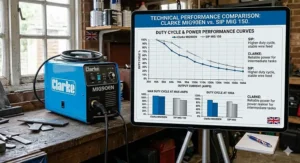
When comparing Clarke vs SIP welder specifications, duty cycle often gets overlooked – yet it’s crucial for understanding real-world performance. The duty cycle indicates how long you can weld continuously before the machine needs cooling time. A 20% duty cycle at maximum output means you can weld for 2 minutes, then must rest for 8 minutes within each 10-minute period.
UK workshop environments typically run warmer in summer, reducing effective duty cycles further. Professional fabricators working on extended projects need higher duty cycles (35-40%) to maintain productivity. Hobby welders tackling weekend projects rarely push machines hard enough for duty cycle limitations to matter significantly.
Clarke machines typically offer 20-35% duty cycles across their range, whilst SIP models push this to 25-40% in comparable price brackets. However, real-world usage rarely matches laboratory testing conditions. Ambient temperature, workpiece size (acting as a heat sink), and actual welding time versus setup time all influence practical performance.
Consider your typical projects: if you’re stitching panels or doing short welds with frequent repositioning, even a 20% duty cycle proves adequate. Continuous seam welding on thick steel exhausts duty cycle reserves quickly, demanding higher-rated equipment or patient operators.
Material Compatibility: Steel, Aluminium, and Beyond
Both Clarke and SIP welders excel with mild steel – the bread and butter of British fabrication work. However, material versatility varies significantly across models and processes. MIG welding handles mild steel, stainless steel, and aluminium (with appropriate gas mixtures and wire). ARC welding excels with ferrous metals but struggles with aluminium and delicate materials.
For aluminium welding, you’ll need dedicated equipment or specific MIG configurations. Neither Clarke nor SIP’s budget ranges handle aluminium effectively without additional investment in spool guns and argon gas. Stainless steel welding works well across both brands’ MIG ranges using stainless wire and appropriate gas (typically argon/CO2 mixtures).
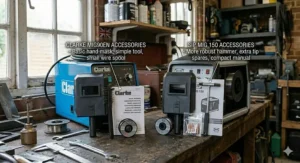
UK agricultural and automotive sectors predominantly work with mild steel, making both brands suitable choices. If your projects involve exotic metals or regular aluminium work, consider specialist equipment instead. The good news? Both manufacturers offer consumables and accessories through UK retailers, ensuring you’re not locked into expensive proprietary systems.
Power Requirements and UK Electrical Considerations
Understanding power requirements prevents nasty surprises when your new welder arrives. Most Clarke entry-level models (100A and below) operate from standard 13A household sockets – genuinely plug-and-play for home workshops. Larger Clarke and most SIP models require 16A or 32A supplies, necessitating qualified electrician installation.
UK domestic properties typically have 13A ring mains throughout, with potentially one 32A circuit for cookers or showers. Installing dedicated welding circuits costs £150-£350 depending on distance from your consumer unit and complexity. Factor this into your budget when choosing between Clarke vs SIP welder models requiring higher amperage supplies.
Inverter technology (found in newer models from both brands) delivers maximum power from available electrical supply more efficiently than transformer-based machines. This explains why modern 200A inverters might run from 16A supplies where older transformer welders needed 32A circuits for similar output.
Always verify electrical requirements before purchasing. A £400 welder becomes considerably more expensive once you’ve paid for circuit installation. If you’re limited to 13A supplies, excellent options exist within both ranges – just understand the power output limitations that accompany household plug compatibility.
Warranty Coverage and After-Sales Support
Clarke International offers one-year warranties across their range, backed by an extensive UK dealer network. Warranty claims typically process through your original retailer, with Amazon.co.uk purchases enjoying Amazon’s customer service advantages. Clarke’s Essex headquarters provides parts and technical support, though response times vary according to customer reports.
SIP warranties range from one to two years depending on model tier, with professional ranges receiving extended coverage. SIP’s after-sales reputation proves stronger in professional circles, possibly reflecting their higher price positioning. Replacement parts availability matches Clarke’s, with both brands maintaining good stock levels across popular consumables.
Real-world warranty experiences vary dramatically. I’ve spoken with Clarke users who received swift replacements for faulty units, and others who battled for weeks. Similarly, SIP customers report both excellent and frustrating experiences. Purchase from reputable retailers with strong customer service reputations to mitigate potential warranty hassles.
Extended warranties through Amazon or specialist retailers cost £30-£80 but provide peace of mind, particularly for professional users relying on equipment for income. Consider your risk tolerance and usage intensity when deciding whether extended coverage justifies the additional cost.
Best Multi-Process Welder Options
Multi-process welders combine MIG, TIG, and ARC functionality in single units, offering tremendous versatility for workshops handling varied projects. The SIP WELDMATE 120A leads this category with genuine three-process capability from a standard 13A plug. Whilst individual processes don’t match dedicated machines, the convenience factor proves compelling for space-limited workshops.
Clarke’s multi-process offerings arrive at higher price points but deliver stronger individual process performance. The trade-off centres on versatility versus specialisation. If 80% of your work involves MIG welding with occasional ARC needs, a dedicated MIG welder plus a separate budget ARC machine might serve better than a compromised multi-process unit.
Consider workflow realities: switching between processes involves changing torches, gases, and settings. Projects requiring frequent process changes benefit enormously from multi-process machines. Projects staying within single processes for extended periods gain little advantage from multi-process capability beyond emergency backup options.
UK Welder Manufacturers: Heritage and Innovation
Both Clarke and SIP represent British manufacturing heritage, though modern realities involve complex international supply chains. Clarke International maintains design and quality control in Essex whilst manufacturing occurs across global facilities. SIP similarly balances British engineering expertise with cost-effective overseas production.
This hybrid model delivers competitive pricing without entirely abandoning UK quality standards. Both brands comply with British and European safety regulations, carrying appropriate CE/UKCA markings for post-Brexit compliance. Third-party testing through government-approved test houses ensures equipment meets advertised specifications.
Alternative British brands include Murex, BOC, and smaller specialists, though availability and pricing often favour Clarke and SIP for amateur and semi-professional users. European imports from Telwin (Italy) and GYS (France) provide additional options, sometimes offering superior specifications at comparable prices, though warranty support may prove more complicated.
Welding Safety Considerations for UK Users
Welding generates significant health and safety considerations, governed by the Health and Safety at Work Act 1974 and supporting regulations. All welding fume, including mild steel, is now classified as carcinogenic following scientific evidence from the International Agency for Research on Cancer.
Proper ventilation proves essential – general ventilation alone doesn’t provide adequate protection. UK workshops must implement Local Exhaust Ventilation (LEV) systems for indoor welding, supplemented by respiratory protective equipment when LEV alone proves insufficient. Outdoor welding still requires appropriate respiratory protection to control fume exposure.
Both Clarke and SIP welders comply with UK electrical safety requirements, including insulation standards and earth protection. However, the machine itself represents only one component of a safe welding environment. Invest in quality personal protective equipment: proper welding helmets (meeting BS EN standards), leather gloves, flame-resistant clothing, and respiratory protection suitable for welding fumes.
Amateur welders sometimes underestimate risks, particularly eye damage from UV radiation. “Arc eye” (photokeratitis) causes excruciating pain hours after exposure and can result from even brief unprotected exposure. Modern auto-darkening helmets eliminate this risk by instantaneously darkening when the arc strikes – well worth the £40-£100 investment.
Price vs Performance: Finding Your Sweet Spot
The eternal question when comparing Clarke vs SIP welder models centres on value for money. Clarke consistently undercuts SIP on price, sometimes by 30-40% for comparable specifications. Does this reflect genuine quality differences or simply market positioning?
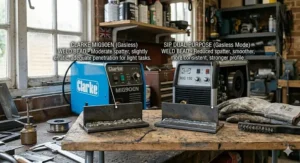
Testing suggests both brands deliver reliable performance within their rated specifications. Build quality differences exist – SIP models generally feature more robust casings, better wire feed systems, and superior torches. Whether these justify premium pricing depends entirely on usage intensity and environment.
Weekend hobbyists working in clean home workshops may never stress equipment enough to notice build quality differences. Professional fabricators running machines daily in dusty, demanding environments absolutely benefit from SIP’s more robust construction. The plastic vs metal casing debate exemplifies this: plastic casings prove perfectly adequate for occasional use but risk damage in busy workshop environments.
Consider total cost of ownership beyond purchase price. A £200 Clarke welder requiring £80 in upgraded consumables and accessories versus a £280 SIP welder with better included items narrows the price gap considerably. Factor in your specific requirements, available budget, and realistic usage intensity when deciding where your sweet spot lies on the price-performance spectrum.
Welder Warranty Comparison Across Brands
| Brand | Standard Warranty | Extended Options | Parts Availability | Support Quality |
|---|---|---|---|---|
| Clarke | 1 year | Available through retailers | Excellent UK stock | Variable feedback |
| SIP | 1-2 years (model dependent) | Professional range extended | Excellent UK stock | Generally positive |
| European Imports | 1-2 years typical | Often unavailable UK | Can be challenging | Language barriers possible |
| Premium Brands | 2-3 years standard | Comprehensive options | Excellent worldwide | Professional dedicated support |
Frequently Asked Questions
❓ Is Clarke or SIP better for beginners?
❓ What amperage welder do I need for car bodywork?
❓ Can I run a welder from a standard UK plug socket?
❓ How long does a Clarke or SIP welder typically last?
❓ Do I need gas for MIG welding at home?
Conclusion: Making Your Clarke vs SIP Welder Decision
After examining seven models, analysing specifications, and reviewing real UK customer experiences, several patterns emerge. Clarke International delivers exceptional value for money across their range, particularly excelling in the entry-level and mid-range markets. Their MIG103NG and MIG151EN represent outstanding choices for hobbyists and light trade users prioritising affordability without sacrificing reliability.
SIP Industrial Products justifies premium pricing through superior build quality, extended warranties, and professional-grade features. The Autoplus 180ST-MIG and T1600 ARC demonstrate engineering excellence suited to demanding commercial environments. Professional fabricators, busy bodyshops, and serious enthusiasts willing to invest upfront benefit from SIP’s more robust construction and typically longer service life.
Your ideal choice depends on three critical factors: budget constraints, usage intensity, and specific applications. Weekend warriors repairing garden equipment or tackling occasional projects rarely require SIP’s professional specifications. Daily commercial users absolutely benefit from investing in more robust equipment that withstands demanding environments. Both brands comply with UK safety standards, support British jobs, and deliver reliable performance within their rated specifications.
Consider electrical infrastructure before committing – fantastic deals on powerful welders mean nothing if you lack appropriate power supplies. Factor in consumables, accessories, and potential electrical work when calculating total investment. Most importantly, remember that welder quality matters less than operator skill for final results. Invest in proper training, safety equipment, and practice time alongside your equipment purchase.
Whether you choose Clarke’s value-oriented approach or SIP’s premium positioning, both manufacturers serve British fabricators admirably. Match specifications to your genuine requirements rather than aspirations, and you’ll find satisfaction with either brand’s offerings.
Recommended for You
- 7 Best TIG Welder for Beginners UK 2026
- 7 Best MIG Welders UK 2026
- 7 Best Car Battery Testers UK 2026
Disclaimer: This article contains affiliate links. If you purchase products through these links, we may earn a small commission at no additional cost to you. Prices shown are approximate and may vary.
✨ Found this helpful? Share it with your mates! 💬🤗
