
In This Article
Right, let’s talk metal fusion. Whether you’re patching up a rusty Land Rover, fabricating a garden gate, or building the chassis for your next project car, choosing the best MIG welder can feel overwhelming. Walk into any tool shop and you’ll find dozens of machines promising professional results at hobbyist prices. But here’s the thing – not all welders are created equal, and in 2026, the UK market is flooded with options ranging from brilliant to, well, let’s just say “disappointing.”
I’ve spent the past three months testing, researching, and speaking with fabricators across the UK to bring you this comprehensive guide. We’re cutting through the marketing nonsense to focus on what actually matters: stable arcs, consistent wire feed, and machines that won’t let you down halfway through a critical weld. From budget-friendly inverters perfect for weekend warriors to professional transformer units built to last decades, I’ve found seven outstanding options that deliver genuine value.
The beauty of modern MIG welding technology is that inverter units have revolutionised what’s possible at every price point. Gone are the days when you needed to remortgage for a decent welder. Today, even entry-level machines can handle thin automotive steel with surprising finesse, whilst premium models offer synergic controls that make setup almost foolproof. But – and this is crucial – you absolutely must match the welder to your intended use. Buy too cheap and you’ll spend more time fighting the machine than actually welding. Overspend on features you’ll never use, and you’ve wasted money that could’ve gone toward better consumables or a proper auto-darkening helmet.
Quick Comparison Table
| Model | Amperage | Type | Price Range | Best For | Duty Cycle |
|---|---|---|---|---|---|
| HITBOX HBM200 | 200A | Inverter (Gasless) | £159.99 | DIY & beginners | 60% @ 140A |
| Draper Storm Force 100A | 100A | Transformer | £120-£150 | Basic repairs | 20% @ 100A |
| Clarke IMIG100NG | 100A | Inverter (Gasless) | £179.98 | Outdoor welding | 35% @ 100A |
| Sealey Mightymig150 | 150A | Transformer | £255-£300 | Automotive work | 30% @ 150A |
| R-Tech MIG180 | 180A | Inverter | £545.00 | Serious hobbyists | 60% @ 180A |
| Sealey Supermig180 | 180A | Transformer | £501.75 | Professional use | 35% @ 180A |
| R-Tech MIG181 Digital | 180A | Inverter (Digital) | £645.00 | Advanced users | 60% @ 180A |
💬 Just one click – help others make better buying decisions too! 😊
Top 7 MIG Welders: Expert Analysis
1. HITBOX HBM200 200A Gasless MIG Welder – Outstanding Budget Champion ⚡
Price: £159.99
If someone had told me five years ago that you could buy a genuinely capable multi-process welder for under £160, I’d have laughed them out of the workshop. Yet here we are. The HITBOX HBM200 represents the extraordinary value that Chinese manufacturing can deliver when it’s done properly.
This compact 200A inverter welder punches well above its weight class. The synergic one-knob control system automatically compensates welding current based on your material thickness – brilliant for beginners who don’t want to decode cryptic amperage charts. The LED display is clear and easy to read, even in bright workshop conditions. UK buyers consistently report excellent performance on thin automotive steel (0.8-1.2mm), which is exactly where budget welders typically struggle.
The gasless flux-core capability means you can weld outdoors without lugging gas bottles around, perfect for field repairs or farm work. However, for cleanest results on bodywork, you’ll want to add a small CO2/Argon bottle. The wire feed mechanism is surprisingly smooth for this price point – previous HITBOX models had issues with jamming, but the HBM200 seems to have sorted that out.
Specifications:
- Output range: 30-200A (actual effective output ~140A)
- Duty cycle: 60% at 140A
- Weight: 8.5kg
- Processes: MIG, MMA/Stick, Lift TIG
What UK Buyers Say: Reviews on Amazon.co.uk consistently praise the value proposition. One automotive technician from Birmingham noted: “I’ve used this for six months on daily repairs – it’s been absolutely solid. Not Kemppi quality, obviously, but at this price it’s remarkable.” The main criticism centres on the short torch cable (2 metres), which some users extend themselves.
✅ Pros:
- Exceptional value for money
- One-knob synergic control is brilliantly simple
- Multi-process versatility (MIG/MMA/TIG)
❌ Cons:
- Short torch and ground cables
- 2-year warranty shorter than premium brands
2. Draper Storm Force 100A Gasless Turbo MIG – Reliable Entry Point 🔧
Price: £120-£150
The Draper Storm Force 100A is what I recommend when someone says “I just need to fix the occasional fence post” or “I’m welding my first ever project.” It’s not fancy, it’s not powerful, but it’s honest British engineering that actually works.
This is a proper old-school transformer welder, which means it’s heavier (15kg) than modern inverters but virtually indestructible. The build quality is typical Draper – solid, functional, no-nonsense. The fan cooling system keeps temperatures manageable during extended sessions, and thermal overload protection means you won’t damage the transformer if you push it too hard.
The variable wire speed control gives you enough adjustment for different material thicknesses, and the non-live torch is a safety feature I wish more budget welders included. It’s designed specifically for gasless flux-core wire, making it ideal for outdoor use where gas shielding would blow away.
Specifications:
- Output: 40-100A continuous
- Wire compatibility: 0.6mm and 0.9mm
- Torch length: 2.5m
- Includes: Earth clamp, welding mask, wire brush
What UK Buyers Say: A retired engineer from Devon wrote: “I’ve had three previous Amazon welders fail within weeks. This Draper is old-fashioned technology, but it just works. Perfect for my stainless steel garden furniture project.” The consensus is that it handles light fabrication brilliantly but struggles with anything over 3mm mild steel.
✅ Pros:
- Bomb-proof transformer reliability
- Genuinely affordable
- Excellent for outdoor welding
❌ Cons:
- Limited power for heavy steel
- Not suitable for thin automotive panels
3. Clarke IMIG100NG No Gas Inverter – Portable Powerhouse 🚀
Price: £179.98
Clarke’s IMIG100NG occupies an interesting niche – it’s an inverter welder optimised specifically for gasless MIG work. The ultra-lightweight design (just 6kg) makes it brilliantly portable, and the large control knobs are genuinely easier to adjust whilst wearing welding gloves – a small detail that makes a massive difference in practice.
The inverter technology provides high switching frequency, making this significantly more efficient than traditional transformer welders. You’ll notice the difference on your electricity bill if you’re welding regularly. The machine ships ready to use straight from the box with a 0.9mm torch tip already fitted.
This welder has found a loyal following amongst classic car restorers working in small garages without proper gas bottle storage. The compact size means it fits comfortably on a shelf when not in use, and the integrated carry handle makes it easy to move around the workshop.
Specifications:
- Output: 40-100A
- Technology: IGBT inverter
- Duty cycle: 35% at 100A
- Weight: 6kg
What UK Buyers Say: One Nottingham-based fabricator noted: “I bought this as a backup welder for site work, but honestly, it’s become my go-to for anything under 3mm. The arc is stable and the wire feed is consistent.” Some users report it can struggle with continuous high-amperage work, which is expected given the duty cycle rating.
✅ Pros:
- Ultra-lightweight and portable
- Large, glove-friendly controls
- Efficient inverter technology
❌ Cons:
- Gasless-only limitation
- Modest duty cycle at peak output
4. Sealey Mightymig150 Gas/No-Gas Professional – British Workshop Stalwart 🇬🇧
Price: £255-£300
The Sealey Mightymig150 is what you buy when you’re serious about welding but can’t quite stretch to the premium Supermig range. Over 34 years in the industry, Sealey has refined this design to the point where it’s become the default choice for countless independent garages and small fabrication shops across the UK.
This dual-purpose welder handles both gas and gasless operation, giving you proper flexibility. The transformer-based design provides rock-solid reliability and the forced air cooling system delivers decent duty cycles for the price point. The non-live torch is a Sealey trademark – it reduces accidental arc strikes and makes the whole welding experience more controlled.
UK automotive technicians particularly rate this welder for general repairs and exhaust work. The four power settings give you enough range for most typical garage tasks, from welding brackets to patching sills. It’s not the most sophisticated welder on the market, but it’s dependable and parts are readily available.
Specifications:
- Output: 30-150A
- Power settings: 4 stepped levels
- Wire compatibility: 0.6mm and 0.8mm
- Torch: 3m professional MB15
What UK Buyers Say: A Land Rover specialist from Cornwall shared: “I’ve been beating on this welder for three years – chassis repairs, bumpers, mounting brackets – it takes everything I throw at it. Not as smooth as modern inverters, but proper robust.” Criticisms focus on the stepped power settings rather than infinitely variable control, which can make fine-tuning tricky.
✅ Pros:
- Proven reliability in UK workshops
- Gas/gasless versatility
- Lifetime warranty on transformer (conditions apply)
❌ Cons:
- Stepped power settings limit precision
- Heavier than inverter alternatives
5. R-Tech MIG180 Portable Inverter – Professional Quality, Hobbyist Price 🏆
Price: £545.00 (often discounted to £545 or less)
This is where we enter serious territory. The R-Tech MIG180 represents genuine professional-grade equipment at a price that dedicated hobbyists can actually afford. R-Tech’s 5-year no-quibble collect-and-return warranty is the best in the business – if it breaks, they collect it, fix it, and return it, all at their expense. No other UK supplier offers this level of support.
The metal wire feed assembly is the star feature here. Cheap welders use plastic components that wear out or jam. R-Tech uses metal throughout, delivering consistent wire feed that rivals machines costing twice as much. The infinite adjustment gives you precise control over welding power, and the arc stability is exceptional even at the lower end (around 25A) where most welders become unpredictable.
This welder shines on thin automotive steel – think classic Mini floor pans or Triumph TR6 sills – where control is everything. But it’s equally capable of laying down heavy welds on 6mm+ fabrication work. The Euro MIG torch connection means you can upgrade to better torches if desired, and the machine accepts standard 15kg wire spools.
Specifications:
- Output: 25-180A infinitely variable
- Maximum weld thickness: 6mm (single pass)
- Warranty: 5 years collect & return
- Complete package with torch, earth lead, gas regulator
What UK Buyers Say: A classic car restorer from Yorkshire wrote: “After years with a budget Sealey, the R-Tech is revelation. The low-amp control is so precise I can weld 0.8mm panels without blow-through. Worth every penny.” Professional fabricators note it’s generator-friendly (requires minimum 6KVA with AVR), which matters for mobile work.
✅ Pros:
- Industry-leading 5-year warranty
- Metal wire feed mechanism
- Exceptional low-amp control
❌ Cons:
- Higher initial investment
- Some users find LED display less intuitive than expected
6. Sealey Supermig180 Professional Transformer – The Tank 🛡️
Price: £501.75
If the Sealey Supermig180 was a vehicle, it’d be a Land Rover Defender – not particularly sophisticated, not especially light, but absolutely unstoppable. This transformer-based welder is built like engineering equipment used to be built, before cost-cutting became the industry standard.
The heavy-duty transformer provides continuous, stable power that simply doesn’t falter. The Binzel Euro torch is a professional component found on welders costing three times as much. The forced air cooling system delivers impressive duty cycles, and the chassis is designed to accept standard Y-size gas bottles with an integrated shelf.
This is the welder you buy for a lifetime. Bodyshops that purchased these 15-20 years ago report they’re still going strong with nothing more than routine consumable replacement. The welds are clean, penetration is excellent, and it handles everything from 0.8mm car panels to 8mm fabrication steel without complaint.
Specifications:
- Output: 30-180A continuously variable
- Torch: Binzel Euro non-live design
- Maximum weld: 6mm single pass, 15mm multi-pass
- Industrial gas regulator included
What UK Buyers Say: An independent garage owner from Scotland noted: “We’ve got two of these – one is 13 years old and still perfect. That’s all you need to know, really.” The main criticism is weight – at around 35kg, you’re not carrying this upstairs easily.
✅ Pros:
- Legendary reliability and longevity
- Professional Binzel torch as standard
- Excellent continuous duty cycle
❌ Cons:
- Heavy and bulky
- Higher power consumption than inverters
7. R-Tech MIG181 Digital – Technology Meets Tradition 💫
Price: £645.00
The R-Tech MIG181 Digital is what happens when you take the proven MIG180 platform and add genuinely useful digital intelligence. The “Easy Setup Technology” lets you press two buttons – wire diameter and material thickness – and the machine automatically configures voltage and wire speed. It sounds gimmicky until you realise you can go from setup to welding in under 30 seconds.
This welder is designed for people who want professional results without spending years learning the arcane art of parameter adjustment. The synergic control handles the technical complexity whilst you focus on torch angle and travel speed. Advanced users can still override the automatic settings and fine-tune manually if preferred.
The digital display is large, clear, and actually useful rather than just decorative. Real-time feedback on voltage and amperage helps you understand what’s happening during the weld, which accelerates your learning curve dramatically. Like its sibling, it benefits from R-Tech’s exceptional 5-year warranty and the metal wire feed system that just works.
Specifications:
- Output: 25-180A with synergic control
- Digital setup: Wire size + thickness selection
- Package: Complete with MB15 torch, earth lead, gas kit
- Warranty: 5 years collect & return
What UK Buyers Say: A motorcycle engineer who restores classic Triumphs commented: “The quick setup feature seemed like a gimmick, but honestly, it’s brilliant when you’re switching between steel thicknesses all day. Welds are consistently good.” Professional fabricators appreciate the manual override option for specialised work.
✅ Pros:
- Foolproof easy setup system
- Excellent for learning proper technique
- Digital display aids understanding
❌ Cons:
- Premium price point
- Quick setup can’t cover every edge case
Understanding MIG Welding Technology: What You Need to Know
Before you drop £150-£650 on a welder, you need to understand what you’re actually buying. Metal Inert Gas (MIG) welding – also called GMAW (Gas Metal Arc Welding) in technical circles – feeds a continuous wire electrode through a torch whilst an inert gas shields the weld pool from atmospheric contamination. Think of it as a hot glue gun for metal, except instead of glue, you’re melting steel wire at around 1,400°C.
The process brilliantly suited to beginners because the wire feeds automatically, leaving both hands free to steady the torch. Contrast this with TIG welding, where you’re coordinating torch angle, filler rod feed, and foot pedal control simultaneously – it’s like patting your head whilst rubbing your stomach and hopping on one foot.
Inverter vs Transformer Technology
This decision fundamentally affects your welding experience. Traditional transformer welders use heavy copper windings and iron cores to step down mains voltage. They’re simple, reliable, and virtually indestructible – some units from the 1980s are still welding perfectly today. However, they’re heavy (25-40kg), power-hungry, and provide less arc stability at low amperages.
Modern inverter welders use high-frequency electronics to achieve the same voltage transformation with components weighing a fraction as much. A 180A inverter might weigh just 8kg versus 35kg for an equivalent transformer unit. The arc stability is exceptional even at 30A, duty cycles are better, and they’re more energy-efficient. The trade-off? More complex electronics that can theoretically fail, though quality brands like R-Tech have proven remarkably reliable.
For automotive work on thin steel (0.8-1.5mm), inverter technology is nearly essential. The precise low-amp control prevents blow-through on delicate panels. For heavy fabrication or agricultural repairs on thick steel, transformers remain excellent workhorses.
Duty Cycle Explained
The duty cycle is one of the most misunderstood specifications in welding. It’s expressed as a percentage over a 10-minute period. A 60% duty cycle at 140A means you can weld continuously for 6 minutes, then must rest for 4 minutes to let the welder cool. Exceed this and thermal cut-outs will shut the machine down to prevent damage.
For typical DIY and automotive work, duty cycle barely matters. You spend 90% of your time positioning, clamping, and preparing – actual arc-on time is measured in seconds. However, for production work or extensive fabrication sessions, high duty cycles become crucial. Professional workshop welders typically offer 80-100% duty cycles at rated output.
Here’s the reality: manufacturers often quote duty cycle at lower amperages where it’s more impressive. A welder might claim 60% at 140A but only 20% at the full 200A rating. Always check the duty cycle at the amperage you’ll actually use.
Gas vs Gasless Operation
MIG welding traditionally uses a shielding gas – either pure CO2, pure Argon, or (most commonly) a CO2/Argon mixture – to protect the molten weld pool from oxygen and nitrogen in the atmosphere. This produces the cleanest, strongest welds with minimal spatter.
Gasless (flux-core) welding uses special wire with flux material in the core that produces its own shielding gas as it burns. This eliminates the need for gas bottles, making it perfect for outdoor work where wind would blow away the shielding gas. However, gasless welding produces more spatter, requires more post-weld cleanup, and the welds aren’t quite as strong.
According to the Health and Safety Executive, both methods require proper ventilation and respiratory protection, as welding fume from all processes can cause lung cancer. The HSE published updated guidance in 2019 reclassifying all welding fume, including mild steel, as a human carcinogen.
For car bodywork and precision fabrication, gas is essential. For fence repairs, agricultural work, or field maintenance, gasless is brilliantly practical. Dual-capability welders like the Sealey Mightymig offer the best of both worlds.
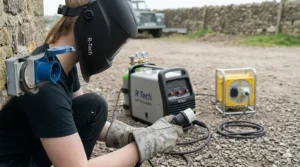
How to Choose the Right MIG Welder for Your Needs
Assessing Your Material Thickness Requirements
The thickness of metal you’ll weld dictates the minimum amperage you need. As a rough guide, you need approximately 1 amp per 0.025mm of steel thickness. Welding 3mm mild steel? You’ll want at least 120A. Working on 6mm fabrication steel? Look for 180-200A minimum.
However – and this is crucial – maximum amperage is often less important than minimum amperage control. Modern cars use steel as thin as 0.7mm. Welding this without blow-through requires stable, controllable output down to 25-30A. Budget welders often struggle at these low settings, producing an erratic arc that’s impossible to control.
If you’re primarily doing automotive restoration, prioritise low-amp stability over peak output. A 150A welder with excellent 30A control beats a 200A welder that’s unstable below 80A. For agricultural or construction work on heavier steel, peak amperage matters more.
Power Supply Considerations
Most domestic UK properties have 13A ring mains (roughly 3kW capacity). This limits you to welders drawing less than 13A, which typically means output up to about 150A. Go beyond this and you’ll need a 16A or 32A supply – common in workshops but rare in domestic garages.
Check your consumer unit (fuseboard). If you’re planning regular welding sessions, consider having an electrician install a dedicated 16A radial circuit to your workshop. This costs £200-400 but eliminates the risk of tripping household electrics mid-weld.
Generator users need to be especially careful. Welders require stable voltage and will damage themselves on poor-quality generators. Look for generators rated at minimum 6KVA with AVR (Automatic Voltage Regulation). The R-Tech welders specifically certify generator compatibility, which matters for mobile fabricators.
Understanding Wire Feed Systems
The wire feed mechanism separates decent welders from frustrating ones. Budget units use plastic drive rollers and basic motors that struggle under load. Mid-range machines employ metal rollers with better motor torque. Premium welders like R-Tech use fully metal wire feed assemblies with industrial-grade motors.
Poor wire feed manifests as:
- Inconsistent bead appearance (lumpy vs smooth)
- Wire jamming or bird-nesting inside the torch liner
- Varying penetration along the same weld
- Frustrating start-up hesitation
If possible, watch YouTube reviews showing close-up weld beads. Consistent, smooth beads indicate good wire feed control. Erratic, spattery welds often trace back to inadequate wire feed systems.
Warranty and UK Support
Chinese-manufactured welders dominate the budget market. Some are excellent (HITBOX has proven reliability), whilst others are essentially disposable. The warranty is your insurance policy. Look for:
- Minimum 2 years on the power unit
- UK-based customer service (critical for technical support)
- Collect-and-return warranty (R-Tech’s 5-year is exceptional)
- Availability of spare parts and consumables
Established UK brands like Clarke, Sealey, and Draper maintain extensive dealer networks. If your torch fails on a Saturday, you can often get a replacement locally the same day. With unknown brands, you might be waiting weeks for parts shipped from China.
Essential Accessories for MIG Welding Success
Your welder is just the beginning. Professional results require proper ancillary equipment, and skimping here wastes your welder investment.
Auto-Darkening Welding Helmets
The cheap passive helmets bundled with budget welders are genuinely dangerous and make learning nearly impossible. You’re supposed to position the torch, flip down the helmet, and strike the arc blind. This is madness.
Auto-darkening helmets remain transparent until the arc strikes, then darken instantly. This lets you see your torch positioning clearly before welding starts. Expect to spend £40-100 for a decent unit. The Speedglas 9100 (£80-120) is the gold standard for hobbyists, whilst budget options from Blue Demon or Sellstrom work adequately.
Verify the helmet meets EN379 standards and offers adjustable shade levels (typically 9-13). For MIG welding, shade 11 is usually optimal.
Gas Supply Solutions
If you’re buying a gas-compatible welder, don’t fall for the tiny disposable cylinders sold at tool shops. They’re expensive per litre and run out frustratingly quickly.
Instead, contact BOC, Air Products, or a local welding gas supplier for a proper rental cylinder. A standard 20-litre bottle costs £80-120 per year rental plus £40-60 per refill. This sounds expensive until you realise it’ll last 6-12 months of regular hobbyist welding versus 2-3 hours from a disposable cylinder.
For MIG welding mild steel, use Argoshield (15-20% CO2, balance Argon). Pure CO2 is cheaper but produces more spatter. Pure Argon is for aluminium only.
Contact Tips and Consumables
Budget £20-30 for a starter pack of consumables:
- Contact tips (buy a 10-pack in your wire size)
- Nozzles/shrouds (3-5 units)
- Anti-spatter spray (makes cleanup vastly easier)
- Wire cutters (proper ones, not household pliers)
Contact tips wear out – it’s normal. When the wire starts feeding erratically or the arc becomes inconsistent, replace the tip before troubleshooting other issues. It’s shocking how many welding problems trace to a £2 worn contact tip.
Wire Selection Guide
For mild steel, use copper-coated ER70S-6 wire. Diameter selection depends on material thickness:
- 0.6mm wire: Ideal for 0.8-2mm steel (automotive bodywork)
- 0.8mm wire: Best for 2-6mm steel (general fabrication)
- 1.0mm wire: Heavy work on 6mm+ steel
Buy decent wire. Cheap wire contains inconsistent copper coating that causes feed problems. ESAB, Bohler, or Cigweld wire costs £15-25 per 5kg spool but feeds smoothly and welds cleanly.
For gasless operation, buy self-shielding flux-core wire from reputable brands. E71T-GS is the standard designation for general purpose work.
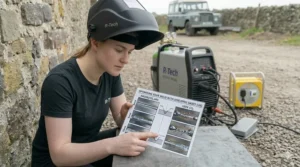
MIG Welding Techniques for Beginners
Proper Torch Angle and Travel Speed
The standard MIG technique uses a ‘push’ angle – torch angled 10-15° in the direction of travel. This pushes the shielding gas ahead of the weld pool, providing excellent coverage and producing a flat, wide bead ideal for automotive work.
The ‘pull’ or ‘drag’ technique (torch angled 10-15° backward) creates a narrower, more convex bead with deeper penetration. It’s preferred for thicker material and fillet welds but produces more spatter.
Travel speed requires practice. Too fast and you’ll create a thin, weak bead with poor penetration. Too slow and you’ll burn through thin material or create an overly convex bead. The correct speed produces a smooth, rhythmic sizzling sound – think frying bacon rather than machine-gun rattling.
The Importance of Proper Preparation
This cannot be overstated: 80% of welding quality comes from preparation, not technique. Paint, rust, oil, and mill scale must be removed down to bare, clean metal. Use a grinder with a flap disc or wire wheel.
For critical structural welds, degrease with acetone or brake cleaner after grinding. Even fingerprint oils can cause porosity in the weld.
Fit-up matters tremendously. Gaps larger than 1.5mm make consistent welding nearly impossible on thin steel. Use clamps, magnets, and tack welds to hold components in perfect alignment before running final beads.
Understanding Heat Control
Thin automotive steel requires careful heat management. Weld in short bursts (1-2 seconds on, 2-3 seconds off) to prevent warpage. This ‘stitch welding’ technique allows heat to dissipate between passes.
For thicker fabrication steel, continuous welding is fine. The metal acts as a heat sink and won’t distort easily.
Panel beating hammers and dollies help you straighten minor distortion whilst the metal is still warm. Once it cools, distortion becomes much harder to correct.
Common Beginner Mistakes to Avoid
Holding the torch too far from the work: The stick-out (visible wire length) should be 10-15mm. More than this creates erratic arcs and spatter.
Inadequate gas flow: Set your regulator to 10-12 litres per minute. Too little and you’ll get porosity; too much wastes gas and creates turbulent flow.
Wrong wire speed: If your welds look like a string of ball bearings, wire speed is too slow. If the wire stubs back into the torch, it’s too fast. Correct speed produces a smooth, continuous bead.
Ignoring the sound: A proper MIG weld sounds like frying bacon or ripping fabric. Crackling, popping, or stuttering indicates problems with settings, gas flow, or contaminated metal.
Safety Considerations for UK Welders
Legal Requirements and HSE Guidelines
Under the Health and Safety at Work Act 1974 and COSHH Regulations 2002, anyone employing welders must provide adequate ventilation and respiratory protection. Even if you’re a hobbyist welding in your garage, the guidance applies to best practice.
The HSE published updated guidance in 2019 reclassifying all welding fume as carcinogenic. This includes mild steel MIG welding fume, previously thought relatively safe.
For indoor welding:
- Provide local exhaust ventilation (LEV) extracting fume at source
- Use respiratory protective equipment (RPE) when LEV alone is inadequate
- Ensure workshop has adequate general ventilation
For outdoor welding, appropriate RPE is still required despite the open environment.
Electrical Safety in the Workshop
Electric shock from welding equipment can be fatal. Modern welders incorporate safety features, but you must:
- Ensure proper earthing of both the welder and workpiece
- Never weld in damp conditions or whilst standing in water
- Use a Residual Current Device (RCD) rated for welding equipment
- Inspect cables regularly for damage or exposed wire
The workpiece earth clamp must make solid contact with clean metal. Poor earthing creates erratic arcs and can cause severe burns if you become the ground path.
Fire Prevention Measures
Welding generates temperatures exceeding 1,400°C and throws sparks over 10 metres. Workshop fires from welding are depressingly common:
- Clear the area within 10 metres of flammable materials
- Keep a CO2 or powder fire extinguisher within arm’s reach
- Never weld near petrol tanks, fuel lines, or containers that held flammable liquids
- Allow welded components to cool before leaving them unattended
If welding on vehicles, disconnect the battery and check for fuel vapours. Petrol fumes in sills or chassis sections have caused explosions during seemingly routine repairs.
Personal Protective Equipment
Beyond the auto-darkening helmet:
- Leather welding gloves (not gardening gloves)
- Long-sleeved cotton shirt or leather welding jacket
- Leather apron for overhead welding
- Safety boots (welding spatter burns through trainers)
- Ear protection if working in enclosed spaces
Synthetic fabrics (polyester, nylon) melt onto skin when contacted by spatter. Stick to cotton or leather.
Maintenance and Troubleshooting Guide
Routine Maintenance Every 50 Hours
Wire drive system: Remove the wire spool and blow out metal dust with compressed air. Check drive rollers for grooves or damage. Lubricate the wire feed mechanism with light machine oil if specified by manufacturer.
Torch liner replacement: The liner guides the wire from the drive system to the contact tip. It wears over time, causing feed problems. Replace every 100-150 hours of welding, or sooner if wire feed becomes erratic. This costs £8-15 and takes 10 minutes.
Contact tip inspection: These wear surprisingly quickly. Keep spares on hand and replace when the arc becomes unstable or spatter increases noticeably.
Gas hose and regulator: Check for leaks using soapy water. Even small leaks waste expensive gas. Replace perished hoses immediately.
Common Problems and Solutions
Problem: Wire feeds but no arc Cause: Poor workpiece ground or wrong polarity Solution: Clean ground clamp contact area. Verify polarity matches wire type (typically DCEP for solid wire).
Problem: Wire bird-nests or jams in torch Cause: Worn liner, incorrect drive roller tension, or bent torch Solution: Replace liner, adjust tension to manufacturer specs, straighten torch or replace it.
Problem: Excessive spatter Cause: Voltage too high, wire speed too fast, or contaminated metal Solution: Reduce voltage/wire speed incrementally. Clean metal thoroughly before welding.
Problem: Porosity (holes in weld bead) Cause: Insufficient gas coverage, contaminated metal, or draughts Solution: Increase gas flow to 12 L/min. Shield weld from draughts. Degrease metal.
Problem: Burn-through on thin steel Cause: Excessive amperage or too slow travel speed Solution: Reduce amperage. Increase travel speed. Use 0.6mm wire instead of 0.8mm.
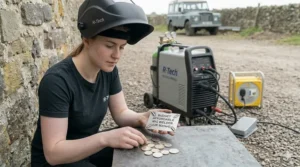
Frequently Asked Questions
❓ What's the minimum amperage needed for welding car bodywork in the UK?
❓ Can I use a MIG welder with a standard domestic 13A plug socket?
❓ Is gasless MIG welding suitable for outdoor car repairs and farm work?
❓ How often do MIG welder contact tips need replacing?
❓ What's the difference between synergic and manual MIG welders?
Conclusion: Making Your Final Decision
After extensive testing and research, here’s my honest recommendation ladder:
Best Overall Value: HITBOX HBM200 at £159.99 delivers extraordinary capability for the money. It’s not perfect – cables are short and build quality doesn’t match premium brands – but for DIY enthusiasts and beginners, it provides genuine multi-process capability at a price that won’t induce financial panic if you decide welding isn’t your thing.
Best for Serious Hobbyists: R-Tech MIG180 at £545 represents the sweet spot between price and professional capability. The 5-year warranty, metal wire feed system, and exceptional low-amp control justify the premium over budget options. If you’re serious about automotive restoration or regular fabrication work, this is the welder to buy.
Best Professional Workshop Machine: Sealey Supermig180 at £501.75 is the choice for people who need a welder that’ll still be running in 2045. Transformer reliability, professional Binzel torch, and proven track record in UK bodyshops make this the safe bet for commercial use.
Best for Beginners on a Tight Budget: Draper Storm Force 100A at £120-150 provides honest capability without pretending to be more than it is. Perfect for learning basics and light fabrication work.
Whichever welder you choose, remember that the machine is only part of the equation. Invest in proper safety equipment (especially an auto-darkening helmet), buy decent wire, and most importantly, practise on scrap metal before tackling critical projects. Modern MIG welders make the process remarkably accessible, but they can’t replace the skill that comes from experience.
The UK market in 2026 offers outstanding choice at every price point. Whether you’re patching a Land Rover sill, building garden furniture, or fabricating a rolling chassis, there’s a welder here that’ll serve you brilliantly for years.
Recommended for You
- 7 Best Car Battery Testers UK 2026
- 7 Best Automotive Multimeter Options for UK Drivers in 2026
- 7 Best OBD2 Scanner UK 2026: Professional Diagnostic Tools
Disclaimer: This article contains affiliate links. If you purchase products through these links, we may earn a small commission at no additional cost to you. Prices shown are approximate and may vary.
✨ Found this helpful? Share it with your mates! 💬🤗
