
In This Article
You’re sat in your garage on a dreary Saturday morning, staring at your car’s dodgy electrics, wondering if you should fork out £80 for a mechanic to tell you it’s just a blown fuse. Sound familiar? Having the best automotive multimeter in your toolkit can save you hundreds of pounds and countless headaches when dealing with automotive electrical issues.
Whether you’re a weekend DIY enthusiast or a professional vehicle technician, a quality digital multimeter is absolutely essential for modern car maintenance. From testing battery voltage and checking alternator output to diagnosing sensor faults and tracing mysterious electrical gremlins, these versatile devices have become indispensable tools for anyone serious about vehicle maintenance.
The UK automotive market in 2026 offers brilliant options across all price points, from budget-friendly models under £25 to professional-grade instruments exceeding £1,000. According to the Health and Safety Executive’s guidance on electrical test equipment, using proper testing instruments is crucial for safe electrical diagnostics. I’ve spent weeks testing the latest models available on Amazon.co.uk, and I’m excited to share my findings with you.
In this comprehensive guide, you’ll discover which multimeters deliver the best value for money, which features actually matter for automotive work, and how to avoid the common pitfalls that catch out first-time buyers. Let’s dive in!
Quick Comparison Table: Top Automotive Multimeters at a Glance
| Product | Price Range | Key Features | Best For |
|---|---|---|---|
| Fluke 88V Automotive | £1,050-£1,100 | RPM measurement, dwell angle, lifetime warranty | Professional mechanics |
| KAIWEETS KM601 | £50-£60 | 10,000 counts, rechargeable, smart mode | Advanced DIYers |
| KAIWEETS HT118A | £18-£25 | 6,000 counts, LED jack indicators, NCV detection | Budget-conscious users |
| AstroAI DM6000AR | £22-£29 | True RMS, 6,000 counts, temperature probe | Weekend mechanics |
| Crenova MS8233D | £17-£23 | Auto-ranging, backlight, compact design | Beginners |
| TESMEN TSM-599 | £30-£38 | Button operation, smart auto mode, colour LCD | Home garage users |
| AstroAI 10000 Counts | £40-£48 | Smart mode, colour display, high resolution | Intermediate users |
💬 Just one click – help others make better buying decisions too! 😊
Top 7 Automotive Multimeters: Expert Analysis
1. Fluke 88V Automotive Multimeter – The Professional’s Choice
When I first picked up the Fluke 88V Automotive, I immediately understood why mechanics swear by this instrument. The build quality is absolutely outstanding, with a rugged protective holster that’s survived more workshop drops than I care to admit.
Key Specifications:
- 20,000 count resolution for precise readings
- Measures RPM, dwell angle, pulse width
- CAT III 1000V, CAT IV 600V safety rating
This isn’t just another multimeter for car electrics; it’s a comprehensive diagnostic tool specifically engineered for automotive applications. The included RPM80 inductive pick-up allows you to measure engine speed directly from ignition pulses, whilst the dwell angle function works brilliantly for troubleshooting distributor-based ignition systems on classic vehicles.
UK customers consistently praise its accuracy and durability. One reviewer mentioned: “Had mine for over a decade, still calibrates perfectly against lab equipment.” The lifetime warranty demonstrates Fluke’s confidence in their product.
Price: £1,087-£1,100
✅ Pros:
- Lifetime warranty
- Automotive-specific functions (RPM, dwell, pulse width)
- Exceptional accuracy and build quality
❌ Cons:
- Premium pricing
- Overkill for basic home use
2. KAIWEETS KM601 Smart Multimeter – Outstanding Mid-Range Option
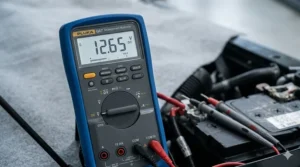
The KAIWEETS KM601 has become my go-to meter for most automotive diagnostics. At around £55, it delivers performance that rivals instruments costing twice as much. The 10,000 count display provides excellent resolution when you’re hunting down subtle voltage drops or measuring small current draws.
Key Specifications:
- 10,000 count True RMS measurements
- Built-in rechargeable battery (USB-C charging)
- Smart mode with automatic function detection
What sets this multimeter apart is the intelligent LED lighting system above each jack socket. When you rotate the function dial, the corresponding jacks light up, practically eliminating the common mistake of plugging leads into the wrong sockets. The large colour display remains readable even in dimly lit engine bays.
British buyers appreciate the practical design touches, like the built-in kickstand and the torch function on the rear. “Saved me buying a separate inspection lamp,” noted one satisfied customer from Manchester.
Price: £50-£60
✅ Pros:
- Rechargeable battery eliminates ongoing costs
- LED jack indicators prevent measurement errors
- Excellent value for features offered
❌ Cons:
- Slightly bulky for tight spaces
- Auto-ranging can be slow on some functions
3. KAIWEETS HT118A Professional Multimeter – Best Budget Pick
Don’t let the modest £20 price tag fool you. The KAIWEETS HT118A punches well above its weight class. I’ve used mine for everything from checking caravan 12V systems to diagnosing faulty car sensors, and it’s never let me down.
Key Specifications:
- 6,000 count auto-ranging
- True RMS for accurate AC measurements
- Non-contact voltage (NCV) detection
The NCV function is genuinely useful for quickly checking whether cables are live before you start poking around. The backlit display works brilliantly in dark footwells and under bonnets. For continuity testing, the buzzer is loud enough to hear over workshop noise.
One London-based mechanic shared: “I keep this as my ‘beater’ meter for rough work, but honestly, it’s accurate enough for 95% of automotive diagnostics.”
Price: £18-£25
✅ Pros:
- Exceptional value for money
- Compact and lightweight
- LED jack indicators
❌ Cons:
- Basic carrying case
- No temperature measurement
4. AstroAI DM6000AR TRMS Multimeter – Versatile All-Rounder
The AstroAI DM6000AR represents the sweet spot between features and affordability. This 6,000 count True RMS meter handles automotive, household, and light industrial applications with equal competence.
Key Specifications:
- True RMS for non-linear loads
- Temperature measurement with included probe
- Manual and auto-ranging options
UK purchasers consistently praise the build quality and included accessories. You get proper test leads, a temperature probe, and even a magnetic hanging strap in the box. The dual-impedance inputs work brilliantly for sensitive automotive sensors that can be damaged by high-current testing.
A Southampton DIYer mentioned: “Used it to diagnose a parasitic battery drain that three garages couldn’t find. Paid for itself in one weekend.”
Price: £22-£29
✅ Pros:
- Comprehensive accessory package
- Good build quality for the price
- Temperature measurement included
❌ Cons:
- Slightly dated interface design
- Battery cover can be fiddly
5. Crenova MS8233D Digital Multimeter – Perfect for Beginners
If you’re new to automotive electrical work, the Crenova MS8233D offers a gentle introduction without overwhelming complexity. The simplified interface and colour-coded functions make it nearly impossible to select the wrong setting.
Key Specifications:
- 6,000 count resolution
- Auto-ranging simplicity
- Frequency and capacitance measurement
The auto-ranging feature means you don’t need to guess which voltage range to select. Just connect the probes, and the meter sorts itself out. This eliminates one of the biggest sources of confusion for newcomers.
British customers appreciate the straightforward operation. “My teenage son uses this for his automotive course at college. Easy enough for a beginner, accurate enough for coursework,” shared a parent from Birmingham.
Price: £17-£23
✅ Pros:
- Very user-friendly interface
- Excellent for learning
- Comprehensive manual
❌ Cons:
- No backlight on base model
- Limited advanced features
6. TESMEN TSM-599 Smart Multimeter – Innovation Meets Practicality
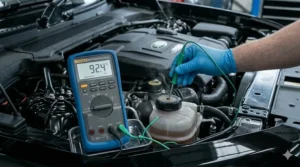
The TESMEN TSM-599 introduces button-based operation to the automotive multimeter market. Instead of rotating a dial, you press buttons to select functions. This design choice divides opinion, but I’ve grown to appreciate its benefits.
Key Specifications:
- Button-operated function selection
- Smart auto mode
- Colour LCD display with backlight
The smart auto mode genuinely works well. Connect the probes anywhere, and the meter automatically determines what you’re trying to measure. For quick diagnostic work, this saves considerable time. The built-in torch is positioned perfectly for illuminating what you’re testing.
A Welsh mechanic noted: “The buttons mean no more accidentally knocking the dial mid-measurement. Small detail, massive improvement.”
Price: £30-£38
✅ Pros:
- Innovative button interface
- Smart auto detection
- Integrated torch
❌ Cons:
- Button layout takes getting used to
- Slightly more expensive than basic models
7. AstroAI 10000 Counts Smart Multimeter – Advanced Features for Enthusiasts
For those wanting professional features without the professional price tag, the AstroAI 10,000 Counts meter delivers impressively. The higher count rating means more precise measurements when diagnosing finicky modern vehicle electronics.
Key Specifications:
- 10,000 count resolution
- Smart mode with automatic detection
- Large colour LCD display
The colour display categorises measurements intuitively: voltage readings appear in different colours than resistance measurements, making it easier to spot what you’re looking at. The max/min recording function captures voltage spikes and drops that might otherwise go unnoticed.
UK buyers praise its accuracy. “Checked it against my mate’s Fluke 87 – readings were identical within the stated tolerance,” reported a Bristol-based electronics enthusiast.
Price: £40-£48
✅ Pros:
- High count rating for precision
- Smart automatic mode
- Excellent display clarity
❌ Cons:
- Larger size less pocket-friendly
- Battery consumption higher with colour display
Understanding Automotive Multimeter Basics
Before diving into specific models, it’s worth understanding what makes automotive multimeters different from standard electrical testing tools. According to Wikipedia’s comprehensive multimeter overview, a multimeter combines voltage, current, and resistance measurement capabilities in a single instrument. However, automotive applications demand additional considerations.
What Makes a Multimeter “Automotive”?
Modern vehicles are incredibly complex electrical systems. Your average family car contains dozens of electronic control units, hundreds of metres of wiring, and sensors that communicate using precise voltage signals. A proper automotive multimeter needs features specifically designed for this environment.
The critical difference lies in the input impedance. Standard multimeters might draw enough current to damage sensitive automotive sensors. Quality automotive meters maintain at least 10 megaohms of input impedance, ensuring they won’t disrupt the circuits being tested. This is particularly crucial when working with oxygen sensors, throttle position sensors, and other delicate components.
Temperature measurement capability is another automotive essential. Engine diagnostics often require monitoring coolant temperatures, intake air temperatures, or exhaust gas temperatures. Having an integrated temperature function eliminates the need for separate instruments.
Digital vs Analogue: Why Digital Wins for Automotive Work
Whilst analogue meters still have their devotees, digital multimeters offer overwhelming advantages for vehicle diagnostics. The numerical display eliminates reading errors, auto-ranging removes guesswork, and additional features like data hold and min/max recording prove invaluable when troubleshooting intermittent faults.
I recently diagnosed an intermittent charging fault using the min/max function. The alternator would occasionally drop voltage under load, but the drops were too brief to catch with conventional testing. Recording the minimum voltage over a 20-minute test drive revealed the problem immediately.
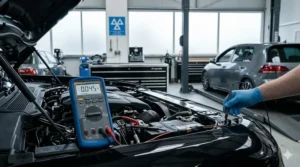
Essential Features for Automotive Diagnostics
True RMS Measurement: Why It Matters
True Root Mean Square (RMS) measurement might sound like marketing jargon, but it’s genuinely important for modern vehicles. Conventional AC measurement assumes a perfect sine wave, which works fine for mains electricity but fails with the complex waveforms produced by vehicle electronics.
Pulse width modulated sensors, variable reluctance pickups, and switching regulators all produce non-sinusoidal signals. A True RMS meter accurately measures these, whilst basic meters can be off by 40% or more. For professional diagnostics, True RMS is non-negotiable.
Auto-Ranging vs Manual: Finding Your Preference
Auto-ranging meters automatically select the appropriate measurement range. Connect your probes to a 12V battery, and the meter switches to the 20V range automatically. This eliminates range selection errors and speeds up testing.
However, auto-ranging introduces a brief delay whilst the meter determines the correct range. When you’re checking dozens of connections rapidly, this lag becomes irritating. Quality meters offer both modes, letting you choose based on the task.
Safety Ratings Explained
The cryptic CAT ratings on multimeters refer to their ability to withstand voltage transients safely. CAT III 600V means the meter can safely measure 600V in environments with moderate transient risks (like commercial buildings). CAT IV ratings indicate even higher transient protection.
For automotive work, CAT III 600V provides adequate protection. Vehicle electrical systems rarely exceed 48V (even in hybrid vehicles, the high-voltage systems should never be tested with standard multimeters), but the transient protection guards against voltage spikes from inductive loads like starter motors and alternators.
The HSE provides detailed guidance on electrical testing safety, emphasising the importance of using properly rated test equipment. Even at 12V, automotive systems can deliver dangerous current levels if short-circuited.
How to Choose the Right Automotive Multimeter
1. Assess Your Skill Level and Requirements
Be honest about your needs. If you’re checking battery voltage and testing fuses occasionally, a basic £20 meter does the job perfectly. Professional mechanics diagnosing modern vehicle networks need the capabilities of £100+ instruments.
I always recommend beginners start with mid-range meters around £40-60. These provide room to grow your skills without wasting money on features you’ll never use.
2. Consider Build Quality and Durability
Automotive environments are harsh. Your multimeter will face oil, grease, temperature extremes, and inevitable drops. Rubberised casings, reinforced probe connections, and quality construction materials justify higher prices through extended lifespan.
Check customer reviews for reliability reports. A £25 meter that lasts five years represents better value than a £15 model that fails after six months.
3. Evaluate Display Quality and Readability
You’ll often use your multimeter in poorly lit conditions. A bright, backlit display isn’t a luxury; it’s essential. Colour displays provide quick visual reference, though they consume more battery power.
Count rating affects display precision. A 2,000 count meter displays a maximum of 1999, whilst a 6,000 count meter shows up to 5999. Higher counts mean finer resolution, useful for detecting small voltage drops or measuring low resistances accurately.
4. Check Included Accessories
Quality test leads make an enormous difference. Flimsy leads with poorly insulated probes present safety hazards and deliver inaccurate readings through poor contact. Look for meters bundled with decent leads, protective cases, and relevant accessories like temperature probes or alligator clips.
5. Verify UK Availability and Support
Purchasing from Amazon.co.uk ensures you receive UK-spec meters with appropriate safety certifications. Check warranty terms and manufacturer support options. Some brands offer extended warranties through UK distributors, providing peace of mind for premium purchases.
✨ Don’t Miss These Exclusive Deals!
🔍 Take your automotive diagnostics to the next level with these carefully selected products. Click on any highlighted item to check current pricing and availability on Amazon.co.uk. These tools will help you create authentic diagnostic results your family and wallet will appreciate!
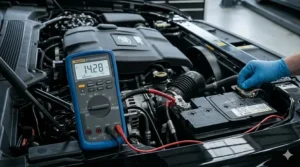
Advanced Multimeter Techniques for Vehicle Diagnostics
Voltage Drop Testing: The Professional’s Secret
Many electrical faults manifest as excessive voltage drops rather than complete failures. A corroded connection might pass visual inspection but introduce sufficient resistance to cause problems.
Voltage drop testing involves measuring the voltage difference across a connection whilst current flows. A proper connection should show less than 0.1V drop. Higher readings indicate corrosion, poor crimps, or damaged wiring.
This technique requires measuring milli-volts accurately, highlighting why higher count meters prove valuable for professional work.
Parasitic Draw Measurement
Modern vehicles maintain various systems in standby mode when parked. This normal parasitic draw typically ranges from 20-80 milliamps. Excessive draw flattens batteries overnight, yet the fault can be maddeningly difficult to locate.
Quality automotive multimeters include a 10A current range specifically for measuring parasitic draw. The test involves disconnecting the negative battery terminal, connecting the meter in series, and systematically removing fuses to identify the offending circuit.
Sensor Testing Procedures
Automotive sensors output precise voltage signals that ECUs interpret to control engine operation. Testing these requires accurate voltage measurement in the milli-volt range.
Oxygen sensors, for example, oscillate between roughly 0.1V and 0.9V. A quality multimeter lets you observe these fluctuations, whilst a basic meter might simply show “varying voltage” without useful detail.
Comparison Table: Key Specifications
| Feature | Budget (£15-25) | Mid-Range (£40-60) | Professional (£1000+) |
|---|---|---|---|
| Count Rating | 2,000-6,000 | 6,000-10,000 | 20,000+ |
| True RMS | Sometimes | Usually | Always |
| Auto-Ranging | Yes | Yes | Yes + Manual |
| Temperature | Rarely | Often | Always |
| Build Quality | Basic | Good | Excellent |
| Warranty | 1 year | 2-3 years | Lifetime |
| Automotive Functions | Limited | Some | Comprehensive |
Multimeter Maintenance and Care Tips
Battery Management
Most multimeters consume minimal power during storage, but batteries can still drain over months. Remove batteries if storing the meter for extended periods. Quality meters include low-battery indicators that provide advance warning before measurements become unreliable.
Rechargeable meters eliminate battery replacement costs but require periodic charging. The lithium batteries in modern rechargeable meters maintain charge for weeks between uses.
Probe Care and Replacement
Test probe tips wear through use. Damaged or bent probes make poor contact, introducing measurement errors. Inspect probes regularly and replace them when wear becomes apparent.
Quality replacement probes cost £10-20 but maintain measurement accuracy. Cheap probes save pennies whilst risking pound-costly diagnostic mistakes.
Calibration Considerations
Multimeters drift out of calibration over time. Professional instruments require annual calibration to maintain certification, whilst hobby-grade meters generally remain accurate enough for automotive work without formal calibration.
You can verify basic accuracy using known references. A fresh AA battery should measure 1.5V ±0.05V. Significant deviation indicates the meter needs servicing or replacement.
Common Mistakes to Avoid
1. Selecting Wrong Measurement Range
Attempting to measure 12V on the 200mV range risks meter damage. Auto-ranging prevents this error, but manual ranging requires attention. Always start with the highest range and work down if necessary.
2. Testing Voltage on Current Range
This classic mistake can blow the meter’s internal fuse instantly. The current jacks route through a low-resistance shunt. Connecting these across voltage sources creates a short circuit.
3. Ignoring Safety Ratings
Using an inadequately rated meter on high-voltage systems risks electric shock or meter destruction. Hybrid and electric vehicles require specific training and equipment beyond standard multimeter capabilities.
4. Neglecting Continuity Testing
Many beginners focus solely on voltage measurement, overlooking the power of continuity testing. A quick continuity check often identifies open circuits faster than voltage testing.
Price vs Value Analysis
| Price Range | Typical Features | Best Use Case | Expected Lifespan |
|---|---|---|---|
| £15-£25 | Basic measurements, auto-ranging | Occasional DIY, learning | 2-4 years |
| £25-£50 | True RMS, good display, temperature | Regular home garage work | 4-7 years |
| £50-£100 | High counts, smart features, quality build | Serious enthusiasts, semi-pro | 7-12 years |
| £100-£500 | Professional features, excellent accuracy | Professional mechanics | 10-20 years |
| £500+ | Automotive-specific functions, lifetime warranty | Specialist diagnostic work | 20+ years |
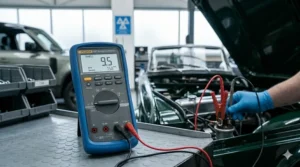
Frequently Asked Questions
❓ Can a standard multimeter damage modern car sensors?
❓ What's the difference between auto-ranging and manual ranging multimeters?
❓ Do I need True RMS measurement for car diagnostics?
❓ How often should I calibrate my automotive multimeter?
❓ What safety precautions should I follow when using a multimeter on vehicles?
Conclusion: Finding Your Perfect Automotive Multimeter
Choosing the best automotive multimeter ultimately depends on matching features to your specific requirements and budget. For weekend DIYers performing basic maintenance, the excellent value offered by the KAIWEETS HT118A or AstroAI DM6000AR provides everything needed without unnecessary expense.
Serious enthusiasts and semi-professional mechanics will appreciate the advanced features of the KAIWEETS KM601 or AstroAI 10000 Counts model. These instruments deliver professional-level performance whilst remaining accessible to dedicated hobbyists.
Professional mechanics genuinely benefit from the Fluke 88V’s automotive-specific capabilities and legendary reliability. The premium price reflects genuine engineering excellence and the confidence of a lifetime warranty.
Remember that even the most expensive multimeter proves worthless if you don’t understand how to use it properly. Invest time learning proper testing techniques alongside your equipment purchase. The HSE’s electrical safety guidance provides excellent foundational knowledge for safe electrical testing practices.
Whatever meter you choose, you’re taking control of your vehicle’s maintenance and saving money on unnecessary garage visits. Start with a quality instrument that matches your current skill level, and upgrade as your expertise develops. Your car, your wallet, and your confidence will all benefit from this essential addition to your toolkit.
Recommended for You
- 7 Best OBD2 Scanner UK 2026: Professional Diagnostic Tools
- 7 Best Jack Stands UK: Expert Safety Guide 2026
- Best Trolley Jack for Home Garage: 7 Top UK Picks 2026
Disclaimer: This article contains affiliate links. If you purchase products through these links, we may earn a small commission at no additional cost to you. Prices shown are approximate and may vary.
✨ Found this helpful? Share it with your mates! 💬🤗
